RECENT
TECHNIQUES AND
METHODS OF
TEACHING
“PART – TRAP”
DR. C. BEULAH JAYARANI
M.Sc., M.A, M.Ed, M.Phil (Edn), M.Phil (ZOO), NET, Ph.D
ASST. PROFESSOR,
LOYOLA COLLEGE OF EDUCATION, CHENNAI - 34
A good teacher is
like a candle which
consumes itself to
light the way for
others.
2
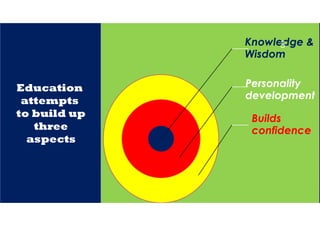
Education
attempts
to build up
three
aspects
Knowledge &
Wisdom
Personality
development
Builds
confidence
3
4
5
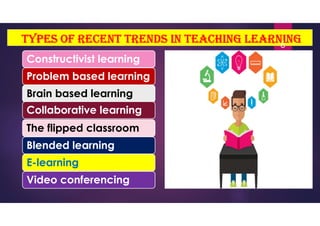
types of recent trends in teaching learning
Constructivist learning
Problem based learning
Brain based learning
Collaborative learning
The flipped classroom
Blended learning
E-learning
Video conferencing
6
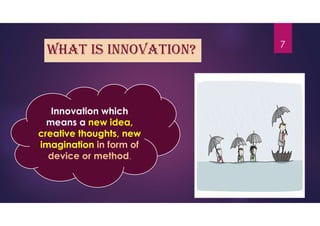
What is innovation?
Innovation which
means a new idea,
creative thoughts, new
imagination in form of
device or method.
7
innovation in the classroom
 It is about empowering teachers to develop intelligent, creative and
effective teaching methods.
 That will challenge and engage learners.
“Education should not be the
filling of a pail, but the lightning
of a fire”.
- William butler
8
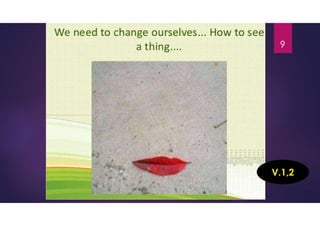
9
V.1,2
“PART TRAP”
Teaching Learning Process (TLP)
“To learn is to know; to know is to understand, to
understand is to teach and to teach is to lead a
successful life…….”
- Alexander Dumas
10
introdUction
 Education is a continuous process which starts in the cradle
and ends in the grave.
 If education is a coin, then teaching and learning process are two
sides of the same coin.
 Hence teaching is not a mechanical process that can be practiced
by robots as it involves the students in doing and researching
rather than listening.
 Need a life building, man making and character designing &
assimilation of ideas.
11
oBJectives
 Imparting an adequate knowledge on teaching and learning process
(TLP)
 Equipping the prospective teachers with necessary skill training
 Enabling the future teachers to acquire information on best practices
 Developing proper attitude towards “PART TRAP” method
12
description
 Four elements form the PART. They are
 PARTICIPATION
 ATTENTION
 RETENSION
 TRANSFORMATION
13
In present, scenario, students experience
 restlessness
 very shy,
 hyperactive
 highly tech-knowledgeable
 Some students are extroverts while others are
introverts.
14
Learning is a process of
adding new ideas to old
ideas.
Teachers need to
recognize the prior
knowledge of learners
and give opportunities to
students to recall what they
already know.
Teachers are in forefront
in motivating the students to
participate in classroom
activities.
They help the students to be critical and
creative thinkers and make them think
out of the box
“Nobody get a
second chance
to create a first
impression”.
15
participation
participation
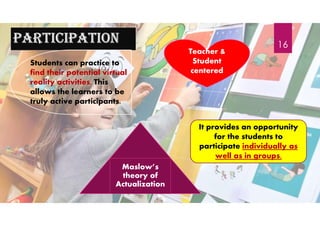
Teacher &
Student
centered
It provides an opportunity
for the students to
participate individually as
well as in groups.
Maslow’s
theory of
Actualization
Students can practice to
find their potential virtual
reality activities. This
allows the learners to be
truly active participants.
16
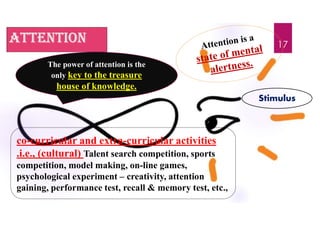
attention
The power of attention is the
only key to the treasure
house of knowledge.
co-curricular and extra-curricular activities
.i.e., (cultural) Talent search competition, sports
competition, model making, on-line games,
psychological experiment – creativity, attention
gaining, performance test, recall & memory test, etc.,
Stimulus
17
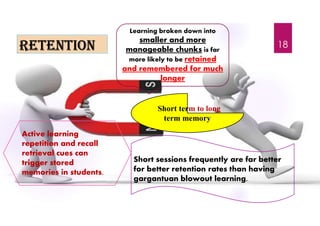
retention
Short term to long
term memory
Learning broken down into
smaller and more
manageable chunks is far
more likely to be retained
and remembered for much
longer
Short sessions frequently are far better
for better retention rates than having
gargantuan blowout learning.
Active learning
repetition and recall
retrieval cues can
trigger stored
memories in students.
18
transformation
 rethinking,
 re-skilling,
 shifting the learning
paradigm,
 learning any time anywhere
and any way
 team work for social
development
 which shapes them as better
teachers.
Students while joining pretty limited to the
theoretical aspect learning with a very
limited scope for experiencing real life
scenarios - transformation.
19
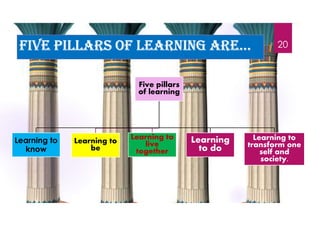
five pillars of learning are…
Five pillars
of learning
Learning to
know
Learning to
be
Learning to
live
together
Learning
to do
Learning to
transform one
self and
society.
20
trap
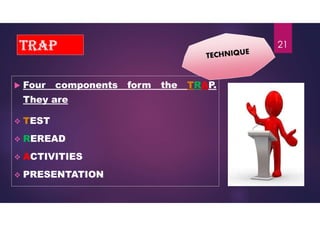
 Four components form the TRAP.
They are
 TEST
 REREAD
 ACTIVITIES
 PRESENTATION
21
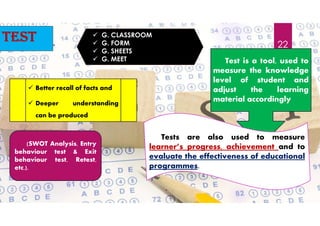
test  G. CLASSROOM
 G. FORM
 G. SHEETS
 G. MEET Test is a tool, used to
measure the knowledge
level of student and
adjust the learning
material accordingly
(SWOT Analysis, Entry
behaviour test & Exit
behaviour test, Retest,
etc.).
 Better recall of facts and
 Deeper understanding
can be produced
Tests are also used to measure
learner’s progress, achievement and to
evaluate the effectiveness of educational
programmes.
22
reread
 Learn to understand in-depth of the content and also be able to answer for
the following question tags apart from test and subject material: who, what,
where, when, why, how, why not, etc.,
 It helps the student to relearn the content, read with greater fluency.
 It allows them to give more attention to what they read and thereby
understand and apply it.
 It also develops greater accuracy in reading and provides deeper
understanding of what they have read.
 G. SEARCH
 G. BOOKS
 G. DOCS
 G. NEWS
23
activities
G. Jamboard
POdcasts, Blogger, drive, power
point, slides with images, moving
images,
Technology - our
life easier - creates
lack of interest that
one feels bored
It teaches cooperation,
leadership, team work,
patience and builds the soft
skills one needs to shine in life.
It also stimulates the senses,
encourages participation,
boosts self-esteem and fulfills
emotional needs.
Co-curricular activities - learn
essential ethical values about different
culture, religions and events of
national and international
importance as well as discipline,
patience, empathy, motivational skills,
compatibility and contentment.
24
Contd.,
The future teachers’ mission should be to make the best use of the leisure times spent in
learning to create value for oneself and to society.
 emotional development,
 social skill development,
 overall personality development.
 foster holistic development
 to face the challenges of the real world. (from real life to real life)
25
presentation
 It is an easy way to create collaborate and present ones ideas in dynamic and
visually compelling ways.
 It creates improvisational, communicative and interactive participation of the
students.
 The visual and audio cues help the students to understand the concept in-depth.
 Holistic development, educationally speaking, addresses a variety of student growth
areas which aim to advance in the educational lifetime of a student.
G. Drive, Excel power point,
slides with images, moving
images, GIF images
26
V.3,4
Benefits 27
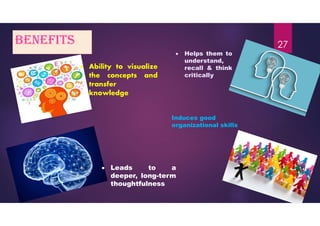
 Ability to visualize
the concepts and
transfer
knowledge
 Leads to a
deeper, long-term
thoughtfulness
 Helps them to
understand,
recall & think
critically
Induces good
organizational skills
28
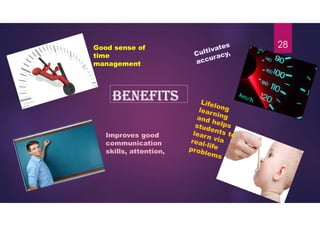
Good sense of
time
management
Improves good
communication
skills, attention,
Benefits
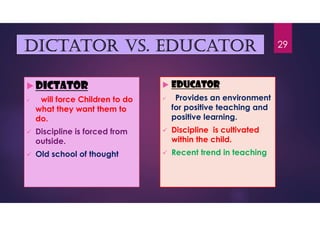
Dictator vs. EDucator
 DICTATOR
 will force Children to do
what they want them to
do.
 Discipline is forced from
outside.
 Old school of thought
 EDUCATOR
 Provides an environment
for positive teaching and
positive learning.
 Discipline is cultivated
within the child.
 Recent trend in teaching
29
conclUsion
 Education is a light that shows the mankind the right direction to
surge. The purpose of education is not just making a student literate,
but to add more rationale thinking, knowledgeability and self-
sufficiency.
 Education is an engine for the growth and progress of any society.
It not only imparts knowledge and skills but also inculcates values.
 We can’t teach third generation students through second
generation teachers by first generation method.
30
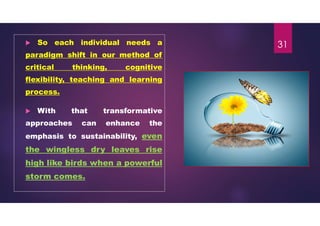
 So each individual needs a
paradigm shift in our method of
critical thinking, cognitive
flexibility, teaching and learning
process.
 With that transformative
approaches can enhance the
emphasis to sustainability, even
the wingless dry leaves rise
high like birds when a powerful
storm comes.
31
32
33

Recent techniques and methods of teaching part - trap

  • 1.
    RECENT TECHNIQUES AND METHODS OF TEACHING “PART– TRAP” DR. C. BEULAH JAYARANI M.Sc., M.A, M.Ed, M.Phil (Edn), M.Phil (ZOO), NET, Ph.D ASST. PROFESSOR, LOYOLA COLLEGE OF EDUCATION, CHENNAI - 34
  • 2.
    A good teacheris like a candle which consumes itself to light the way for others. 2
  • 3.
    Education attempts to build up three aspects Knowledge& Wisdom Personality development Builds confidence 3
  • 4.
  • 5.
  • 6.
    types of recenttrends in teaching learning Constructivist learning Problem based learning Brain based learning Collaborative learning The flipped classroom Blended learning E-learning Video conferencing 6
  • 7.
    What is innovation? Innovationwhich means a new idea, creative thoughts, new imagination in form of device or method. 7
  • 8.
    innovation in theclassroom  It is about empowering teachers to develop intelligent, creative and effective teaching methods.  That will challenge and engage learners. “Education should not be the filling of a pail, but the lightning of a fire”. - William butler 8
  • 9.
  • 10.
    “PART TRAP” Teaching LearningProcess (TLP) “To learn is to know; to know is to understand, to understand is to teach and to teach is to lead a successful life…….” - Alexander Dumas 10
  • 11.
    introdUction  Education isa continuous process which starts in the cradle and ends in the grave.  If education is a coin, then teaching and learning process are two sides of the same coin.  Hence teaching is not a mechanical process that can be practiced by robots as it involves the students in doing and researching rather than listening.  Need a life building, man making and character designing & assimilation of ideas. 11
  • 12.
    oBJectives  Imparting anadequate knowledge on teaching and learning process (TLP)  Equipping the prospective teachers with necessary skill training  Enabling the future teachers to acquire information on best practices  Developing proper attitude towards “PART TRAP” method 12
  • 13.
    description  Four elementsform the PART. They are  PARTICIPATION  ATTENTION  RETENSION  TRANSFORMATION 13
  • 14.
    In present, scenario,students experience  restlessness  very shy,  hyperactive  highly tech-knowledgeable  Some students are extroverts while others are introverts. 14
  • 15.
    Learning is aprocess of adding new ideas to old ideas. Teachers need to recognize the prior knowledge of learners and give opportunities to students to recall what they already know. Teachers are in forefront in motivating the students to participate in classroom activities. They help the students to be critical and creative thinkers and make them think out of the box “Nobody get a second chance to create a first impression”. 15 participation
  • 16.
    participation Teacher & Student centered It providesan opportunity for the students to participate individually as well as in groups. Maslow’s theory of Actualization Students can practice to find their potential virtual reality activities. This allows the learners to be truly active participants. 16
  • 17.
    attention The power ofattention is the only key to the treasure house of knowledge. co-curricular and extra-curricular activities .i.e., (cultural) Talent search competition, sports competition, model making, on-line games, psychological experiment – creativity, attention gaining, performance test, recall & memory test, etc., Stimulus 17
  • 18.
    retention Short term tolong term memory Learning broken down into smaller and more manageable chunks is far more likely to be retained and remembered for much longer Short sessions frequently are far better for better retention rates than having gargantuan blowout learning. Active learning repetition and recall retrieval cues can trigger stored memories in students. 18
  • 19.
    transformation  rethinking,  re-skilling, shifting the learning paradigm,  learning any time anywhere and any way  team work for social development  which shapes them as better teachers. Students while joining pretty limited to the theoretical aspect learning with a very limited scope for experiencing real life scenarios - transformation. 19
  • 20.
    five pillars oflearning are… Five pillars of learning Learning to know Learning to be Learning to live together Learning to do Learning to transform one self and society. 20
  • 21.
    trap  Four componentsform the TRAP. They are  TEST  REREAD  ACTIVITIES  PRESENTATION 21
  • 22.
    test  G.CLASSROOM  G. FORM  G. SHEETS  G. MEET Test is a tool, used to measure the knowledge level of student and adjust the learning material accordingly (SWOT Analysis, Entry behaviour test & Exit behaviour test, Retest, etc.).  Better recall of facts and  Deeper understanding can be produced Tests are also used to measure learner’s progress, achievement and to evaluate the effectiveness of educational programmes. 22
  • 23.
    reread  Learn tounderstand in-depth of the content and also be able to answer for the following question tags apart from test and subject material: who, what, where, when, why, how, why not, etc.,  It helps the student to relearn the content, read with greater fluency.  It allows them to give more attention to what they read and thereby understand and apply it.  It also develops greater accuracy in reading and provides deeper understanding of what they have read.  G. SEARCH  G. BOOKS  G. DOCS  G. NEWS 23
  • 24.
    activities G. Jamboard POdcasts, Blogger,drive, power point, slides with images, moving images, Technology - our life easier - creates lack of interest that one feels bored It teaches cooperation, leadership, team work, patience and builds the soft skills one needs to shine in life. It also stimulates the senses, encourages participation, boosts self-esteem and fulfills emotional needs. Co-curricular activities - learn essential ethical values about different culture, religions and events of national and international importance as well as discipline, patience, empathy, motivational skills, compatibility and contentment. 24
  • 25.
    Contd., The future teachers’mission should be to make the best use of the leisure times spent in learning to create value for oneself and to society.  emotional development,  social skill development,  overall personality development.  foster holistic development  to face the challenges of the real world. (from real life to real life) 25
  • 26.
    presentation  It isan easy way to create collaborate and present ones ideas in dynamic and visually compelling ways.  It creates improvisational, communicative and interactive participation of the students.  The visual and audio cues help the students to understand the concept in-depth.  Holistic development, educationally speaking, addresses a variety of student growth areas which aim to advance in the educational lifetime of a student. G. Drive, Excel power point, slides with images, moving images, GIF images 26 V.3,4
  • 27.
    Benefits 27  Abilityto visualize the concepts and transfer knowledge  Leads to a deeper, long-term thoughtfulness  Helps them to understand, recall & think critically Induces good organizational skills
  • 28.
    28 Good sense of time management Improvesgood communication skills, attention, Benefits
  • 29.
    Dictator vs. EDucator DICTATOR  will force Children to do what they want them to do.  Discipline is forced from outside.  Old school of thought  EDUCATOR  Provides an environment for positive teaching and positive learning.  Discipline is cultivated within the child.  Recent trend in teaching 29
  • 30.
    conclUsion  Education isa light that shows the mankind the right direction to surge. The purpose of education is not just making a student literate, but to add more rationale thinking, knowledgeability and self- sufficiency.  Education is an engine for the growth and progress of any society. It not only imparts knowledge and skills but also inculcates values.  We can’t teach third generation students through second generation teachers by first generation method. 30
  • 31.
     So eachindividual needs a paradigm shift in our method of critical thinking, cognitive flexibility, teaching and learning process.  With that transformative approaches can enhance the emphasis to sustainability, even the wingless dry leaves rise high like birds when a powerful storm comes. 31
  • 32.
  • 33.