Nicolas Loeuille
Laboratoire Ecologie & Evolution,
Université Pierre et Marie Curie
nicolas.loeuille@upmc.fr
Effects of local negative feedbacks on
the evolution of species within
metacommunities
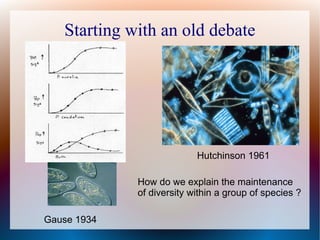
Starting with an old debate
Gause 1934
Hutchinson 1961
How do we explain the maintenance
of diversity within a group of species ?
Spatial components in the maintenance
of diversity
● Total « regional » diversity :
– Colinization-Competition Trade-off (Tilman 1994)
– Spatial heterogeneity and niche partitioning (Leibold
et al. 2004)
– Storage effects (Chesson 1994)
– Random speciation, ecological drift (Hubbell 2001)
● Local diversity
– Mass effects (source-sink relationships) Mouquet &
Loreau (2004)
– Janzen-Connell (Janzen 1970)
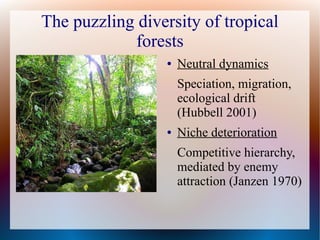
The puzzling diversity of tropical
forests
● Neutral dynamics
Speciation, migration,
ecological drift
(Hubbell 2001)
● Niche deterioration
Competitive hierarchy,
mediated by enemy
attraction (Janzen 1970)
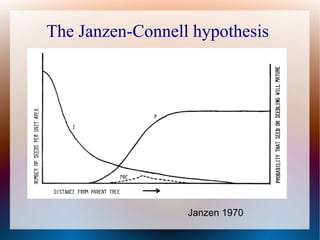
The Janzen-Connell hypothesis
Janzen 1970
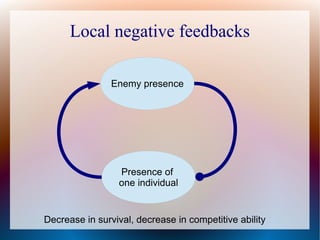
Local negative feedbacks
Enemy presence
Presence of
one individual
Decrease in survival, decrease in competitive ability
An illustrative example
Diez et al. 2010
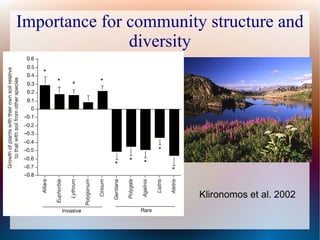
Importance for community structure and
diversity
Klironomos et al. 2002
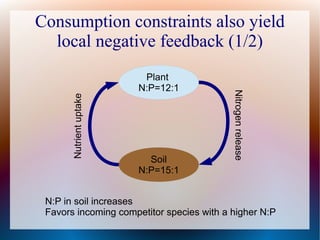
Consumption constraints also yield
local negative feedback (1/2)
Plant
N:P=12:1
Soil
N:P=15:1
Nutrientuptake
Nitrogenrelease
N:P in soil increases
Favors incoming competitor species with a higher N:P
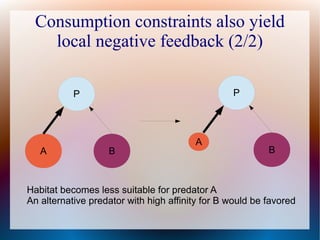
Consumption constraints also yield
local negative feedback (2/2)
P
BA
P
B
A
Habitat becomes less suitable for predator A
An alternative predator with high affinity for B would be favored
Critical conditions under which
feedbacks act on diversity
1)Local environment is largely driven by the species
presence (vs, eg, external abiotic constraints): niche
construction (Laland et al. 1999, Kylafis & Loreau
2008)
2)Spatial constraints: low diffusion of enemies or
nutrient compared to the species dispersal
3)Evolutionary constraints: Evolutionary dynamics lag
behind ecological dynamics
What is the amount of diversity emerging from the
interplay of these three constraints?
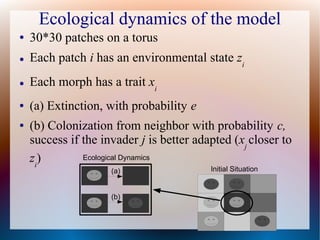
Ecological dynamics of the model
● 30*30 patches on a torus
● Each patch i has an environmental state zi
● Each morph has a trait xi
● (a) Extinction, with probability e
● (b) Colonization from neighbor with probability c,
success if the invader j is better adapted (xj
closer to
zi
)
Initial Situation(a)
(b)
Ecological Dynamics
Evolutionary dynamics
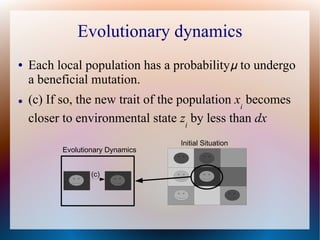
● Each local population has a probabilityμ to undergo
a beneficial mutation.
● (c) If so, the new trait of the population xi
becomes
closer to environmental state zi
by less than dx
Initial Situation
(c)
Evolutionary Dynamics
Environmental dynamics
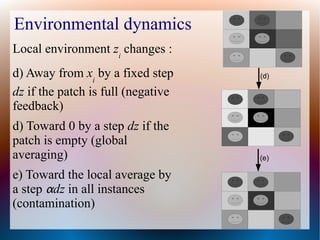
Local environment zi
changes :
d) Away from xi
by a fixed step
dz if the patch is full (negative
feedback)
d) Toward 0 by a step dz if the
patch is empty (global
averaging)
e) Toward the local average by
a step αdz in all instances
(contamination)
Initial Situation
(d)
(e)
Initial conditions and possible dynamics
● Only one population, of trait xi
=0.5
● For each patch, an environmental value z is picked at
random between 0 and 1
● One million time steps considered
Q1 Conditions for the emergence of diversity ?
Q2 Effects on the environmental structure ?
Q3 Effects on the community patterns at various
scales ?
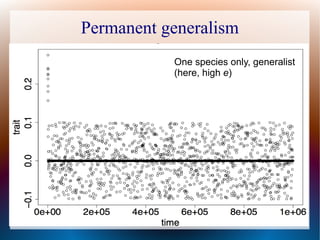
Permanent generalism
One species only, generalist
(here, high e)
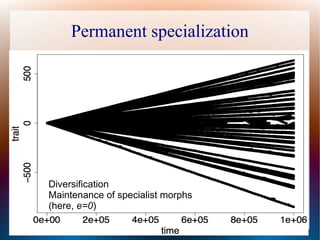
Permanent specialization
Diversification
Maintenance of specialist morphs
(here, e=0)
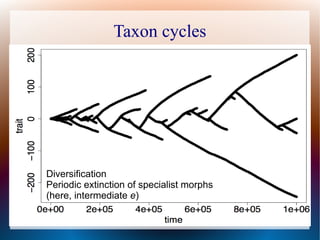
Taxon cycles
Diversification
Periodic extinction of specialist morphs
(here, intermediate e)
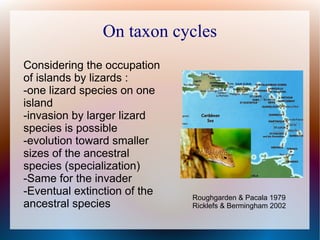
On taxon cycles
Considering the occupation
of islands by lizards :
-one lizard species on one
island
-invasion by larger lizard
species is possible
-evolution toward smaller
sizes of the ancestral
species (specialization)
-Same for the invader
-Eventual extinction of the
ancestral species
Roughgarden & Pacala 1979
Ricklefs & Bermingham 2002
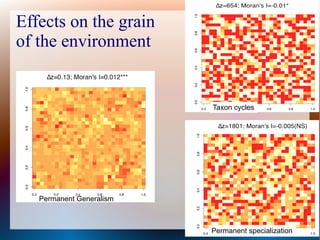
Effects on the grain
of the environment
Permanent Generalism
Taxon cycles
Permanent specialization
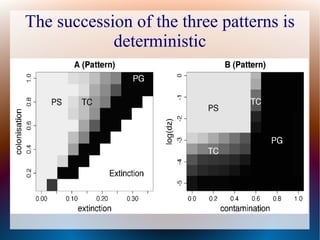
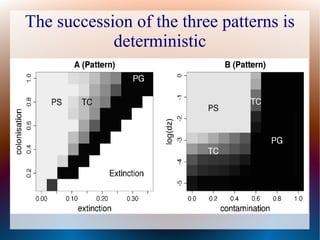
The succession of the three patterns is
deterministic
Conditions for emerging diversity
● From the succession of the three patterns, it is
possible to distinguish parameters favoring diversity
(PG->TC->PS)
● Such parameters include : colonization rate c,
negative feedback dz
● Parameters that prevent the emergence of structure
and diversity : extinction rate e, mutation rate μ (or
mutation amplitude dx), contamination from
surrounding patches α
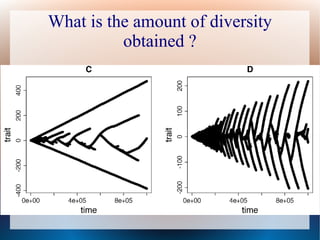
What is the amount of diversity
obtained ?
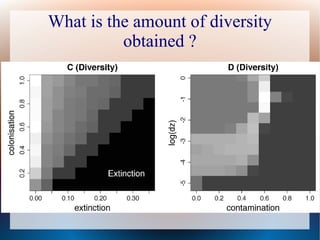
What is the amount of diversity
obtained ?
The succession of the three patterns is
deterministic
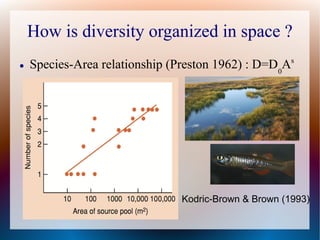
How is diversity organized in space ?
● Species-Area relationship (Preston 1962) : D=D0
As
Kodric-Brown & Brown (1993)
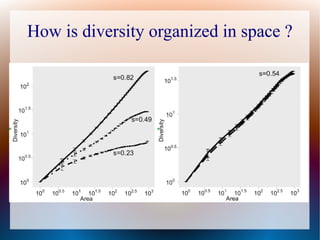
How is diversity organized in space ?
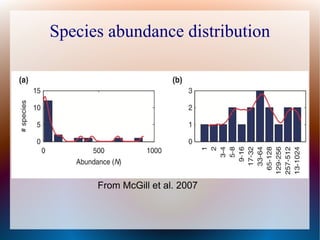
Species abundance distribution
From McGill et al. 2007
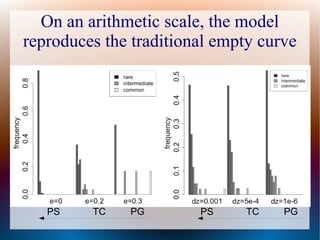
On an arithmetic scale, the model
reproduces the traditional empty curve
PGTCPS PGTCPS
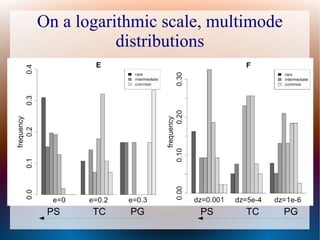
On a logarithmic scale, multimode
distributions
PGTCPS PGTCPS
Conclusions
● Negative feedbacks may allow the emergence of
diversity, but not under all conditions
● Taxon cycle one possible outcome, but in fact part of
a continuum
● The model also provides classical shapes for
macroecological patterns (species abundance
distribution, species area curve)
● Associated with the temporal dynamics of diversity,
such patterns can allow more robust testing of the
model (McGill et al. 2003)
Acknowledgements
Mathew Leibold

Nicolas Loeuille - présentation MEE2013

  • 1.
    Nicolas Loeuille Laboratoire Ecologie& Evolution, Université Pierre et Marie Curie nicolas.loeuille@upmc.fr Effects of local negative feedbacks on the evolution of species within metacommunities
  • 2.
    Starting with anold debate Gause 1934 Hutchinson 1961 How do we explain the maintenance of diversity within a group of species ?
  • 3.
    Spatial components inthe maintenance of diversity ● Total « regional » diversity : – Colinization-Competition Trade-off (Tilman 1994) – Spatial heterogeneity and niche partitioning (Leibold et al. 2004) – Storage effects (Chesson 1994) – Random speciation, ecological drift (Hubbell 2001) ● Local diversity – Mass effects (source-sink relationships) Mouquet & Loreau (2004) – Janzen-Connell (Janzen 1970)
  • 4.
    The puzzling diversityof tropical forests ● Neutral dynamics Speciation, migration, ecological drift (Hubbell 2001) ● Niche deterioration Competitive hierarchy, mediated by enemy attraction (Janzen 1970)
  • 5.
  • 6.
    Local negative feedbacks Enemypresence Presence of one individual Decrease in survival, decrease in competitive ability
  • 7.
  • 8.
    Importance for communitystructure and diversity Klironomos et al. 2002
  • 9.
    Consumption constraints alsoyield local negative feedback (1/2) Plant N:P=12:1 Soil N:P=15:1 Nutrientuptake Nitrogenrelease N:P in soil increases Favors incoming competitor species with a higher N:P
  • 10.
    Consumption constraints alsoyield local negative feedback (2/2) P BA P B A Habitat becomes less suitable for predator A An alternative predator with high affinity for B would be favored
  • 11.
    Critical conditions underwhich feedbacks act on diversity 1)Local environment is largely driven by the species presence (vs, eg, external abiotic constraints): niche construction (Laland et al. 1999, Kylafis & Loreau 2008) 2)Spatial constraints: low diffusion of enemies or nutrient compared to the species dispersal 3)Evolutionary constraints: Evolutionary dynamics lag behind ecological dynamics What is the amount of diversity emerging from the interplay of these three constraints?
  • 12.
    Ecological dynamics ofthe model ● 30*30 patches on a torus ● Each patch i has an environmental state zi ● Each morph has a trait xi ● (a) Extinction, with probability e ● (b) Colonization from neighbor with probability c, success if the invader j is better adapted (xj closer to zi ) Initial Situation(a) (b) Ecological Dynamics
  • 13.
    Evolutionary dynamics ● Eachlocal population has a probabilityμ to undergo a beneficial mutation. ● (c) If so, the new trait of the population xi becomes closer to environmental state zi by less than dx Initial Situation (c) Evolutionary Dynamics
  • 14.
    Environmental dynamics Local environmentzi changes : d) Away from xi by a fixed step dz if the patch is full (negative feedback) d) Toward 0 by a step dz if the patch is empty (global averaging) e) Toward the local average by a step αdz in all instances (contamination) Initial Situation (d) (e)
  • 15.
    Initial conditions andpossible dynamics ● Only one population, of trait xi =0.5 ● For each patch, an environmental value z is picked at random between 0 and 1 ● One million time steps considered Q1 Conditions for the emergence of diversity ? Q2 Effects on the environmental structure ? Q3 Effects on the community patterns at various scales ?
  • 16.
    Permanent generalism One speciesonly, generalist (here, high e)
  • 17.
  • 18.
    Taxon cycles Diversification Periodic extinctionof specialist morphs (here, intermediate e)
  • 19.
    On taxon cycles Consideringthe occupation of islands by lizards : -one lizard species on one island -invasion by larger lizard species is possible -evolution toward smaller sizes of the ancestral species (specialization) -Same for the invader -Eventual extinction of the ancestral species Roughgarden & Pacala 1979 Ricklefs & Bermingham 2002
  • 20.
    Effects on thegrain of the environment Permanent Generalism Taxon cycles Permanent specialization
  • 21.
    The succession ofthe three patterns is deterministic
  • 22.
    Conditions for emergingdiversity ● From the succession of the three patterns, it is possible to distinguish parameters favoring diversity (PG->TC->PS) ● Such parameters include : colonization rate c, negative feedback dz ● Parameters that prevent the emergence of structure and diversity : extinction rate e, mutation rate μ (or mutation amplitude dx), contamination from surrounding patches α
  • 23.
    What is theamount of diversity obtained ?
  • 24.
    What is theamount of diversity obtained ?
  • 25.
    The succession ofthe three patterns is deterministic
  • 26.
    How is diversityorganized in space ? ● Species-Area relationship (Preston 1962) : D=D0 As Kodric-Brown & Brown (1993)
  • 27.
    How is diversityorganized in space ?
  • 28.
  • 29.
    On an arithmeticscale, the model reproduces the traditional empty curve PGTCPS PGTCPS
  • 30.
    On a logarithmicscale, multimode distributions PGTCPS PGTCPS
  • 31.
    Conclusions ● Negative feedbacksmay allow the emergence of diversity, but not under all conditions ● Taxon cycle one possible outcome, but in fact part of a continuum ● The model also provides classical shapes for macroecological patterns (species abundance distribution, species area curve) ● Associated with the temporal dynamics of diversity, such patterns can allow more robust testing of the model (McGill et al. 2003)
  • 32.