Common Assessment #3 Practice Questions
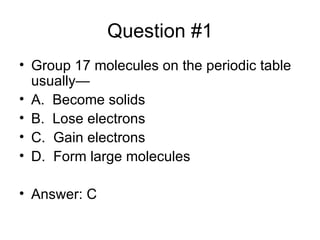
Question #1 Group 17 molecules on the periodic table usually— A.  Become solids B.  Lose electrons C.  Gain electrons D.  Form large molecules Answer: C
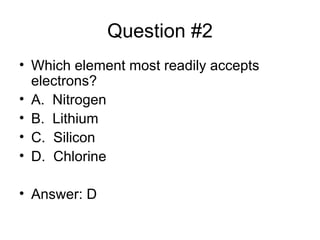
Question #2 Which element most readily accepts electrons? A.  Nitrogen B.  Lithium C.  Silicon D.  Chlorine Answer: D
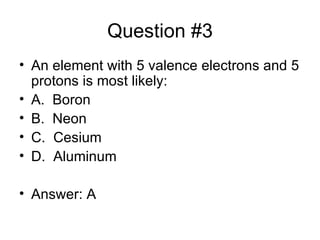
Question #3 An element with 5 valence electrons and 5 protons is most likely: A.  Boron B.  Neon C.  Cesium D.  Aluminum Answer: A
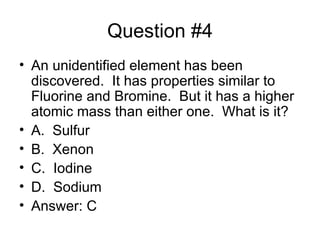
Question #4 An unidentified element has been discovered.  It has properties similar to Fluorine and Bromine.  But it has a higher atomic mass than either one.  What is it? A.  Sulfur B.  Xenon C.  Iodine D.  Sodium Answer: C
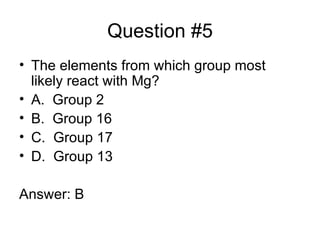
Question #5 The elements from which group most likely react with Mg? A.  Group 2 B.  Group 16 C.  Group 17 D.  Group 13 Answer: B
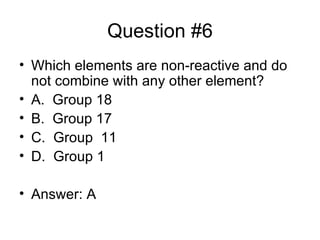
Question #6 Which elements are non-reactive and do not combine with any other element? A.  Group 18 B.  Group 17 C.  Group  11 D.  Group 1 Answer: A
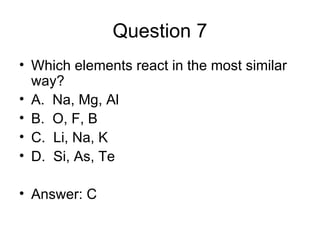
Question 7 Which elements react in the most similar way? A.  Na, Mg, Al B.  O, F, B C.  Li, Na, K D.  Si, As, Te Answer: C
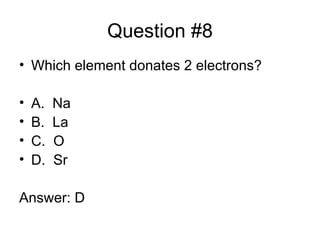
Question #8 Which element donates 2 electrons? A.  Na B.  La C.  O D.  Sr Answer: D
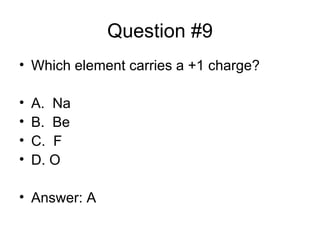
Question #9 Which element carries a +1 charge? A.  Na B.  Be C.  F D. O Answer: A

Common Assessment 3 Practice

  • 1.
    Common Assessment #3Practice Questions
  • 2.
    Question #1 Group17 molecules on the periodic table usually— A. Become solids B. Lose electrons C. Gain electrons D. Form large molecules Answer: C
  • 3.
    Question #2 Whichelement most readily accepts electrons? A. Nitrogen B. Lithium C. Silicon D. Chlorine Answer: D
  • 4.
    Question #3 Anelement with 5 valence electrons and 5 protons is most likely: A. Boron B. Neon C. Cesium D. Aluminum Answer: A
  • 5.
    Question #4 Anunidentified element has been discovered. It has properties similar to Fluorine and Bromine. But it has a higher atomic mass than either one. What is it? A. Sulfur B. Xenon C. Iodine D. Sodium Answer: C
  • 6.
    Question #5 Theelements from which group most likely react with Mg? A. Group 2 B. Group 16 C. Group 17 D. Group 13 Answer: B
  • 7.
    Question #6 Whichelements are non-reactive and do not combine with any other element? A. Group 18 B. Group 17 C. Group 11 D. Group 1 Answer: A
  • 8.
    Question 7 Whichelements react in the most similar way? A. Na, Mg, Al B. O, F, B C. Li, Na, K D. Si, As, Te Answer: C
  • 9.
    Question #8 Whichelement donates 2 electrons? A. Na B. La C. O D. Sr Answer: D
  • 10.
    Question #9 Whichelement carries a +1 charge? A. Na B. Be C. F D. O Answer: A