JUSTIN GEORGE
+2 COMPUTER SCIENCE
SJHSS VAYATTUPARAMBA
KANNUR, KERALA
METALLURGY
• General Principles and Processes
of isolation of Elements.
Minerals:The combined state of metal in the
earth’s crust.
Ex: Oxides ,Carbonates.
• Ore: The Mineral from which the metal
economically and commercially extracted.
• Ex: Al- Bauxite,Fe-Haematite.
• Gangue: Impurities present in minerals.
• Ex: silicates,rock pieces………..
All ores are minerals ,but all minerals are not
ores.
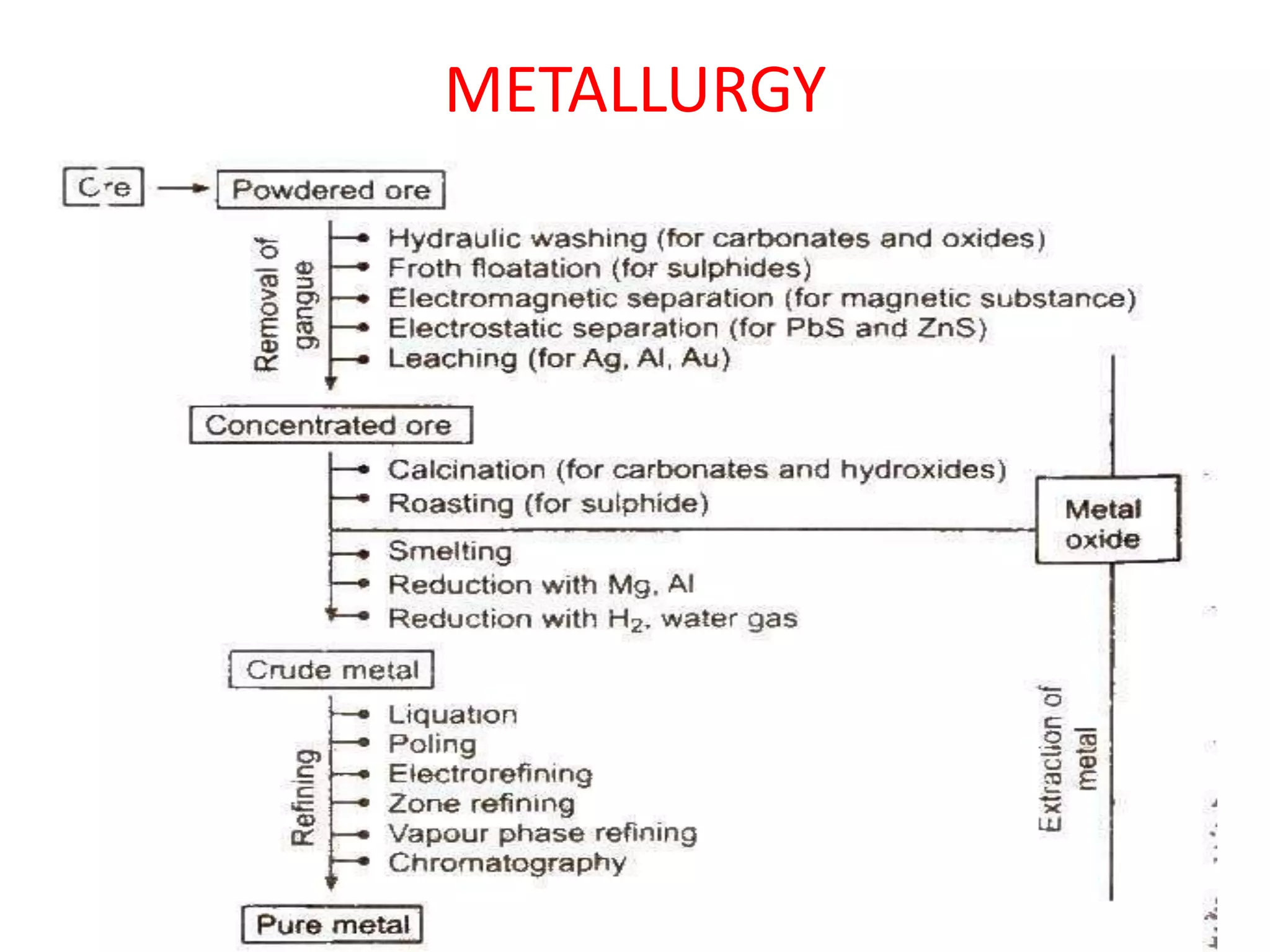
Metallurgy
It is process of extraction of metal from its ores
1. Concentration of the Ore
2. Production of Crude metal
3. Refining of the Crude metal
4. Crushing & Pulverisation
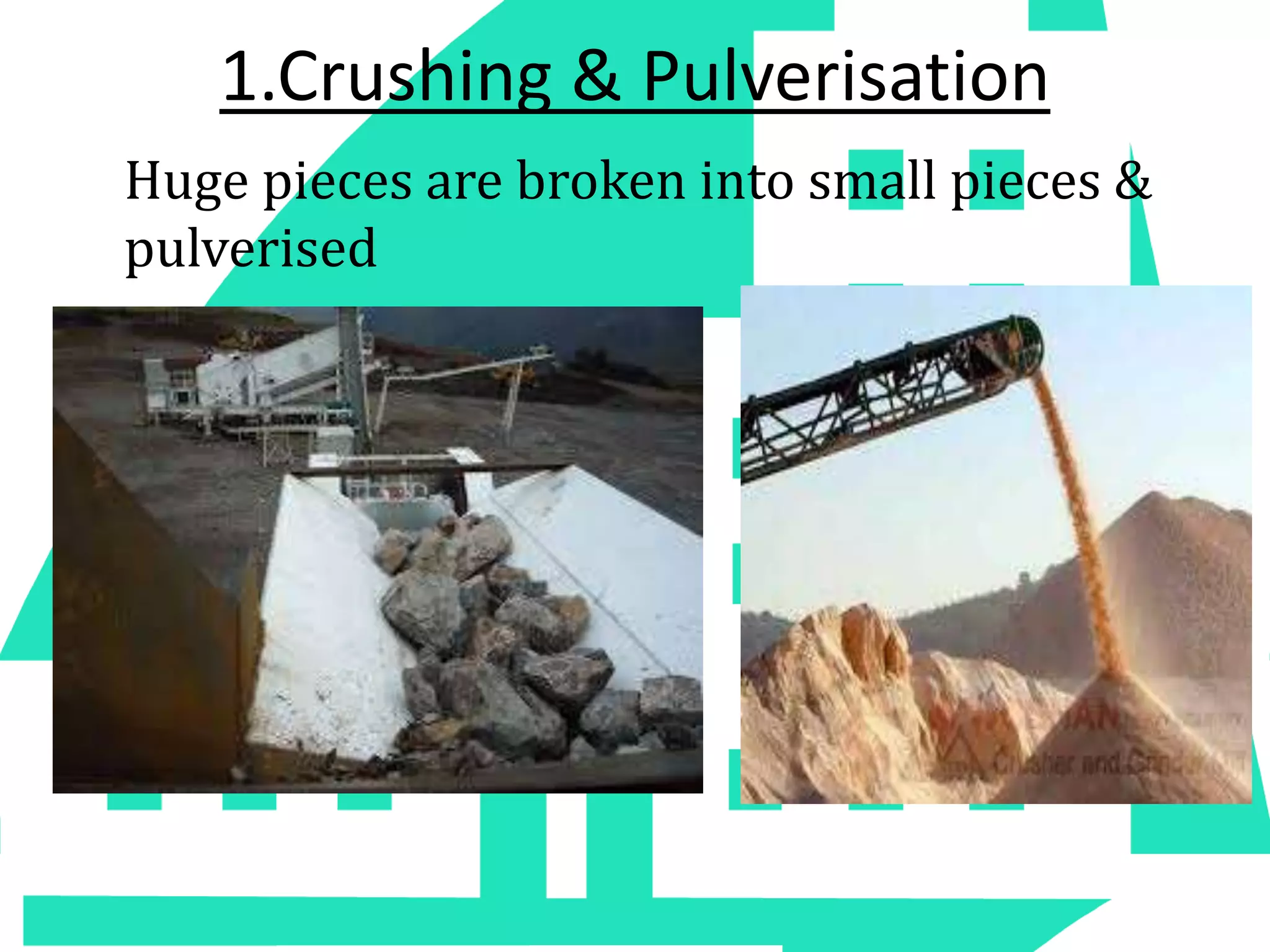
1.Crushing & Pulverisation
Huge pieces are broken into small pieces &
pulverised
2.Concentration of the Ore
Removal of impurities from the pulverised ore
• A) Gravity Separation(hydraulic washing)
• B) Froth floation
• C) Magnetic Seperation
• D) Leaching
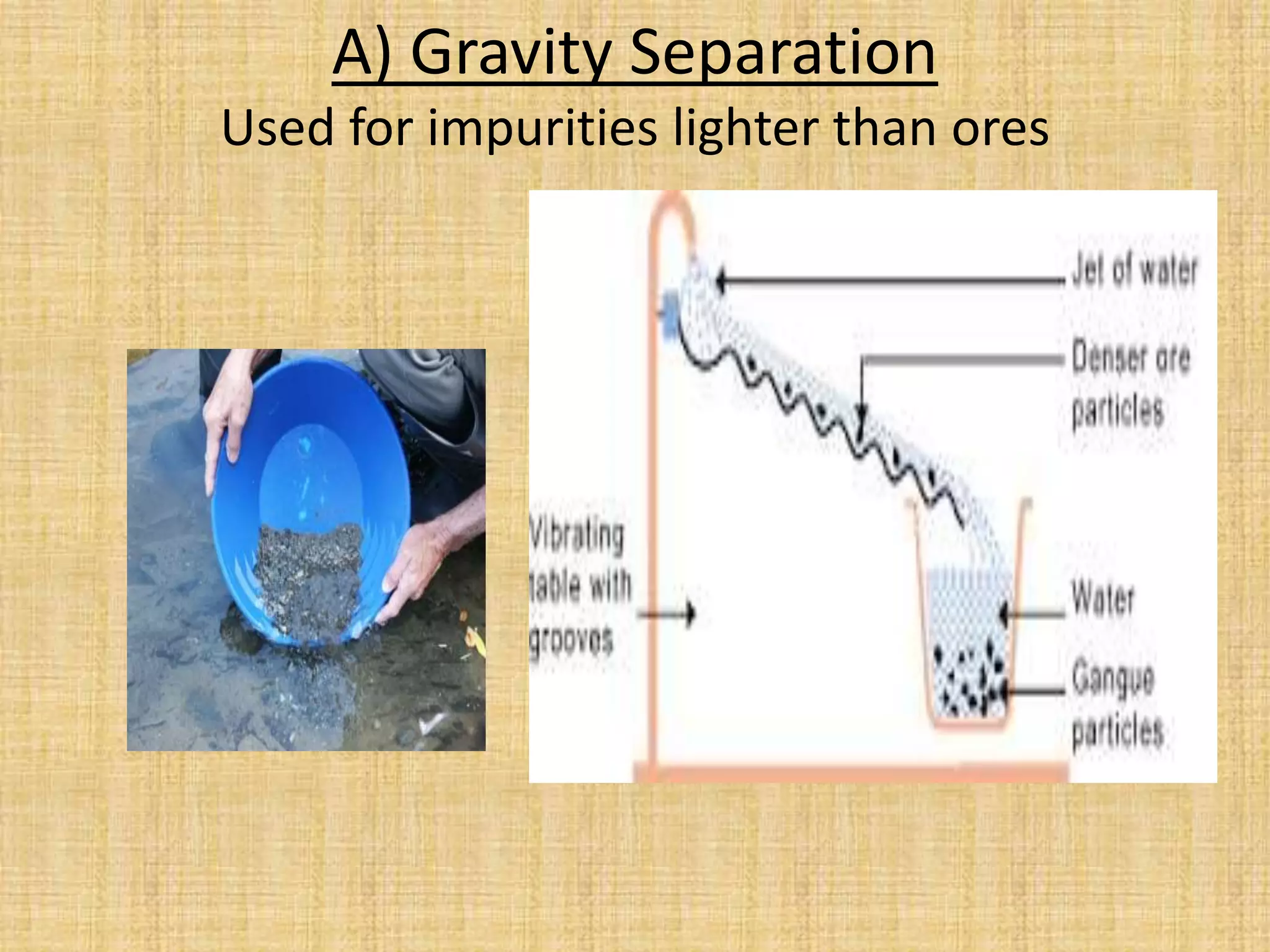
A) Gravity Separation
Used for impurities lighter than ores
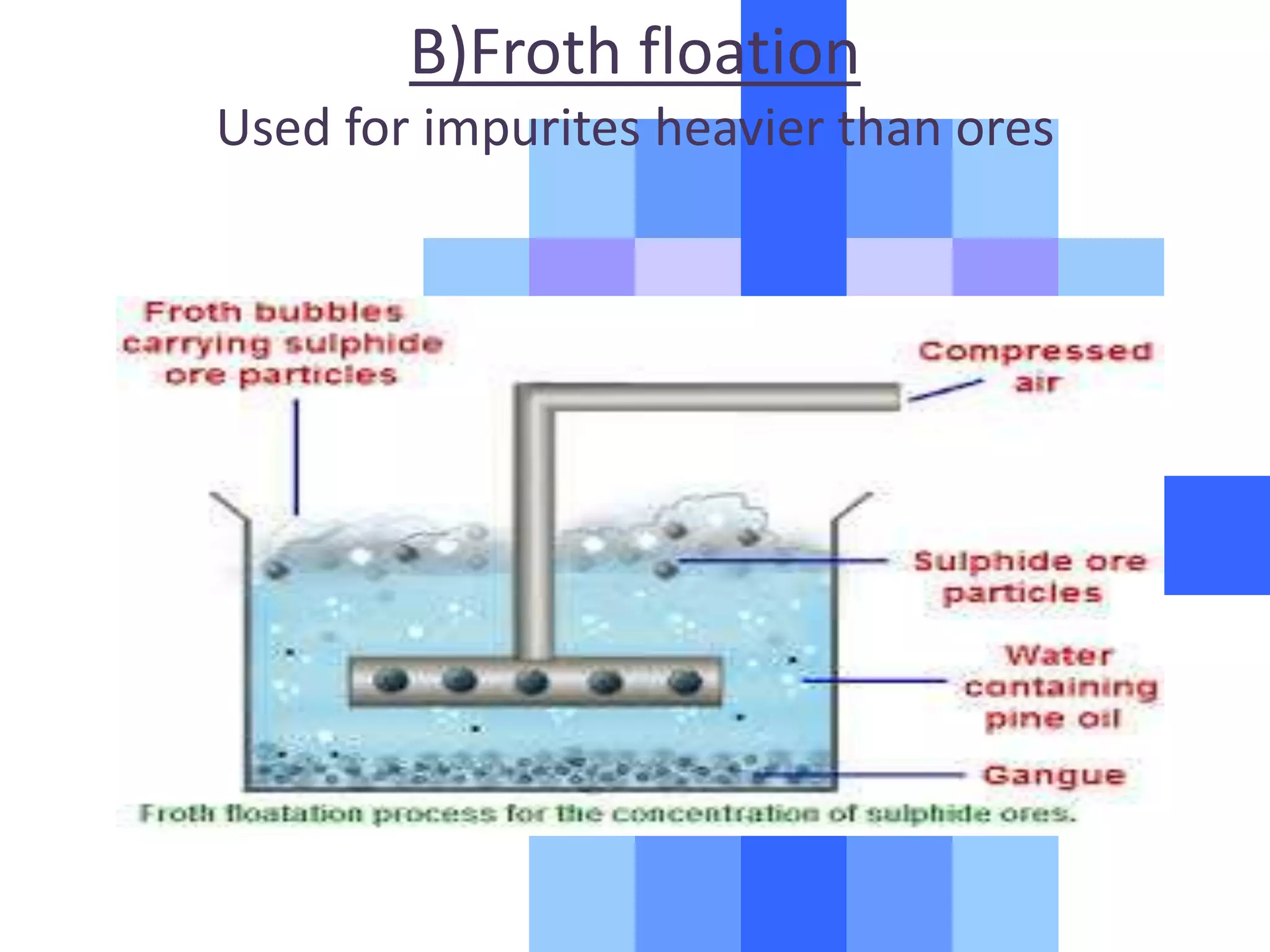
B)Froth floation
Used for impurites heavier than ores
froth floation
• Collectors: pine oil
• Froth stabilizers: aniline,cresol
• Depressents: NaCN act as depressent for
ZnS
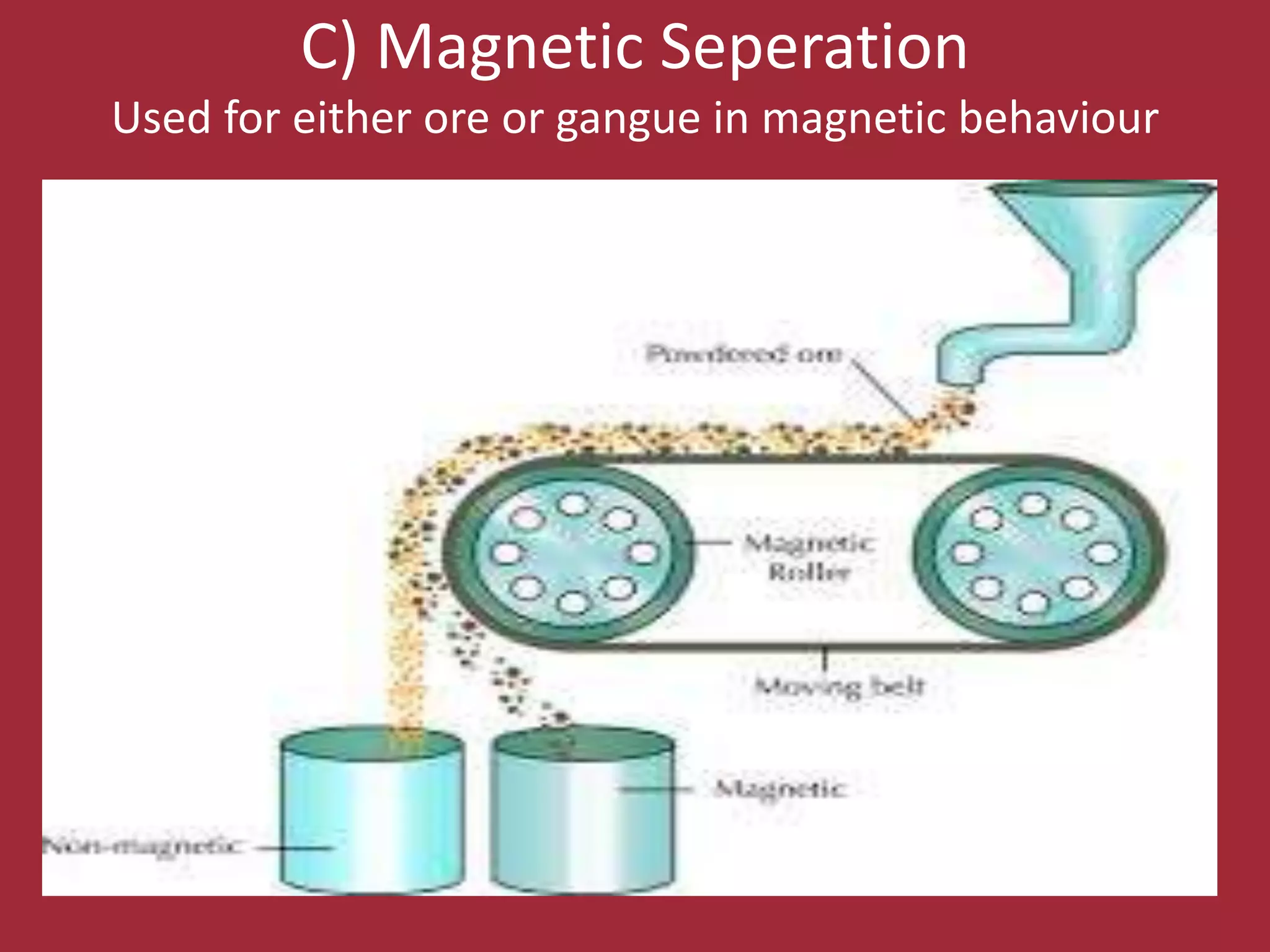
C) Magnetic Seperation
Used for either ore or gangue in magnetic behaviour
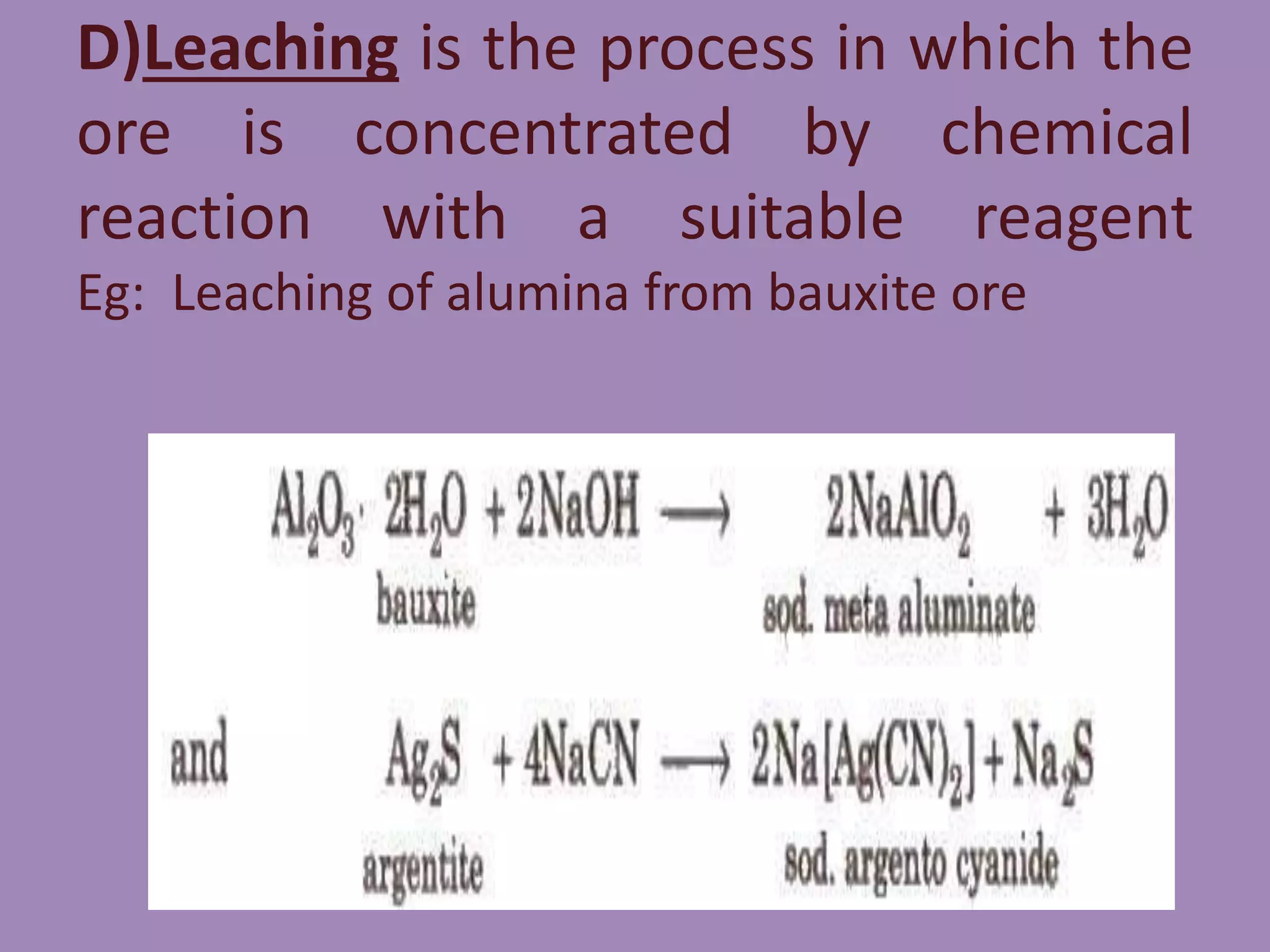
D)Leaching is the process in which the
ore is concentrated by chemical
reaction with a suitable reagent
Eg: Leaching of alumina from bauxite ore
3.Production of Crude metal
• 1. Conversion to oxide.
• 2. Reduction of the oxides to metal.
Calcination-heat
• Conversion to oxide ( absence of air)
Roasting-heat
(Excess of air)
. Reduction of the oxides to metal
• (i) Smelting (reduction with carbon)
• Flux: During smelting a substance. called flux is
added which removes the non-fusible impurities
as fusible slag. [Flux + Gangue = Slag]
• Acidic flux For basic impurities, acidic flux is
added.
• e.g., CaO + SiO2 → CaSiO3
Refining of the Crude metal:
The process of removing impurities from the crude
metal
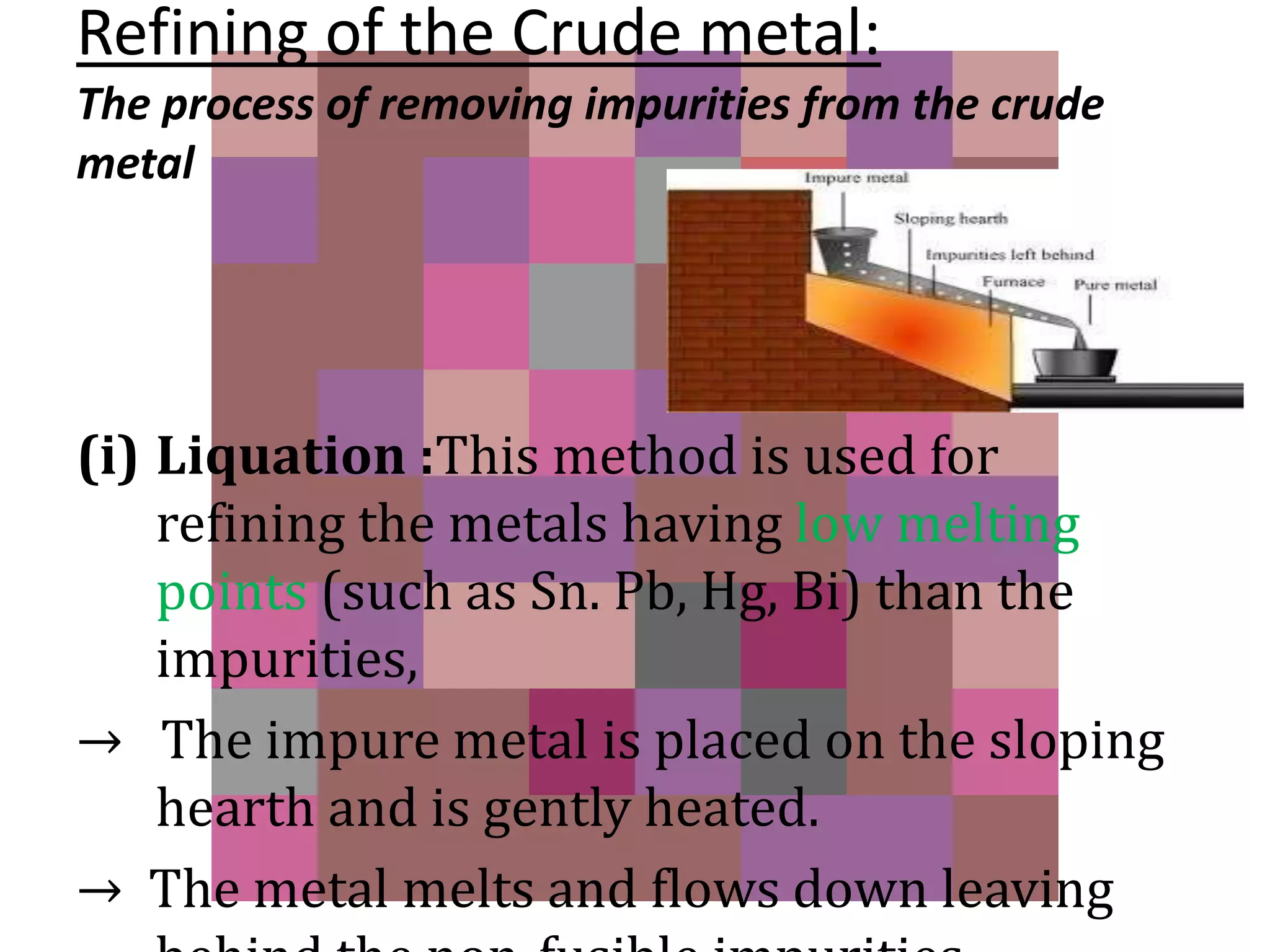
(i) Liquation :This method is used for
refining the metals having low melting
points (such as Sn. Pb, Hg, Bi) than the
impurities,
→ The impure metal is placed on the sloping
hearth and is gently heated.
→ The metal melts and flows down leaving
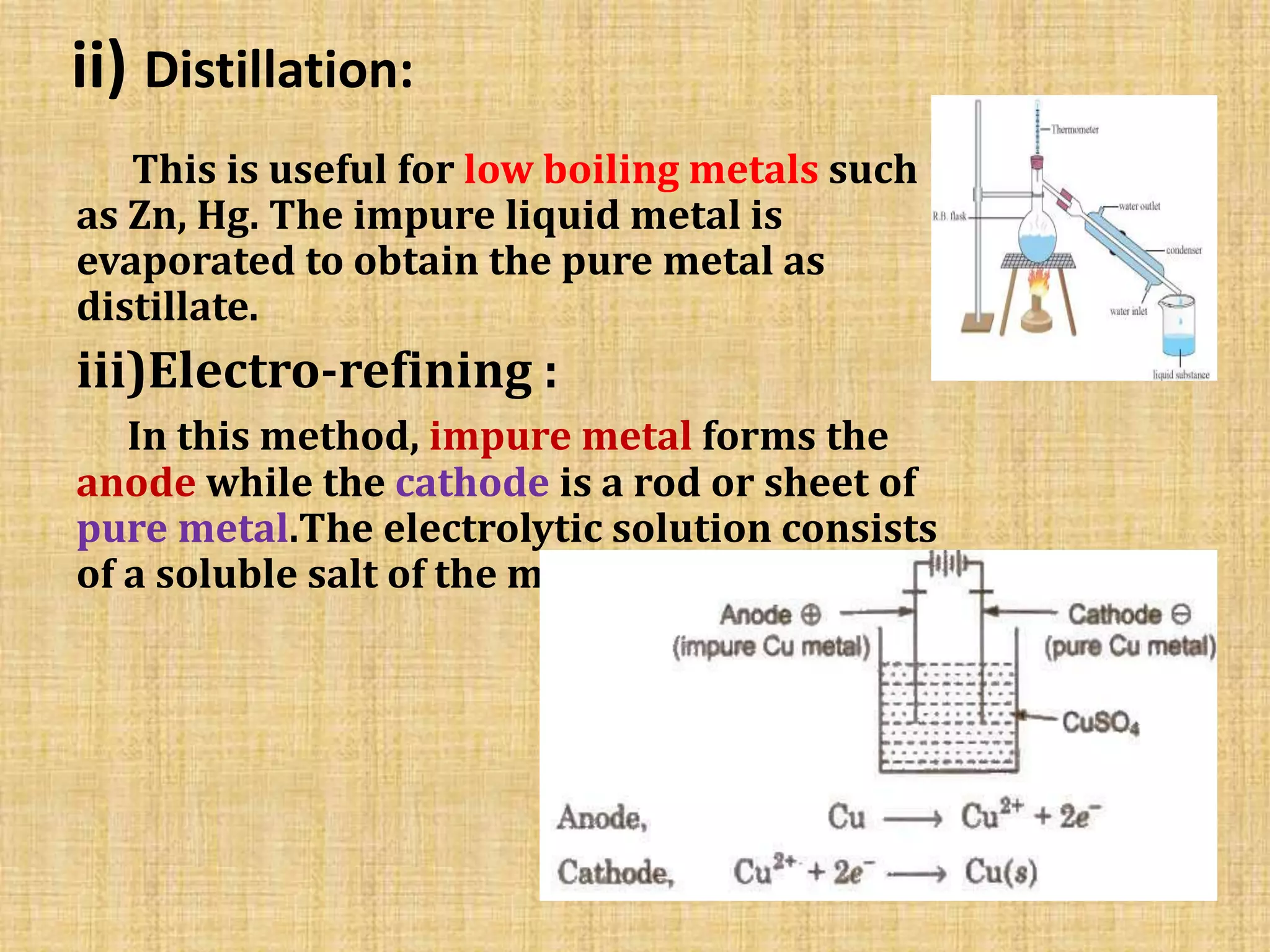
ii) Distillation:
This is useful for low boiling metals such
as Zn, Hg. The impure liquid metal is
evaporated to obtain the pure metal as
distillate.
iii)Electro-refining :
In this method, impure metal forms the
anode while the cathode is a rod or sheet of
pure metal.The electrolytic solution consists
of a soluble salt of the metal.
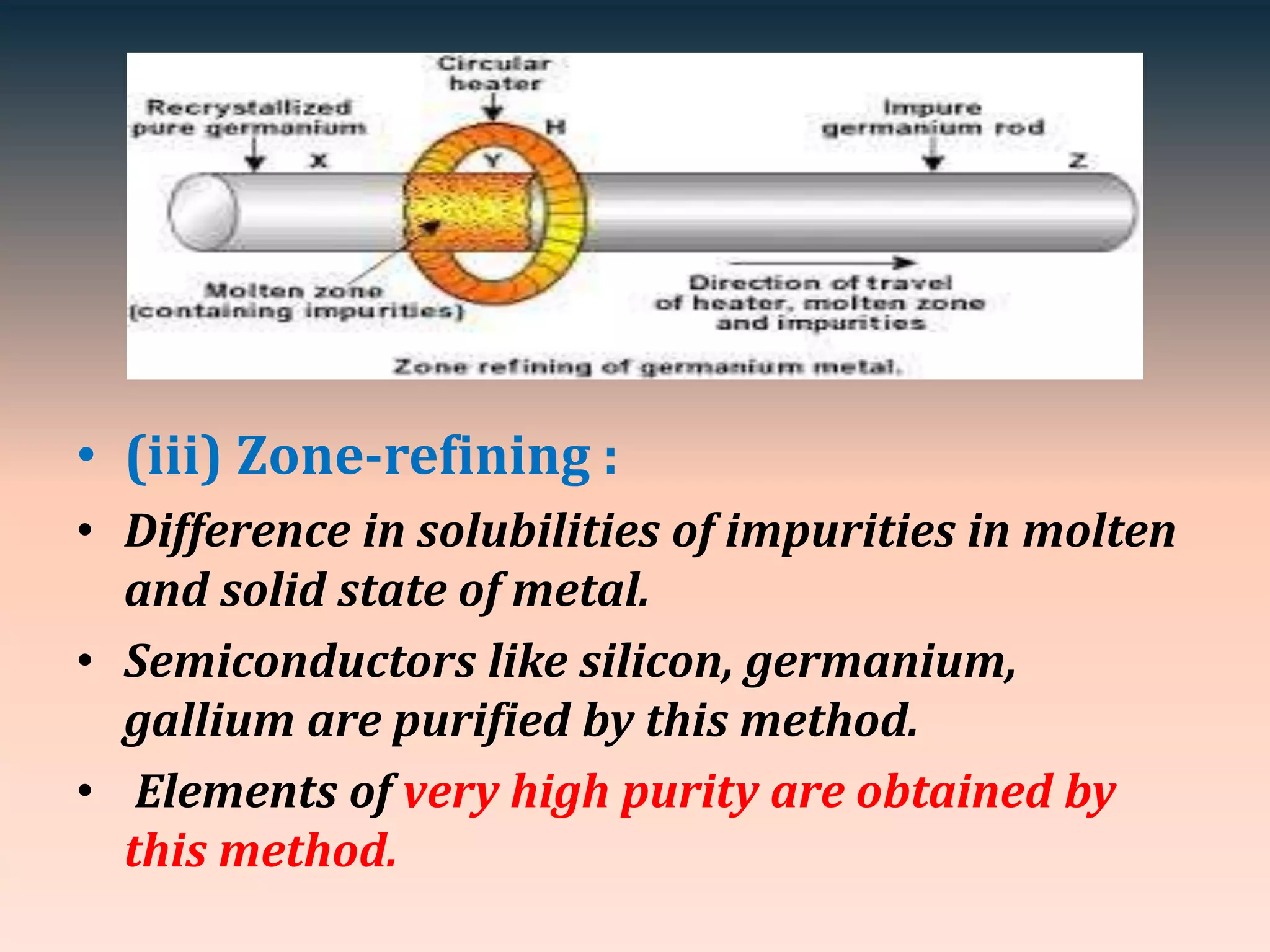
• (iii) Zone-refining :
• Difference in solubilities of impurities in molten
and solid state of metal.
• Semiconductors like silicon, germanium,
gallium are purified by this method.
• Elements of very high purity are obtained by
this method.
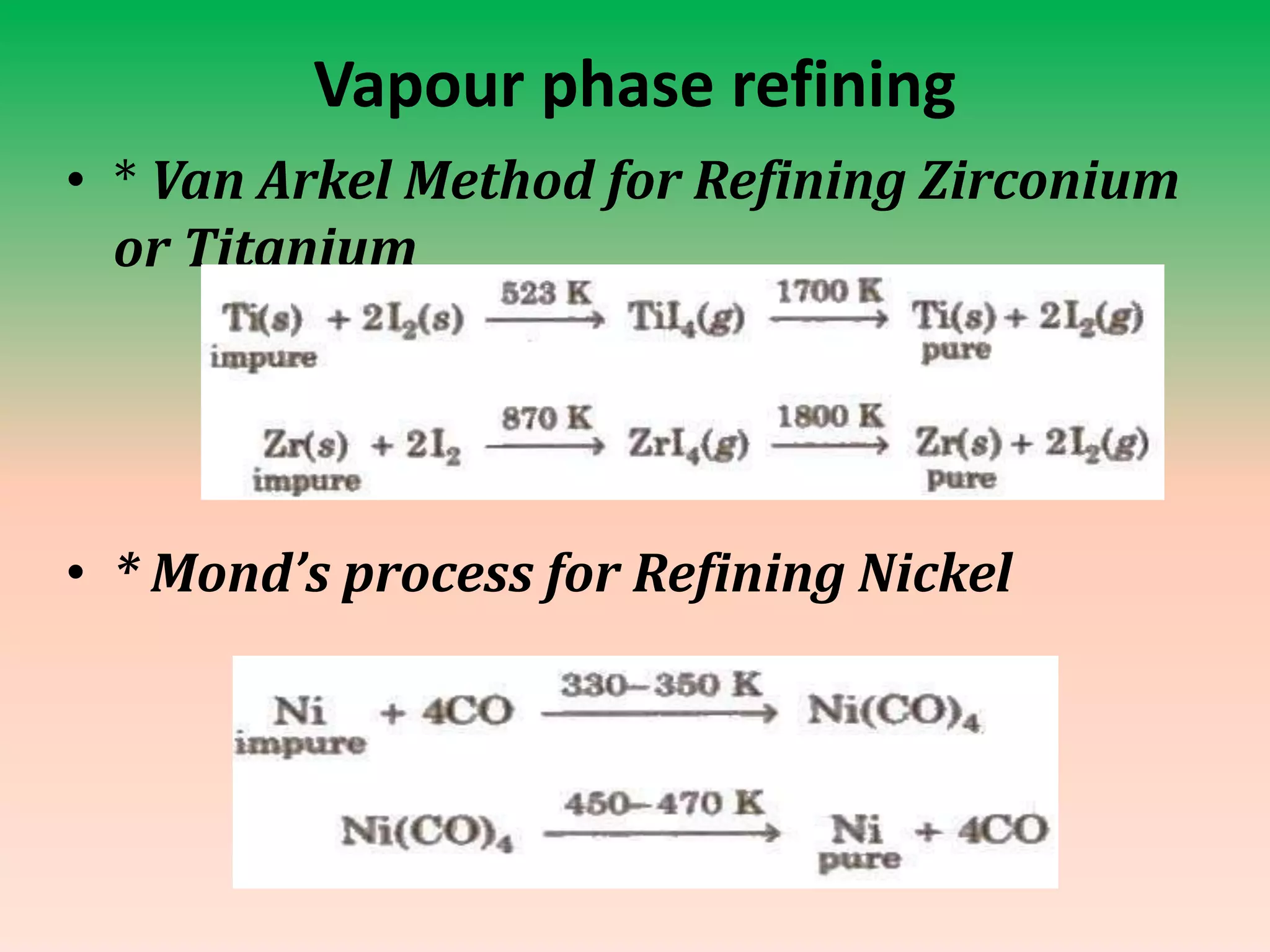
Vapour phase refining
• * Van Arkel Method for Refining Zirconium
or Titanium
• * Mond’s process for Refining Nickel
Chromatographic method:
• Paper chromatography
• Column chromatography
• Gas chromatography
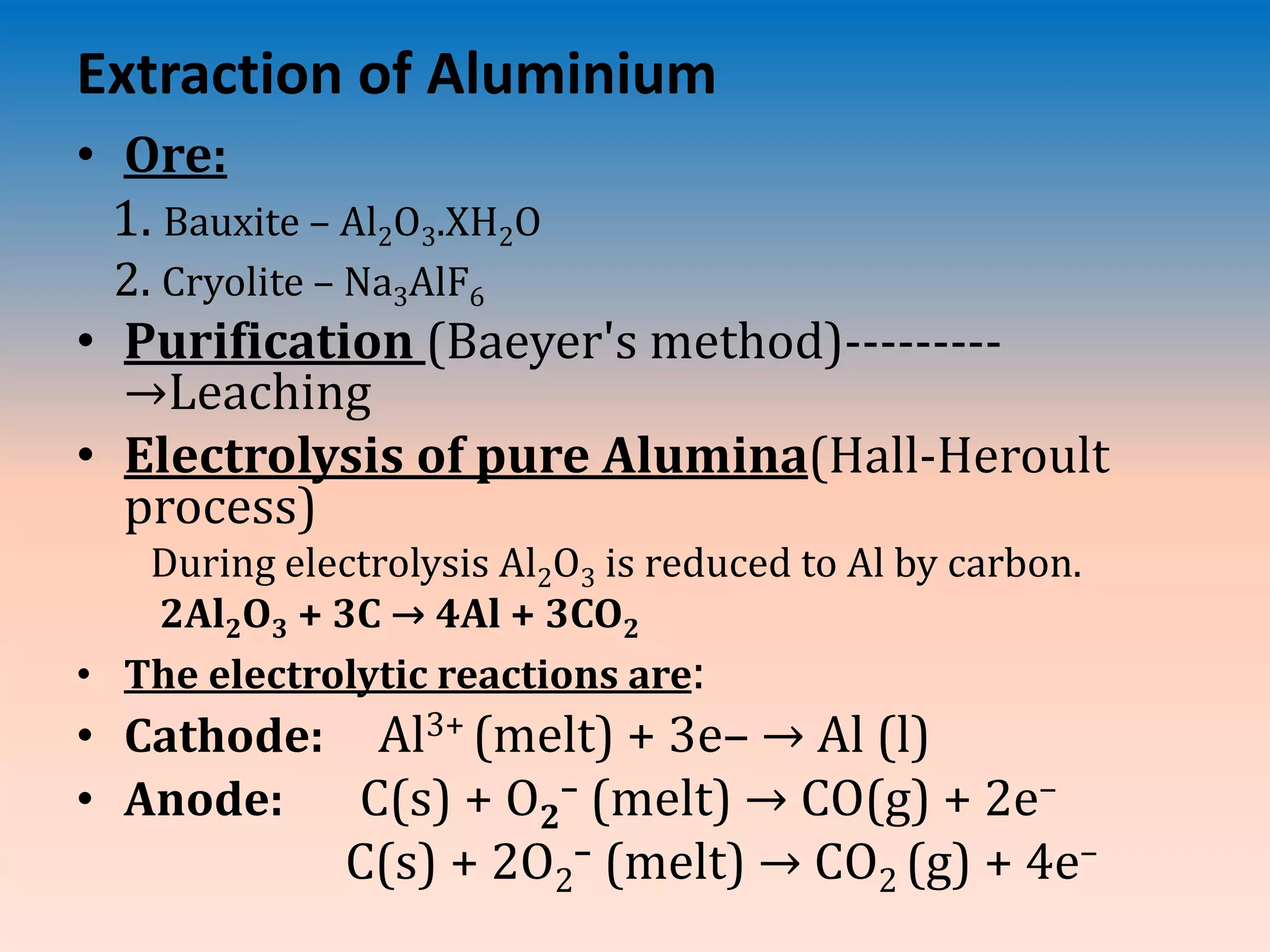
Extraction of Aluminium
• Ore:
1. Bauxite – Al2O3.XH2O
2. Cryolite – Na3AlF6
• Purification (Baeyer's method)---------
→Leaching
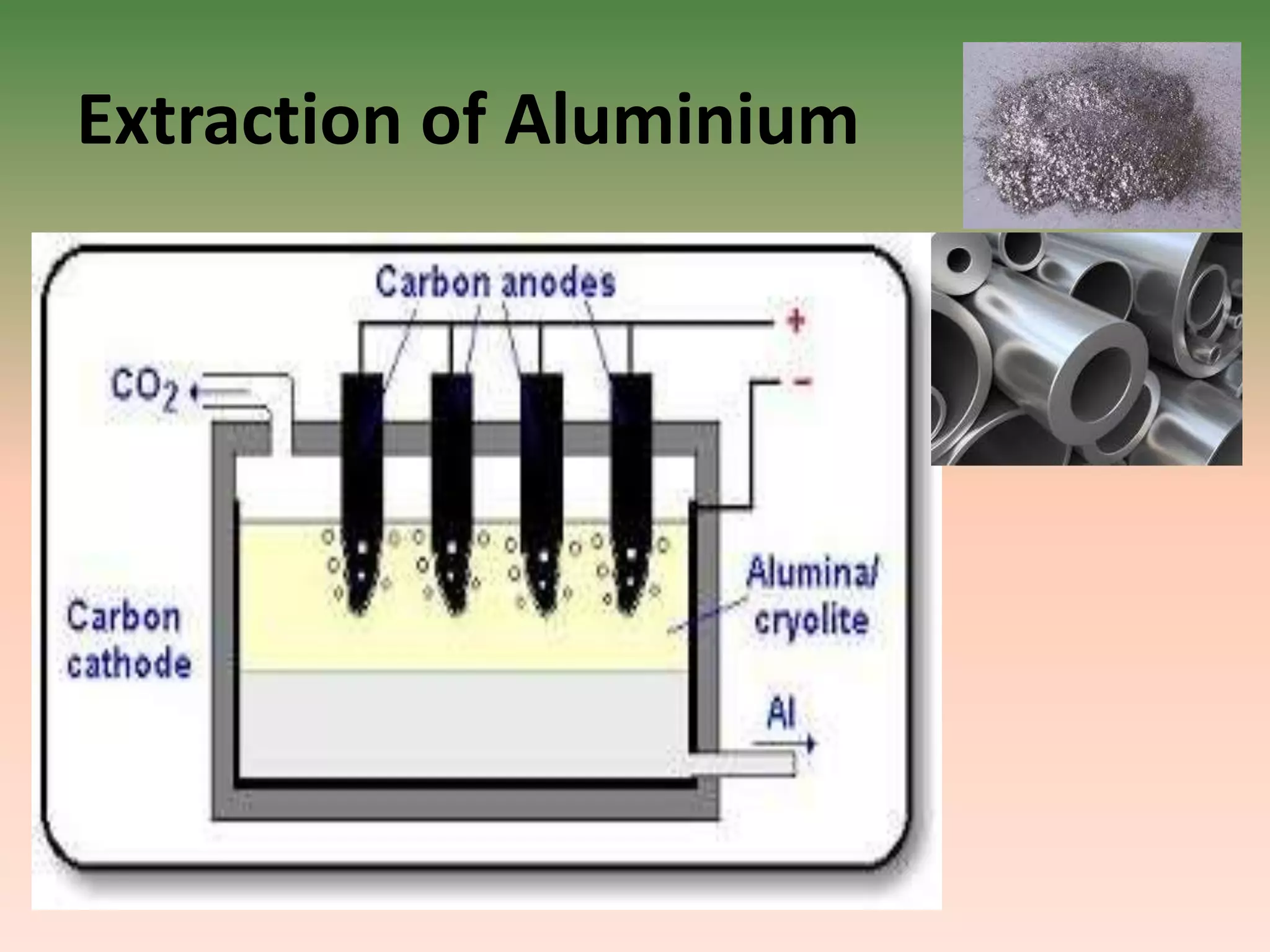
• Electrolysis of pure Alumina(Hall-Heroult
process)
During electrolysis Al2O3 is reduced to Al by carbon.
2Al2O3 + 3C → 4Al + 3CO2
• The electrolytic reactions are:
• Cathode: Al3+ (melt) + 3e– → Al (l)
• Anode: C(s) + O2
– (melt) → CO(g) + 2e–
C(s) + 2O2
– (melt) → CO2 (g) + 4e–
Extraction of Aluminium
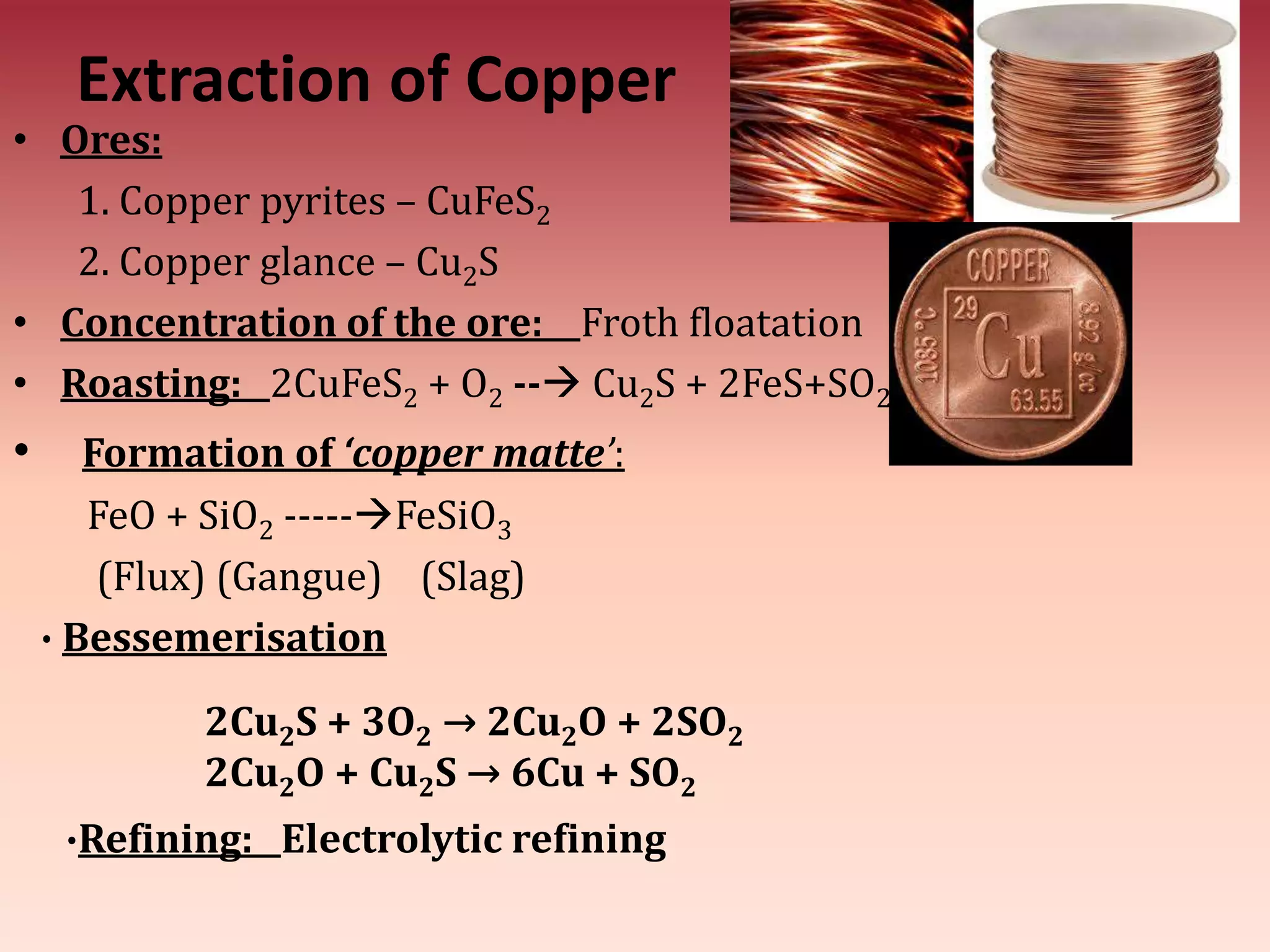
Extraction of Copper
• Ores:
1. Copper pyrites – CuFeS2
2. Copper glance – Cu2S
• Concentration of the ore: Froth floatation
• Roasting: 2CuFeS2 + O2 -- Cu2S + 2FeS+SO2
• Formation of ‘copper matte’:
FeO + SiO2 -----FeSiO3
(Flux) (Gangue) (Slag)
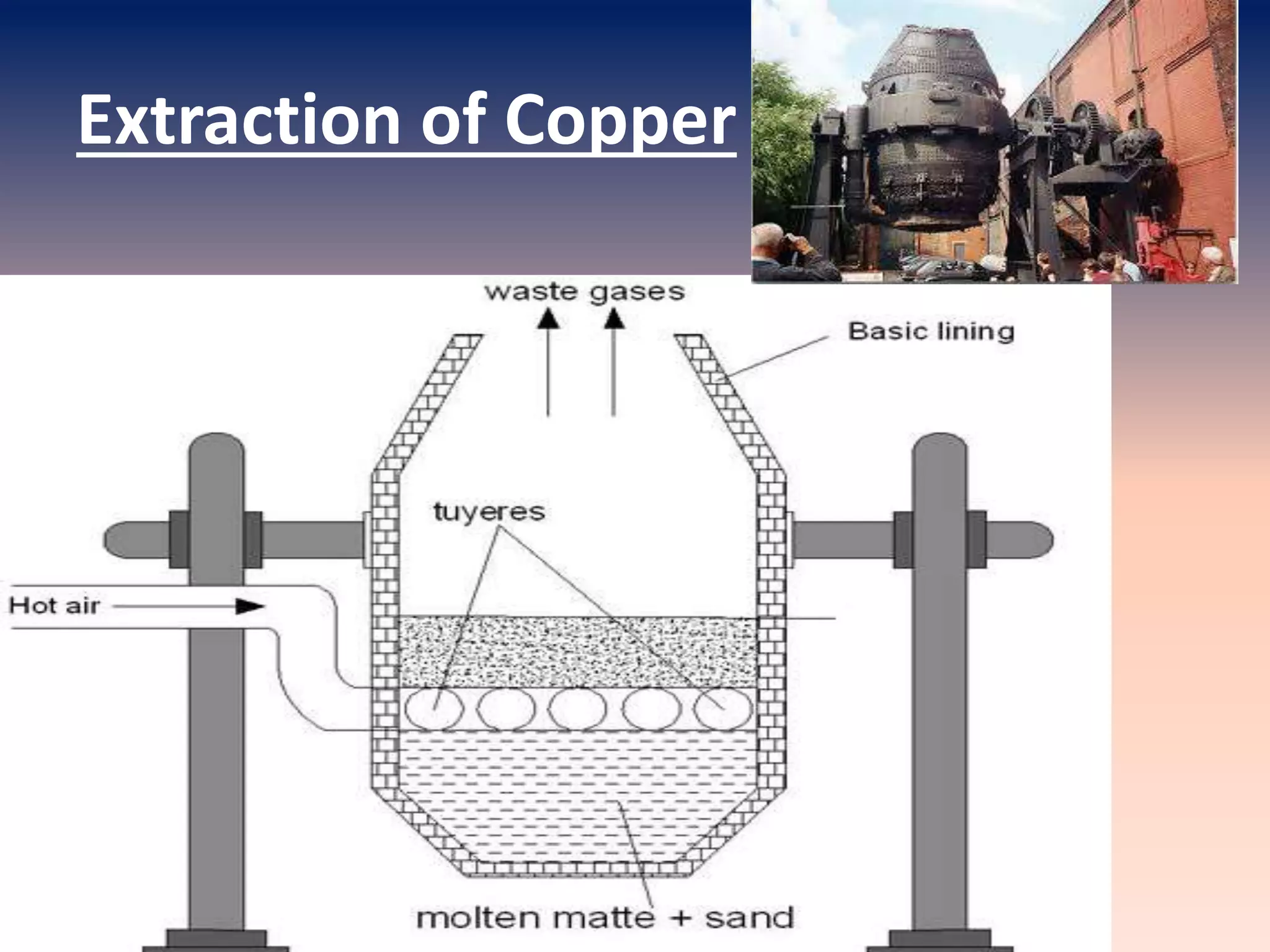
∙ Bessemerisation
2Cu2S + 3O2 → 2Cu2O + 2SO2
2Cu2O + Cu2S → 6Cu + SO2
∙Refining: Electrolytic refining
Extraction of Copper
Extraction of Iron
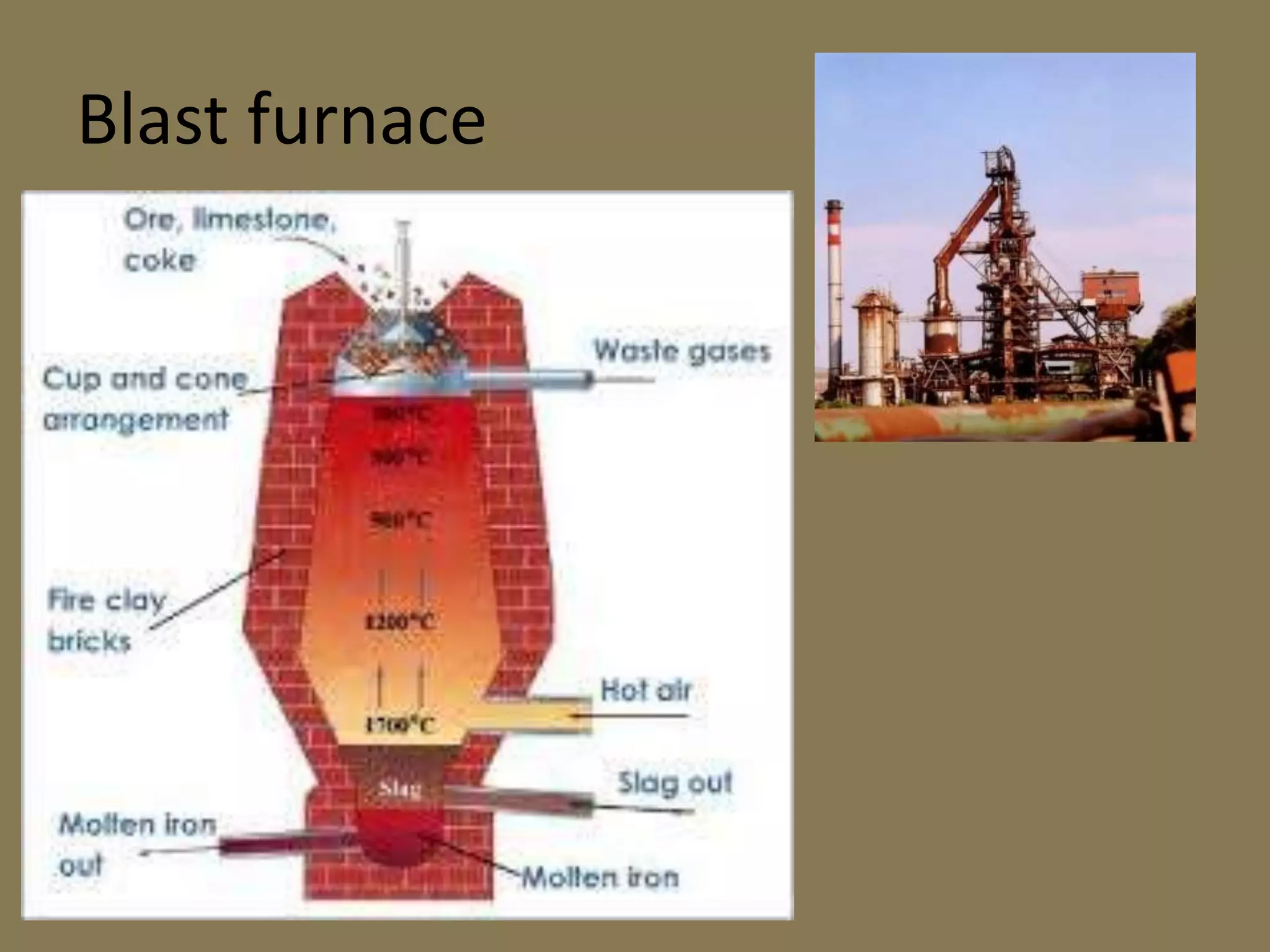
ores: Haematite (Fe2O3) and Magnetite (Fe3O4).
 Concentration of the ore: Gravity Separation
 Calcination :
 Reduction of the ore:
 2 C(s) + O2(g) → 2 CO2(g+ Heat [ Combustion Zone] (1775K)
 C(s) + CO2(g) → 2 CO(g [ Fusion Zone] (1575K)
 CaCO3 CaO + CO2 [Slag Formation Zone] (1275K)
CaO + SiO2 CaSiO3
 3Fe2O3 + CO → 2 Fe3O4 + CO2 [Reduction Zone] (875K)
Fe3O4 + 4 CO → 3Fe + 4 CO2o
FeO(s) + CO(g) → Fe(s) + CO2(g
Blast furnace
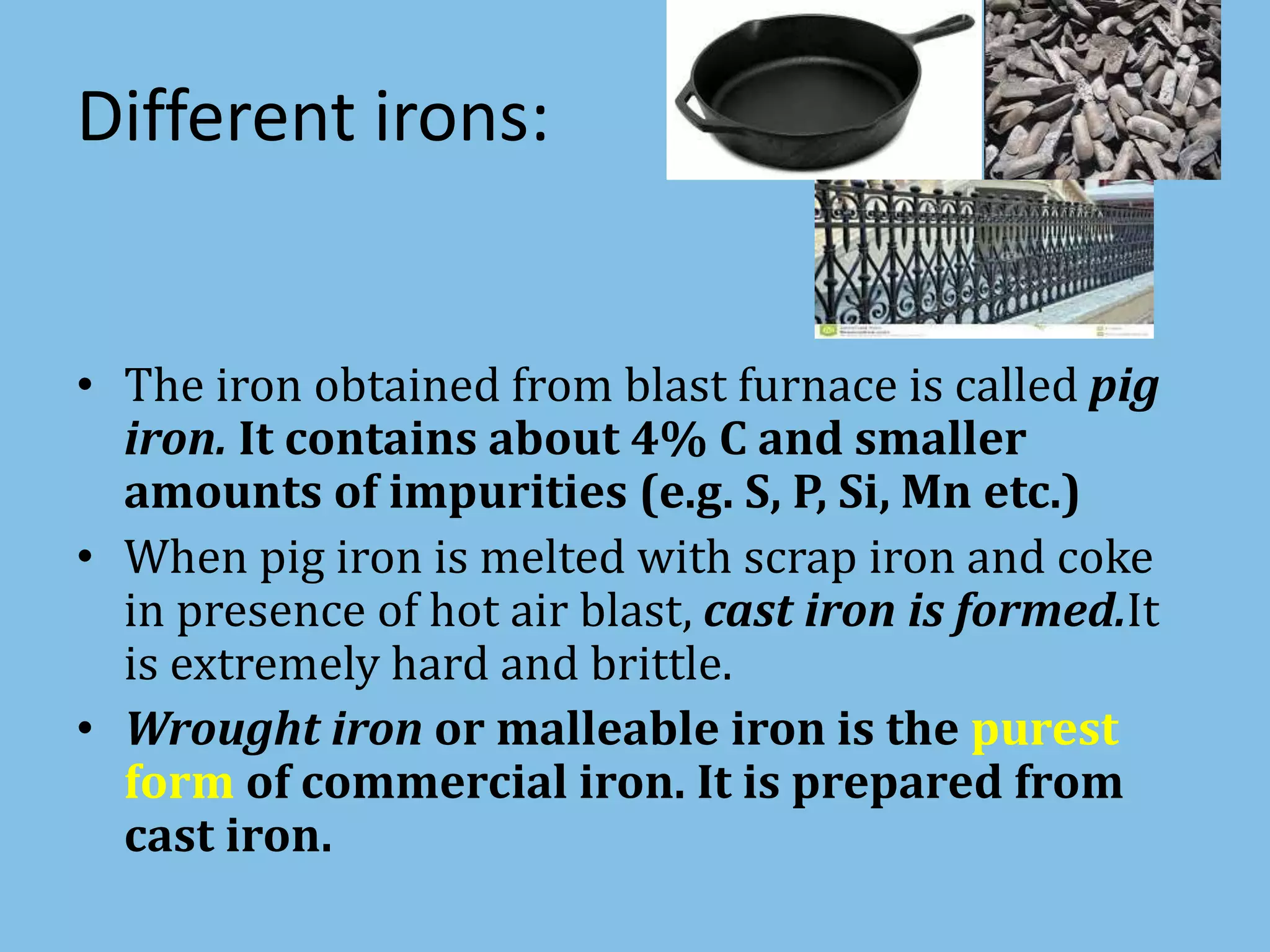
Different irons:
• The iron obtained from blast furnace is called pig
iron. It contains about 4% C and smaller
amounts of impurities (e.g. S, P, Si, Mn etc.)
• When pig iron is melted with scrap iron and coke
in presence of hot air blast, cast iron is formed.It
is extremely hard and brittle.
• Wrought iron or malleable iron is the purest
form of commercial iron. It is prepared from
cast iron.
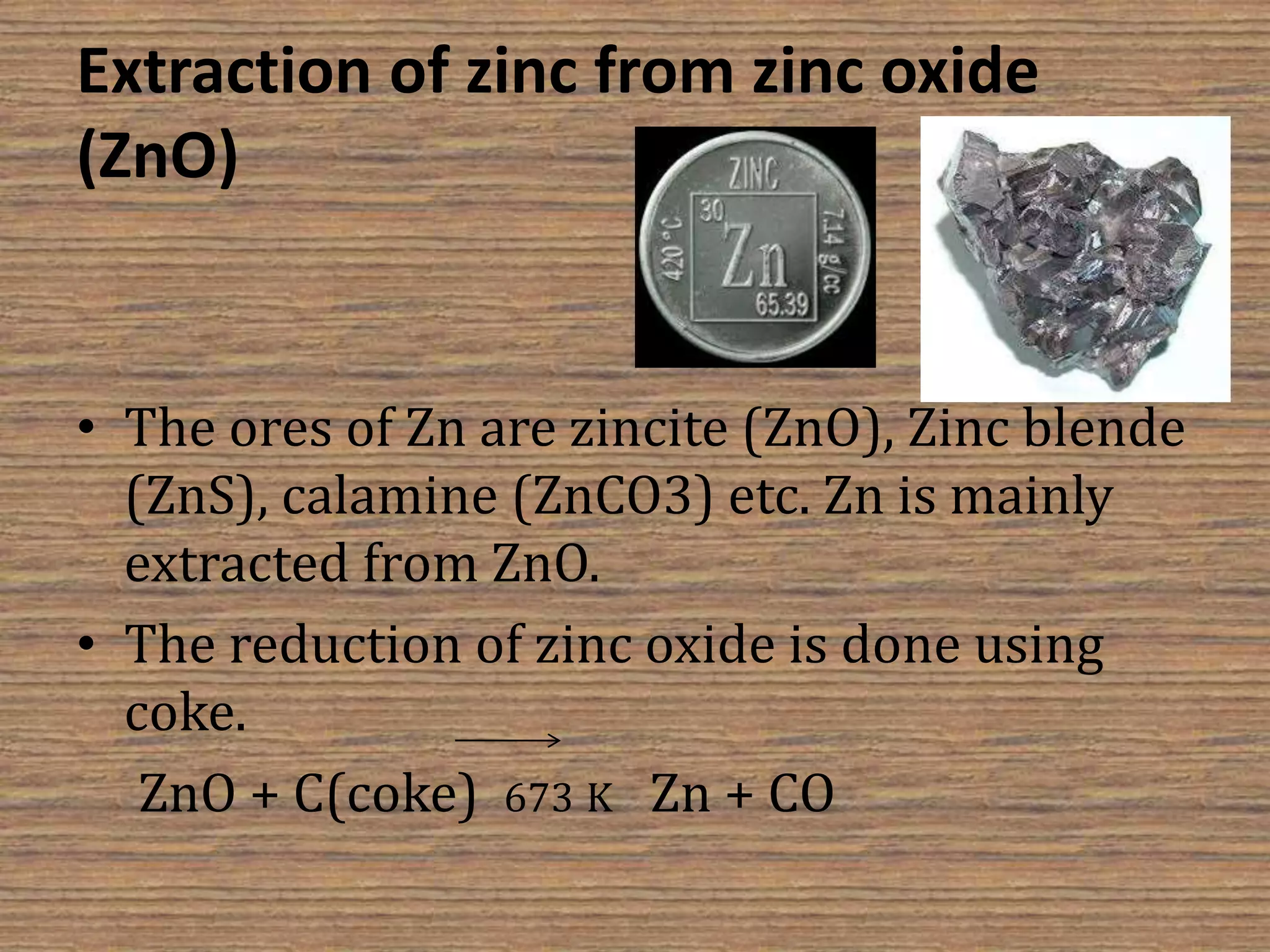
Extraction of zinc from zinc oxide
(ZnO)
• The ores of Zn are zincite (ZnO), Zinc blende
(ZnS), calamine (ZnCO3) etc. Zn is mainly
extracted from ZnO.
• The reduction of zinc oxide is done using
coke.
ZnO + C(coke) 673 K Zn + CO
Thermodynamic Principles of Metallurgy
• ΔG = ΔH – TΔS
• ΔH is the enthalpy change ,ΔS is the entropy change.
• The reaction will proceed only when the value of ΔG
is negative in the above equation.
• This can be possible in the following ways:
• 1. If ΔS is positive, on increasing the temperature
(T), the value of TΔS would increase (i.e. TΔS > ΔH )
and then ΔG will become –ve.
• 2. If two reactions having different ΔG values are
coupled, the net ΔG of the reactions becomes –ve
Ellingham Diagram
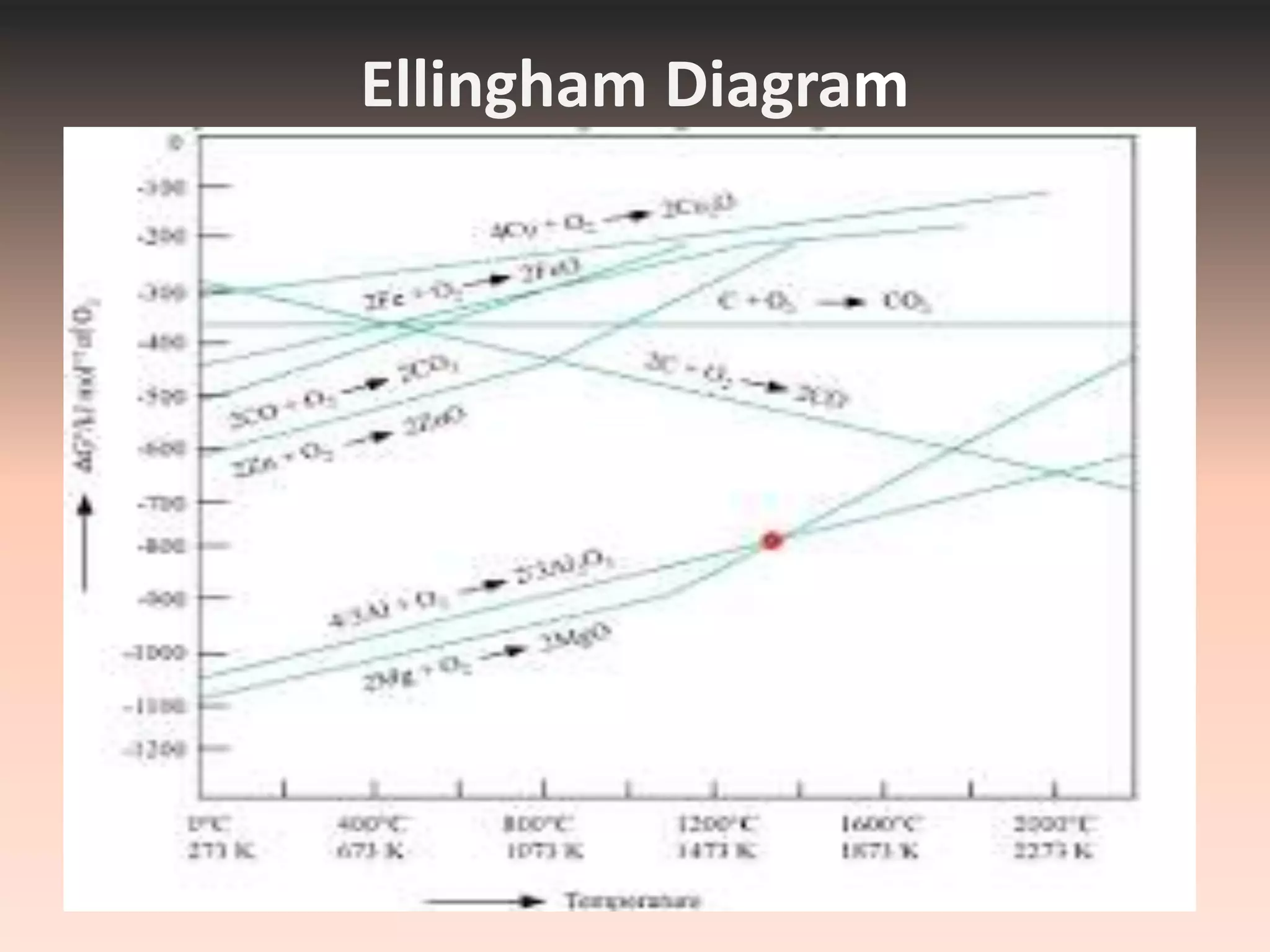
• The graphical representation of Gibbs energy vs
Temperature was first given by H.J.T.Ellingham and
these graphs are known as Ellingham Diagram.
• It gives a sound basis for considering the
choice of reducing agent in the reduction of
oxides.
• These diagrams help us in predicting the
feasibility of thermal reduction of an ore.
(The criterion of feasibility is that at a given
temperature, Gibbs energy of the reaction
must be negative.)
Ellingham Diagram
METALLURGY
THANK YOU………

Metallurgy based on chemistry the reactions and processes

  • 2.
    JUSTIN GEORGE +2 COMPUTERSCIENCE SJHSS VAYATTUPARAMBA KANNUR, KERALA
  • 3.
    METALLURGY • General Principlesand Processes of isolation of Elements.
  • 4.
    Minerals:The combined stateof metal in the earth’s crust. Ex: Oxides ,Carbonates. • Ore: The Mineral from which the metal economically and commercially extracted. • Ex: Al- Bauxite,Fe-Haematite. • Gangue: Impurities present in minerals. • Ex: silicates,rock pieces……….. All ores are minerals ,but all minerals are not ores.
  • 5.
    Metallurgy It is processof extraction of metal from its ores 1. Concentration of the Ore 2. Production of Crude metal 3. Refining of the Crude metal 4. Crushing & Pulverisation
  • 6.
    1.Crushing & Pulverisation Hugepieces are broken into small pieces & pulverised
  • 7.
    2.Concentration of theOre Removal of impurities from the pulverised ore • A) Gravity Separation(hydraulic washing) • B) Froth floation • C) Magnetic Seperation • D) Leaching
  • 8.
    A) Gravity Separation Usedfor impurities lighter than ores
  • 9.
    B)Froth floation Used forimpurites heavier than ores
  • 10.
    froth floation • Collectors:pine oil • Froth stabilizers: aniline,cresol • Depressents: NaCN act as depressent for ZnS
  • 11.
    C) Magnetic Seperation Usedfor either ore or gangue in magnetic behaviour
  • 12.
    D)Leaching is theprocess in which the ore is concentrated by chemical reaction with a suitable reagent Eg: Leaching of alumina from bauxite ore
  • 13.
    3.Production of Crudemetal • 1. Conversion to oxide. • 2. Reduction of the oxides to metal. Calcination-heat • Conversion to oxide ( absence of air) Roasting-heat (Excess of air)
  • 14.
    . Reduction ofthe oxides to metal • (i) Smelting (reduction with carbon) • Flux: During smelting a substance. called flux is added which removes the non-fusible impurities as fusible slag. [Flux + Gangue = Slag] • Acidic flux For basic impurities, acidic flux is added. • e.g., CaO + SiO2 → CaSiO3
  • 15.
    Refining of theCrude metal: The process of removing impurities from the crude metal (i) Liquation :This method is used for refining the metals having low melting points (such as Sn. Pb, Hg, Bi) than the impurities, → The impure metal is placed on the sloping hearth and is gently heated. → The metal melts and flows down leaving
  • 16.
    ii) Distillation: This isuseful for low boiling metals such as Zn, Hg. The impure liquid metal is evaporated to obtain the pure metal as distillate. iii)Electro-refining : In this method, impure metal forms the anode while the cathode is a rod or sheet of pure metal.The electrolytic solution consists of a soluble salt of the metal.
  • 17.
    • (iii) Zone-refining: • Difference in solubilities of impurities in molten and solid state of metal. • Semiconductors like silicon, germanium, gallium are purified by this method. • Elements of very high purity are obtained by this method.
  • 18.
    Vapour phase refining •* Van Arkel Method for Refining Zirconium or Titanium • * Mond’s process for Refining Nickel
  • 19.
    Chromatographic method: • Paperchromatography • Column chromatography • Gas chromatography
  • 20.
    Extraction of Aluminium •Ore: 1. Bauxite – Al2O3.XH2O 2. Cryolite – Na3AlF6 • Purification (Baeyer's method)--------- →Leaching • Electrolysis of pure Alumina(Hall-Heroult process) During electrolysis Al2O3 is reduced to Al by carbon. 2Al2O3 + 3C → 4Al + 3CO2 • The electrolytic reactions are: • Cathode: Al3+ (melt) + 3e– → Al (l) • Anode: C(s) + O2 – (melt) → CO(g) + 2e– C(s) + 2O2 – (melt) → CO2 (g) + 4e–
  • 21.
  • 22.
    Extraction of Copper •Ores: 1. Copper pyrites – CuFeS2 2. Copper glance – Cu2S • Concentration of the ore: Froth floatation • Roasting: 2CuFeS2 + O2 -- Cu2S + 2FeS+SO2 • Formation of ‘copper matte’: FeO + SiO2 -----FeSiO3 (Flux) (Gangue) (Slag) ∙ Bessemerisation 2Cu2S + 3O2 → 2Cu2O + 2SO2 2Cu2O + Cu2S → 6Cu + SO2 ∙Refining: Electrolytic refining
  • 23.
  • 24.
    Extraction of Iron ores:Haematite (Fe2O3) and Magnetite (Fe3O4).  Concentration of the ore: Gravity Separation  Calcination :  Reduction of the ore:  2 C(s) + O2(g) → 2 CO2(g+ Heat [ Combustion Zone] (1775K)  C(s) + CO2(g) → 2 CO(g [ Fusion Zone] (1575K)  CaCO3 CaO + CO2 [Slag Formation Zone] (1275K) CaO + SiO2 CaSiO3  3Fe2O3 + CO → 2 Fe3O4 + CO2 [Reduction Zone] (875K) Fe3O4 + 4 CO → 3Fe + 4 CO2o FeO(s) + CO(g) → Fe(s) + CO2(g
  • 25.
  • 26.
    Different irons: • Theiron obtained from blast furnace is called pig iron. It contains about 4% C and smaller amounts of impurities (e.g. S, P, Si, Mn etc.) • When pig iron is melted with scrap iron and coke in presence of hot air blast, cast iron is formed.It is extremely hard and brittle. • Wrought iron or malleable iron is the purest form of commercial iron. It is prepared from cast iron.
  • 27.
    Extraction of zincfrom zinc oxide (ZnO) • The ores of Zn are zincite (ZnO), Zinc blende (ZnS), calamine (ZnCO3) etc. Zn is mainly extracted from ZnO. • The reduction of zinc oxide is done using coke. ZnO + C(coke) 673 K Zn + CO
  • 28.
    Thermodynamic Principles ofMetallurgy • ΔG = ΔH – TΔS • ΔH is the enthalpy change ,ΔS is the entropy change. • The reaction will proceed only when the value of ΔG is negative in the above equation. • This can be possible in the following ways: • 1. If ΔS is positive, on increasing the temperature (T), the value of TΔS would increase (i.e. TΔS > ΔH ) and then ΔG will become –ve. • 2. If two reactions having different ΔG values are coupled, the net ΔG of the reactions becomes –ve
  • 29.
    Ellingham Diagram • Thegraphical representation of Gibbs energy vs Temperature was first given by H.J.T.Ellingham and these graphs are known as Ellingham Diagram. • It gives a sound basis for considering the choice of reducing agent in the reduction of oxides. • These diagrams help us in predicting the feasibility of thermal reduction of an ore. (The criterion of feasibility is that at a given temperature, Gibbs energy of the reaction must be negative.)
  • 30.
  • 31.
  • 32.