KETAN.R.THAKKAR
IMPORTANT TERMS
Metallurgy:-The science and technology which deals with
commercial production of metals from their ores is known
as metallurgy
Minerals :- Naturally occurring compounds of metals are
known as minerals
Ores:- Ores are those minerals from which metal can be
extracted profitably
Gangue :- The impurity of sand,clay and rocky materials
associated with ore is called as Gangue
ALL THE ORES ARE MINERALS BUT ALL THE
MINERALS ARE NOT ORES
3.
KETAN.R.THAKKAR
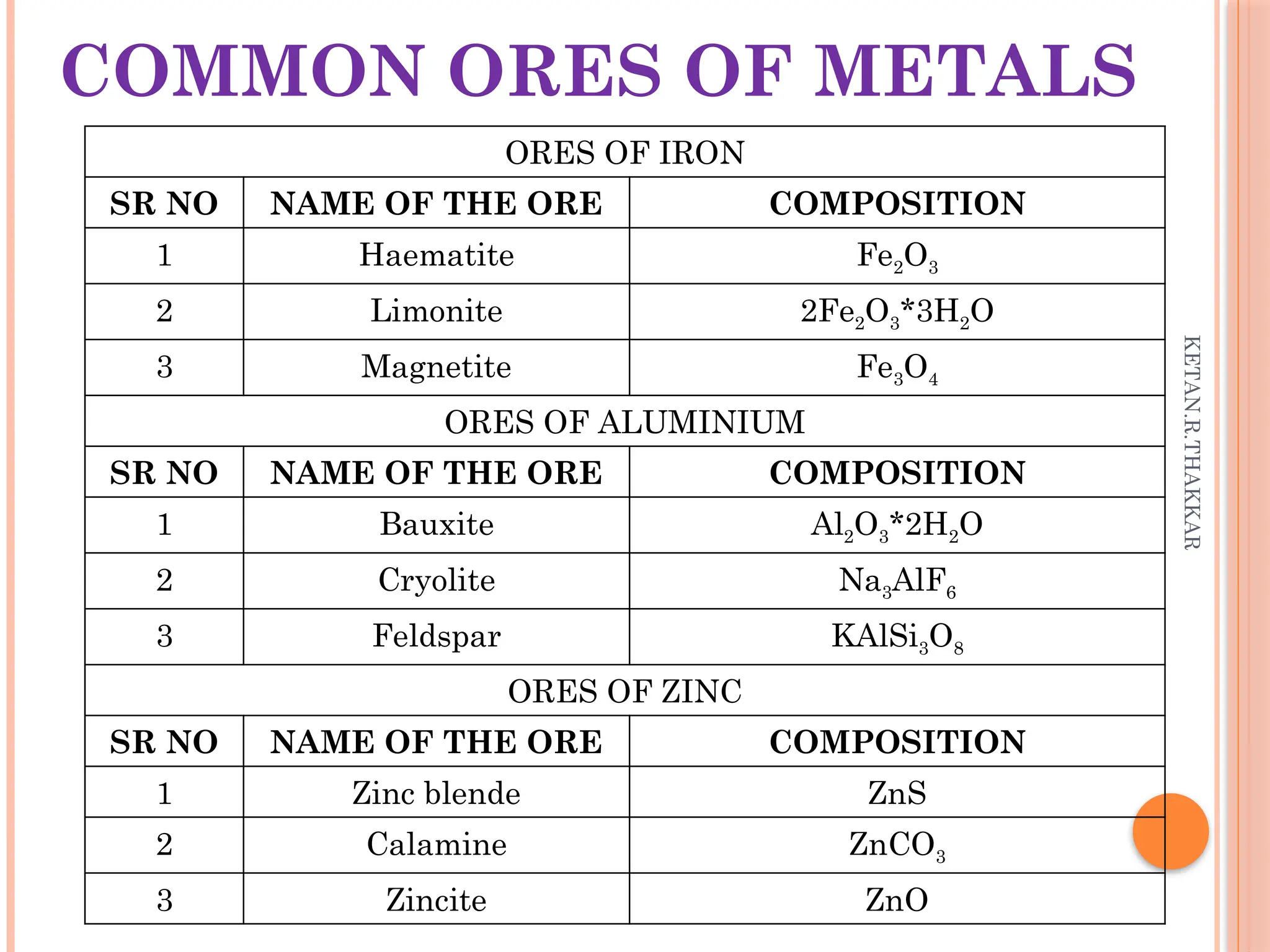
COMMON ORES OFMETALS
ORES OF IRON
SR NO NAME OF THE ORE COMPOSITION
1 Haematite Fe2O3
2 Limonite 2Fe2O3*3H2O
3 Magnetite Fe3O4
ORES OF ALUMINIUM
SR NO NAME OF THE ORE COMPOSITION
1 Bauxite Al2O3*2H2O
2 Cryolite Na3AlF6
3 Feldspar KAlSi3O8
ORES OF ZINC
SR NO NAME OF THE ORE COMPOSITION
1 Zinc blende ZnS
2 Calamine ZnCO3
3 Zincite ZnO
4.
KETAN.R.THAKKAR
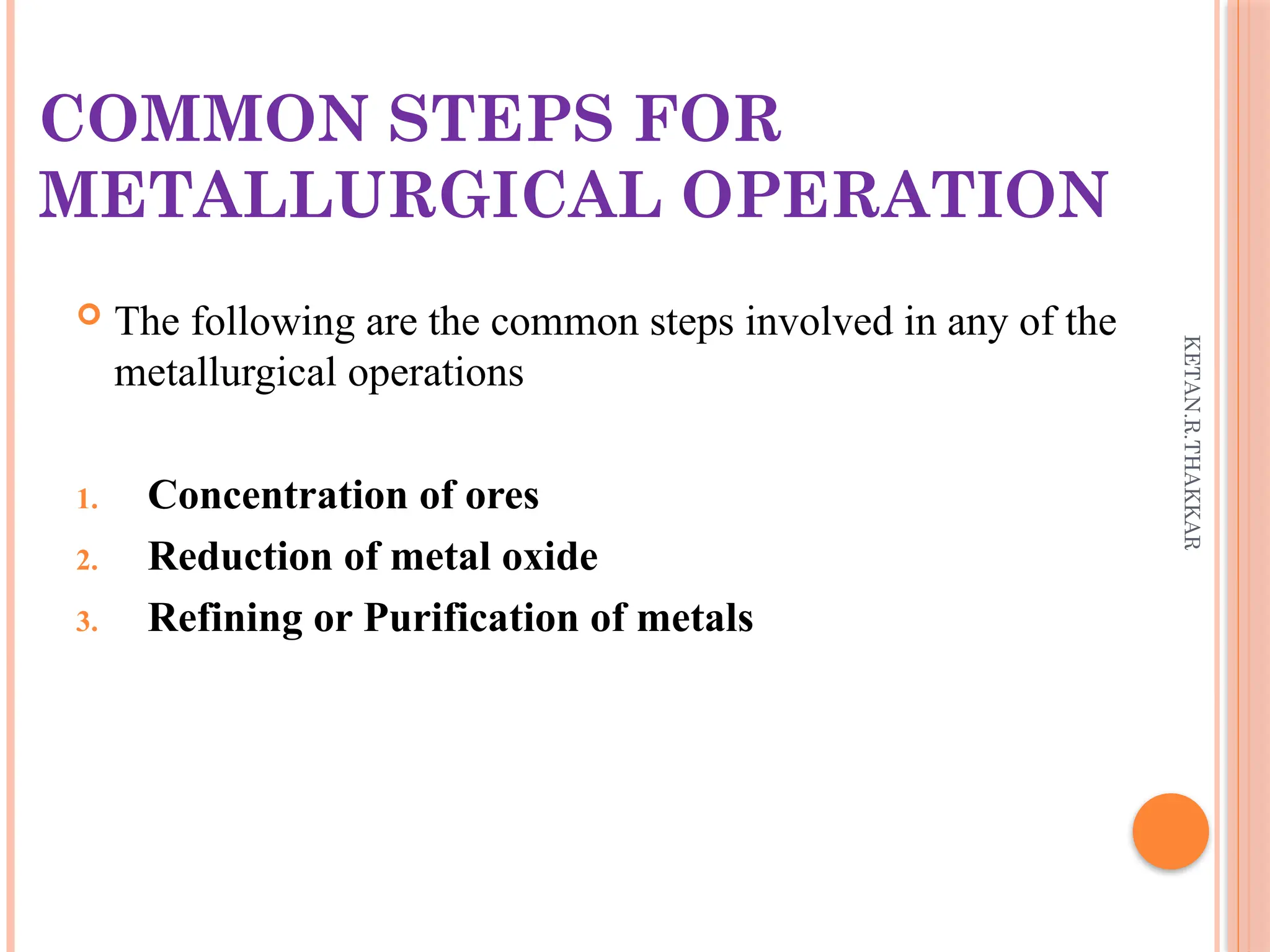
COMMON STEPS FOR
METALLURGICALOPERATION
The following are the common steps involved in any of the
metallurgical operations
1. Concentration of ores
2. Reduction of metal oxide
3. Refining or Purification of metals
5.
KETAN.R.THAKKAR
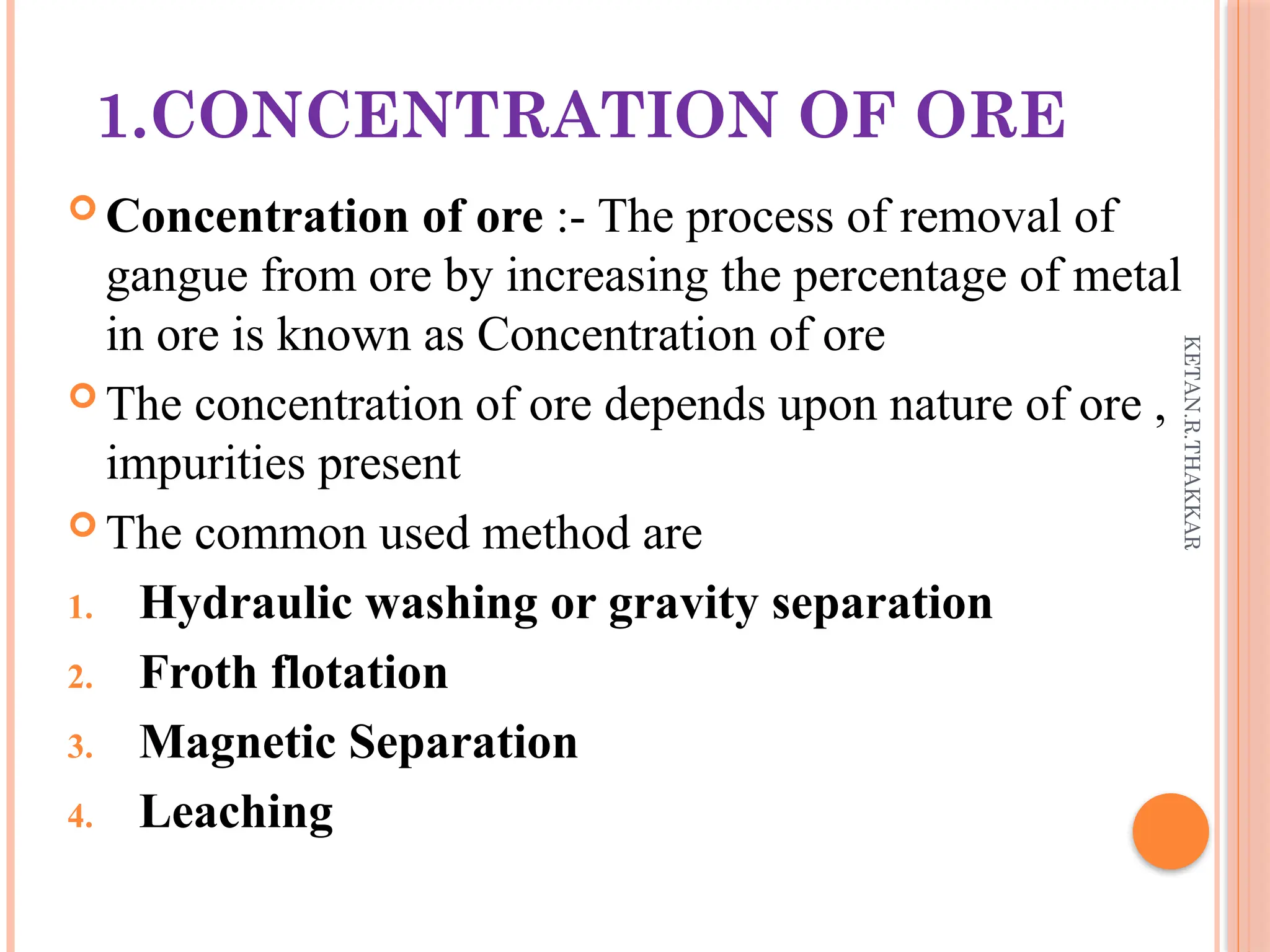
1.CONCENTRATION OF ORE
Concentration of ore :- The process of removal of
gangue from ore by increasing the percentage of metal
in ore is known as Concentration of ore
The concentration of ore depends upon nature of ore ,
impurities present
The common used method are
1. Hydraulic washing or gravity separation
2. Froth flotation
3. Magnetic Separation
4. Leaching
6.
KETAN.R.THAKKAR
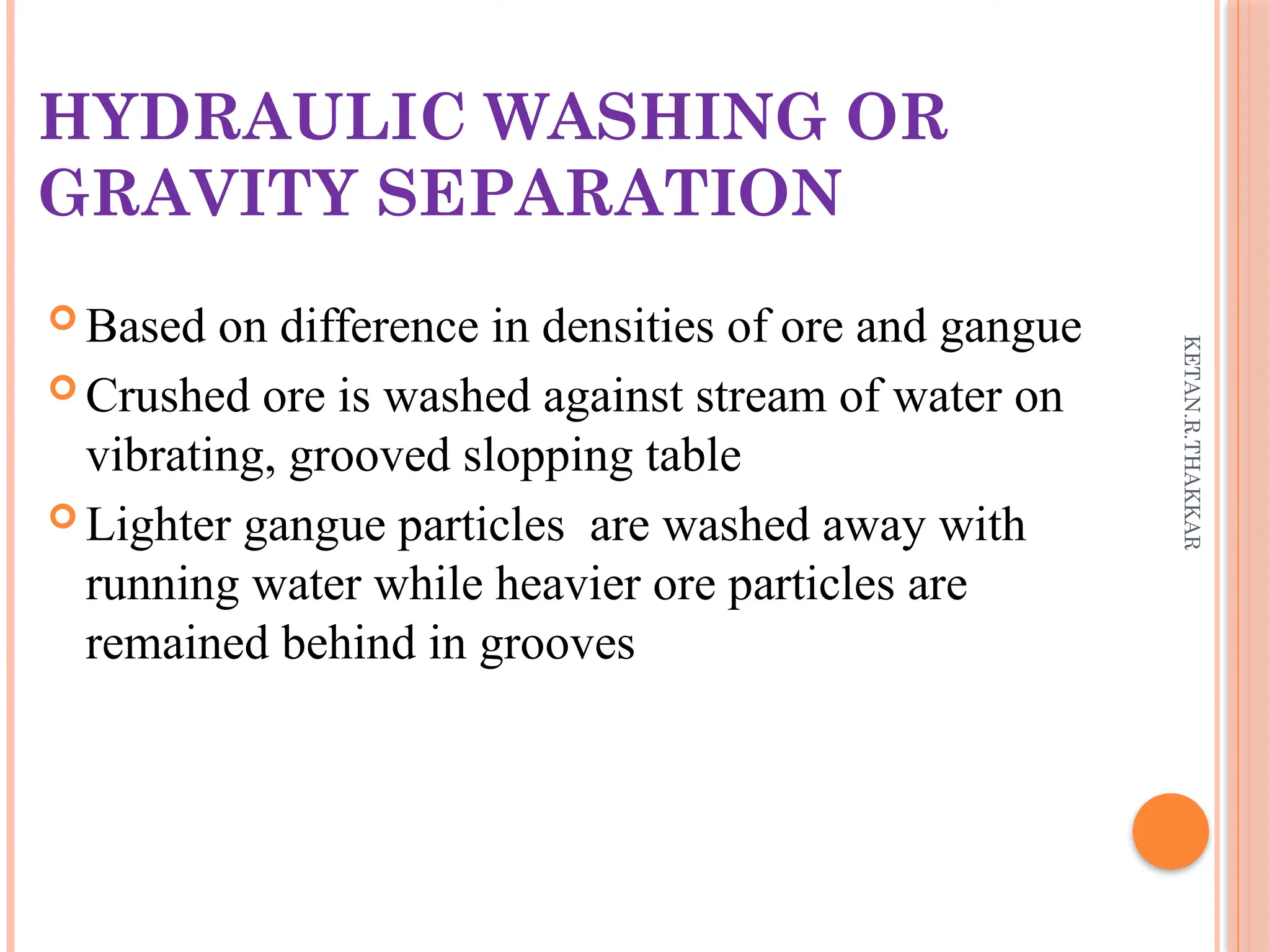
HYDRAULIC WASHING OR
GRAVITYSEPARATION
Based on difference in densities of ore and gangue
Crushed ore is washed against stream of water on
vibrating, grooved slopping table
Lighter gangue particles are washed away with
running water while heavier ore particles are
remained behind in grooves
7.
KETAN.R.THAKKAR
FROTH FLOATION
Basedon difference in wetting properties of ore and
gangue particles
Ore wetted by oil and gangue wetted by water
Powdered ore + pine oil + water+ ethyl xanthate is
taken in container and agitated against with air
Ore wetted with oil forms a froth can be skimmed of
leaving gangue in container at bottom
8.
KETAN.R.THAKKAR
MAGNETIC SEPARTION
Basedon the ability of either ore or gangue to get
attracted towards magnet
Powdered ore is passed over the conveyer belt attached
with electromagnet
Nonmagnetic substance will fall down under the
influence of gravity and forms separate heap
Magnetic substance which attracted by magnet forms a
separate heap
9.
KETAN.R.THAKKAR
LEACHING
It isa method of converting the metal into its soluble
salt by treating the concentrated ore with a solution of
suitable chemical .This leaves behind the insoluble
impurities.
The bauxite ore containing iron oxide as a impurities
is leached with 45% NaOH .Al2O3 goes into the
solution forming soluble sodium aluminate while
impurities are left behind
Al2O3 +2NaOH 2NaAlO2 +3H2O
The solution is filtered to remove insoluble impurities
.The filtrate is seeded with freshly precipitated
Al(OH)3 when most of metal is precipitated as
Al(OH)3 which is dried and heated to form Al2O3
10.
KETAN.R.THAKKAR
DIFFRENCE BETWEEN
CALCINATION ANDROASTING
The process of
conversion of
carbonate ore into its
oxide
The process is carried
out in absence of air
In this CO2 is given
out
The process of
conversion of
sulphide ore into its
oxide
The process is carried
out in presence of air
In this SO2 is given
out
CALCINATION ROASTING
11.
KETAN.R.THAKKAR
2.REDUCTION OF METALOXIDE
The method of reduction depends upon the position
of metal in reactivity series.
The common method employed are
1. Use of reducing agent like coke or carbon
monoxide
2. By electrolysis
3. By heating alone
12.
KETAN.R.THAKKAR
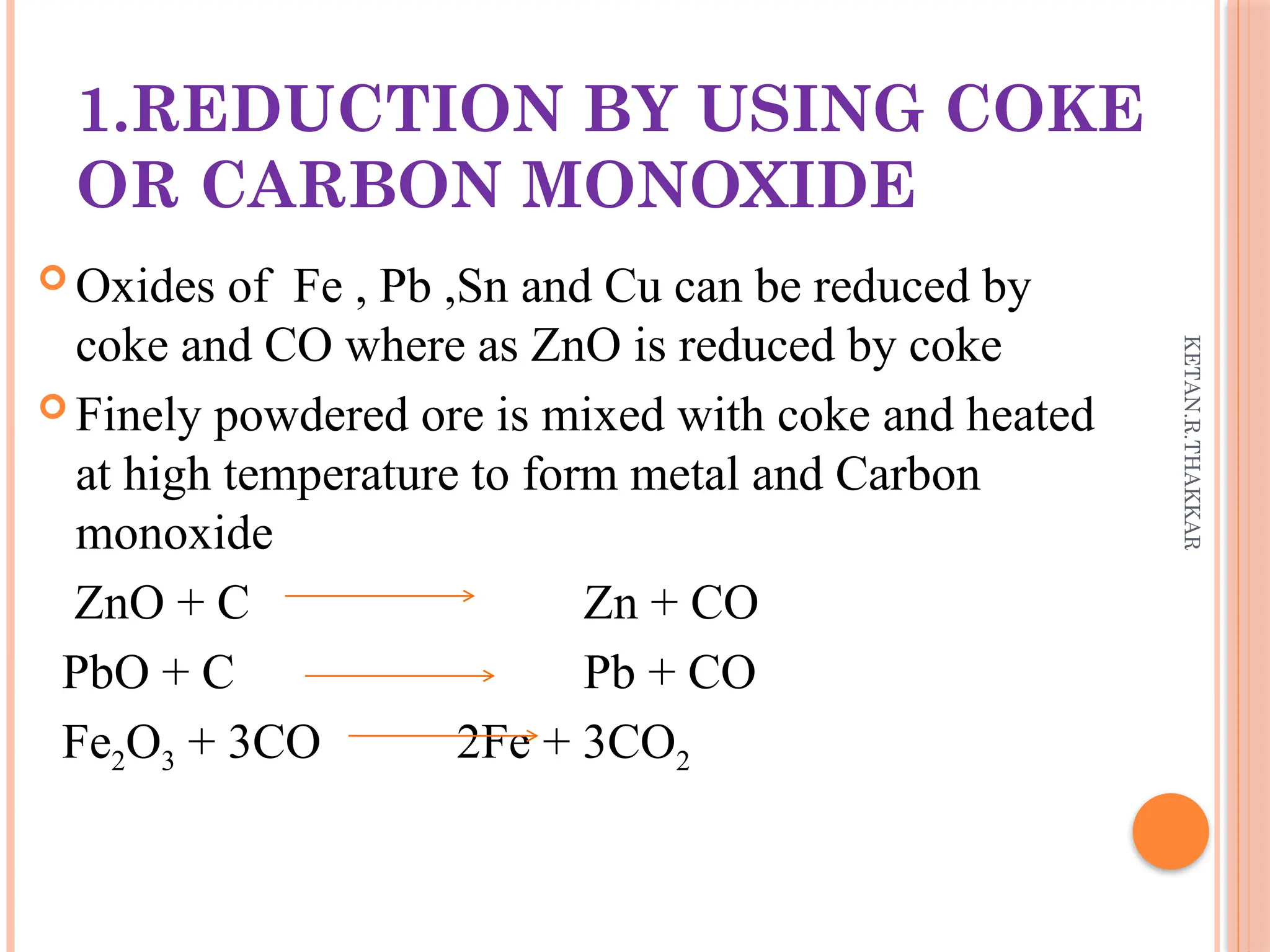
1.REDUCTION BY USINGCOKE
OR CARBON MONOXIDE
Oxides of Fe , Pb ,Sn and Cu can be reduced by
coke and CO where as ZnO is reduced by coke
Finely powdered ore is mixed with coke and heated
at high temperature to form metal and Carbon
monoxide
ZnO + C Zn + CO
PbO + C Pb + CO
Fe2O3 + 3CO 2Fe + 3CO2
13.
KETAN.R.THAKKAR
ALUMINOTHERMY
Oxides ofcertain metals like Cr, Mn are not easily
reduced by CO .In such cases Al which is more
electropositive than Cr, Mn is used as reducing
agent. This process is known as Aluminothermy
It is carried out in fire clay crucible Here the charge
is a mixture of metal oxide and Al powder.
This is ignited with the help of Mg wire embedded
in Mg powder and BaO2 mixture. The reaction is
highly exothermic and heat produced is sufficient to
melt the metal
14.
KETAN.R.THAKKAR
ELECTROLYTIC REDUCTION
Thismethod is employed in extraction of highly
reactive metals like Na,K,Ca,Mg and Al
These metals cannot be obtained by reduction of
their oxide as librated metal can combine with
carbon at high temperature to form the carbide.
Thus this metal are obtained by electrolysis of
their fused salts using suitable electrode
15.
KETAN.R.THAKKAR
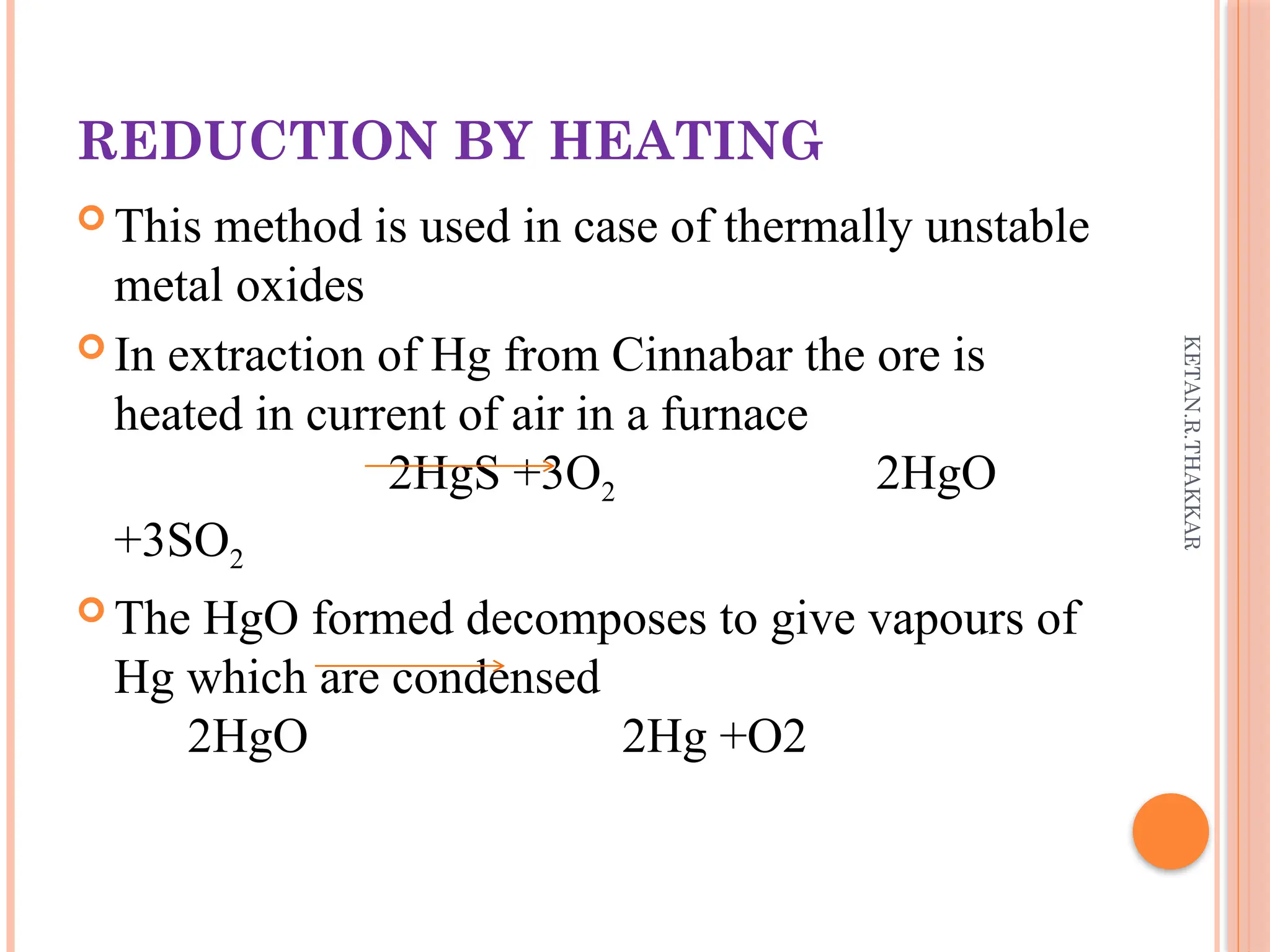
REDUCTION BY HEATING
This method is used in case of thermally unstable
metal oxides
In extraction of Hg from Cinnabar the ore is
heated in current of air in a furnace
2HgS +3O2 2HgO
+3SO2
The HgO formed decomposes to give vapours of
Hg which are condensed
2HgO 2Hg +O2
16.
KETAN.R.THAKKAR
3.PURIFICATION OR REFININGOF METAL
The metals obtained by different reduction process
are associated with some impurities. The method
used for refining an impure metal depends upon the
following
1.Nature of metal
2.Nature of impurities
3.Purpose for which metal is to be used
The common methods employed are distillation,
Oxidation, Liquation, Poling, Electrolytic refining
17.
KETAN.R.THAKKAR
1.DISTILLATION
This methodis used for metals like Zn, Cd,Hg
which vaporizes easily
In this method the impure metal is heated in a
vessel
The metals forms vapors which are condensed
separately in a receiver. The non volatile
impurities are left behind in the first vessel
18.
KETAN.R.THAKKAR
OXIDATION METHOD
Thismethod is employed where the impurities
can be oxidised more easily than the metal
itself
Air is passed through molten metal which
oxidizes impurities like C,P and As etc to their
volatile oxides which are then removed .The
pure metal is left behind.
19.
KETAN.R.THAKKAR
LIQUATION
This methodis used for metals having low melting
points like Sn and Pb.
The impure metal is placed on the sloping hearth
of a furnace and heated gently
The metal melts and flows down leaving behind
the impurities on the hearth of furnace
20.
KETAN.R.THAKKAR
ELECTROLYTIC REFINING
Theblock of impure metal is made as anode and
pure metal rod is made as cathode
Aqueous solution of of some salt solution of metal is
used
On passing electric current the metal ions from
electrolyte is deposited at cathode in the form of pure
metal
On other hand an equivalent amount of of metal
dissolves from anode and goes into electrolyte in the
form of metal ions
The impurities either go to the solution or settle near
anode as anode mud
21.
KETAN.R.THAKKAR
EXTRACTION OF ALUMINIUM
Aluminiumis extracted from Bauxite
[Al2O3*2H2O] ore.
The extraction takes place in two steps
1. Purification of Bauxite to form Alumina
2. Electrolytic reduction of alumina to get
Aluminium.
22.
KETAN.R.THAKKAR
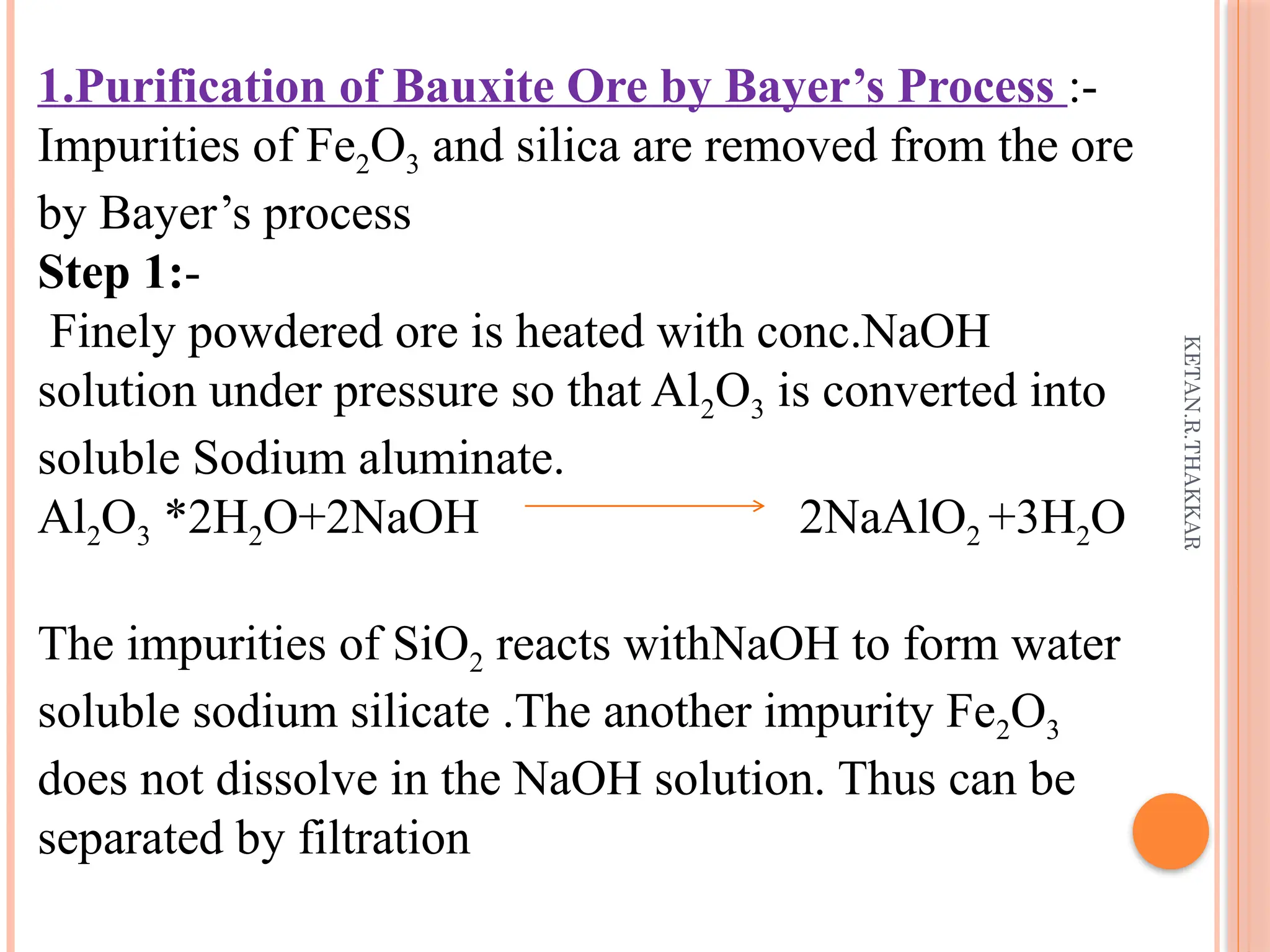
1.Purification of BauxiteOre by Bayer’s Process :-
Impurities of Fe2O3 and silica are removed from the ore
by Bayer’s process
Step 1:-
Finely powdered ore is heated with conc.NaOH
solution under pressure so that Al2O3 is converted into
soluble Sodium aluminate.
Al2O3 *2H2O+2NaOH 2NaAlO2 +3H2O
The impurities of SiO2 reacts withNaOH to form water
soluble sodium silicate .The another impurity Fe2O3
does not dissolve in the NaOH solution. Thus can be
separated by filtration
23.
KETAN.R.THAKKAR
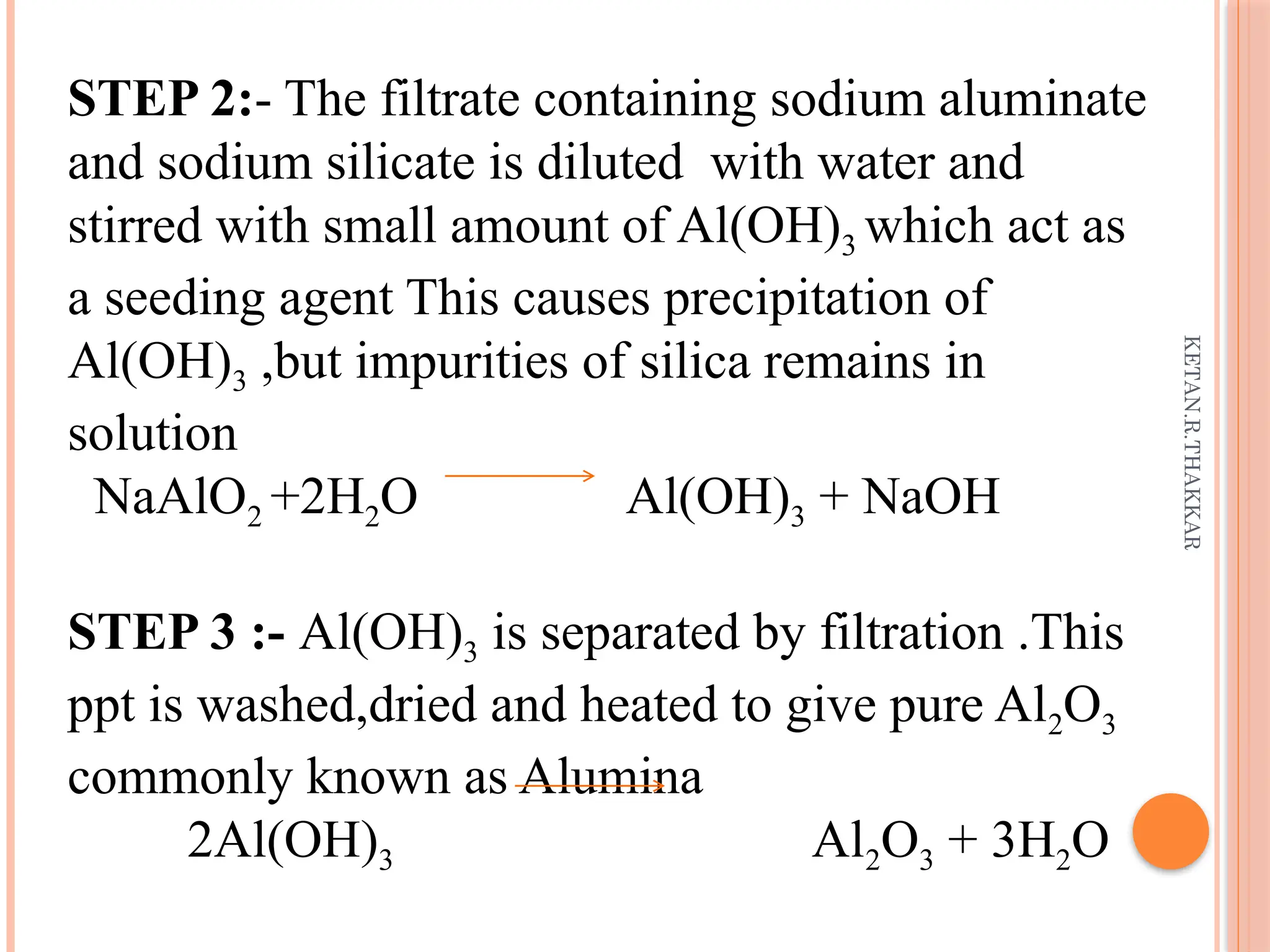
STEP 2:- Thefiltrate containing sodium aluminate
and sodium silicate is diluted with water and
stirred with small amount of Al(OH)3 which act as
a seeding agent This causes precipitation of
Al(OH)3 ,but impurities of silica remains in
solution
NaAlO2 +2H2O Al(OH)3 + NaOH
STEP 3 :- Al(OH)3 is separated by filtration .This
ppt is washed,dried and heated to give pure Al2O3
commonly known as Alumina
2Al(OH)3 Al2O3 + 3H2O
24.
KETAN.R.THAKKAR
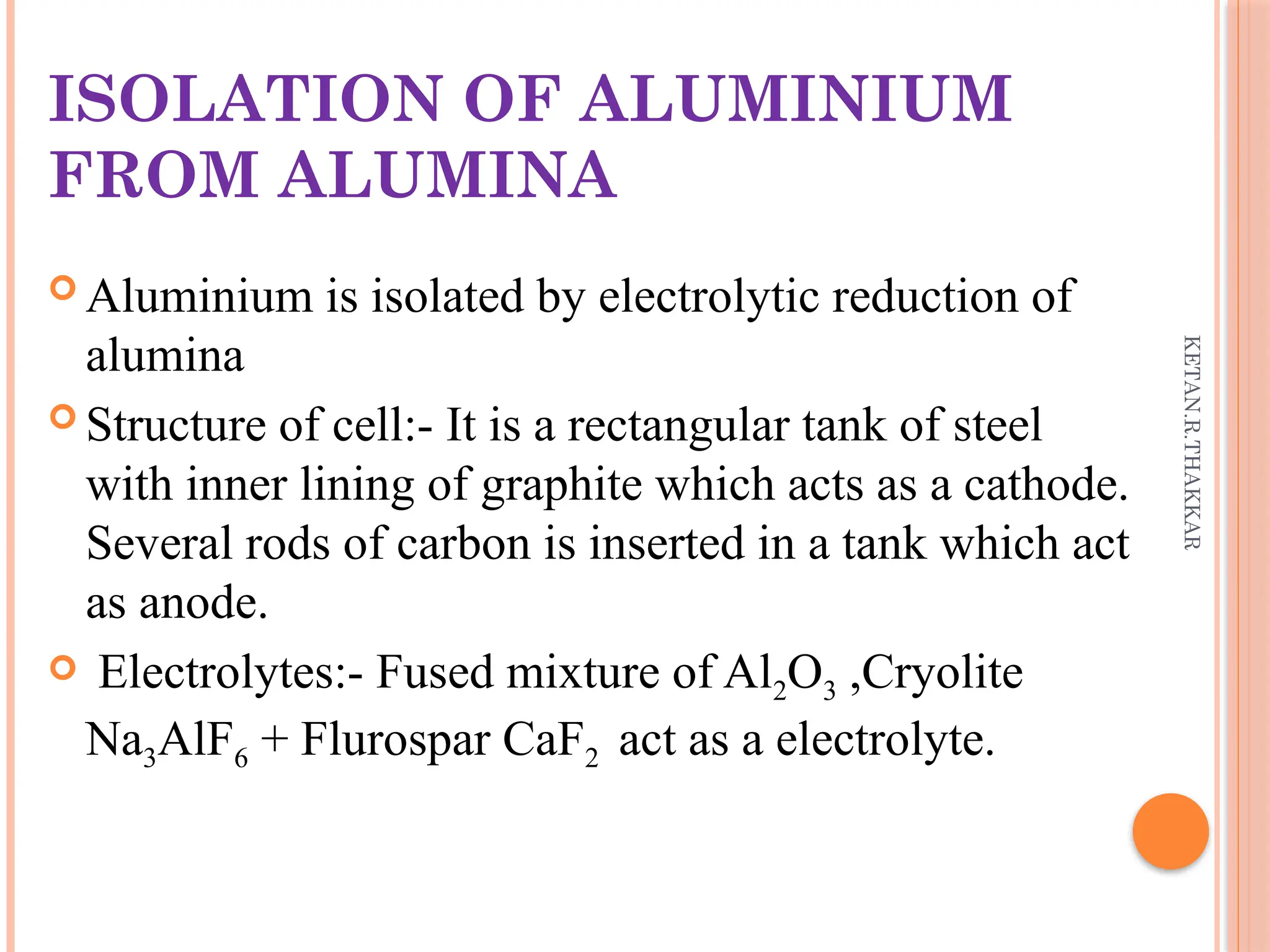
ISOLATION OF ALUMINIUM
FROMALUMINA
Aluminium is isolated by electrolytic reduction of
alumina
Structure of cell:- It is a rectangular tank of steel
with inner lining of graphite which acts as a cathode.
Several rods of carbon is inserted in a tank which act
as anode.
Electrolytes:- Fused mixture of Al2O3 ,Cryolite
Na3AlF6 + Flurospar CaF2 act as a electrolyte.
25.
KETAN.R.THAKKAR
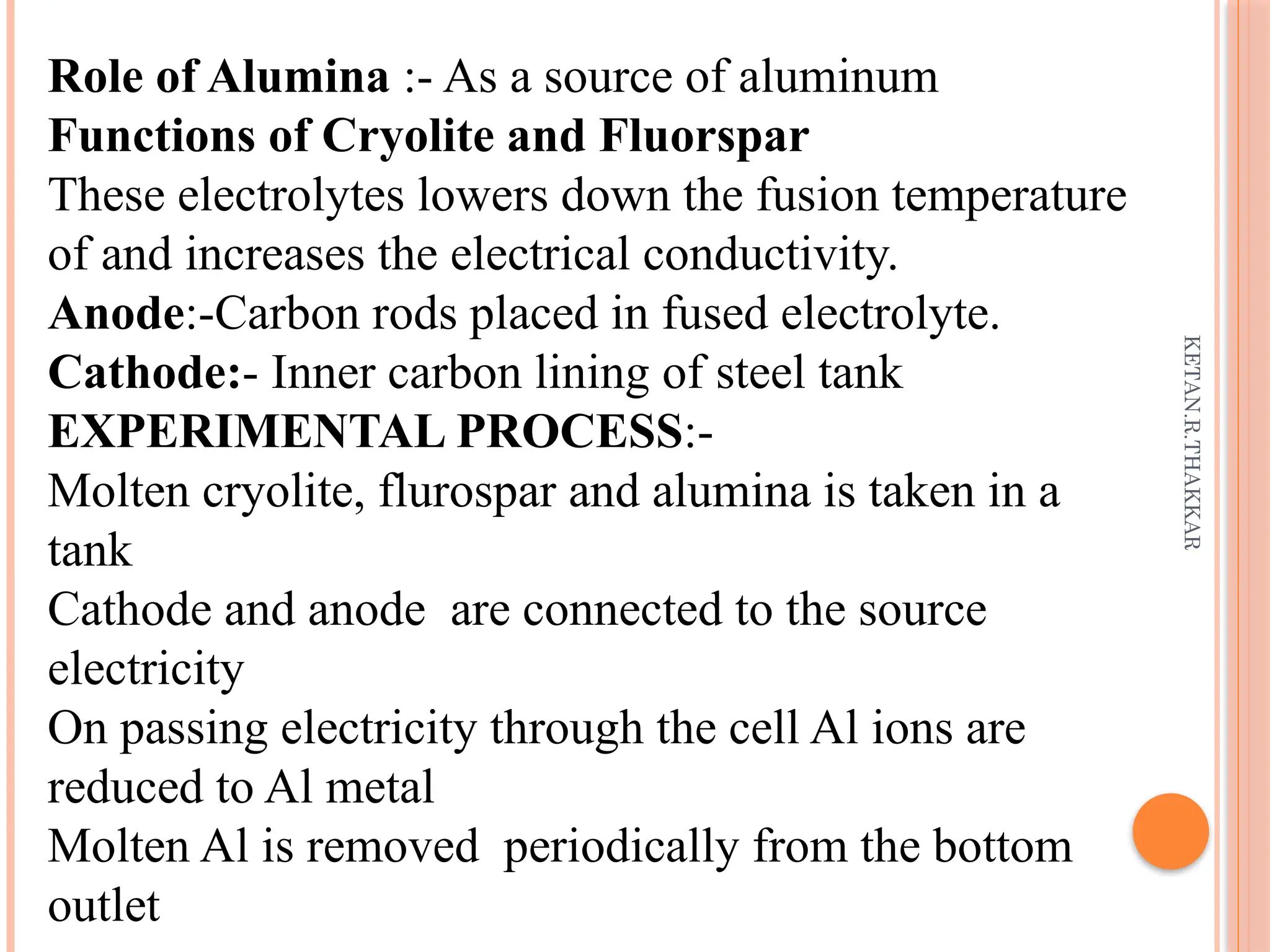
Role of Alumina:- As a source of aluminum
Functions of Cryolite and Fluorspar
These electrolytes lowers down the fusion temperature
of and increases the electrical conductivity.
Anode:-Carbon rods placed in fused electrolyte.
Cathode:- Inner carbon lining of steel tank
EXPERIMENTAL PROCESS:-
Molten cryolite, flurospar and alumina is taken in a
tank
Cathode and anode are connected to the source
electricity
On passing electricity through the cell Al ions are
reduced to Al metal
Molten Al is removed periodically from the bottom
outlet
26.
KETAN.R.THAKKAR
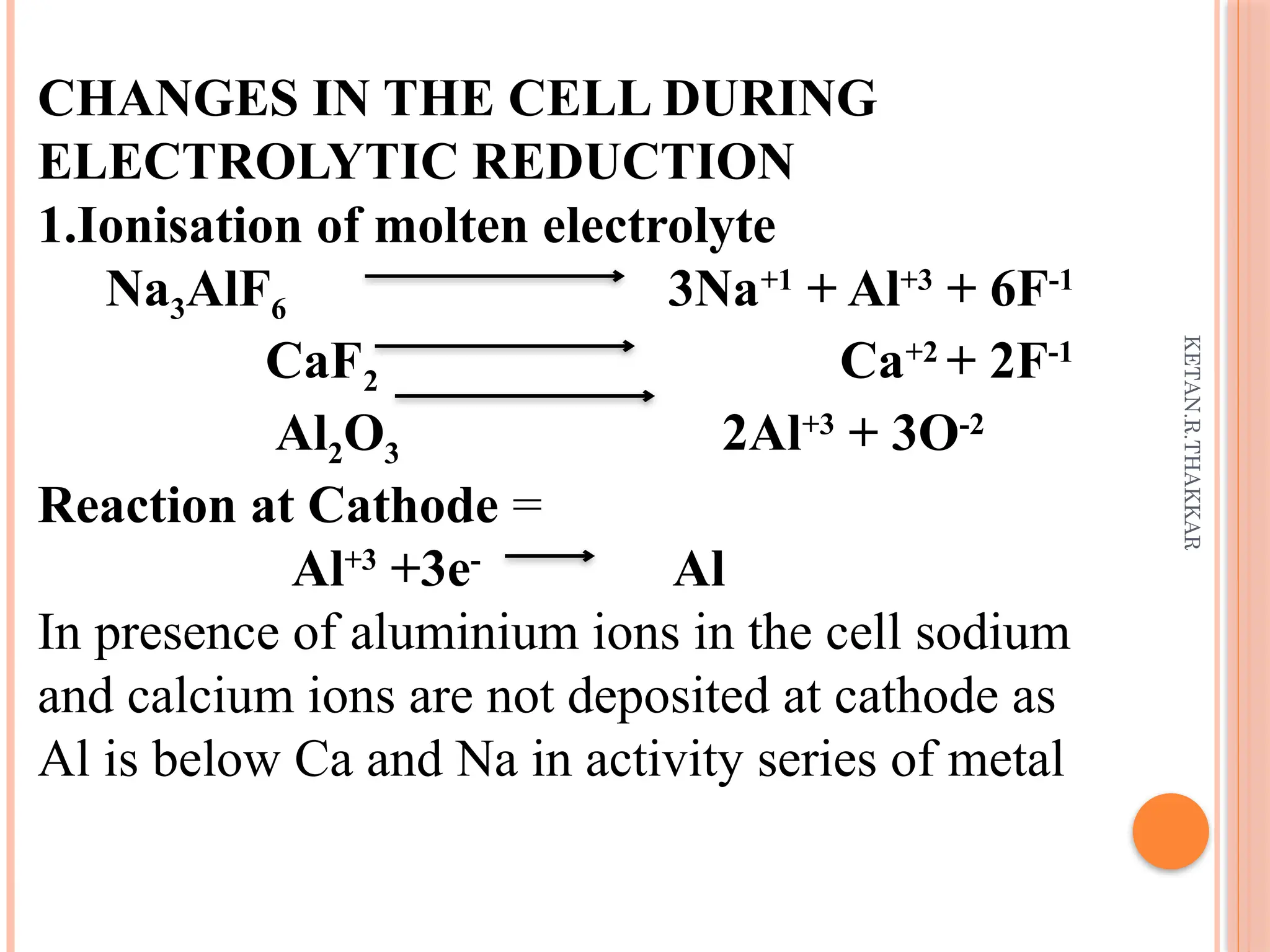
CHANGES IN THECELL DURING
ELECTROLYTIC REDUCTION
1.Ionisation of molten electrolyte
Na3AlF6 3Na+1
+ Al+3
+ 6F-1
CaF2 Ca+2
+ 2F-1
Al2O3 2Al+3
+ 3O-2
Reaction at Cathode =
Al+3
+3e-
Al
In presence of aluminium ions in the cell sodium
and calcium ions are not deposited at cathode as
Al is below Ca and Na in activity series of metal
27.
KETAN.R.THAKKAR
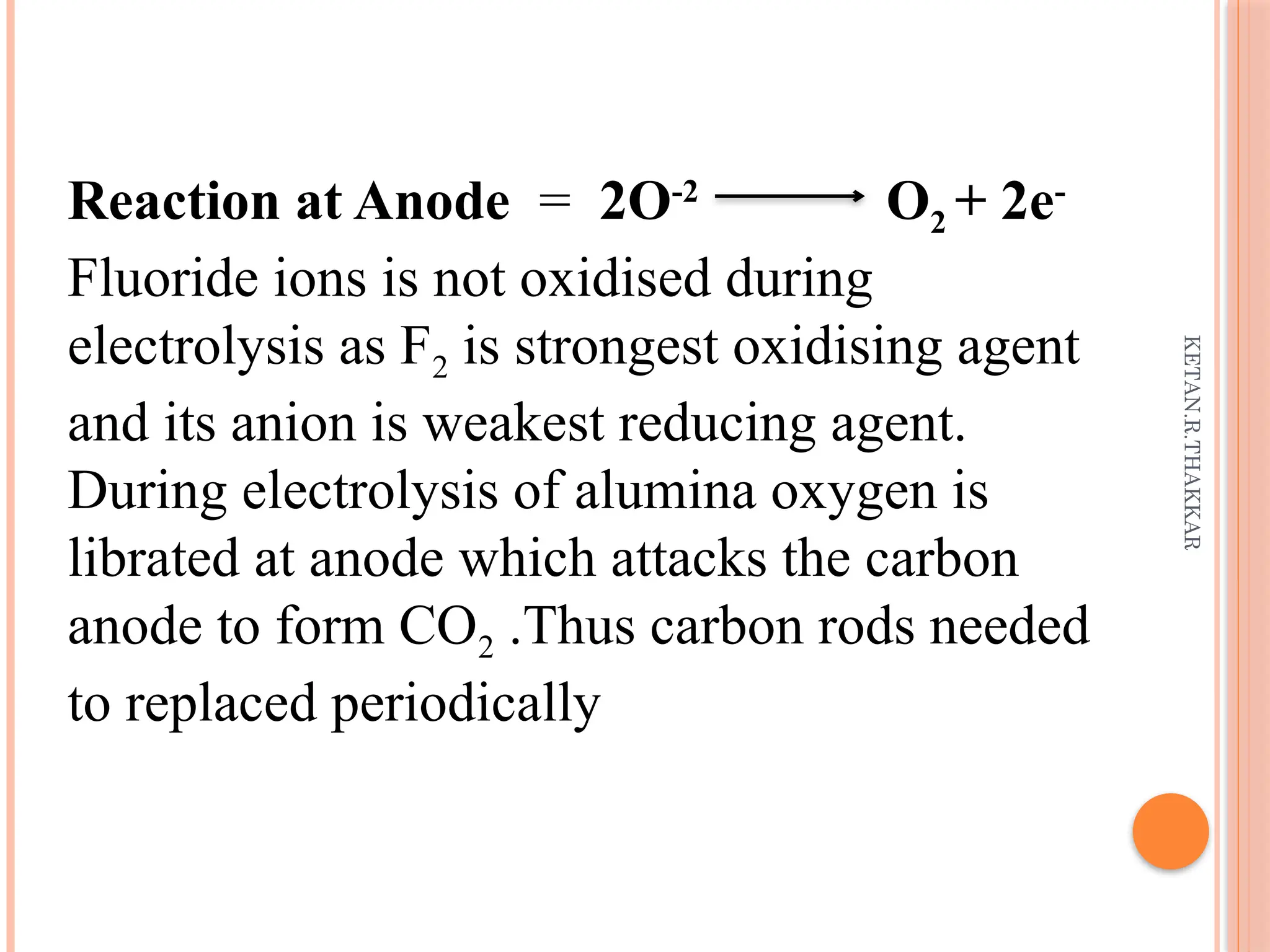
Reaction at Anode= 2O-2
O2 + 2e-
Fluoride ions is not oxidised during
electrolysis as F2 is strongest oxidising agent
and its anion is weakest reducing agent.
During electrolysis of alumina oxygen is
librated at anode which attacks the carbon
anode to form CO2 .Thus carbon rods needed
to replaced periodically
![KETAN.R.THAKKAR
EXTRACTION OF ALUMINIUM
Aluminium is extracted from Bauxite
[Al2O3*2H2O] ore.
The extraction takes place in two steps
1. Purification of Bauxite to form Alumina
2. Electrolytic reduction of alumina to get
Aluminium.](https://image.slidesharecdn.com/6-250524115245-0c8cf0e2/75/6-Metallurgy-pptxSuitable-for-class-12-students-who-read-in-cbse-21-2048.jpg)