
WELDABILITY TESTS
BY:-
ABHISHEK VYAS & RAGHAVENDRA DARJI
GUIDED BY:-
Dr . S.D. KAHAR
19-09-2018
1
CONTENTS
 Introduction to Weld ability
 Weld ability Tests and its Classification
 Importance of Actual Welding Tests
 Fabrication Weld ability Test
 Service Weld ability Test
 References
19-09-20182
INTRODUCTION TO
WELDABILITY
 Weld ability of a material or a combination of materials
to be welded under fabrication conditions into a
specific, suitably designed structure and to perform
satisfactorily in intended service.
 Weld ability compasses the following aspects:-
1. Metallurgical compatibility of materials being welded
2. Mechanical soundness
3. Good serviceability of the welded joint.
19-09-20183
Weld ability Assessment
 Prior to define weld ability three things need to be
decided and they are:-
1) The degree of tolerance that can be allowed for purely
metallurgical defects
2) The degree of tolerance that can be allowed for
operational defects
3) The type of test that would be suitable in circumstances
19-09-20184
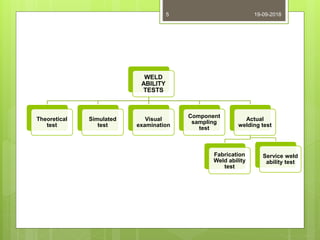
WELD
ABILITY
TESTS
Theoretical
test
Simulated
test
Visual
examination
Component
sampling
test
Actual
welding test
Fabrication
Weld ability
test
Service weld
ability test
19-09-20185
Importance of Actual Welding
Test
 It overcomes the limitation of theoretical tests as theoretical tests do
not take into account all welding variables while calculating weld
ability. Also it doesn’t take into account effect of preheat, electrode
composition, etc.
 It also overcomes the limitation of simulated test as simulated test
does not accounts for residual and reaction stresses, HIC and other
conditions that may be imposed on production welds
 Visual test can’t be used as weld ability defects are often difficult to
see.
19-09-20186
Purposes of Actual Welding Test
 They are used to calibrate the weld ability of
particular grades of individual heats of metals and
alloys. For this purpose the specimen dimensions
and welding conditions are prescribed and fixed to
make the material sample the only variable
 They are used to establish a compatible
combination of base material, filler metal &
welding conditions that will produce welded joints
satisfactory for the application
19-09-20187
Fabrication Welding Test
 The test in this category determines the
susceptibility of the welded joint to cracking and
can be grouped under three headings according
to type of cracking that they produce:-
1)Hot cracking test
2)Cold cracking test
3)Test related to cracks associated with
specific fabrication conditions or structures
19-09-20188
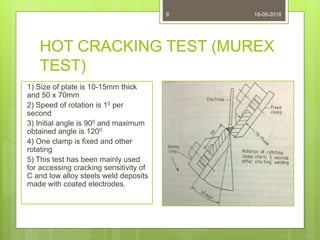
HOT CRACKING TEST (MUREX
TEST)
1) Size of plate is 10-15mm thick
and 50 x 70mm
2) Speed of rotation is 10 per
second
3) Initial angle is 900 and maximum
obtained angle is 1200
4) One clamp is fixed and other
rotating
5) This test has been mainly used
for accessing cracking sensitivity of
C and low alloy steels weld deposits
made with coated electrodes.
19-09-20189
COLD CRACKING TEST
(LEHIGH RESTRAINT TEST
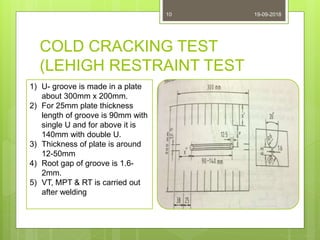
1) U- groove is made in a plate
about 300mm x 200mm.
2) For 25mm plate thickness
length of groove is 90mm with
single U and for above it is
140mm with double U.
3) Thickness of plate is around
12-50mm
4) Root gap of groove is 1.6-
2mm.
5) VT, MPT & RT is carried out
after welding
19-09-201810
Lehigh Restraint Test
 Steels with 0.3% C cracks occur practically
exclusively in the weld metal but may be
initiated in the root or upper part whereas the
crack sensitive higher C and alloy steels show
cracking in HAZ.
 This test is recommended for selection of
electrodes for use with Arc welding Processes
19-09-201811
Test for Specific Types of
Cracking
 Various types of cracks categorised have distinct
characteristics and thus specially designed cracks are there
for them and they are as follows:-
 Lamellar Tearing and
 Reheat Cracking
19-09-201812
Lamellar Tearing
 Through thickness Ductility test,
 The cranfield test,
 Lehigh cantilever lamellar tearing test,
 The window test,
 The H test,
 The Brodeau test,
 The notched tensile strength test.
19-09-201813
Reheat Cracking:
 Vinckier test,
 Compact Tension test,
 Hot tensile test.
19-09-201814
Service Weld ability test
 Tensile test,
 Bend Test,
 Impact test,
 Hardness Test,
 Fracture toughness test,
 Fatigue test,
 Corrosion test,
 Creep Test.
19-09-201815
References
 R.S.Parmar, Welding Engineering and
Technology, Page no:431-499.
 Joint Design, Testing and Inspection by
Edward R. Bohnart.
 Other Internet papers.
19-09-201816

Weldability tests

  • 1.
    WELDABILITY TESTS BY:- ABHISHEK VYAS& RAGHAVENDRA DARJI GUIDED BY:- Dr . S.D. KAHAR 19-09-2018 1
  • 2.
    CONTENTS  Introduction toWeld ability  Weld ability Tests and its Classification  Importance of Actual Welding Tests  Fabrication Weld ability Test  Service Weld ability Test  References 19-09-20182
  • 3.
    INTRODUCTION TO WELDABILITY  Weldability of a material or a combination of materials to be welded under fabrication conditions into a specific, suitably designed structure and to perform satisfactorily in intended service.  Weld ability compasses the following aspects:- 1. Metallurgical compatibility of materials being welded 2. Mechanical soundness 3. Good serviceability of the welded joint. 19-09-20183
  • 4.
    Weld ability Assessment Prior to define weld ability three things need to be decided and they are:- 1) The degree of tolerance that can be allowed for purely metallurgical defects 2) The degree of tolerance that can be allowed for operational defects 3) The type of test that would be suitable in circumstances 19-09-20184
  • 5.
  • 6.
    Importance of ActualWelding Test  It overcomes the limitation of theoretical tests as theoretical tests do not take into account all welding variables while calculating weld ability. Also it doesn’t take into account effect of preheat, electrode composition, etc.  It also overcomes the limitation of simulated test as simulated test does not accounts for residual and reaction stresses, HIC and other conditions that may be imposed on production welds  Visual test can’t be used as weld ability defects are often difficult to see. 19-09-20186
  • 7.
    Purposes of ActualWelding Test  They are used to calibrate the weld ability of particular grades of individual heats of metals and alloys. For this purpose the specimen dimensions and welding conditions are prescribed and fixed to make the material sample the only variable  They are used to establish a compatible combination of base material, filler metal & welding conditions that will produce welded joints satisfactory for the application 19-09-20187
  • 8.
    Fabrication Welding Test The test in this category determines the susceptibility of the welded joint to cracking and can be grouped under three headings according to type of cracking that they produce:- 1)Hot cracking test 2)Cold cracking test 3)Test related to cracks associated with specific fabrication conditions or structures 19-09-20188
  • 9.
    HOT CRACKING TEST(MUREX TEST) 1) Size of plate is 10-15mm thick and 50 x 70mm 2) Speed of rotation is 10 per second 3) Initial angle is 900 and maximum obtained angle is 1200 4) One clamp is fixed and other rotating 5) This test has been mainly used for accessing cracking sensitivity of C and low alloy steels weld deposits made with coated electrodes. 19-09-20189
  • 10.
    COLD CRACKING TEST (LEHIGHRESTRAINT TEST 1) U- groove is made in a plate about 300mm x 200mm. 2) For 25mm plate thickness length of groove is 90mm with single U and for above it is 140mm with double U. 3) Thickness of plate is around 12-50mm 4) Root gap of groove is 1.6- 2mm. 5) VT, MPT & RT is carried out after welding 19-09-201810
  • 11.
    Lehigh Restraint Test Steels with 0.3% C cracks occur practically exclusively in the weld metal but may be initiated in the root or upper part whereas the crack sensitive higher C and alloy steels show cracking in HAZ.  This test is recommended for selection of electrodes for use with Arc welding Processes 19-09-201811
  • 12.
    Test for SpecificTypes of Cracking  Various types of cracks categorised have distinct characteristics and thus specially designed cracks are there for them and they are as follows:-  Lamellar Tearing and  Reheat Cracking 19-09-201812
  • 13.
    Lamellar Tearing  Throughthickness Ductility test,  The cranfield test,  Lehigh cantilever lamellar tearing test,  The window test,  The H test,  The Brodeau test,  The notched tensile strength test. 19-09-201813
  • 14.
    Reheat Cracking:  Vinckiertest,  Compact Tension test,  Hot tensile test. 19-09-201814
  • 15.
    Service Weld abilitytest  Tensile test,  Bend Test,  Impact test,  Hardness Test,  Fracture toughness test,  Fatigue test,  Corrosion test,  Creep Test. 19-09-201815
  • 16.
    References  R.S.Parmar, WeldingEngineering and Technology, Page no:431-499.  Joint Design, Testing and Inspection by Edward R. Bohnart.  Other Internet papers. 19-09-201816