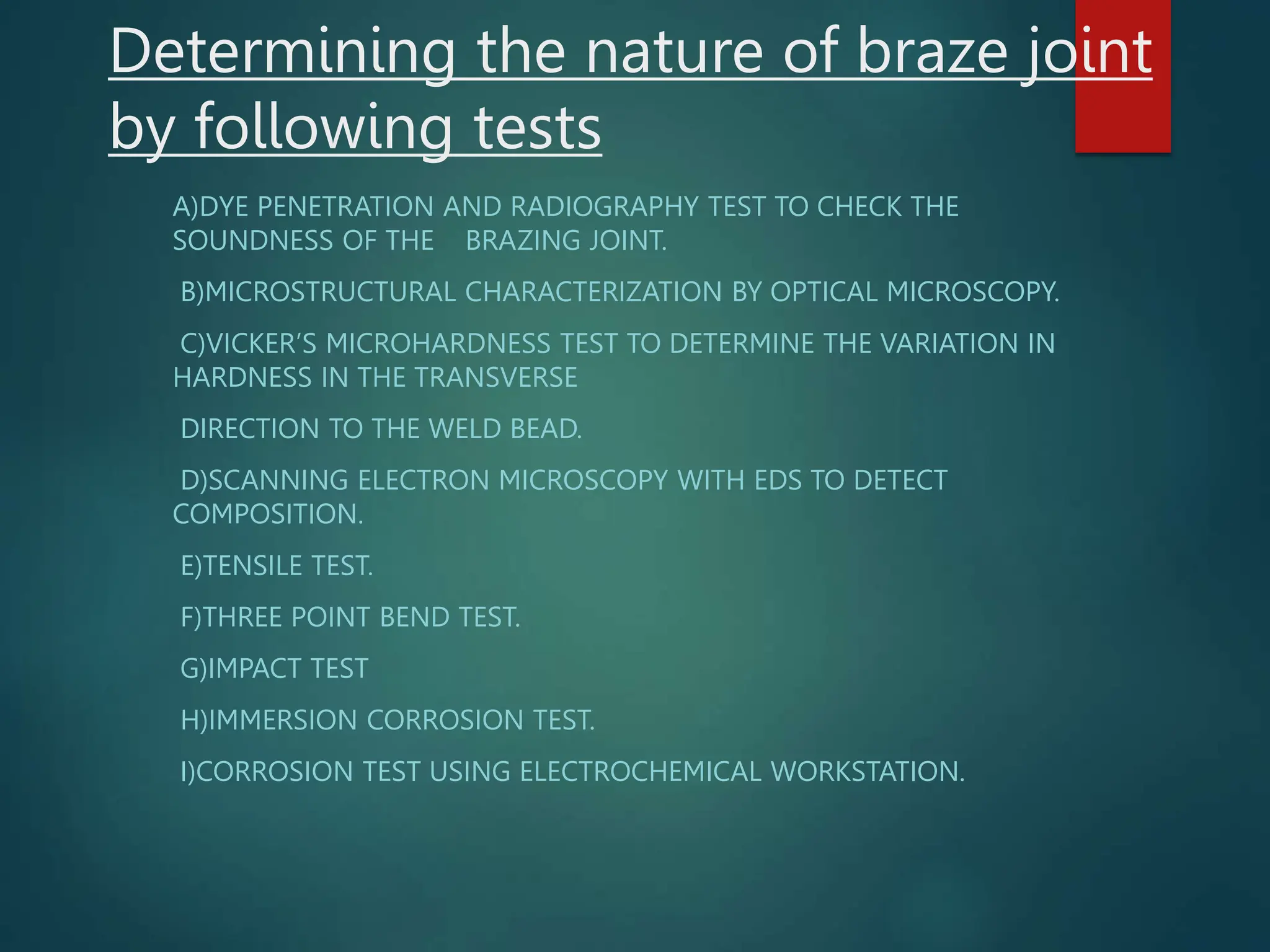
Determining the nature of braze joint
by following tests
A)DYE PENETRATION AND RADIOGRAPHY TEST TO CHECK THE
SOUNDNESS OF THE BRAZING JOINT.
B)MICROSTRUCTURAL CHARACTERIZATION BY OPTICAL MICROSCOPY.
C)VICKER’S MICROHARDNESS TEST TO DETERMINE THE VARIATION IN
HARDNESS IN THE TRANSVERSE
DIRECTION TO THE WELD BEAD.
D)SCANNING ELECTRON MICROSCOPY WITH EDS TO DETECT
COMPOSITION.
E)TENSILE TEST.
F)THREE POINT BEND TEST.
G)IMPACT TEST
H)IMMERSION CORROSION TEST.
I)CORROSION TEST USING ELECTROCHEMICAL WORKSTATION.
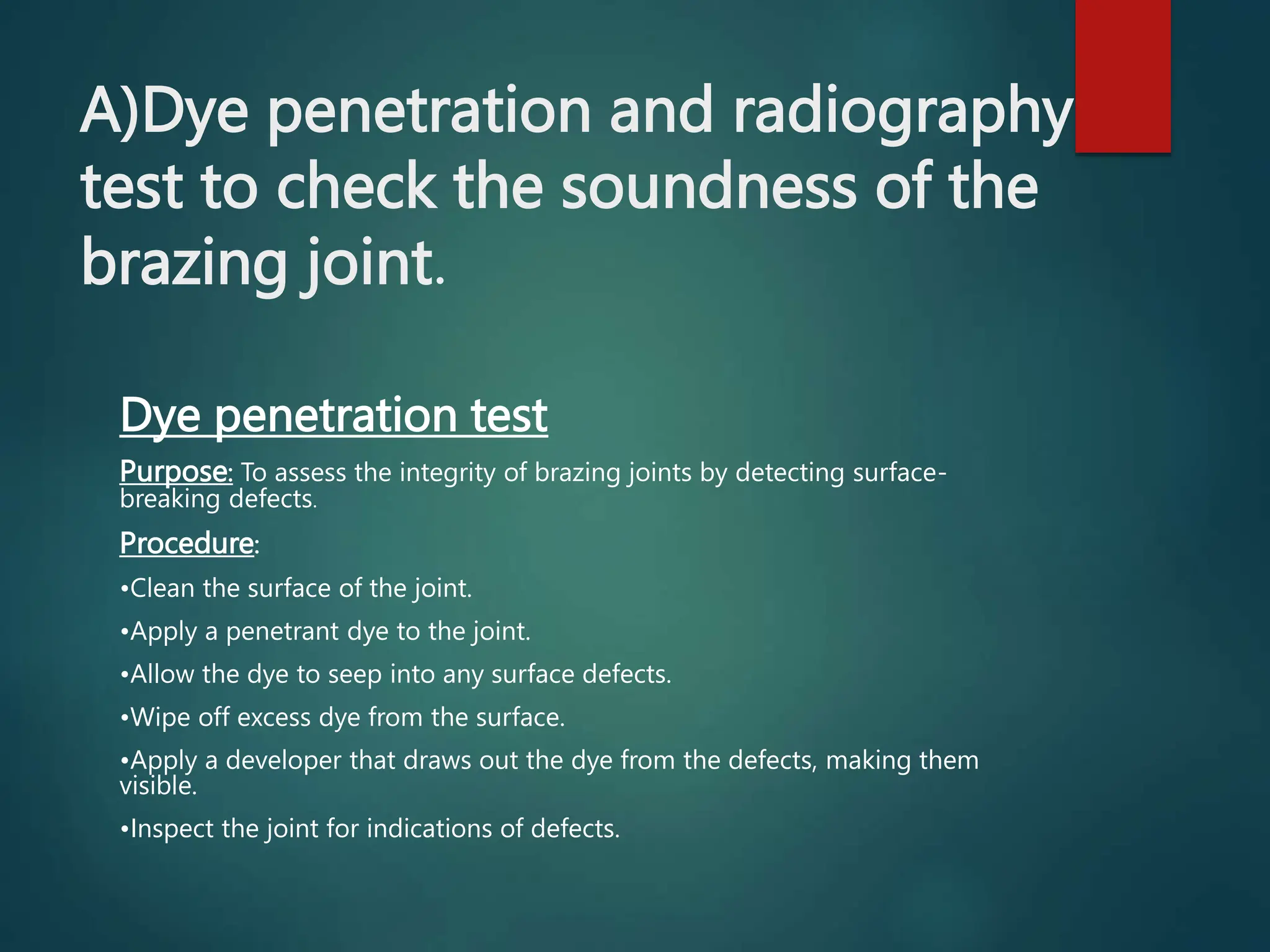
A)Dye penetration and radiography
test to check the soundness of the
brazing joint.
Dye penetration test
Purpose: To assess the integrity of brazing joints by detecting surface-
breaking defects.
Procedure:
•Clean the surface of the joint.
•Apply a penetrant dye to the joint.
•Allow the dye to seep into any surface defects.
•Wipe off excess dye from the surface.
•Apply a developer that draws out the dye from the defects, making them
visible.
•Inspect the joint for indications of defects.
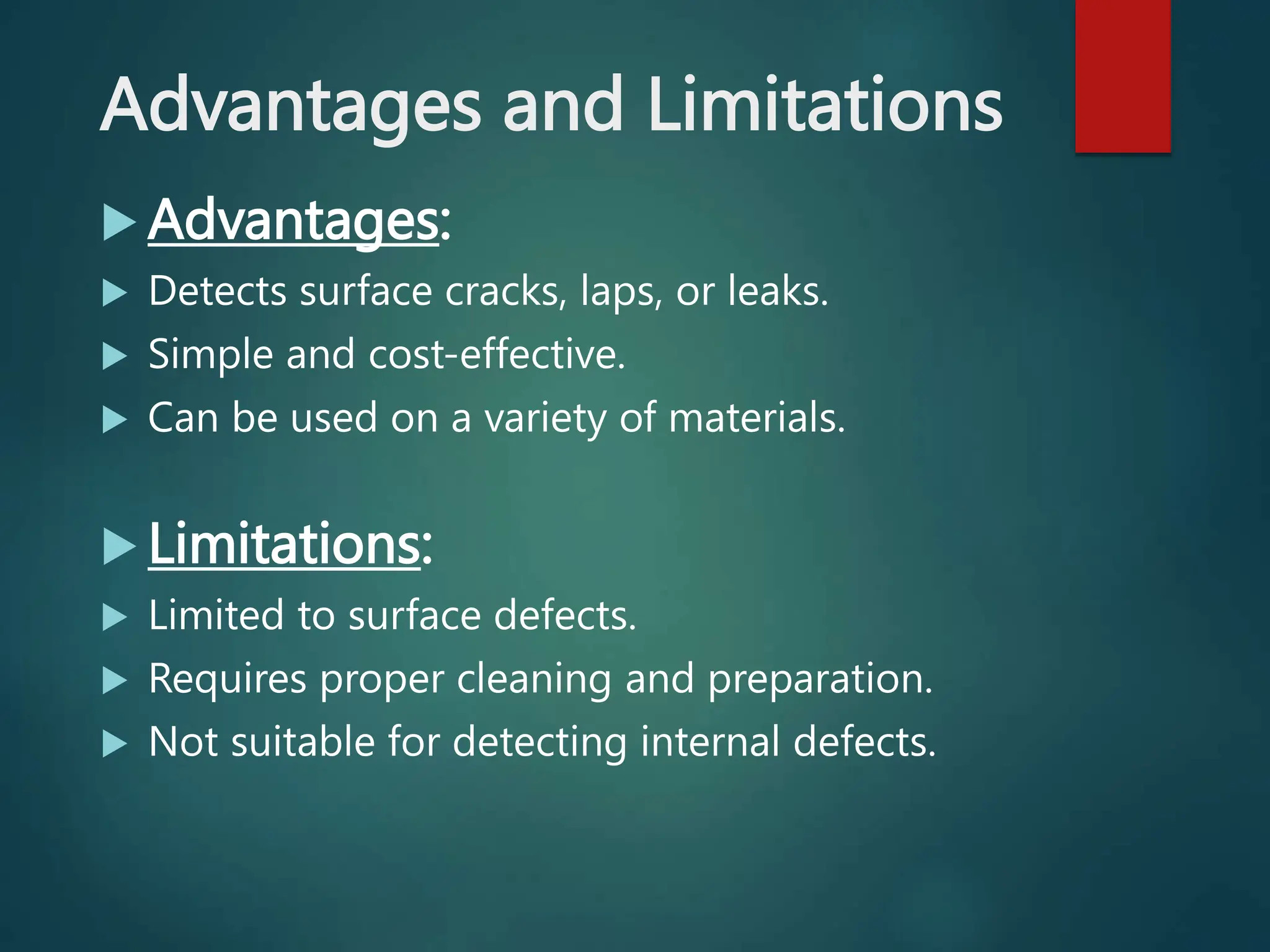
Advantages and Limitations
 Advantages:
 Detects surface cracks, laps, or leaks.
 Simple and cost-effective.
 Can be used on a variety of materials.
 Limitations:
 Limited to surface defects.
 Requires proper cleaning and preparation.
 Not suitable for detecting internal defects.
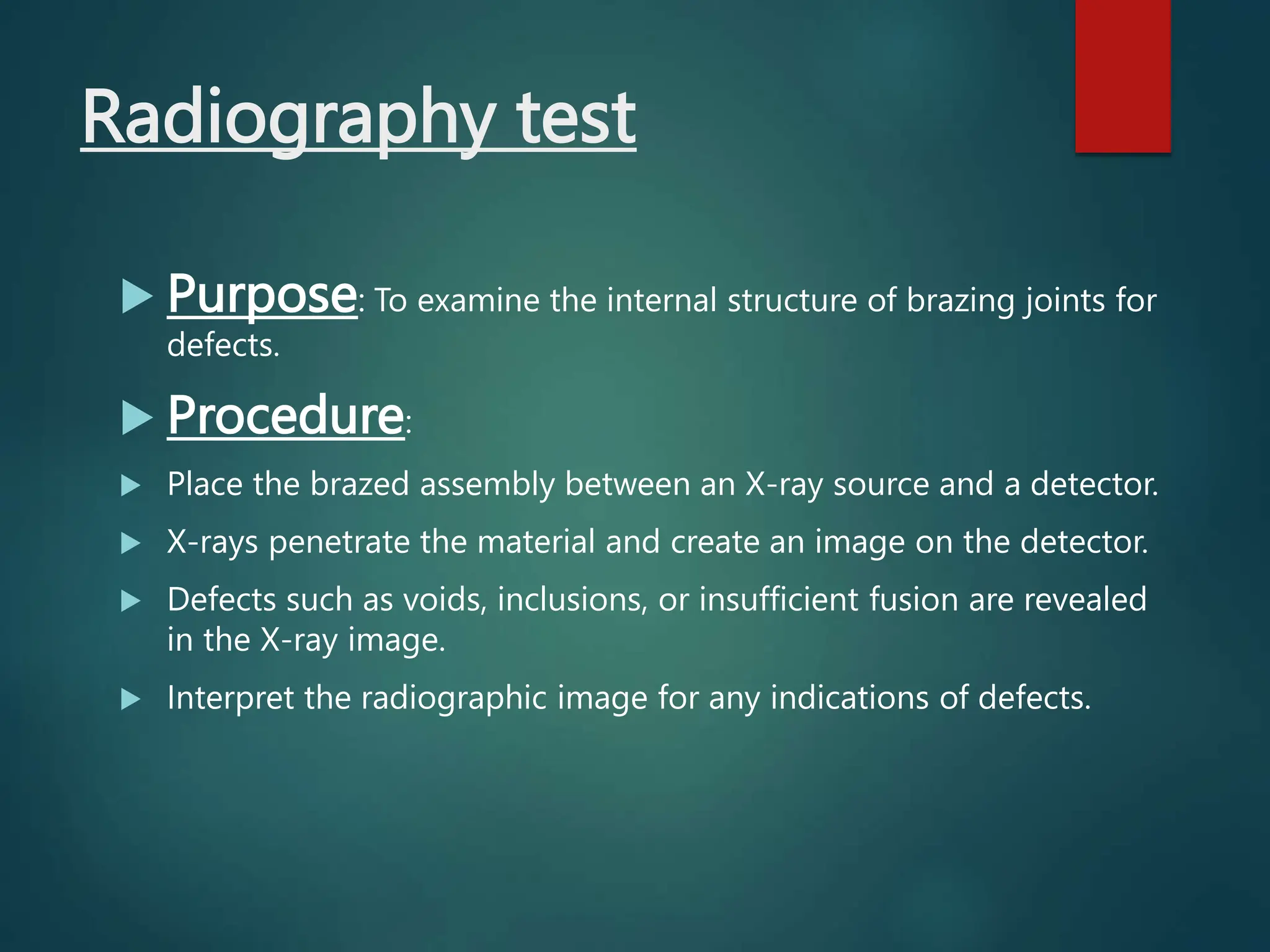
Radiography test
 Purpose: To examine the internal structure of brazing joints for
defects.
 Procedure:
 Place the brazed assembly between an X-ray source and a detector.
 X-rays penetrate the material and create an image on the detector.
 Defects such as voids, inclusions, or insufficient fusion are revealed
in the X-ray image.
 Interpret the radiographic image for any indications of defects.
Advantages and Limitations
 Advantages:
 Provides detailed images of internal defects.
 Non-destructive testing method.
 Suitable for complex geometries.
 Limitations:
 Requires specialized equipment and trained personnel.
 Exposure to radiation necessitates safety precautions.
 Costlier compared to some other testing methods.
B)Microstructural characterization by
Optical microscopy.
Microstructural Analysis Process
C)Vicker’s microhardness test to
determine the variation in hardness in
the transverse
Brief overview of Vicker’s microhardness
test.
 Definition: Vicker’s microhardness test is a method used to
determine the hardness of materials by measuring the size of
impressions made by a pyramidal diamond indenter under a certain
load.
 Purpose of the test: To assess the variation in hardness
across a material's transverse section.
 Importance: Understanding hardness distribution helps in
material characterization, quality control, and predicting material
behavior under different conditions.
 Key components: Microhardness tester, Vickers indenter,
optical microscope for measuring indentation sizes.
D)Scanning Electron Microscopy with
EDS to detect composition
Working principle:
 SEM uses electron beam scanning to produce high-
resolution images.
 When the electron beam interacts with the sample, it
generates characteristic X-rays.
 EDS detects and measures these X-rays to determine
the elemental composition of the sample.
 Mapping and quantitative analysis are possible with
SEM-EDS, providing valuable insights
Versatility and Importance of
SEM-EDS
 Versatility: SEM-EDS is applicable across diverse scientific
disciplines and industries.
 Material Analysis: Enables detailed examination of
elemental composition, morphology, and microstructure.
 Research: Facilitates groundbreaking discoveries in fields like
materials science, biology, and environmental science.
 Industry: Essential for quality control, failure analysis, and
product development in manufacturing sectors.
 Innovation: Supports innovation by providing insights into
material properties and behavior at the microscale.
 Problem-solving: Helps troubleshoot issues, identify
contaminants, and optimize processes
Applications:
 Material characterization in metallurgy, geology,
biology, and nanotechnology.
 Identification of unknown substances, contaminants,
and defects.
 Analysis of particle morphology, chemical composition,
and distribution.
 Quality control in industries such as semiconductor
manufacturing, automotive, and aerospace.
E) Tensile test
Introduction:
 Tensile test, also known as tension test, is a fundamental mechanical test used to determine
the behavior of materials under tensile loading.
Objective:
 To assess the mechanical properties of materials, including yield strength, ultimate tensile
strength, elongation, and modulus of elasticity.
Testing Procedure:
 A standardized specimen is subjected to a gradually increasing tensile load until failure occurs.
 Load and extension measurements are recorded throughout the test.
Equipment:
 Tensile testing machine equipped with grips to hold the specimen.
 Extensometer for accurate measurement of elongation.
Standards:
 ASTM E8/E8M and ISO 6892 are commonly referenced standards for tensile testing.
Tensile Test Results and
Interpretation
Parameters Measured:
 Yield Strength: Stress at which material begins to deform plastically.
 Ultimate Tensile Strength: Maximum stress material can withstand before failure.
 Elongation: Percentage increase in gauge length at failure.
 Modulus of Elasticity: Measure of material's stiffness.
Typical Stress-Strain Curve:
 Initial linear region represents elastic deformation.
 Yield point indicates transition to plastic deformation.
 Ultimate tensile strength is the peak stress before fracture.
Significance:
 Helps in material selection for engineering applications.
 Provides insights into material behavior under load.
Applications:
 Aerospace, automotive, construction, and manufacturing industries utilize tensile testing for quality control and material characterization.
F)Three point bend test.
Procedure and Results
 Procedure:
 Prepare the specimen according to ASTM or ISO standards.
 Place the specimen on two supports.
 Apply a load at the center of the specimen using a loading nose or roller.
 Record the applied load and the resulting displacement until failure
occurs.
 Calculate flexural strength and modulus of elasticity based on the
recorded data.
 Results:
 Flexural Strength: Measure of the maximum stress a material can
withstand before it breaks under bending.
 Modulus of Elasticity: Measure of a material's stiffness and ability to
deform under stress.
Analysis and conclusion
 Analysis: Interpret the results to understand the
material's mechanical properties and behavior under
bending stress. Compare results with industry
standards or specifications.
 Conclusion: Summarize the findings and discuss
implications for material selection, design
optimization, and potential improvements in
manufacturing processes.
G)Impact test
 Overview and importance
 Overview: The impact test is a crucial method for evaluating the toughness
and resistance of materials against sudden or dynamic loading conditions.
 Purpose: It assesses how a material responds when subjected to high-velocity or
impact loading, simulating real-world scenarios such as collisions, drops, or other
abrupt forces.
 Importance:
 Ensures product safety: Impact testing helps ensure that products meet
safety standards and can withstand potential impacts during use.
 Material selection: It aids engineers and designers in selecting appropriate
materials for applications where impact resistance is critical.
 Quality control: By assessing the material's ability to absorb energy under
impact, manufacturers can maintain consistent quality and durability of their
products.
Methods and Applications
 Common Test Methods:
 Charpy Impact Test: Measures the amount of
energy absorbed by a material during fracture.
 Izod Impact Test: Similar to the Charpy test but
involves a different sample geometry.
 Applications: Widely used in industries such as
automotive, aerospace, construction, and
manufacturing to ensure the reliability and safety of
materials and products.
H)Immersion Corrosion Test
Introduction:
 Immersion corrosion testing is a widely used method to evaluate the corrosion resistance of
materials.
 It involves exposing materials to a corrosive environment by immersing them in a solution for a
specific duration.
 Purpose:
 Assess the susceptibility of materials to corrosion in various environments.
 Determine the effectiveness of corrosion protection methods or coatings.
Procedure:
 Prepare the test samples by cleaning and pre-treating them as per standard procedures.
 Immersion: Submerge the samples completely in the corrosive solution.
 Duration: Maintain the immersion for a predetermined period, typically ranging from hours to
months.
 Monitoring: Regularly inspect the samples for signs of corrosion such as rust, discoloration, or surface
degradation.
 Evaluation: Analyze the extent and type of corrosion to assess the material's resistance.
Parameters and Applications
Parameters:
 Corrosive solution composition (e.g., saltwater, acid,
alkali).
 Temperature and pressure conditions.
 Immersion duration.
Applications:
 Quality control in manufacturing industries (e.g.,
automotive, aerospace).
 Material selection for infrastructure projects.
 Research and development of corrosion-resistant
materials and coatings.
I)Corrosion test using
electrochemical workstation.
Corrosion Test Using Electrochemical
Workstation
 Objective: Evaluate the corrosion resistance of materials using
electrochemical techniques.
 Importance: Corrosion can lead to structural degradation, safety
hazards, and economic losses, making accurate testing crucial for
various industries.
 Overview: This presentation discusses the principles, methods, and
benefits of corrosion testing using electrochemical workstations.
Electrochemical Workstation and
Testing Process
Electrochemical Workstation:
A sophisticated instrument for measuring and controlling
electrochemical processes such as corrosion, electroplating, and battery
testing.
 Testing Process:
 Setup: Prepare the sample, electrolyte solution, and electrodes
according to the testing standards.
 Measurement: Apply a controlled potential or current to the
sample and measure the resulting electrochemical parameters (e.g.,
corrosion rate, polarization resistance).
 Data Analysis: Analyze the obtained data to assess the
corrosion behavior and performance of the material.
Advantages and Application
Advantages:
 Precise control over experimental conditions.
 Real-time monitoring of corrosion processes.
 High sensitivity and accuracy.
 Applications: Widely used in industries such as
automotive, aerospace, marine, and oil & gas for
material selection, quality control, and research
purposes.

determining the braze joint and other mechanical tests

  • 1.
    Determining the natureof braze joint by following tests A)DYE PENETRATION AND RADIOGRAPHY TEST TO CHECK THE SOUNDNESS OF THE BRAZING JOINT. B)MICROSTRUCTURAL CHARACTERIZATION BY OPTICAL MICROSCOPY. C)VICKER’S MICROHARDNESS TEST TO DETERMINE THE VARIATION IN HARDNESS IN THE TRANSVERSE DIRECTION TO THE WELD BEAD. D)SCANNING ELECTRON MICROSCOPY WITH EDS TO DETECT COMPOSITION. E)TENSILE TEST. F)THREE POINT BEND TEST. G)IMPACT TEST H)IMMERSION CORROSION TEST. I)CORROSION TEST USING ELECTROCHEMICAL WORKSTATION.
  • 2.
    A)Dye penetration andradiography test to check the soundness of the brazing joint. Dye penetration test Purpose: To assess the integrity of brazing joints by detecting surface- breaking defects. Procedure: •Clean the surface of the joint. •Apply a penetrant dye to the joint. •Allow the dye to seep into any surface defects. •Wipe off excess dye from the surface. •Apply a developer that draws out the dye from the defects, making them visible. •Inspect the joint for indications of defects.
  • 3.
    Advantages and Limitations Advantages:  Detects surface cracks, laps, or leaks.  Simple and cost-effective.  Can be used on a variety of materials.  Limitations:  Limited to surface defects.  Requires proper cleaning and preparation.  Not suitable for detecting internal defects.
  • 4.
    Radiography test  Purpose:To examine the internal structure of brazing joints for defects.  Procedure:  Place the brazed assembly between an X-ray source and a detector.  X-rays penetrate the material and create an image on the detector.  Defects such as voids, inclusions, or insufficient fusion are revealed in the X-ray image.  Interpret the radiographic image for any indications of defects.
  • 5.
    Advantages and Limitations Advantages:  Provides detailed images of internal defects.  Non-destructive testing method.  Suitable for complex geometries.  Limitations:  Requires specialized equipment and trained personnel.  Exposure to radiation necessitates safety precautions.  Costlier compared to some other testing methods.
  • 6.
  • 7.
  • 8.
    C)Vicker’s microhardness testto determine the variation in hardness in the transverse Brief overview of Vicker’s microhardness test.  Definition: Vicker’s microhardness test is a method used to determine the hardness of materials by measuring the size of impressions made by a pyramidal diamond indenter under a certain load.  Purpose of the test: To assess the variation in hardness across a material's transverse section.  Importance: Understanding hardness distribution helps in material characterization, quality control, and predicting material behavior under different conditions.  Key components: Microhardness tester, Vickers indenter, optical microscope for measuring indentation sizes.
  • 9.
    D)Scanning Electron Microscopywith EDS to detect composition Working principle:  SEM uses electron beam scanning to produce high- resolution images.  When the electron beam interacts with the sample, it generates characteristic X-rays.  EDS detects and measures these X-rays to determine the elemental composition of the sample.  Mapping and quantitative analysis are possible with SEM-EDS, providing valuable insights
  • 10.
    Versatility and Importanceof SEM-EDS  Versatility: SEM-EDS is applicable across diverse scientific disciplines and industries.  Material Analysis: Enables detailed examination of elemental composition, morphology, and microstructure.  Research: Facilitates groundbreaking discoveries in fields like materials science, biology, and environmental science.  Industry: Essential for quality control, failure analysis, and product development in manufacturing sectors.  Innovation: Supports innovation by providing insights into material properties and behavior at the microscale.  Problem-solving: Helps troubleshoot issues, identify contaminants, and optimize processes
  • 11.
    Applications:  Material characterizationin metallurgy, geology, biology, and nanotechnology.  Identification of unknown substances, contaminants, and defects.  Analysis of particle morphology, chemical composition, and distribution.  Quality control in industries such as semiconductor manufacturing, automotive, and aerospace.
  • 12.
    E) Tensile test Introduction: Tensile test, also known as tension test, is a fundamental mechanical test used to determine the behavior of materials under tensile loading. Objective:  To assess the mechanical properties of materials, including yield strength, ultimate tensile strength, elongation, and modulus of elasticity. Testing Procedure:  A standardized specimen is subjected to a gradually increasing tensile load until failure occurs.  Load and extension measurements are recorded throughout the test. Equipment:  Tensile testing machine equipped with grips to hold the specimen.  Extensometer for accurate measurement of elongation. Standards:  ASTM E8/E8M and ISO 6892 are commonly referenced standards for tensile testing.
  • 13.
    Tensile Test Resultsand Interpretation Parameters Measured:  Yield Strength: Stress at which material begins to deform plastically.  Ultimate Tensile Strength: Maximum stress material can withstand before failure.  Elongation: Percentage increase in gauge length at failure.  Modulus of Elasticity: Measure of material's stiffness. Typical Stress-Strain Curve:  Initial linear region represents elastic deformation.  Yield point indicates transition to plastic deformation.  Ultimate tensile strength is the peak stress before fracture. Significance:  Helps in material selection for engineering applications.  Provides insights into material behavior under load. Applications:  Aerospace, automotive, construction, and manufacturing industries utilize tensile testing for quality control and material characterization.
  • 14.
  • 15.
    Procedure and Results Procedure:  Prepare the specimen according to ASTM or ISO standards.  Place the specimen on two supports.  Apply a load at the center of the specimen using a loading nose or roller.  Record the applied load and the resulting displacement until failure occurs.  Calculate flexural strength and modulus of elasticity based on the recorded data.  Results:  Flexural Strength: Measure of the maximum stress a material can withstand before it breaks under bending.  Modulus of Elasticity: Measure of a material's stiffness and ability to deform under stress.
  • 16.
    Analysis and conclusion Analysis: Interpret the results to understand the material's mechanical properties and behavior under bending stress. Compare results with industry standards or specifications.  Conclusion: Summarize the findings and discuss implications for material selection, design optimization, and potential improvements in manufacturing processes.
  • 17.
    G)Impact test  Overviewand importance  Overview: The impact test is a crucial method for evaluating the toughness and resistance of materials against sudden or dynamic loading conditions.  Purpose: It assesses how a material responds when subjected to high-velocity or impact loading, simulating real-world scenarios such as collisions, drops, or other abrupt forces.  Importance:  Ensures product safety: Impact testing helps ensure that products meet safety standards and can withstand potential impacts during use.  Material selection: It aids engineers and designers in selecting appropriate materials for applications where impact resistance is critical.  Quality control: By assessing the material's ability to absorb energy under impact, manufacturers can maintain consistent quality and durability of their products.
  • 18.
    Methods and Applications Common Test Methods:  Charpy Impact Test: Measures the amount of energy absorbed by a material during fracture.  Izod Impact Test: Similar to the Charpy test but involves a different sample geometry.  Applications: Widely used in industries such as automotive, aerospace, construction, and manufacturing to ensure the reliability and safety of materials and products.
  • 19.
    H)Immersion Corrosion Test Introduction: Immersion corrosion testing is a widely used method to evaluate the corrosion resistance of materials.  It involves exposing materials to a corrosive environment by immersing them in a solution for a specific duration.  Purpose:  Assess the susceptibility of materials to corrosion in various environments.  Determine the effectiveness of corrosion protection methods or coatings. Procedure:  Prepare the test samples by cleaning and pre-treating them as per standard procedures.  Immersion: Submerge the samples completely in the corrosive solution.  Duration: Maintain the immersion for a predetermined period, typically ranging from hours to months.  Monitoring: Regularly inspect the samples for signs of corrosion such as rust, discoloration, or surface degradation.  Evaluation: Analyze the extent and type of corrosion to assess the material's resistance.
  • 20.
    Parameters and Applications Parameters: Corrosive solution composition (e.g., saltwater, acid, alkali).  Temperature and pressure conditions.  Immersion duration. Applications:  Quality control in manufacturing industries (e.g., automotive, aerospace).  Material selection for infrastructure projects.  Research and development of corrosion-resistant materials and coatings.
  • 21.
    I)Corrosion test using electrochemicalworkstation. Corrosion Test Using Electrochemical Workstation  Objective: Evaluate the corrosion resistance of materials using electrochemical techniques.  Importance: Corrosion can lead to structural degradation, safety hazards, and economic losses, making accurate testing crucial for various industries.  Overview: This presentation discusses the principles, methods, and benefits of corrosion testing using electrochemical workstations.
  • 22.
    Electrochemical Workstation and TestingProcess Electrochemical Workstation: A sophisticated instrument for measuring and controlling electrochemical processes such as corrosion, electroplating, and battery testing.  Testing Process:  Setup: Prepare the sample, electrolyte solution, and electrodes according to the testing standards.  Measurement: Apply a controlled potential or current to the sample and measure the resulting electrochemical parameters (e.g., corrosion rate, polarization resistance).  Data Analysis: Analyze the obtained data to assess the corrosion behavior and performance of the material.
  • 23.
    Advantages and Application Advantages: Precise control over experimental conditions.  Real-time monitoring of corrosion processes.  High sensitivity and accuracy.  Applications: Widely used in industries such as automotive, aerospace, marine, and oil & gas for material selection, quality control, and research purposes.