DEPARTMENT OF
CHEMISTRY
Presented By
GARIMA SHARMA
M.Sc. Chemistry
2018MSCH008
SEM - III
 CONTENT
 Introduction
 Structural Properties
 Characteristics
 Reaction & Catalytic Cycle
 Functions
 Medical Significance and Future Implications
1. Ureases functionally belong to superfamily of amidohydrolases and
phosphotriesterases.
2. Found in numerous bacteria, fungi, algae, plants, and some
invertebrates, as well as in soils as soil enzyme.
3. Nickel containing metalloenzyme.
4. Not synthesized by animals.
5. Jack bean urease was the first enzyme to be crystallized.
6. By James. B. Sumner in 1926, Nobel Prize in chemistry in 1946.
7. Urease catalyzes the hydrolysis of urea to form ammonia and CO2.
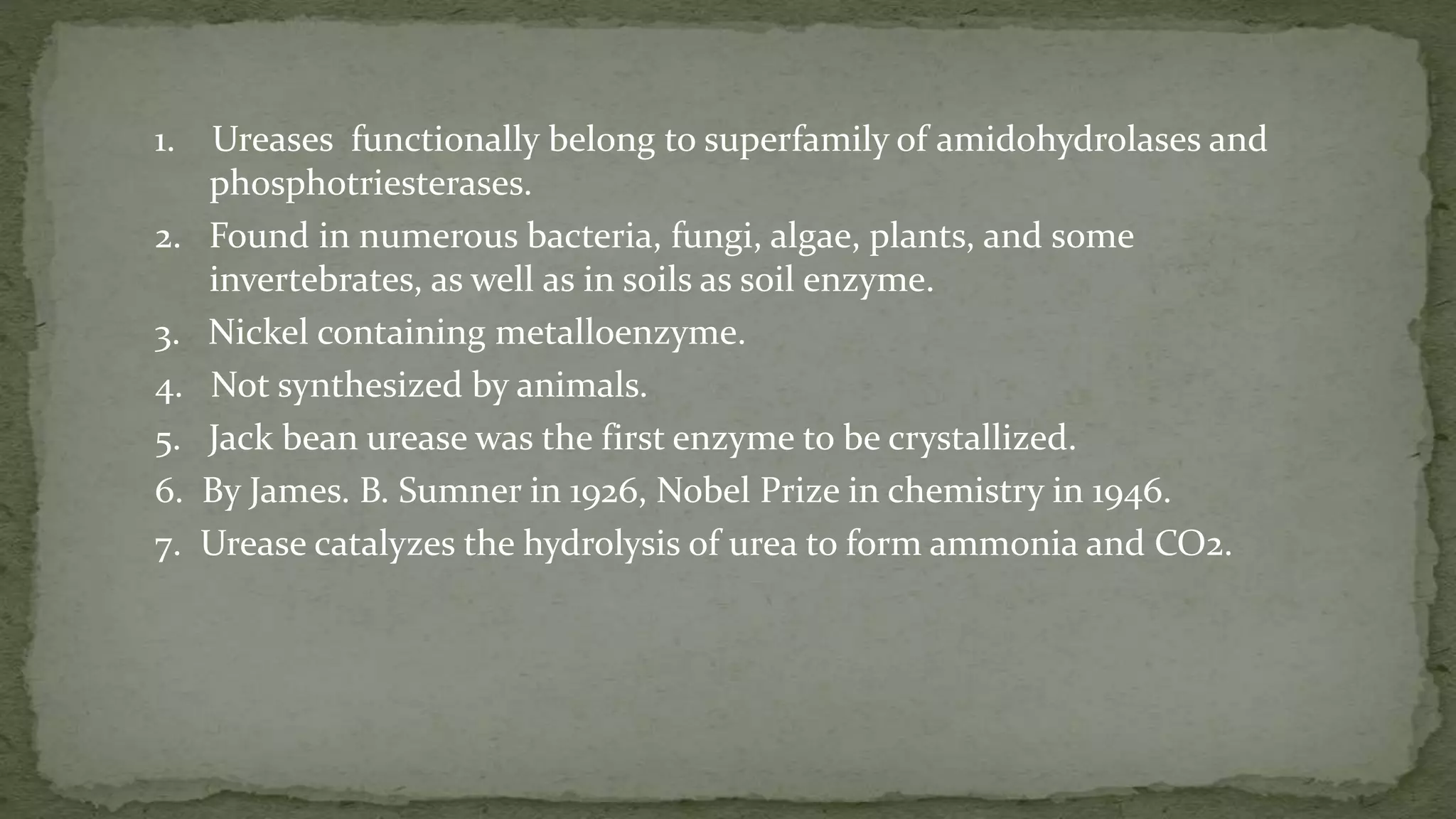
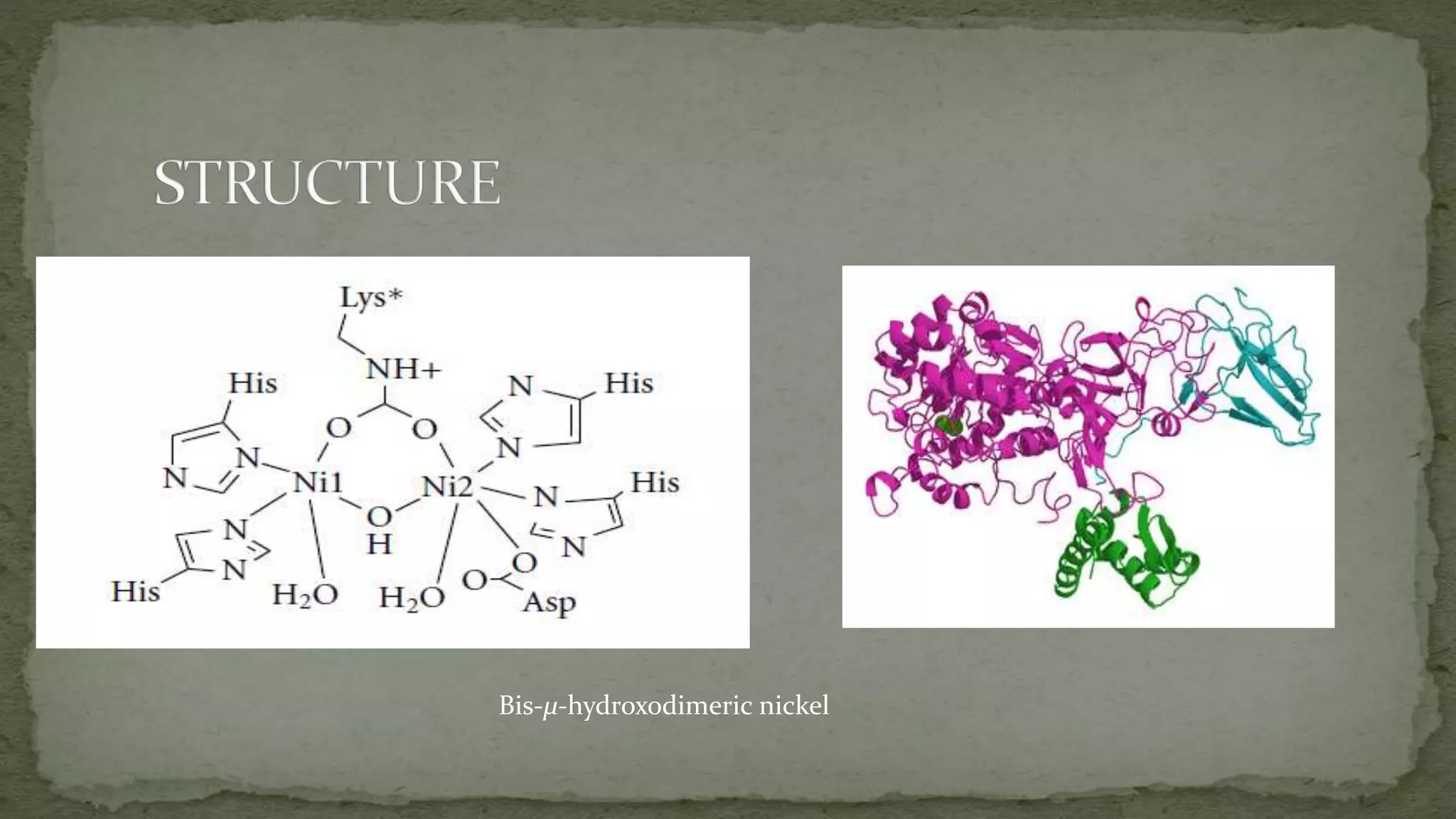
Bis-μ-hydroxodimeric nickel
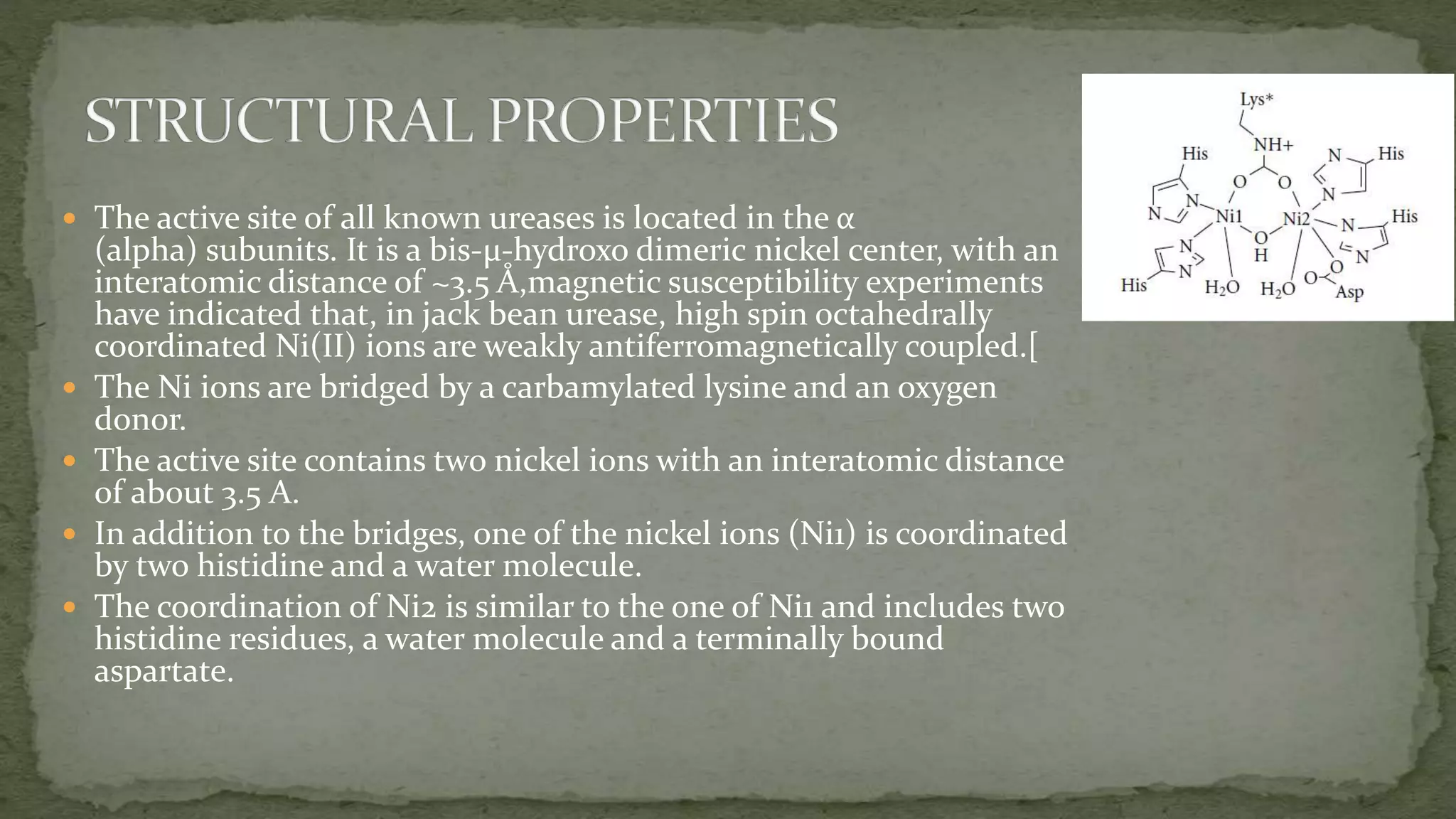
 The active site of all known ureases is located in the α
(alpha) subunits. It is a bis-μ-hydroxo dimeric nickel center, with an
interatomic distance of ~3.5 Å,magnetic susceptibility experiments
have indicated that, in jack bean urease, high spin octahedrally
coordinated Ni(II) ions are weakly antiferromagnetically coupled.[
 The Ni ions are bridged by a carbamylated lysine and an oxygen
donor.
 The active site contains two nickel ions with an interatomic distance
of about 3.5 A.
 In addition to the bridges, one of the nickel ions (Ni1) is coordinated
by two histidine and a water molecule.
 The coordination of Ni2 is similar to the one of Ni1 and includes two
histidine residues, a water molecule and a terminally bound
aspartate.
 In vitro activation also has been achieved
with manganese and cobalt in place of nickel .Lead salts
are inhibiting.
 Molecular weight:- 480 manganese and cobalt in place of nickelIn
.[12] Lead salts arekDa or 545 kDa for Jack Bean Urease (Hexamer).
 Optimum pH:- 7.4
 Optimum Temperature:- 60 degrees Celsius.
 Enzymatic Specificity:- Urea and Hydroxyurea.
 Inhibitors:- Heavy Metals (Pb- & Pb2+), Fluorine (F).
 Catalysis hydrolysis of urea to CO2 and NH3.
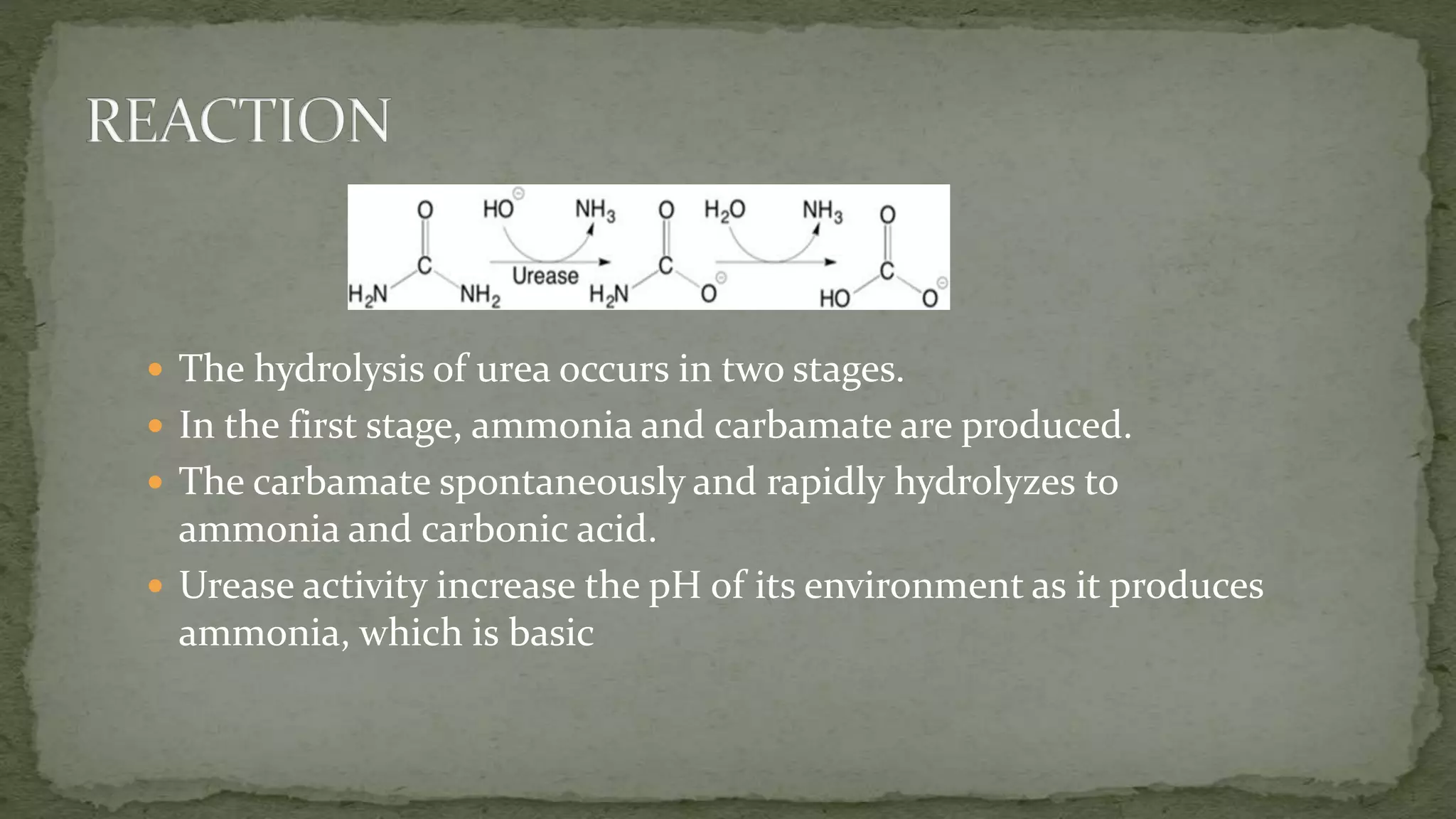
 The hydrolysis of urea occurs in two stages.
 In the first stage, ammonia and carbamate are produced.
 The carbamate spontaneously and rapidly hydrolyzes to
ammonia and carbonic acid.
 Urease activity increase the pH of its environment as it produces
ammonia, which is basic
• Urea binds in a bidentate
manner with its carbonyl
oxygen bound to Ni(1) and
one of the amino group
bound to Ni(2).
• Thus replacing two water
moieties, leaving only the
bridging hydroxide.
• This hydroxide attacks
urea to give the tetrahedral
transition state leading to
formation of ammonia and
carbamate.
[Ni2(µ-OH)(µ-urea)(bdptz)(urea)(CH3CN)](ClO4)3
[Ni2(µ-OH)(µ-H2O)(bdptz)(µ-OCN)]2(OTs)4
[Ni2(µ-OH)(µ-H2O)(bdptz)(urea)2](ClO4)3
The fact that no dinuclear nickel complex reported thus far has proved capable of hydrolyzing urea to ammonia
and carbon dioxide provides an intriguing challenge to the synthetic bioinorganic chemist. The design of a
complex that can produce a sufficiently nucleophilic hydroxide ion and at the same time activate a urea molecule
by coordination to one or both metal ions should facilitate the successful hydrolysis of urea under the right
conditions. So, a dinuclear nickel complex, [Ni2(µ-OH)(µ-H2O)(bdptz)(H2O)2](OTs)3 (where bdptz is the
dinucleating ligand 1,4-bis(2,2′-dipyridylmethyl)- phthalazine), that is capable of hydrolyzing a bound amide
substrate by intramolecular attack of a coordinated hydroxide ion.
Upon heating, this complex effects the hydrolysis of urea by a pathway involving cyanate ion that is distinct
from that previously proposed for the enzyme. These results provide the first direct evidence for a mechanism
long considered as an alternative for the enzymatic hydrolysis of urea.
 Ammonia is the preferred nitrogen source among enteric bacteria and the
ureolytic activity of the human gut microbiota hydrolyzes about 15%-30%
of the urea synthesized by the human body.(Aoyagi et al.,1966;Walser and Bodenlos,1959)
 Microbial ureases are an important factor to be considered in dental
health.(Burne et al., 2012).
 Bacterial ureases in the forestomach of ruminants cleave animal-derived
urea allowing the released ammonia to be used as major nitrogen source
for the rumen microbiota.(Laukova and Koniarova, 1995; Pearson and Smith, 1943)
 Urea hydrolysis to release ammonia and carbon dioxide is the main
physiological role attributed to ureases in plants.(Witte, 2011)
 Worldwide used as a soil fertilizer, urea can only be assimilated after
hydrolysis by urease.(Sirko and Brodzik,2000)
 However, the efficiency of urea fertilization can be decreased by higher
levels of this soil urease, which can cause massive release of ammonia into
the atmosphere, further inducing plant damage by ammonia toxicity and
soil pH increase.(Watson et al., 1994)
 People with genetic defects in any enzyme involved in urea formation cannot tolerate
protein-rich diets. Amino acids ingested in excess of the minimum daily requirements for
protein synthesis are deaminated in the liver, producing free ammonia that cannot be
converted to urea and exported into the bloodstream, as ammonia is highly toxic. The
absence of urea cycle enzyme can result in hyperammonemia.
 Although the breakdown of amino acids can have serious health consequences in individuals
with urea cycle deficiencies, a protein-free diet is not a treatment option.
 The absent enzyme activity can often be identified by determining which cycle intermediate
is present in especially elevated concentration in the blood and/or urine.
 A variety of treatments are available for individuals with urea cycle defects. Careful
administration of the aromatic acids benzoate or phenyl butyrate in the diet can help lower
the level of ammonia in the blood.
 Hindawi Publishing Corporation, Bioinorganic Chemistry and
Applications, Volume 2010, Article ID 364891, 8 pages
doi:10.1155/2010/364891 (http://dx.doi.org/10.1155/2010/364891)
 http://proteopedia.org/wiki/index.php/Urease
 Plantimals, https://sites.tufts.edu/photosyntheticanimals/urease-
mechanism/
 Toxicon 110 (2016) 90-109
 190–192 (1999) 331–355 (http://users.man.poznan.pl/wojtekr/pdf/wr-lit-
22.pdf)
 J. Am. Chem. Soc. 2000, 122, 9172-9177
THANK YOU
For Your Patience…

Urease enzyme and its catalytic cycle

  • 1.
    DEPARTMENT OF CHEMISTRY Presented By GARIMASHARMA M.Sc. Chemistry 2018MSCH008 SEM - III
  • 2.
     CONTENT  Introduction Structural Properties  Characteristics  Reaction & Catalytic Cycle  Functions  Medical Significance and Future Implications
  • 3.
    1. Ureases functionallybelong to superfamily of amidohydrolases and phosphotriesterases. 2. Found in numerous bacteria, fungi, algae, plants, and some invertebrates, as well as in soils as soil enzyme. 3. Nickel containing metalloenzyme. 4. Not synthesized by animals. 5. Jack bean urease was the first enzyme to be crystallized. 6. By James. B. Sumner in 1926, Nobel Prize in chemistry in 1946. 7. Urease catalyzes the hydrolysis of urea to form ammonia and CO2.
  • 4.
  • 5.
     The activesite of all known ureases is located in the α (alpha) subunits. It is a bis-μ-hydroxo dimeric nickel center, with an interatomic distance of ~3.5 Å,magnetic susceptibility experiments have indicated that, in jack bean urease, high spin octahedrally coordinated Ni(II) ions are weakly antiferromagnetically coupled.[  The Ni ions are bridged by a carbamylated lysine and an oxygen donor.  The active site contains two nickel ions with an interatomic distance of about 3.5 A.  In addition to the bridges, one of the nickel ions (Ni1) is coordinated by two histidine and a water molecule.  The coordination of Ni2 is similar to the one of Ni1 and includes two histidine residues, a water molecule and a terminally bound aspartate.
  • 6.
     In vitroactivation also has been achieved with manganese and cobalt in place of nickel .Lead salts are inhibiting.  Molecular weight:- 480 manganese and cobalt in place of nickelIn .[12] Lead salts arekDa or 545 kDa for Jack Bean Urease (Hexamer).  Optimum pH:- 7.4  Optimum Temperature:- 60 degrees Celsius.  Enzymatic Specificity:- Urea and Hydroxyurea.  Inhibitors:- Heavy Metals (Pb- & Pb2+), Fluorine (F).  Catalysis hydrolysis of urea to CO2 and NH3.
  • 7.
     The hydrolysisof urea occurs in two stages.  In the first stage, ammonia and carbamate are produced.  The carbamate spontaneously and rapidly hydrolyzes to ammonia and carbonic acid.  Urease activity increase the pH of its environment as it produces ammonia, which is basic
  • 8.
    • Urea bindsin a bidentate manner with its carbonyl oxygen bound to Ni(1) and one of the amino group bound to Ni(2). • Thus replacing two water moieties, leaving only the bridging hydroxide. • This hydroxide attacks urea to give the tetrahedral transition state leading to formation of ammonia and carbamate.
  • 11.
    [Ni2(µ-OH)(µ-urea)(bdptz)(urea)(CH3CN)](ClO4)3 [Ni2(µ-OH)(µ-H2O)(bdptz)(µ-OCN)]2(OTs)4 [Ni2(µ-OH)(µ-H2O)(bdptz)(urea)2](ClO4)3 The fact thatno dinuclear nickel complex reported thus far has proved capable of hydrolyzing urea to ammonia and carbon dioxide provides an intriguing challenge to the synthetic bioinorganic chemist. The design of a complex that can produce a sufficiently nucleophilic hydroxide ion and at the same time activate a urea molecule by coordination to one or both metal ions should facilitate the successful hydrolysis of urea under the right conditions. So, a dinuclear nickel complex, [Ni2(µ-OH)(µ-H2O)(bdptz)(H2O)2](OTs)3 (where bdptz is the dinucleating ligand 1,4-bis(2,2′-dipyridylmethyl)- phthalazine), that is capable of hydrolyzing a bound amide substrate by intramolecular attack of a coordinated hydroxide ion. Upon heating, this complex effects the hydrolysis of urea by a pathway involving cyanate ion that is distinct from that previously proposed for the enzyme. These results provide the first direct evidence for a mechanism long considered as an alternative for the enzymatic hydrolysis of urea.
  • 12.
     Ammonia isthe preferred nitrogen source among enteric bacteria and the ureolytic activity of the human gut microbiota hydrolyzes about 15%-30% of the urea synthesized by the human body.(Aoyagi et al.,1966;Walser and Bodenlos,1959)  Microbial ureases are an important factor to be considered in dental health.(Burne et al., 2012).  Bacterial ureases in the forestomach of ruminants cleave animal-derived urea allowing the released ammonia to be used as major nitrogen source for the rumen microbiota.(Laukova and Koniarova, 1995; Pearson and Smith, 1943)
  • 13.
     Urea hydrolysisto release ammonia and carbon dioxide is the main physiological role attributed to ureases in plants.(Witte, 2011)  Worldwide used as a soil fertilizer, urea can only be assimilated after hydrolysis by urease.(Sirko and Brodzik,2000)  However, the efficiency of urea fertilization can be decreased by higher levels of this soil urease, which can cause massive release of ammonia into the atmosphere, further inducing plant damage by ammonia toxicity and soil pH increase.(Watson et al., 1994)
  • 14.
     People withgenetic defects in any enzyme involved in urea formation cannot tolerate protein-rich diets. Amino acids ingested in excess of the minimum daily requirements for protein synthesis are deaminated in the liver, producing free ammonia that cannot be converted to urea and exported into the bloodstream, as ammonia is highly toxic. The absence of urea cycle enzyme can result in hyperammonemia.  Although the breakdown of amino acids can have serious health consequences in individuals with urea cycle deficiencies, a protein-free diet is not a treatment option.  The absent enzyme activity can often be identified by determining which cycle intermediate is present in especially elevated concentration in the blood and/or urine.  A variety of treatments are available for individuals with urea cycle defects. Careful administration of the aromatic acids benzoate or phenyl butyrate in the diet can help lower the level of ammonia in the blood.
  • 15.
     Hindawi PublishingCorporation, Bioinorganic Chemistry and Applications, Volume 2010, Article ID 364891, 8 pages doi:10.1155/2010/364891 (http://dx.doi.org/10.1155/2010/364891)  http://proteopedia.org/wiki/index.php/Urease  Plantimals, https://sites.tufts.edu/photosyntheticanimals/urease- mechanism/  Toxicon 110 (2016) 90-109  190–192 (1999) 331–355 (http://users.man.poznan.pl/wojtekr/pdf/wr-lit- 22.pdf)  J. Am. Chem. Soc. 2000, 122, 9172-9177
  • 16.
    THANK YOU For YourPatience…