8/14/2013 1Sakharkar Mohammad Anzar
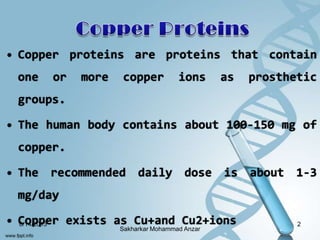
• Copper proteins are proteins that contain
one or more copper ions as prosthetic
groups.
• The human body contains about 100‐150 mg of
copper.
• The recommended daily dose is about 1‐3
mg/day
• Copper exists as Cu+and Cu2+ions8/14/2013 2
Sakharkar Mohammad Anzar
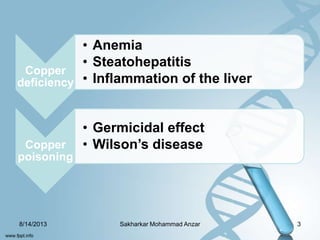
Copper
deficiency
• Anemia
• Steatohepatitis
• Inflammation of the liver
Copper
poisoning
• Germicidal effect
• Wilson’s disease
8/14/2013 3Sakharkar Mohammad Anzar
8/14/2013 4Sakharkar Mohammad Anzar
• Plastocyanin is a copper-containing protein
involved in electron-transfer.
• The protein is monomeric, with a molecular weight
around 10,500 Daltons, and 99 amino acids in most
vascular plants.
• Function:
– In photosynthesis, plastocyanin functions as an
electron transfer agent between cyto-f of the
cyto-b6f complex from P.S- II and P700+
from P.S-I.
8/14/2013 5Sakharkar Mohammad Anzar
• Structure:
– The copper binding site is described as a
distorted trigonal pyramidal.
– The trigonal plane of the pyramidal base is
composed of two nitrogen atoms (N1 and N2) from
separate histidines and a sulfur (S1) from a
cysteine.
– Sulfur (S2) from an axial methionine forms the
apex.
– The ‘distortion’ occurs in the bond lengths
between the copper and sulfur ligands.
8/14/2013 6Sakharkar Mohammad Anzar
• Reactions:
– Plastocyanin (Cu2+Pc) is reduced by
cytochrome f according to the following
reaction:
Cu2+Pc + e- → Cu+Pc
– After dissociation, Cu+Pc diffuses through
the lumen, according to the following
reaction:
Cu+Pc → Cu2+Pc + e-
– The redox potential is about 370 mV and the
isoelectric pH is about 4.
8/14/2013 7Sakharkar Mohammad Anzar
• Copper-containing AO act as a disulphide-linked
homodimer.
They catalyze the oxidation of primary amines to
aldehydes, with the subsequent release of ammonia
and hydrogen peroxide, which requires one copper
ion per subunit and topaquinone as cofactor:
RCH2NH2 + H2O + O2 RCHO + NH3 + H2O2
• Function:
– In eukaryotes they have a broader range of
functions, including cell differentiation and
growth, wound healing, detoxification and cell
signaling as well as functioning as a vascular
adhesion in some mammalian tissues.8/14/2013 8Sakharkar Mohammad Anzar
• Structure:
– The copper amine oxidase 3-dimensional structure
was determined through X-ray crystallography.
– The copper amine oxidases occur as mushroom-
shaped homodimers of 70-95 kDa, each monomer
containing a copper ion and a covalently bound
redox cofactor, topaquinone (TPQ)
– The copper ion is coordinated with three
histidine residues and two water molecules in a
distorted square pyramidal geometry, and has a
dual function in catalysis and TPQ biogenesis.
8/14/2013 9Sakharkar Mohammad Anzar
• Hemocyanins are proteins that transport oxygen
throughout the bodies of some invertebrate animals.
These metalloproteins contain two copper atoms that
reversibly bind a single oxygen molecule (O2).
• Catalytic activity:
– Hemocyanin is homologous to the phenol oxidases
since both enzymes sharing type 3 Cu active site
coordination.
– Hemocyanin also exhibits phenol
oxidase activity, but with slowed kinetics from
greater steric bulk at the active site.
8/14/2013 10Sakharkar Mohammad Anzar
• Antitumor effects:
– The hemocyanin found in concholepas
concholepas blood has immunotherapeutic effects
against bladder and prostate cancer
– Mice treated with c. Concholepas showed
significant antitumor effects: prolonged
survival, decreased tumor growth and incidence,
and lack of toxic effects
8/14/2013 11Sakharkar Mohammad Anzar
• Cytochrome c oxidase is a large transmembrane
protein complex found in bacteria and
the mitochondrion.
• It is the last enzyme in the respiratory electron
transport chain of mitochondria (or bacteria)
located in the mitochondrial (or bacterial)
membrane.
• It receives an electron from each of
four cytochrome c molecules, and transfers them to
one oxygen molecule, converting
molecular oxygen to two molecules of water.
8/14/2013 12Sakharkar Mohammad Anzar
• Histochemistry :
– COX histochemistry is used for mapping regional
brain metabolism in animals, since there is a
direct relation between enzyme activity and
neuronal activity.
– Such brain mapping has been accomplished in
spontaneous mutant mice with cerebellar disease
such as reeler. and a transgenic model
of Alzheimer's disease.
– This technique has also been used to map
learning activity in animal brain.
8/14/2013 13Sakharkar Mohammad Anzar
• Genetic defects and disorders:
– Defects involving genetic mutations altering
cytochrome c oxidase (COX) functionality or
structure can result in severe, often fatal
metabolic disorders.
– Such disorders usually manifest in early
childhood and affect predominantly tissues with
high energy demands (brain, heart, muscle).
– Among the many classified mitochondrial
diseases, those involving dysfunctional COX
assembly are thought to be the most severe.
8/14/2013 14Sakharkar Mohammad Anzar
• Copper is an essential element in many of the
enzymes that cause oxidations in plants and
animals.
• These enzymes are responsible for such varied
functions as producing the darkening in cut apple
slices, turning green tea into black tea,
destroying vitamin C in stored foods.
8/14/2013 15Sakharkar Mohammad Anzar
• The copper probably takes the oxygen from the air,
holds it, and then places it on the oxidizable
organic substrate.
• However, no stable compound of copper are known
that wil hold oxygen.
• Very likely the copper has different properties
when chelated by an enzyme than does free copper
ion in solution.
• The chemistry of chelated copper is not necessarily
the same as the familiar chemistry of copper in
solution.
8/14/2013 16Sakharkar Mohammad Anzar
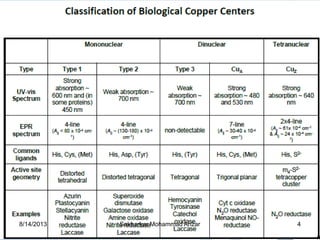
Superoxide dismutase
Tyrosinase
Catechol oxidase
8/14/2013 17Sakharkar Mohammad Anzar
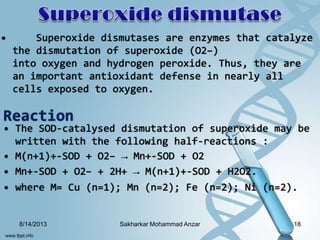
• Superoxide dismutases are enzymes that catalyze
the dismutation of superoxide (O2−)
into oxygen and hydrogen peroxide. Thus, they are
an important antioxidant defense in nearly all
cells exposed to oxygen.
Reaction
• The SOD-catalysed dismutation of superoxide may be
written with the following half-reactions :
• M(n+1)+-SOD + O2− → Mn+-SOD + O2
• Mn+-SOD + O2− + 2H+ → M(n+1)+-SOD + H2O2.
• where M= Cu (n=1); Mn (n=2); Fe (n=2); Ni (n=2).
8/14/2013 18Sakharkar Mohammad Anzar
• Role in disease:
– Overexpression of SOD1 has been linked to the
neural disorders seen in down syndrome.
– The extracellular superoxide dismutase (sod3,
ecsod) is critical in the development of
hypertension.
– Diminished sod3 activity was linked to lung
diseases such as acute respiratory distress
syndrome (ards) or chronic obstructive pulmonary
disease (copd).
• Pharmacological activity:
– Sod has powerful antinflammatory activity.
– An sod-mimetic agent, tempol, is currently in
clinical trials for radioprotection and to prevent
radiation-induced hair-loss.8/14/2013 19Sakharkar Mohammad Anzar
• Cosmetic uses:
– SOD may reduce free radical damage to skin—for
example, to reduce fibrosis following radiation for
breast cancer.
– Superoxide dismutase is known to reverse fibrosis,
perhaps through reversion of myofibroblasts back to
fibroblasts.
8/14/2013 20Sakharkar Mohammad Anzar
• Tyrosinase is a copper-containing enzyme present in
plant and animal tissues that catalyzes the
production of melanin and other pigments from
tyrosine by oxidation, as in the blackening of a
peeled potato exposed to air.
• Tyrosinase is an rate limiting enzyme for
controlling the production of melanin.
• It is mainly involved in two distinct reactions of
melanin synthesis; firstly, the hydroxylation of a
monophenol and secondly, the conversion of an O-
diphenol to the corresponding O-quinone.
8/14/2013 21Sakharkar Mohammad Anzar
• O-Quinone undergoes several reactions
to eventually form melanin.
• It is found inside melanosomes.
• The catalytic action:
– of this enzyme is the conversion of tyrosine +
O2 to dihydroxyphenylalanine (DOPA), which is
then converted to dopaquinone + H2O.
– Dopaquinone in turn, can be readily converted to
dopachrome, an orange-red pigment.
– Dopachrome can then be converted to the
black/brown melanin pigments .
8/14/2013 22Sakharkar Mohammad Anzar
• Active site:
• The two copper atoms within the active site of
tyrosinase enzymes interact with dioxygen to form a
highly reactive chemical intermediate that then
oxidizes the substrate.
• Tyrosinases and catechol oxidases are collectively
termed polyphenol oxidases.
8/14/2013 23Sakharkar Mohammad Anzar
• Transmembrane protein and sorting:
• Human tyrosinase is a single membrane
spanning transmembrane protein.
• In humans, tyrosinase is sorted
into melanosomes. and the catalytically
active domain of the protein resides within
melanosomes.
• Only a small enzymatically non-essential
part of the protein extends into the
cytoplasm of the melanocyte.
8/14/2013 24Sakharkar Mohammad Anzar
• Concepts and Models in Bioinorganic Chemistry-
Kraatz, Heinz-Bernhard, & Metzler-Nolte, Nils;
• http://www.chem.tamu.edu/rgroup/marcetta/chem489/Pr
esentations/Copper.pdf
• http://www.chemwiki.com
8/14/2013 25Sakharkar Mohammad Anzar

Copper in proteins and enzymes

  • 1.
  • 2.
    • Copper proteinsare proteins that contain one or more copper ions as prosthetic groups. • The human body contains about 100‐150 mg of copper. • The recommended daily dose is about 1‐3 mg/day • Copper exists as Cu+and Cu2+ions8/14/2013 2 Sakharkar Mohammad Anzar
  • 3.
    Copper deficiency • Anemia • Steatohepatitis •Inflammation of the liver Copper poisoning • Germicidal effect • Wilson’s disease 8/14/2013 3Sakharkar Mohammad Anzar
  • 4.
  • 5.
    • Plastocyanin isa copper-containing protein involved in electron-transfer. • The protein is monomeric, with a molecular weight around 10,500 Daltons, and 99 amino acids in most vascular plants. • Function: – In photosynthesis, plastocyanin functions as an electron transfer agent between cyto-f of the cyto-b6f complex from P.S- II and P700+ from P.S-I. 8/14/2013 5Sakharkar Mohammad Anzar
  • 6.
    • Structure: – Thecopper binding site is described as a distorted trigonal pyramidal. – The trigonal plane of the pyramidal base is composed of two nitrogen atoms (N1 and N2) from separate histidines and a sulfur (S1) from a cysteine. – Sulfur (S2) from an axial methionine forms the apex. – The ‘distortion’ occurs in the bond lengths between the copper and sulfur ligands. 8/14/2013 6Sakharkar Mohammad Anzar
  • 7.
    • Reactions: – Plastocyanin(Cu2+Pc) is reduced by cytochrome f according to the following reaction: Cu2+Pc + e- → Cu+Pc – After dissociation, Cu+Pc diffuses through the lumen, according to the following reaction: Cu+Pc → Cu2+Pc + e- – The redox potential is about 370 mV and the isoelectric pH is about 4. 8/14/2013 7Sakharkar Mohammad Anzar
  • 8.
    • Copper-containing AOact as a disulphide-linked homodimer. They catalyze the oxidation of primary amines to aldehydes, with the subsequent release of ammonia and hydrogen peroxide, which requires one copper ion per subunit and topaquinone as cofactor: RCH2NH2 + H2O + O2 RCHO + NH3 + H2O2 • Function: – In eukaryotes they have a broader range of functions, including cell differentiation and growth, wound healing, detoxification and cell signaling as well as functioning as a vascular adhesion in some mammalian tissues.8/14/2013 8Sakharkar Mohammad Anzar
  • 9.
    • Structure: – Thecopper amine oxidase 3-dimensional structure was determined through X-ray crystallography. – The copper amine oxidases occur as mushroom- shaped homodimers of 70-95 kDa, each monomer containing a copper ion and a covalently bound redox cofactor, topaquinone (TPQ) – The copper ion is coordinated with three histidine residues and two water molecules in a distorted square pyramidal geometry, and has a dual function in catalysis and TPQ biogenesis. 8/14/2013 9Sakharkar Mohammad Anzar
  • 10.
    • Hemocyanins areproteins that transport oxygen throughout the bodies of some invertebrate animals. These metalloproteins contain two copper atoms that reversibly bind a single oxygen molecule (O2). • Catalytic activity: – Hemocyanin is homologous to the phenol oxidases since both enzymes sharing type 3 Cu active site coordination. – Hemocyanin also exhibits phenol oxidase activity, but with slowed kinetics from greater steric bulk at the active site. 8/14/2013 10Sakharkar Mohammad Anzar
  • 11.
    • Antitumor effects: –The hemocyanin found in concholepas concholepas blood has immunotherapeutic effects against bladder and prostate cancer – Mice treated with c. Concholepas showed significant antitumor effects: prolonged survival, decreased tumor growth and incidence, and lack of toxic effects 8/14/2013 11Sakharkar Mohammad Anzar
  • 12.
    • Cytochrome coxidase is a large transmembrane protein complex found in bacteria and the mitochondrion. • It is the last enzyme in the respiratory electron transport chain of mitochondria (or bacteria) located in the mitochondrial (or bacterial) membrane. • It receives an electron from each of four cytochrome c molecules, and transfers them to one oxygen molecule, converting molecular oxygen to two molecules of water. 8/14/2013 12Sakharkar Mohammad Anzar
  • 13.
    • Histochemistry : –COX histochemistry is used for mapping regional brain metabolism in animals, since there is a direct relation between enzyme activity and neuronal activity. – Such brain mapping has been accomplished in spontaneous mutant mice with cerebellar disease such as reeler. and a transgenic model of Alzheimer's disease. – This technique has also been used to map learning activity in animal brain. 8/14/2013 13Sakharkar Mohammad Anzar
  • 14.
    • Genetic defectsand disorders: – Defects involving genetic mutations altering cytochrome c oxidase (COX) functionality or structure can result in severe, often fatal metabolic disorders. – Such disorders usually manifest in early childhood and affect predominantly tissues with high energy demands (brain, heart, muscle). – Among the many classified mitochondrial diseases, those involving dysfunctional COX assembly are thought to be the most severe. 8/14/2013 14Sakharkar Mohammad Anzar
  • 15.
    • Copper isan essential element in many of the enzymes that cause oxidations in plants and animals. • These enzymes are responsible for such varied functions as producing the darkening in cut apple slices, turning green tea into black tea, destroying vitamin C in stored foods. 8/14/2013 15Sakharkar Mohammad Anzar
  • 16.
    • The copperprobably takes the oxygen from the air, holds it, and then places it on the oxidizable organic substrate. • However, no stable compound of copper are known that wil hold oxygen. • Very likely the copper has different properties when chelated by an enzyme than does free copper ion in solution. • The chemistry of chelated copper is not necessarily the same as the familiar chemistry of copper in solution. 8/14/2013 16Sakharkar Mohammad Anzar
  • 17.
  • 18.
    • Superoxide dismutasesare enzymes that catalyze the dismutation of superoxide (O2−) into oxygen and hydrogen peroxide. Thus, they are an important antioxidant defense in nearly all cells exposed to oxygen. Reaction • The SOD-catalysed dismutation of superoxide may be written with the following half-reactions : • M(n+1)+-SOD + O2− → Mn+-SOD + O2 • Mn+-SOD + O2− + 2H+ → M(n+1)+-SOD + H2O2. • where M= Cu (n=1); Mn (n=2); Fe (n=2); Ni (n=2). 8/14/2013 18Sakharkar Mohammad Anzar
  • 19.
    • Role indisease: – Overexpression of SOD1 has been linked to the neural disorders seen in down syndrome. – The extracellular superoxide dismutase (sod3, ecsod) is critical in the development of hypertension. – Diminished sod3 activity was linked to lung diseases such as acute respiratory distress syndrome (ards) or chronic obstructive pulmonary disease (copd). • Pharmacological activity: – Sod has powerful antinflammatory activity. – An sod-mimetic agent, tempol, is currently in clinical trials for radioprotection and to prevent radiation-induced hair-loss.8/14/2013 19Sakharkar Mohammad Anzar
  • 20.
    • Cosmetic uses: –SOD may reduce free radical damage to skin—for example, to reduce fibrosis following radiation for breast cancer. – Superoxide dismutase is known to reverse fibrosis, perhaps through reversion of myofibroblasts back to fibroblasts. 8/14/2013 20Sakharkar Mohammad Anzar
  • 21.
    • Tyrosinase isa copper-containing enzyme present in plant and animal tissues that catalyzes the production of melanin and other pigments from tyrosine by oxidation, as in the blackening of a peeled potato exposed to air. • Tyrosinase is an rate limiting enzyme for controlling the production of melanin. • It is mainly involved in two distinct reactions of melanin synthesis; firstly, the hydroxylation of a monophenol and secondly, the conversion of an O- diphenol to the corresponding O-quinone. 8/14/2013 21Sakharkar Mohammad Anzar
  • 22.
    • O-Quinone undergoesseveral reactions to eventually form melanin. • It is found inside melanosomes. • The catalytic action: – of this enzyme is the conversion of tyrosine + O2 to dihydroxyphenylalanine (DOPA), which is then converted to dopaquinone + H2O. – Dopaquinone in turn, can be readily converted to dopachrome, an orange-red pigment. – Dopachrome can then be converted to the black/brown melanin pigments . 8/14/2013 22Sakharkar Mohammad Anzar
  • 23.
    • Active site: •The two copper atoms within the active site of tyrosinase enzymes interact with dioxygen to form a highly reactive chemical intermediate that then oxidizes the substrate. • Tyrosinases and catechol oxidases are collectively termed polyphenol oxidases. 8/14/2013 23Sakharkar Mohammad Anzar
  • 24.
    • Transmembrane proteinand sorting: • Human tyrosinase is a single membrane spanning transmembrane protein. • In humans, tyrosinase is sorted into melanosomes. and the catalytically active domain of the protein resides within melanosomes. • Only a small enzymatically non-essential part of the protein extends into the cytoplasm of the melanocyte. 8/14/2013 24Sakharkar Mohammad Anzar
  • 25.
    • Concepts andModels in Bioinorganic Chemistry- Kraatz, Heinz-Bernhard, & Metzler-Nolte, Nils; • http://www.chem.tamu.edu/rgroup/marcetta/chem489/Pr esentations/Copper.pdf • http://www.chemwiki.com 8/14/2013 25Sakharkar Mohammad Anzar