NOTES AND FORMULAE ADDITIONAL MATHEMATICS FORM 5
1.   PROGRESSIONS                                             (iii)
     (a) Arithmetic Progression                         b                 c           c
         Tn = a + (n – 1)d
               n
                                                        
                                                        a
                                                                          
                                                            f ( x )dx  f ( x )dx 
                                                                          b
                                                                                       f ( x)dx
                                                                                      a
           Sn = [2a  ( n  1)d ]
               2                                        (d)   Area under a curve
               n                                                                                                       
                                                                                                                               
              = [ a  Tn ]                                                                                           AC  AB  BC
               2
     (b)   Geometric Progression
                                                                                                     (b)   A, B and C are collinear if
           Tn = ar
                   n–1
                                                                                                           
                                                                                                                 
                            n                                                                              AB   BC where  is a constant.
           Sn 
                    a (1  r )                                                                             
                                                                                                                  
                       1 r                                                                                AB and PQ are parallel if
           Sum to infinity
                                                                                                              
                                                                      b                   b
                                                                                                           PQ   AB where  is a constant.
                      a
           S 
                     1 r
                                                               A=
                                                                      
                                                                      a
                                                                          ydx     A=
                                                                                           xdy
                                                                                          a
                                                                                                     (c)   Subtraction of Two Vectors
     (c)   General
           Tn = Sn − Sn – 1
           T1 = a = S1                                  (e)   Volume of Revolution

2.   INTEGRATION
                        x n 1                                                                               
                                                                                                                    
     (a)
                xn dx        c
                        n 1                                                                               AB  OB  OA
                                (ax  b) n 1                                                        (d)   Vectors in the Cartesian Plane
     (b)
              ( ax  b) n dx                c
                                  (n  1)a
     (c)   Rules of Integration:
                     b              b                          b                              b
                                                        V   y 2 dx
                                                                                     V   x 2 dy
                                                                                              
           (i)
                      nf ( x)dx  n f ( x)dx
                     a              a                          a                              a
                     a             b
                                                   3.   VECTORS                                            
                                                                                                             
           (ii)
                      f ( x)dx   f ( x)dx
                     b             a
                                                        (a) Triangle Law of Vector Addition                OA  xi  yj
                                                                                                                   
                                                                                                           Magnitude of
                                                                                                            
                                                                                                                  
                                                                                                           OA  OA  x 2  y 2


Prepared by Mr. Sim Kwang Yaw                                                                                                               1
(g)   Double Angle Formulae
             Unit vector in the direction of    OA                                                         sin 2A = 2 sin A cos A
                r   xi  yj                                                                                              2
                                                                                                           cos 2A = cos A – sin A
                                                                                                                                 2
             r    
             ˆ                                                                                                             2
                                                                                                                  = 2cos A – 1
              r    x2  y 2                                                                                                 2
                                                                                                                  = 1 – 2sin A
                
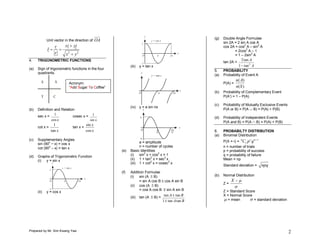
4.    TRIGONOMETRIC FUNCTIONS                                                                                           2 tan A
                                                                                                           tan 2A =
                                                           (iii)   y = tan x                                          1  tan 2 A
(a)   Sign of trigonometric functions in the four
                                                                                                     5.    PROBABILITY
      quadrants.
                                                                                                     (a)   Probability of Event A
                                                                                                                    n( A)
                            Acronym:                                                                       P(A) =
                            “Add Sugar To Coffee”                                                                   n( S )
                                                                                                     (b)   Probability of Complementary Event
                                                                                                           P(A) = 1 – P(A)

                                                                                                     (c)   Probability of Mutually Exclusive Events
                                                           (iv) y = a sin nx
(b)   Definition and Relation                                                                              P(A or B) = P(A  B) = P(A) + P(B)
      sec x =
                 1          cosec x = 1                                                              (d)   Probability of Independent Events
               cos x                 sin x
                                                                                                           P(A and B) = P(A  B) = P(A) × P(B)
                  1                     sin x
      cot x =                 tan x =
                tan x                   cos x                                                        6.    PROBABILTY DISTRIBUTION
                                                                                                     (a)   Binomial Distribution
(c)   Supplementary Angles                                                                                             n
                                                                                                           P(X = r) = Cr p q
                                                                                                                              r   n r
             o
      sin (90 − x) = cos x                                       a = amplitude
             o
      cot (90 – x) = tan x                                       n = number of cycles                      n = number of trials
                                                     (e)   Basic Identities                                p = probability of success
                                                                    2       2
(d)   Graphs of Trigonometric Function                     (i) sin x + cos x = 1                           q = probability of failure
                                                                        2       2
      (i) y = sin x                                        (ii) 1 + tan x = sec x                          Mean = np
                                                                        2         2
                                                           (iii) 1 + cot x = cosec x
                                                                                                           Standard deviation =          npq
                                                     (f)   Addition Formulae
                                                           (i) sin (A  B)                           (b)   Normal Distribution
                                                                = sin A cos B  cos A sin B                     X 
                                                                                                           Z=
                                                           (ii) cos (A  B)                                      
                                                                = cos A cos B  sin A sin B                Z = Standard Score
      (ii)   y = cos x
                                                           (iii)   tan (A    B) = tan A  tan B           X = Normal Score
                                                                                   1  tan A tan B          = mean        = standard deviation


Prepared by Mr. Sim Kwang Yaw                                                                                                                         2
(b) Condition and Implication:
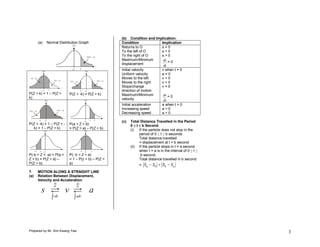
      (a)   Normal Distribution Graph              Condition            Implication
                                                   Returns to O         s=0
                                                   To the left of O     s<0
                                                   To the right of O    s>0
                                                   Maximum/Minimum       ds = 0
                                                   displacement          dt
                                                   Initial velocity     v when t = 0
                                                   Uniform velocity     a=0
                                                   Moves to the left    v<0
                                                   Moves to the right   v>0
                                                   Stops/change         v=0
                                                   direction of motion
P(Z < k) = 1 – P(Z >      P(Z < -k) = P(Z > k)     Maximum/Minimum       dv = 0
k)                                                 velocity              dt
                                                   Initial acceleration a when t = 0
                                                   Increasing speed     a>0
                                                   Decreasing speed     a<0

                                                   (c)   Total Distance Travelled in the Period
P(Z > -k) = 1 – P(Z < -   P(a < Z < b)                   0 ≤ t ≤ b Second
  k) = 1 – P(Z > k)       = P(Z > a) – P(Z > b)          (i) If the particle does not stop in the
                                                               period of 0 ≤ t ≤ b seconds
                                                               Total distance travelled
                                                               = displacement at t = b second
                                                         (ii) If the particle stops in t = a second
                                                               when t = a is in the interval of 0 ≤ t ≤
P(-b < Z < -a) = P(a <    P(- b < Z < a)                        b second,
Z < b) = P(Z > a) –       = 1 – P(z > b) – P(Z >               Total distance travelled in b second
P(Z > b)                  a)                                  =   Sa  S0  Sb  Sa
7.    MOTION ALONG A STRAIGHT LINE
(a)   Relation Between Displacement,
      Velocity and Acceleration


               vdt           adt


Prepared by Mr. Sim Kwang Yaw                                                                             3

Form 5 formulae and note

  • 1.
    NOTES AND FORMULAEADDITIONAL MATHEMATICS FORM 5 1. PROGRESSIONS (iii) (a) Arithmetic Progression b c c Tn = a + (n – 1)d n  a  f ( x )dx  f ( x )dx  b  f ( x)dx a Sn = [2a  ( n  1)d ] 2 (d) Area under a curve n      = [ a  Tn ] AC  AB  BC 2 (b) Geometric Progression (b) A, B and C are collinear if Tn = ar n–1    n AB   BC where  is a constant. Sn  a (1  r )    1 r AB and PQ are parallel if Sum to infinity   b b PQ   AB where  is a constant. a S  1 r A=  a ydx A=  xdy a (c) Subtraction of Two Vectors (c) General Tn = Sn − Sn – 1 T1 = a = S1 (e) Volume of Revolution 2. INTEGRATION x n 1       (a)  xn dx  c n 1 AB  OB  OA (ax  b) n 1 (d) Vectors in the Cartesian Plane (b)  ( ax  b) n dx  c (n  1)a (c) Rules of Integration: b b b b V   y 2 dx  V   x 2 dy  (i)  nf ( x)dx  n f ( x)dx a a a a a b 3. VECTORS   (ii)  f ( x)dx   f ( x)dx b a (a) Triangle Law of Vector Addition OA  xi  yj   Magnitude of     OA  OA  x 2  y 2 Prepared by Mr. Sim Kwang Yaw 1
  • 2.
    (g) Double Angle Formulae Unit vector in the direction of OA sin 2A = 2 sin A cos A r xi  yj 2 cos 2A = cos A – sin A 2 r     ˆ 2 = 2cos A – 1  r x2  y 2 2 = 1 – 2sin A  4. TRIGONOMETRIC FUNCTIONS 2 tan A tan 2A = (iii) y = tan x 1  tan 2 A (a) Sign of trigonometric functions in the four 5. PROBABILITY quadrants. (a) Probability of Event A n( A) Acronym: P(A) = “Add Sugar To Coffee” n( S ) (b) Probability of Complementary Event P(A) = 1 – P(A) (c) Probability of Mutually Exclusive Events (iv) y = a sin nx (b) Definition and Relation P(A or B) = P(A  B) = P(A) + P(B) sec x = 1 cosec x = 1 (d) Probability of Independent Events cos x sin x P(A and B) = P(A  B) = P(A) × P(B) 1 sin x cot x = tan x = tan x cos x 6. PROBABILTY DISTRIBUTION (a) Binomial Distribution (c) Supplementary Angles n P(X = r) = Cr p q r n r o sin (90 − x) = cos x a = amplitude o cot (90 – x) = tan x n = number of cycles n = number of trials (e) Basic Identities p = probability of success 2 2 (d) Graphs of Trigonometric Function (i) sin x + cos x = 1 q = probability of failure 2 2 (i) y = sin x (ii) 1 + tan x = sec x Mean = np 2 2 (iii) 1 + cot x = cosec x Standard deviation = npq (f) Addition Formulae (i) sin (A  B) (b) Normal Distribution = sin A cos B  cos A sin B X  Z= (ii) cos (A  B)  = cos A cos B  sin A sin B Z = Standard Score (ii) y = cos x (iii) tan (A  B) = tan A  tan B X = Normal Score 1  tan A tan B  = mean  = standard deviation Prepared by Mr. Sim Kwang Yaw 2
  • 3.
    (b) Condition andImplication: (a) Normal Distribution Graph Condition Implication Returns to O s=0 To the left of O s<0 To the right of O s>0 Maximum/Minimum ds = 0 displacement dt Initial velocity v when t = 0 Uniform velocity a=0 Moves to the left v<0 Moves to the right v>0 Stops/change v=0 direction of motion P(Z < k) = 1 – P(Z > P(Z < -k) = P(Z > k) Maximum/Minimum dv = 0 k) velocity dt Initial acceleration a when t = 0 Increasing speed a>0 Decreasing speed a<0 (c) Total Distance Travelled in the Period P(Z > -k) = 1 – P(Z < - P(a < Z < b) 0 ≤ t ≤ b Second k) = 1 – P(Z > k) = P(Z > a) – P(Z > b) (i) If the particle does not stop in the period of 0 ≤ t ≤ b seconds Total distance travelled = displacement at t = b second (ii) If the particle stops in t = a second when t = a is in the interval of 0 ≤ t ≤ P(-b < Z < -a) = P(a < P(- b < Z < a) b second, Z < b) = P(Z > a) – = 1 – P(z > b) – P(Z > Total distance travelled in b second P(Z > b) a) = Sa  S0  Sb  Sa 7. MOTION ALONG A STRAIGHT LINE (a) Relation Between Displacement, Velocity and Acceleration  vdt  adt Prepared by Mr. Sim Kwang Yaw 3