DENTAL
AMALGAM
Kimathi Denis
😉
OBJECTIVES :
o Define dental amalgam.
o Outline formulation of dental amalgam.
o Classify dental amalgam.
o Describe setting reaction of dental amalgam
o Discuss properties of dental amalgam
o Discuss manipulation of dental amalgam and manipulation
variables that may affect properties.
o Justify continued use of amalgam.
defination
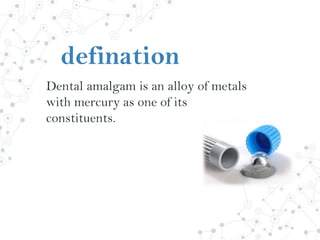
Dental amalgam is an alloy of metals
with mercury as one of its
constituents.
Formulation
Powder and liquid
Alloy powder Silver – 69%
Tin – 17%
Copper – 13%
+/- zinc – 0-1%
+/- Indium/gold
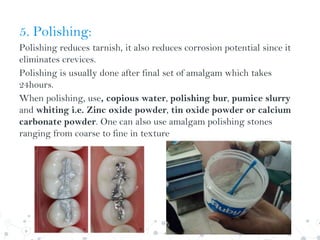
+/- palladium/platinum
Liquid
Triple distilled mercury. Reason?
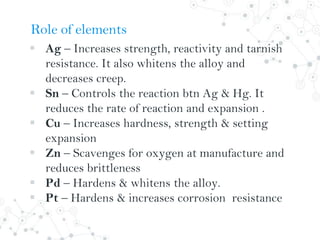
Role of elements
 Ag – Increases strength, reactivity and tarnish
resistance. It also whitens the alloy and
decreases creep.
 Sn – Controls the reaction btn Ag & Hg. It
reduces the rate of reaction and expansion .
 Cu – Increases hardness, strength & setting
expansion
 Zn – Scavenges for oxygen at manufacture and
reduces brittleness
 Pd – Hardens & whitens the alloy.
 Pt – Hardens & increases corrosion resistance
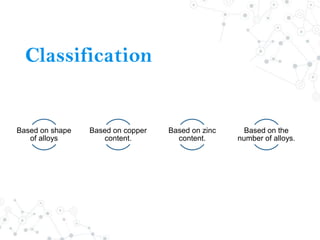
Classification
Based on shape
of alloys
Based on copper
content.
Based on zinc
content.
Based on the
number of alloys.
Based on shape of alloys
o Lathe cut alloy
o Spherical alloy
o Admixed alloy
o Low copper amalgam – has copper < 6%
(Conventional alloys) Traditional alloys .
o High copper amalgam – has copper > 6%(12-30%)
1. Admixed high copper amalgam alloys.
2. Single composition amalgam alloys.
Based on Copper Content
Based on the number of alloys
o Binary alloys – silver and tin
o Tertiary alloys – silver, tin and copper
o Quaternary alloys – silver, tin, copper and zinc
Based on zinc content
o Zinc containing amalgam – Contains > 0.01% zinc
o Non – zinc amalgam – Contains < 0.01 zinc
What are the advantages and disadvantages of having zinc in
dental amalgam?
Any remedies to the cons of zinc?
Advantage – Zinc has been included as an aid in manufacturing; it
helps produce clean, sound casting of ingots used for producing
cut-particle alloys.
Disadvantage – presence of zinc has been shown to produce a
delayed expansion if water based fluids such as saliva or blood are
present within amalgam during condensation.
Delayed expansion - The gradual expansion of zinc containing
amalgam over a period of weeks to months. This expansion is
associated with the development of hydrogen gas, which is caused
by the incorporation of moisture in plastic mass during its
manipulation in a cavity preparation.
Remedy – Use zinc-free alloys
- Careful attention given to rubber dam isolation of the
prepared tooth.
Alloy Manufacture
Lathe Cut Powder
These are formed by cooling molten alloy particles into an
ingot that is then fed to a cutting tool which turns as it
crushes the chips off the ingot. These particles can then be
ball milled to further reduce them and round them off. They
are usually 30µm in size.
Spherical alloys
These are manufactured via atomization. Molten alloy is
sprayed under high pressure into a non-oxidizing chamber
where the molten string cools into spherical particles. The
sizes are about 40-50µm.
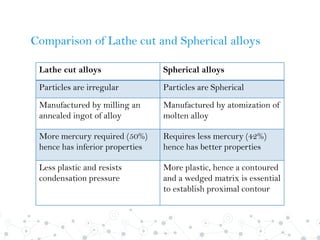
Comparison of Lathe cut and Spherical alloys
Lathe cut alloys Spherical alloys
Particles are irregular Particles are Spherical
Manufactured by milling an
annealed ingot of alloy
Manufactured by atomization of
molten alloy
More mercury required (50%)
hence has inferior properties
Requires less mercury (42%)
hence has better properties
Less plastic and resists
condensation pressure
More plastic, hence a contoured
and a wedged matrix is essential
to establish proximal contour
Manipulation:
A dental amalgam
restoration is
placed by the
following steps:
• Proportioning
• Trituration
• Condensation
• Trimming & Carving
• Polishing
1. Proportioning
The alloy powder and liquid mercury are proportioned as per the
manufacturer's instructions, usually a ratio of 1:1.
Powder and liquid presented in 2 ways:
I. Bulk packages
The dentist would buy bulk quantity of the alloy powder and liquid
mercury. The alloy could also be supplied as tablets. The dentist
would then have to proportion what he needed using supplied
measuring containers or weight gauge.
Disadvantages of this method?
o The method was cumbersome
o It exposed the dentist, his staff and patients to risk of mercury
poisoning through spills or inhalation of fumes
NB – this presentation has been replaced by the capsulated forms.
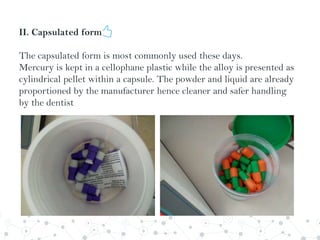
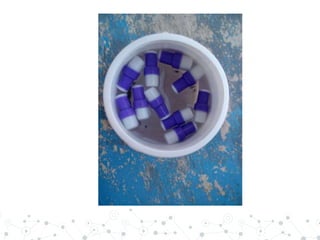
II. Capsulated form
The capsulated form is most commonly used these days.
Mercury is kept in a cellophane plastic while the alloy is presented as
cylindrical pellet within a capsule. The powder and liquid are already
proportioned by the manufacturer hence cleaner and safer handling
by the dentist
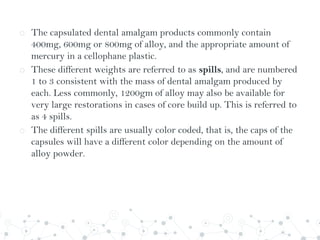
o The capsulated dental amalgam products commonly contain
400mg, 600mg or 800mg of alloy, and the appropriate amount of
mercury in a cellophane plastic.
o These different weights are referred to as spills, and are numbered
1 to 3 consistent with the mass of dental amalgam produced by
each. Less commonly, 1200gm of alloy may also be available for
very large restorations in cases of core build up. This is referred to
as 4 spills.
o The different spills are usually color coded, that is, the caps of the
capsules will have a different color depending on the amount of
alloy powder.
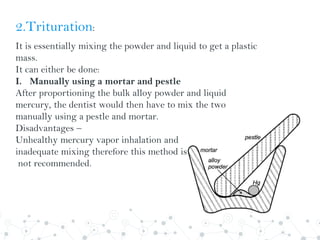
2.Trituration:
It is essentially mixing the powder and liquid to get a plastic
mass.
It can either be done:
I. Manually using a mortar and pestle
After proportioning the bulk alloy powder and liquid
mercury, the dentist would then have to mix the two
manually using a pestle and mortar.
Disadvantages –
Unhealthy mercury vapor inhalation and
inadequate mixing therefore this method is currently
not recommended.
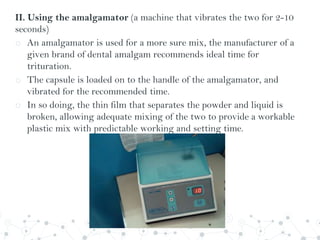
II. Using the amalgamator (a machine that vibrates the two for 2-10
seconds)
o An amalgamator is used for a more sure mix, the manufacturer of a
given brand of dental amalgam recommends ideal time for
trituration.
o The capsule is loaded on to the handle of the amalgamator, and
vibrated for the recommended time.
o In so doing, the thin film that separates the powder and liquid is
broken, allowing adequate mixing of the two to provide a workable
plastic mix with predictable working and setting time.
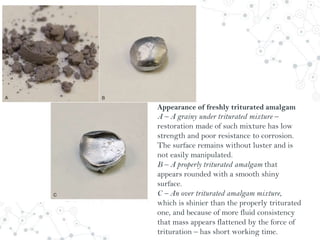
Appearance of freshly triturated amalgam
A – A grainy under triturated mixture –
restoration made of such mixture has low
strength and poor resistance to corrosion.
The surface remains without luster and is
not easily manipulated.
B – A properly triturated amalgam that
appears rounded with a smooth shiny
surface.
C – An over triturated amalgam mixture,
which is shinier than the properly triturated
one, and because of more fluid consistency
that mass appears flattened by the force of
trituration – has short working time.
3. Condensation:
o The plastic mass of freshly triturated dental amalgam is packed
into the cavity in increments with a condenser, the aim being to
remove excess mercury and to get a compact and homogenous
restoration.
o A force of 4-5kg should be applied when packing the amalgam with
the condenser. Condensation yields a shiny layer of mercury that
should be removed.
o After condensation of each increment, the surface should be shiny
in appearance. Reason?
o Condensation should be done immediately after trituration to avoid
porosities.
o Lathe cut amalgam is easier to condense because the particles can
resist the force, while spherical alloy particles give a sliding
sensation.
o Light condensation pressure is usually sufficient for adequate
compaction of spherical particles.
4. Carving:
o Done to remove last mercury rich layer and to achieve tooth
morphology.
o The amalgam restoration should not be higher than the occlusal
plane or else it will fracture.
o Spherical particles are easier to curve than lathe cut which are
coarser.
o The setting time is 2-5minutes, and working time less than 2
minutes.
NB – the objective of carving is to simulate the anatomy rather than
to reproduce extremely fine details.
5. Polishing:
Polishing reduces tarnish, it also reduces corrosion potential since it
eliminates crevices.
Polishing is usually done after final set of amalgam which takes
24hours.
When polishing, use, copious water, polishing bur, pumice slurry
and whiting i.e. Zinc oxide powder, tin oxide powder or calcium
carbonate powder. One can also use amalgam polishing stones
ranging from coarse to fine in texture
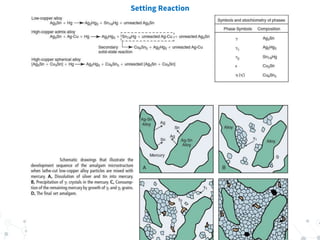
Setting Reaction
Properties:💃
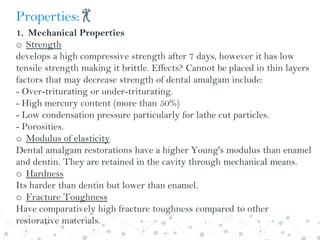
1. Mechanical Properties
o Strength
develops a high compressive strength after 7 days, however it has low
tensile strength making it brittle. Effects? Cannot be placed in thin layers
factors that may decrease strength of dental amalgam include:
- Over-triturating or under-triturating.
- High mercury content (more than 50%)
- Low condensation pressure particularly for lathe cut particles.
- Porosities.
o Modulus of elasticity
Dental amalgam restorations have a higher Young's modulus than enamel
and dentin. They are retained in the cavity through mechanical means.
o Hardness
Its harder than dentin but lower than enamel.
o Fracture Toughness
Have comparatively high fracture toughness compared to other
restorative materials.
2. Radiopacity
Dental amalgam is an alloy of metals and is therefore radiopaque.
3. Tarnish
It is managed by polishing. Tarnish may be a pre-cursor to corrosion.
4. Corrosion
The gamma 2 phase mainly found in low copper amalgams, has been
shown to be extremely susceptible to corrosion(crevice type corrosion
along the tooth-restoration interface), tarnish and creep
Electrolytic cell type corrosion may also occur if an amalgam
restoration is placed opposite a gold restoration due to the difference
in the electromotive force of the two metals, leading to destruction of
gold.
5. Dimensional stability
Ideally amalgam should be dimensionally stable but certain factors
may affect this stability hence compromising its success and longevity.
Primary expansion and secondary expansion?
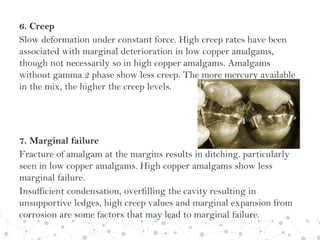
6. Creep
Slow deformation under constant force. High creep rates have been
associated with marginal deterioration in low copper amalgams,
though not necessarily so in high copper amalgams. Amalgams
without gamma 2 phase show less creep. The more mercury available
in the mix, the higher the creep levels.
7. Marginal failure
Fracture of amalgam at the margins results in ditching. particularly
seen in low copper amalgams. High copper amalgams show less
marginal failure.
Insufficient condensation, overfilling the cavity resulting in
unsupportive ledges, high creep values and marginal expansion from
corrosion are some factors that may lead to marginal failure.
8. Thermal Properties
o Thermal conductivity
Amalgam conducts heat and should therefore be placed with a
liner/base/thermal insulator in deep cavities.
o Coefficient of thermal expansion
It differs highly from that of enamel and dentine. This may lead to
gaps being formed around the margin hence amalgam restoration may
leak a lot.
“
A good dentist never gets on your
nerves – Wiseman.
Newer Modifications
1.RESIN COATED AMALGAM
• To overcome the limitation of microleakage with amalgams, a
coating of unfilled resin is placed over the restoration margins and the
adjacent enamel, after etching the enamel, has been tried. Although
the resin may eventually wear away, it delays microleakage until
corrosion products begin to fill the tooth restoration interface.
2. FLUORIDATED AMALGAM
• Fluoride, being cariostatic, has been included in amalgam to deal
with the problem of recurrent caries associated with amalgam
restorations. The problem with this method is that the fluoride is not
delivered long enough to provide maximum benefit.
3. BONDED AMALGAM
• Conventional amalgam is an obturating material as it merely fills the
space of prepared cavity, and thus, does not restore the fracture
resistance of the tooth, which was lost during cavity preparations.
In addition, the provision for adequate resistance and retention form
for amalgams may require removal of healthy tooth structure.
Further, since amalgam does not bond to tooth structure,
microleakage immediately after insertion is inevitable.
So, to overcome these disadvantages of amalgam, adhesive systems
that reliably bond to enamel and dentin have been introduced. •
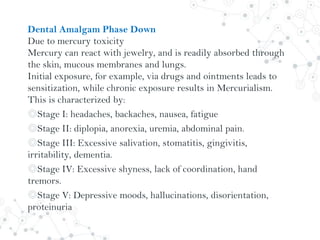
Dental Amalgam Phase Down
Due to mercury toxicity
Mercury can react with jewelry, and is readily absorbed through
the skin, mucous membranes and lungs.
Initial exposure, for example, via drugs and ointments leads to
sensitization, while chronic exposure results in Mercurialism.
This is characterized by:
◎Stage I: headaches, backaches, nausea, fatigue
◎Stage II: diplopia, anorexia, uremia, abdominal pain.
◎Stage III: Excessive salivation, stomatitis, gingivitis,
irritability, dementia.
◎Stage IV: Excessive shyness, lack of coordination, hand
tremors.
◎Stage V: Depressive moods, hallucinations, disorientation,
proteinuria
o In attempts to eliminate the use of amalgam, gallium was mixed
with normal alloy powder to form gallium alloys, however these
are expensive, unstable and exhibit poor clinical results as
compared to dental amalgam.
o Pure mercury, whether liquid or gaseous, is toxic. However in
dental amalgam, it is reacted and is no longer presented in any of
the toxic forms.
o Nowadays, most dental amalgam products are presented as pre-
proportioned capsules hence the amount of un-reacted mercury is
negligible and there is little exposure to mercury vapor because the
capsule is sealed.
o Therefore, if properly handled, there is very little chance of
mercury toxicity.
o FDI has categorically stated that this is an excellent restorative
material which can only be phased out only if a better and safer
alternative is found.
FUTURE OF DENTAL AMALGAM
• The prediction that amalgam would not last until the end of the
20th century was wrong.
• Its unaesthetic appearance, its inability to bond tooth, concerns
about the mercury and versatility of other materials have not led to
the elimination of this inexpensive and durable material. As other
materials and techniques improve, the use of amalgam will likely
continue to diminish, and it will eventually disappear from the scene.
• Yet, amalgam continues to be the best bargain in the restorative
armamentarium because of its durability and technique insensitivity.
Amalgam will probably disappear eventually, but its disappearance
will be brought about by a better and more aesthetic material, rather
than by concerns over health hazards. When it does disappear, it will
have served dentistry and patients well for more than 200 years.
Best practice management when handling dental amalgam:
- Do not handle spilled Hg by hand. Instead, pipette or suction it.
- For minor spillage or vapor, improve ventilation in the surgery.
- Excess amalgam should be stored under sodium or ammonium
thiosulphate solution in an unbreakable container.
- Fit amalgam traps and filters in the suction system to prevent
release to the common sewer lines.
- Recycle dental amalgam.
- Ensure that the surgery is well aerated.
- Staff education on handling of mercury is important.
- Use capsulated amalgam.
- Use plenty of water when polishing or removing amalgam.
- Wash and remove amalgam debris from instruments before
sterilizing.
- Avoid carpeting the surgical area.
-Conduct periodic Hg test; recommended amount is 30µg/ml of blood.
- Avoid handling amalgam with bare hands; use gloves and masks!
MCQs
1. The dental amalgam alloys and mercury are mixed in the ratio
A. 1:1
B. 2:1
C. 1:2
D. 1:3
E. 1:4
2. The main advantage in developing high copper amalgam alloy
A. Elimination of gamma 1 phase
B. Increase the strength of amalgam
C. Decrease the flow value of amalgam
D. Elimination of gamma phase 2
E. Reduce the conductivity of amalgam
Questions ?
The end!
It’s Friday… 😉

Dental amalgam

  • 1.
  • 2.
    OBJECTIVES : o Definedental amalgam. o Outline formulation of dental amalgam. o Classify dental amalgam. o Describe setting reaction of dental amalgam o Discuss properties of dental amalgam o Discuss manipulation of dental amalgam and manipulation variables that may affect properties. o Justify continued use of amalgam.
  • 3.
    defination Dental amalgam isan alloy of metals with mercury as one of its constituents.
  • 4.
    Formulation Powder and liquid Alloypowder Silver – 69% Tin – 17% Copper – 13% +/- zinc – 0-1% +/- Indium/gold +/- palladium/platinum Liquid Triple distilled mercury. Reason?
  • 5.
    Role of elements Ag – Increases strength, reactivity and tarnish resistance. It also whitens the alloy and decreases creep.  Sn – Controls the reaction btn Ag & Hg. It reduces the rate of reaction and expansion .  Cu – Increases hardness, strength & setting expansion  Zn – Scavenges for oxygen at manufacture and reduces brittleness  Pd – Hardens & whitens the alloy.  Pt – Hardens & increases corrosion resistance
  • 6.
    Classification Based on shape ofalloys Based on copper content. Based on zinc content. Based on the number of alloys.
  • 7.
    Based on shapeof alloys o Lathe cut alloy o Spherical alloy o Admixed alloy
  • 8.
    o Low copperamalgam – has copper < 6% (Conventional alloys) Traditional alloys . o High copper amalgam – has copper > 6%(12-30%) 1. Admixed high copper amalgam alloys. 2. Single composition amalgam alloys. Based on Copper Content
  • 9.
    Based on thenumber of alloys o Binary alloys – silver and tin o Tertiary alloys – silver, tin and copper o Quaternary alloys – silver, tin, copper and zinc
  • 10.
    Based on zinccontent o Zinc containing amalgam – Contains > 0.01% zinc o Non – zinc amalgam – Contains < 0.01 zinc What are the advantages and disadvantages of having zinc in dental amalgam? Any remedies to the cons of zinc?
  • 11.
    Advantage – Zinchas been included as an aid in manufacturing; it helps produce clean, sound casting of ingots used for producing cut-particle alloys. Disadvantage – presence of zinc has been shown to produce a delayed expansion if water based fluids such as saliva or blood are present within amalgam during condensation. Delayed expansion - The gradual expansion of zinc containing amalgam over a period of weeks to months. This expansion is associated with the development of hydrogen gas, which is caused by the incorporation of moisture in plastic mass during its manipulation in a cavity preparation. Remedy – Use zinc-free alloys - Careful attention given to rubber dam isolation of the prepared tooth.
  • 12.
    Alloy Manufacture Lathe CutPowder These are formed by cooling molten alloy particles into an ingot that is then fed to a cutting tool which turns as it crushes the chips off the ingot. These particles can then be ball milled to further reduce them and round them off. They are usually 30µm in size. Spherical alloys These are manufactured via atomization. Molten alloy is sprayed under high pressure into a non-oxidizing chamber where the molten string cools into spherical particles. The sizes are about 40-50µm.
  • 13.
    Comparison of Lathecut and Spherical alloys Lathe cut alloys Spherical alloys Particles are irregular Particles are Spherical Manufactured by milling an annealed ingot of alloy Manufactured by atomization of molten alloy More mercury required (50%) hence has inferior properties Requires less mercury (42%) hence has better properties Less plastic and resists condensation pressure More plastic, hence a contoured and a wedged matrix is essential to establish proximal contour
  • 14.
    Manipulation: A dental amalgam restorationis placed by the following steps: • Proportioning • Trituration • Condensation • Trimming & Carving • Polishing
  • 15.
    1. Proportioning The alloypowder and liquid mercury are proportioned as per the manufacturer's instructions, usually a ratio of 1:1. Powder and liquid presented in 2 ways: I. Bulk packages The dentist would buy bulk quantity of the alloy powder and liquid mercury. The alloy could also be supplied as tablets. The dentist would then have to proportion what he needed using supplied measuring containers or weight gauge. Disadvantages of this method? o The method was cumbersome o It exposed the dentist, his staff and patients to risk of mercury poisoning through spills or inhalation of fumes NB – this presentation has been replaced by the capsulated forms.
  • 17.
    II. Capsulated form Thecapsulated form is most commonly used these days. Mercury is kept in a cellophane plastic while the alloy is presented as cylindrical pellet within a capsule. The powder and liquid are already proportioned by the manufacturer hence cleaner and safer handling by the dentist
  • 18.
    o The capsulateddental amalgam products commonly contain 400mg, 600mg or 800mg of alloy, and the appropriate amount of mercury in a cellophane plastic. o These different weights are referred to as spills, and are numbered 1 to 3 consistent with the mass of dental amalgam produced by each. Less commonly, 1200gm of alloy may also be available for very large restorations in cases of core build up. This is referred to as 4 spills. o The different spills are usually color coded, that is, the caps of the capsules will have a different color depending on the amount of alloy powder.
  • 19.
    2.Trituration: It is essentiallymixing the powder and liquid to get a plastic mass. It can either be done: I. Manually using a mortar and pestle After proportioning the bulk alloy powder and liquid mercury, the dentist would then have to mix the two manually using a pestle and mortar. Disadvantages – Unhealthy mercury vapor inhalation and inadequate mixing therefore this method is currently not recommended.
  • 20.
    II. Using theamalgamator (a machine that vibrates the two for 2-10 seconds) o An amalgamator is used for a more sure mix, the manufacturer of a given brand of dental amalgam recommends ideal time for trituration. o The capsule is loaded on to the handle of the amalgamator, and vibrated for the recommended time. o In so doing, the thin film that separates the powder and liquid is broken, allowing adequate mixing of the two to provide a workable plastic mix with predictable working and setting time.
  • 21.
    Appearance of freshlytriturated amalgam A – A grainy under triturated mixture – restoration made of such mixture has low strength and poor resistance to corrosion. The surface remains without luster and is not easily manipulated. B – A properly triturated amalgam that appears rounded with a smooth shiny surface. C – An over triturated amalgam mixture, which is shinier than the properly triturated one, and because of more fluid consistency that mass appears flattened by the force of trituration – has short working time.
  • 22.
    3. Condensation: o Theplastic mass of freshly triturated dental amalgam is packed into the cavity in increments with a condenser, the aim being to remove excess mercury and to get a compact and homogenous restoration. o A force of 4-5kg should be applied when packing the amalgam with the condenser. Condensation yields a shiny layer of mercury that should be removed. o After condensation of each increment, the surface should be shiny in appearance. Reason? o Condensation should be done immediately after trituration to avoid porosities. o Lathe cut amalgam is easier to condense because the particles can resist the force, while spherical alloy particles give a sliding sensation. o Light condensation pressure is usually sufficient for adequate compaction of spherical particles.
  • 23.
    4. Carving: o Doneto remove last mercury rich layer and to achieve tooth morphology. o The amalgam restoration should not be higher than the occlusal plane or else it will fracture. o Spherical particles are easier to curve than lathe cut which are coarser. o The setting time is 2-5minutes, and working time less than 2 minutes. NB – the objective of carving is to simulate the anatomy rather than to reproduce extremely fine details.
  • 24.
    5. Polishing: Polishing reducestarnish, it also reduces corrosion potential since it eliminates crevices. Polishing is usually done after final set of amalgam which takes 24hours. When polishing, use, copious water, polishing bur, pumice slurry and whiting i.e. Zinc oxide powder, tin oxide powder or calcium carbonate powder. One can also use amalgam polishing stones ranging from coarse to fine in texture
  • 25.
  • 26.
    Properties:💃 1. Mechanical Properties oStrength develops a high compressive strength after 7 days, however it has low tensile strength making it brittle. Effects? Cannot be placed in thin layers factors that may decrease strength of dental amalgam include: - Over-triturating or under-triturating. - High mercury content (more than 50%) - Low condensation pressure particularly for lathe cut particles. - Porosities. o Modulus of elasticity Dental amalgam restorations have a higher Young's modulus than enamel and dentin. They are retained in the cavity through mechanical means. o Hardness Its harder than dentin but lower than enamel. o Fracture Toughness Have comparatively high fracture toughness compared to other restorative materials.
  • 27.
    2. Radiopacity Dental amalgamis an alloy of metals and is therefore radiopaque. 3. Tarnish It is managed by polishing. Tarnish may be a pre-cursor to corrosion. 4. Corrosion The gamma 2 phase mainly found in low copper amalgams, has been shown to be extremely susceptible to corrosion(crevice type corrosion along the tooth-restoration interface), tarnish and creep Electrolytic cell type corrosion may also occur if an amalgam restoration is placed opposite a gold restoration due to the difference in the electromotive force of the two metals, leading to destruction of gold. 5. Dimensional stability Ideally amalgam should be dimensionally stable but certain factors may affect this stability hence compromising its success and longevity. Primary expansion and secondary expansion?
  • 28.
    6. Creep Slow deformationunder constant force. High creep rates have been associated with marginal deterioration in low copper amalgams, though not necessarily so in high copper amalgams. Amalgams without gamma 2 phase show less creep. The more mercury available in the mix, the higher the creep levels. 7. Marginal failure Fracture of amalgam at the margins results in ditching. particularly seen in low copper amalgams. High copper amalgams show less marginal failure. Insufficient condensation, overfilling the cavity resulting in unsupportive ledges, high creep values and marginal expansion from corrosion are some factors that may lead to marginal failure.
  • 29.
    8. Thermal Properties oThermal conductivity Amalgam conducts heat and should therefore be placed with a liner/base/thermal insulator in deep cavities. o Coefficient of thermal expansion It differs highly from that of enamel and dentine. This may lead to gaps being formed around the margin hence amalgam restoration may leak a lot.
  • 30.
    “ A good dentistnever gets on your nerves – Wiseman.
  • 31.
    Newer Modifications 1.RESIN COATEDAMALGAM • To overcome the limitation of microleakage with amalgams, a coating of unfilled resin is placed over the restoration margins and the adjacent enamel, after etching the enamel, has been tried. Although the resin may eventually wear away, it delays microleakage until corrosion products begin to fill the tooth restoration interface. 2. FLUORIDATED AMALGAM • Fluoride, being cariostatic, has been included in amalgam to deal with the problem of recurrent caries associated with amalgam restorations. The problem with this method is that the fluoride is not delivered long enough to provide maximum benefit.
  • 32.
    3. BONDED AMALGAM •Conventional amalgam is an obturating material as it merely fills the space of prepared cavity, and thus, does not restore the fracture resistance of the tooth, which was lost during cavity preparations. In addition, the provision for adequate resistance and retention form for amalgams may require removal of healthy tooth structure. Further, since amalgam does not bond to tooth structure, microleakage immediately after insertion is inevitable. So, to overcome these disadvantages of amalgam, adhesive systems that reliably bond to enamel and dentin have been introduced. •
  • 33.
    Dental Amalgam PhaseDown Due to mercury toxicity Mercury can react with jewelry, and is readily absorbed through the skin, mucous membranes and lungs. Initial exposure, for example, via drugs and ointments leads to sensitization, while chronic exposure results in Mercurialism. This is characterized by: ◎Stage I: headaches, backaches, nausea, fatigue ◎Stage II: diplopia, anorexia, uremia, abdominal pain. ◎Stage III: Excessive salivation, stomatitis, gingivitis, irritability, dementia. ◎Stage IV: Excessive shyness, lack of coordination, hand tremors. ◎Stage V: Depressive moods, hallucinations, disorientation, proteinuria
  • 34.
    o In attemptsto eliminate the use of amalgam, gallium was mixed with normal alloy powder to form gallium alloys, however these are expensive, unstable and exhibit poor clinical results as compared to dental amalgam. o Pure mercury, whether liquid or gaseous, is toxic. However in dental amalgam, it is reacted and is no longer presented in any of the toxic forms. o Nowadays, most dental amalgam products are presented as pre- proportioned capsules hence the amount of un-reacted mercury is negligible and there is little exposure to mercury vapor because the capsule is sealed. o Therefore, if properly handled, there is very little chance of mercury toxicity. o FDI has categorically stated that this is an excellent restorative material which can only be phased out only if a better and safer alternative is found.
  • 35.
    FUTURE OF DENTALAMALGAM • The prediction that amalgam would not last until the end of the 20th century was wrong. • Its unaesthetic appearance, its inability to bond tooth, concerns about the mercury and versatility of other materials have not led to the elimination of this inexpensive and durable material. As other materials and techniques improve, the use of amalgam will likely continue to diminish, and it will eventually disappear from the scene. • Yet, amalgam continues to be the best bargain in the restorative armamentarium because of its durability and technique insensitivity. Amalgam will probably disappear eventually, but its disappearance will be brought about by a better and more aesthetic material, rather than by concerns over health hazards. When it does disappear, it will have served dentistry and patients well for more than 200 years.
  • 36.
    Best practice managementwhen handling dental amalgam: - Do not handle spilled Hg by hand. Instead, pipette or suction it. - For minor spillage or vapor, improve ventilation in the surgery. - Excess amalgam should be stored under sodium or ammonium thiosulphate solution in an unbreakable container. - Fit amalgam traps and filters in the suction system to prevent release to the common sewer lines. - Recycle dental amalgam. - Ensure that the surgery is well aerated. - Staff education on handling of mercury is important. - Use capsulated amalgam. - Use plenty of water when polishing or removing amalgam. - Wash and remove amalgam debris from instruments before sterilizing. - Avoid carpeting the surgical area. -Conduct periodic Hg test; recommended amount is 30µg/ml of blood. - Avoid handling amalgam with bare hands; use gloves and masks!
  • 38.
    MCQs 1. The dentalamalgam alloys and mercury are mixed in the ratio A. 1:1 B. 2:1 C. 1:2 D. 1:3 E. 1:4 2. The main advantage in developing high copper amalgam alloy A. Elimination of gamma 1 phase B. Increase the strength of amalgam C. Decrease the flow value of amalgam D. Elimination of gamma phase 2 E. Reduce the conductivity of amalgam
  • 39.
  • 40.

Editor's Notes

  • #6 Sn - high rate of reaction and expansion - would decrease the strength and result in corrosion
  • #27 Porosities – caused by delayed condensation, undertrituration and insufficient condensation pressure in lathe cut alloys. Condensation pressure – spherical amalgams require lighter pressures while higher pressures required in lathe cut alloys.
  • #28 Main type of corrosion – crevice type (localized, occurs in crevices of unpolished restorations) occurs at the tooth restoration interface, most of the corrosion products are oxides and chlorides that eventually seal off the space, amalgam known to be self sealing. the other type is galvanic – occurs when 2 dissimilar metals are combined. Primary expansion due to mercury – continues to react and form gamma one phase, however modern amalgams have less mercury hence less primary expansion