NORTH BENGAL DENTAL
COLLEGE & HOSPITAL
PHONETICS IN
PROSTHODONTICS
By- SK AZIZ
IKBAL
Definition
 Speech:- The expression of or the ability to express
thoughts and feelings, by the articulation of words.
 Phonetics:-The branch of linguistics that deals with the
sounds of speech and their production, combination,
description, and representation by written symbols.
1. The motor( lungs, associated muscle that supply the air).
MECHANISM OF SPEECH
PRODUCTION
Normal speech depends on proper functioning of 5
essential mechanism
2. The vibrator ( vocal cord that give pitch to the tone).
3. The resonator ( consist of the oral,nasal, pharyngeal cavity and
paranasal sinuses).
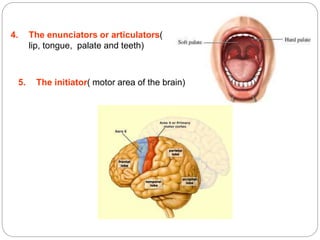
4. The enunciators or articulators(
lip, tongue, palate and teeth)
5. The initiator( motor area of the brain)
TYPES OF SPEECH
 1.VOWELS: a,e,i,o,u. they are voiced sounds,
 2.CONSONANTS: may be either voiced or
produced without vocal cord vibration, in which
case they are called breathed sounds. eg: p, b, m, s,
t, r, z etc…
 3.COMBINATION: Is blend of a consonant and
vowel, articulated in quick succession that they are
identified as single phonemes.
EX:- WORD
 Consonant sounds are most important from the
dental point of view. They may be classified according
to the anatomic parts involved in their formation:
(1) Palatolingual sounds, formed by tongue and hard or
soft
palate,
(2) Linguodental sounds, formed by the tongue and teeth,
(3) Labiodental sounds, formed by the lips and teeth, and
(4) Bilabial sounds, formed by the lips.
CLASSIFICATION OF CONSONANTS BASED
ON THE PLACE OF THEIR PRODUCTION
 PALATOLINGUAL SOUNDS FORMED
1. Tongue and hard palate
2. Tongue and rugae
3. Tongue and soft palate
TONGUE AND HARD PALATE
Word like S,T, D, N and L belong
to this category
S- the sound ‘s’ as in sixty six- is
formed by a hiss of air as it escapes
form the median groove of the
tongue when the tongue is behind
the upper incisor- Sears
If groove is decreased s is softened towards sh
(Lisping)
If groove is deep a whistling will be
heard when s is pronounced
CLINICAL SIGNIFICANCE
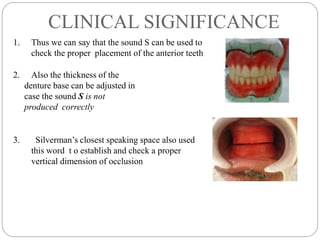
1. Thus we can say that the sound S can be used to
check the proper placement of the anterior teeth
2. Also the thickness of the
denture base can be adjusted in
case the sound S is not
produced correctly
3. Silverman’s closest speaking space also used
this word t o establish and check a proper
vertical dimension of occlusion
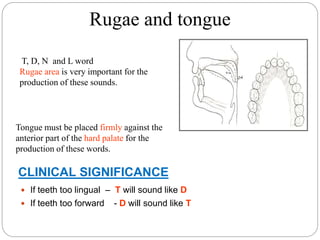
Rugae and tongue
T, D, N and L word
Rugae area is very important for the
production of these sounds.
Tongue must be placed firmly against the
anterior part of the hard palate for the
production of these words.
CLINICAL SIGNIFICANCE
 If teeth too lingual – T will sound like D
 If teeth too forward - D will sound like T
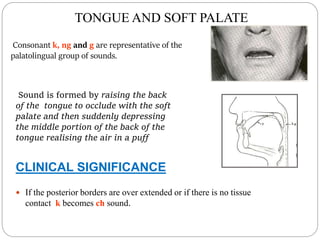
TONGUE AND SOFT PALATE
Consonant k, ng and g are representative of the
palatolingual group of sounds.
Sound is formed by raising the back
of the tongue to occlude with the soft
palate and then suddenly depressing
the middle portion of the back of the
tongue realising the air in a puff
CLINICAL SIGNIFICANCE
 If the posterior borders are over extended or if there is no tissue
contact k becomes ch sound.
LINGUODENTAL SOUNDS
Consonant Th is representative of the linguodental
group of sounds
Dental sounds are made with the tip of the tongue
extending slightly between the upper and lower
anterior teeth.
 Sound is actually made closer to the alveolus (the ridge) than to the tip of
the teeth.
 Careful observation of the amount of tongue that can be seen with the
words - this, that, these and those will provide information as to the
labio-lingual position of the anterior teeth.
CLINICAL SIGNIFICANCE
 If about 3mm of the tip of the tongue is not visible,
the anterior teeth are probably too far forward,
 If more than 6mm of the tongue extends out between
the teeth when such sounds are made, the teeth are
probably too lingual
LABIODENTAL SOUNDS
 F and V are representatives of
the labiodental group of sounds.
 Formed by raising the lower lip
into contact with the incisal
edge of the maxilliary anterior
teeth.
CLINICAL SIGNIFICANCE
Upper anterior teeth are too short (set too high up), V sound will be more
like an F.
If they are too long (set too far down), F will sound more like a V.
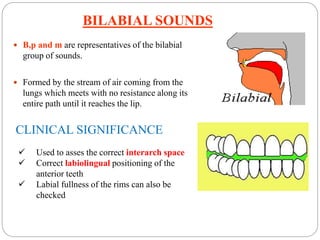
BILABIAL SOUNDS
 B,p and m are representatives of the bilabial
group of sounds.
 Formed by the stream of air coming from the
lungs which meets with no resistance along its
entire path until it reaches the lip.
CLINICAL SIGNIFICANCE
 Used to asses the correct interarch space
 Correct labiolingual positioning of the
anterior teeth
 Labial fullness of the rims can also be
checked
 Also called as the speaking method
determining sliverman closest
speaking space
 Sibiliant sounds like S and M is
used.
 S sound gives the approximate
closest speaking space
 M sound gives us the freeway space
 Approximately 2mm of space must
be there between the two occlusal
rims
PHONETICS IN RECORDING JAW RELATION
1. Thickness of denture
2. Antero-posterior position of teeth
3. Vertical dimension of occlusion
4. Width of dental arch:
5. Relationship of upper teeth to the lower anterior
teeth by “S-POSITION
CLINICAL SIGNIFICANCE OF ‘S’ SOUND
1. Denture thickness and peripheral outline
2. Vertical dimension
3. Occlusal plane
6. Anteroposterior positioning of teeth
5. Post dam area
7. Width of dental arch
4. Relationship of the upper and lower teeth
PROSTHODONTIC IMPLICATION IN DENTURE DESIGN
AFFECTING SPEECH
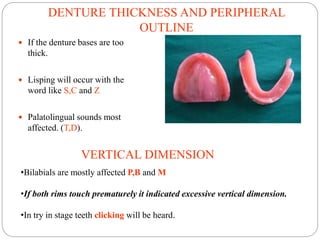
DENTURE THICKNESS AND PERIPHERAL
OUTLINE
 If the denture bases are too
thick.
 Lisping will occur with the
word like S,C and Z
 Palatolingual sounds most
affected. (T,D).
VERTICAL DIMENSION
•Bilabials are mostly affected P,B and M
•If both rims touch prematurely it indicated excessive vertical dimension.
•In try in stage teeth clicking will be heard.
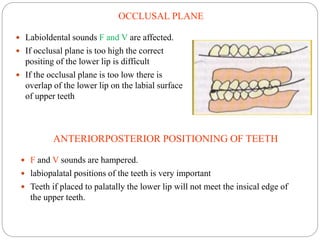
OCCLUSAL PLANE
 Labioldental sounds F and V are affected.
 If occlusal plane is too high the correct
positing of the lower lip is difficult
 If the occlusal plane is too low there is
overlap of the lower lip on the labial surface
of upper teeth
ANTERIORPOSTERIOR POSITIONING OF TEETH
 F and V sounds are hampered.
 labiopalatal positions of the teeth is very important
 Teeth if placed to palatally the lower lip will not meet the insical edge of
the upper teeth.
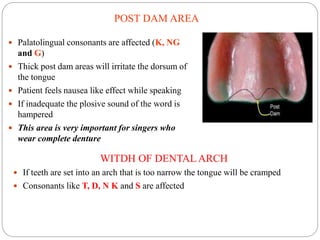
POST DAM AREA
 Palatolingual consonants are affected (K, NG
and G)
 Thick post dam areas will irritate the dorsum of
the tongue
 Patient feels nausea like effect while speaking
 If inadequate the plosive sound of the word is
hampered
 This area is very important for singers who
wear complete denture
WITDH OF DENTAL ARCH
 If teeth are set into an arch that is too narrow the tongue will be cramped
 Consonants like T, D, N K and S are affected
RELATIONSHIP OF THE UPPER AND LOWER INCISORS
 The chief concern is the S
CH, J and Z sound.
 These sounds need a near
contact of the upper and
lower teeth so that the air
stream is allowed to pass.
TERMINLOGIES RELATED TO
SOME SPEECH DISTURBANCES
1. APHASIA (DYSPHASIA): Means defective speech due
to damage of cortical area required for speech making.
(Broca’s area, Wernicke’s area).
2. DYSARTHRIA: Motor speech problems caused, not due
to sensory loss or mental retardation.
3. SPEECH AND LANGUAGE RETARDATION: Delay
in acquistion of communicating skills
REFERENCES
1. John. Sharry. Complete denture Prosthodontics 3rd
edition; Phonetics.
2. Zarb- Bolender:Speech consideration with complete
dentures ;Prosthodontic treatment For Edentulous
Patients.
3. Fenn, Clinical Dental Prosthetics, 3rd edition pg 138.
4. Chierici, Lawson; Clinical speech consideration in
prosthodontics. J Prosthet dent;1973;29;1:29-39.
5. Robert Rothman; Phonetic consideration in denture
prosthesis, J Prosthet Dent;1961;11:214-223).
6. Meyer M Silverman :The speaking method in measuring
vertical dimension; J prosthet dent 1953;3:193-199.

Phonetics

  • 1.
    NORTH BENGAL DENTAL COLLEGE& HOSPITAL PHONETICS IN PROSTHODONTICS By- SK AZIZ IKBAL
  • 2.
    Definition  Speech:- Theexpression of or the ability to express thoughts and feelings, by the articulation of words.  Phonetics:-The branch of linguistics that deals with the sounds of speech and their production, combination, description, and representation by written symbols.
  • 3.
    1. The motor(lungs, associated muscle that supply the air). MECHANISM OF SPEECH PRODUCTION Normal speech depends on proper functioning of 5 essential mechanism 2. The vibrator ( vocal cord that give pitch to the tone). 3. The resonator ( consist of the oral,nasal, pharyngeal cavity and paranasal sinuses).
  • 4.
    4. The enunciatorsor articulators( lip, tongue, palate and teeth) 5. The initiator( motor area of the brain)
  • 5.
    TYPES OF SPEECH 1.VOWELS: a,e,i,o,u. they are voiced sounds,  2.CONSONANTS: may be either voiced or produced without vocal cord vibration, in which case they are called breathed sounds. eg: p, b, m, s, t, r, z etc…  3.COMBINATION: Is blend of a consonant and vowel, articulated in quick succession that they are identified as single phonemes. EX:- WORD
  • 6.
     Consonant soundsare most important from the dental point of view. They may be classified according to the anatomic parts involved in their formation: (1) Palatolingual sounds, formed by tongue and hard or soft palate, (2) Linguodental sounds, formed by the tongue and teeth, (3) Labiodental sounds, formed by the lips and teeth, and (4) Bilabial sounds, formed by the lips. CLASSIFICATION OF CONSONANTS BASED ON THE PLACE OF THEIR PRODUCTION
  • 7.
     PALATOLINGUAL SOUNDSFORMED 1. Tongue and hard palate 2. Tongue and rugae 3. Tongue and soft palate
  • 8.
    TONGUE AND HARDPALATE Word like S,T, D, N and L belong to this category S- the sound ‘s’ as in sixty six- is formed by a hiss of air as it escapes form the median groove of the tongue when the tongue is behind the upper incisor- Sears If groove is decreased s is softened towards sh (Lisping) If groove is deep a whistling will be heard when s is pronounced
  • 9.
    CLINICAL SIGNIFICANCE 1. Thuswe can say that the sound S can be used to check the proper placement of the anterior teeth 2. Also the thickness of the denture base can be adjusted in case the sound S is not produced correctly 3. Silverman’s closest speaking space also used this word t o establish and check a proper vertical dimension of occlusion
  • 10.
    Rugae and tongue T,D, N and L word Rugae area is very important for the production of these sounds. Tongue must be placed firmly against the anterior part of the hard palate for the production of these words. CLINICAL SIGNIFICANCE  If teeth too lingual – T will sound like D  If teeth too forward - D will sound like T
  • 11.
    TONGUE AND SOFTPALATE Consonant k, ng and g are representative of the palatolingual group of sounds. Sound is formed by raising the back of the tongue to occlude with the soft palate and then suddenly depressing the middle portion of the back of the tongue realising the air in a puff CLINICAL SIGNIFICANCE  If the posterior borders are over extended or if there is no tissue contact k becomes ch sound.
  • 12.
    LINGUODENTAL SOUNDS Consonant This representative of the linguodental group of sounds Dental sounds are made with the tip of the tongue extending slightly between the upper and lower anterior teeth.  Sound is actually made closer to the alveolus (the ridge) than to the tip of the teeth.  Careful observation of the amount of tongue that can be seen with the words - this, that, these and those will provide information as to the labio-lingual position of the anterior teeth.
  • 13.
    CLINICAL SIGNIFICANCE  Ifabout 3mm of the tip of the tongue is not visible, the anterior teeth are probably too far forward,  If more than 6mm of the tongue extends out between the teeth when such sounds are made, the teeth are probably too lingual
  • 14.
    LABIODENTAL SOUNDS  Fand V are representatives of the labiodental group of sounds.  Formed by raising the lower lip into contact with the incisal edge of the maxilliary anterior teeth. CLINICAL SIGNIFICANCE Upper anterior teeth are too short (set too high up), V sound will be more like an F. If they are too long (set too far down), F will sound more like a V.
  • 15.
    BILABIAL SOUNDS  B,pand m are representatives of the bilabial group of sounds.  Formed by the stream of air coming from the lungs which meets with no resistance along its entire path until it reaches the lip. CLINICAL SIGNIFICANCE  Used to asses the correct interarch space  Correct labiolingual positioning of the anterior teeth  Labial fullness of the rims can also be checked
  • 16.
     Also calledas the speaking method determining sliverman closest speaking space  Sibiliant sounds like S and M is used.  S sound gives the approximate closest speaking space  M sound gives us the freeway space  Approximately 2mm of space must be there between the two occlusal rims PHONETICS IN RECORDING JAW RELATION
  • 17.
    1. Thickness ofdenture 2. Antero-posterior position of teeth 3. Vertical dimension of occlusion 4. Width of dental arch: 5. Relationship of upper teeth to the lower anterior teeth by “S-POSITION CLINICAL SIGNIFICANCE OF ‘S’ SOUND
  • 18.
    1. Denture thicknessand peripheral outline 2. Vertical dimension 3. Occlusal plane 6. Anteroposterior positioning of teeth 5. Post dam area 7. Width of dental arch 4. Relationship of the upper and lower teeth PROSTHODONTIC IMPLICATION IN DENTURE DESIGN AFFECTING SPEECH
  • 19.
    DENTURE THICKNESS ANDPERIPHERAL OUTLINE  If the denture bases are too thick.  Lisping will occur with the word like S,C and Z  Palatolingual sounds most affected. (T,D). VERTICAL DIMENSION •Bilabials are mostly affected P,B and M •If both rims touch prematurely it indicated excessive vertical dimension. •In try in stage teeth clicking will be heard.
  • 20.
    OCCLUSAL PLANE  Labioldentalsounds F and V are affected.  If occlusal plane is too high the correct positing of the lower lip is difficult  If the occlusal plane is too low there is overlap of the lower lip on the labial surface of upper teeth ANTERIORPOSTERIOR POSITIONING OF TEETH  F and V sounds are hampered.  labiopalatal positions of the teeth is very important  Teeth if placed to palatally the lower lip will not meet the insical edge of the upper teeth.
  • 21.
    POST DAM AREA Palatolingual consonants are affected (K, NG and G)  Thick post dam areas will irritate the dorsum of the tongue  Patient feels nausea like effect while speaking  If inadequate the plosive sound of the word is hampered  This area is very important for singers who wear complete denture WITDH OF DENTAL ARCH  If teeth are set into an arch that is too narrow the tongue will be cramped  Consonants like T, D, N K and S are affected
  • 22.
    RELATIONSHIP OF THEUPPER AND LOWER INCISORS  The chief concern is the S CH, J and Z sound.  These sounds need a near contact of the upper and lower teeth so that the air stream is allowed to pass.
  • 23.
    TERMINLOGIES RELATED TO SOMESPEECH DISTURBANCES 1. APHASIA (DYSPHASIA): Means defective speech due to damage of cortical area required for speech making. (Broca’s area, Wernicke’s area). 2. DYSARTHRIA: Motor speech problems caused, not due to sensory loss or mental retardation. 3. SPEECH AND LANGUAGE RETARDATION: Delay in acquistion of communicating skills
  • 24.
    REFERENCES 1. John. Sharry.Complete denture Prosthodontics 3rd edition; Phonetics. 2. Zarb- Bolender:Speech consideration with complete dentures ;Prosthodontic treatment For Edentulous Patients. 3. Fenn, Clinical Dental Prosthetics, 3rd edition pg 138. 4. Chierici, Lawson; Clinical speech consideration in prosthodontics. J Prosthet dent;1973;29;1:29-39. 5. Robert Rothman; Phonetic consideration in denture prosthesis, J Prosthet Dent;1961;11:214-223). 6. Meyer M Silverman :The speaking method in measuring vertical dimension; J prosthet dent 1953;3:193-199.

Editor's Notes