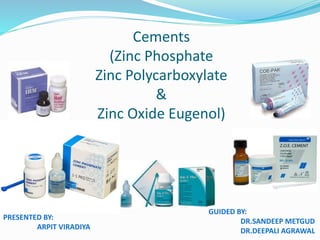

Cements 
(Zinc Phosphate 
Zinc Polycarboxylate 
& 
Zinc Oxide Eugenol) 
PRESENTED BY: 
ARPIT VIRADIYA 
GUIDED BY: 
DR.SANDEEP METGUD 
DR.DEEPALI AGRAWAL
Contents 
• Zinc Phosphate Cement 
• Introduction 
• Composition 
• Setting Reaction 
• Working & Setting 
Time 
• Physical Properties 
• Retention 
• Biological Properties 
• Manipulation 
• Applications 
• Zinc Polycarboxylate 
Cement 
• Introduction 
• Composition 
• Chemical Reaction 
• Bonding to Tooth 
Structure 
• Working & Setting 
Time 
• Mechanical Properties 
• Biological 
Consideration 
• Manipulation 
• Applications 
• Zinc Oxide Eugenol Cement 
• Introduction 
• Classification 
• Composition 
• Setting Reaction 
• Manipulation 
• Physical Properties 
• Biological Properties 
• Polymer reinforced 
ZOE 
• EBA and Alumina 
reinforced ZOE 
• Non Eugenol ZOE 
• Summary & Conclusin 
• References
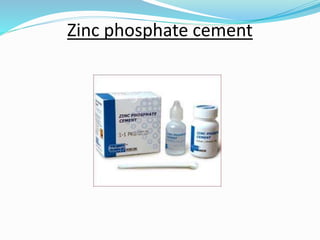
Zinc phosphate cement
Introduction 
• Oldest of the luting cement 
• Longest clinical track record 
• Serves as a standard with which newer materials can 
be compared 
• Supplied as a powder and liquid.
Composition 
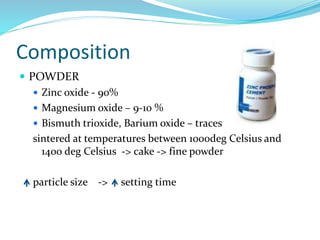
 POWDER 
 Zinc oxide - 90% 
 Magnesium oxide – 9-10 % 
 Bismuth trioxide, Barium oxide – traces 
sintered at temperatures between 1000deg Celsius and 
1400 deg Celsius -> cake -> fine powder 
particle size -> setting time
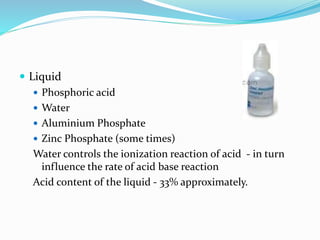
 Liquid 
 Phosphoric acid 
 Water 
 Aluminium Phosphate 
 Zinc Phosphate (some times) 
Water controls the ionization reaction of acid - in turn 
influence the rate of acid base reaction 
Acid content of the liquid - 33% approximately.
SETTING REACTION 
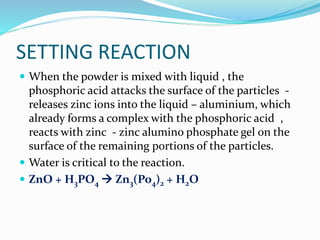
 When the powder is mixed with liquid , the 
phosphoric acid attacks the surface of the particles - 
releases zinc ions into the liquid – aluminium, which 
already forms a complex with the phosphoric acid , 
reacts with zinc - zinc alumino phosphate gel on the 
surface of the remaining portions of the particles. 
 Water is critical to the reaction. 
 ZnO + H3PO4 
 Zn3(Po4)2 + H2O
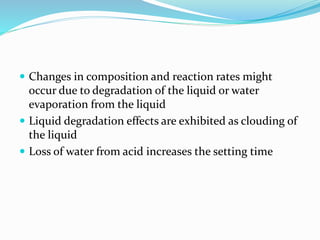
 Changes in composition and reaction rates might 
occur due to degradation of the liquid or water 
evaporation from the liquid 
 Liquid degradation effects are exhibited as clouding of 
the liquid 
 Loss of water from acid increases the setting time
Working and Setting Times 
 Mixing time of 1.5 – 2 mins 
 Setting time – 2.5 – 8 mins 
 The following procedures can extend the setting time 
 Reducing P/L ratio 
 Mixing in increments 
 Prolonging the spatulation of last increment. 
 Cooling the glass slab
Physical Properties 
 Compressive strength :104MPa 
 Tensile strength:5.5MPa 
 Thermal conductivity : 3.11 mcal.cm/cm2.sec.K 
 Low water solubility 0.04wt% 
 More soluble in dilute organic acids 
 Modulus of elasticity:13.7GPa 
 Quiet stiff & resistant to elastic deformation 
Loss/Gain water content compressive tensile strength.
Retention 
Doesn’t involve reaction with surrounding hard 
tissue/restorative material 
No chemical interactions 
Mechanical bonding at interfaces
Biological Properties 
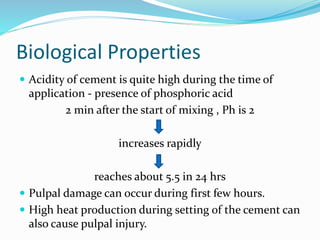
 Acidity of cement is quite high during the time of 
application - presence of phosphoric acid 
2 min after the start of mixing , Ph is 2 
increases rapidly 
reaches about 5.5 in 24 hrs 
 Pulpal damage can occur during first few hours. 
 High heat production during setting of the cement can 
also cause pulpal injury.
Manipulation 
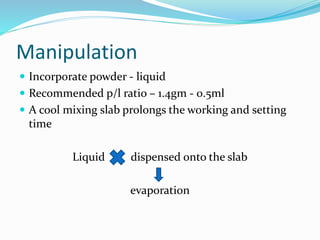
 Incorporate powder - liquid 
 Recommended p/l ratio – 1.4gm - 0.5ml 
 A cool mixing slab prolongs the working and setting 
time 
Liquid dispensed onto the slab 
evaporation
 Powder -several increments 
 spatulated : 15 – 20 secs 
 smaller quantities - first few 
increments – working - setting time. 
 middle of the mixing – larger amounts 
of powder– to further saturate the 
liquid with newly formed zinc 
phosphate. 
 Finally , smaller increments are added 
– so that the desired ultimate 
consistency of the cement is not 
exceeded 
 begins & ends with small increments
Applications 
 Luting permanent restorations 
 Bases 
 Cementation of orthodontic bands 
 Provisional restoration
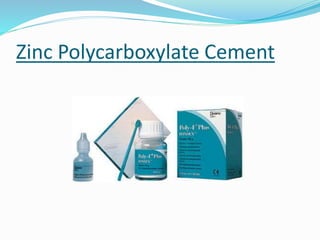
Zinc Polycarboxylate Cement
Introduction 
 Zinc polyacrylate cement 
 First - adhesive bond to tooth structure. 
 Supplied as 
 Powder and liquid
Composition 
 Powder 
Zinc oxide – 72% Basic ingredient 
Magnesium oxide – 7% Modifier , aids in sintering 
Other oxides like bismuth 
and aluminium 
Stannous fluoride 
Increase strength, modifies 
setting time, imparts 
anticariogenic properties
 Liquid 
 Liqueous solution of polyacrylic acid (32-48%) 
Or 
 Copolymer of acrylic acid with other unsaturated 
carboxylic acids (itaconic , maleic , tricarballylic acids) 
 Molecular weight – 25,000 – 50,000
Chemical reaction 
 When acid comes in contact with powder , acid reacts 
and releases zinc, magnesium, and tin ions 
 They bond to the polymer chain , through the carboxyl 
groups 
 These ions also react with carboxylic groups of 
adjacent poly acid chains 
 Cross inked salts are formed
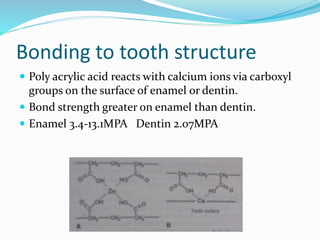
Bonding to tooth structure 
 Poly acrylic acid reacts with calcium ions via carboxyl 
groups on the surface of enamel or dentin. 
 Bond strength greater on enamel than dentin. 
 Enamel 3.4-13.1MPA Dentin 2.07MPA
Working and Setting time 
 Working time : 2.5 min 
 Setting time : 6-9 min 
 Lowering the temperature of chemical reaction can 
increase the setting time.
Mechanical Properties 
 Comprssive strength : 55-67 Mpa 
 Tensile strength : 2.4-4.4 Gpa 
 Modules of elasticity is lower then zinc phosphate 
cement 5.1GPa 
 More soluble than zinc phosphate cement 0.06% 
 More soluble in organic acids. 
 Not as brittle as zinc phosphate cement 
 Excess removal is difficult.
Biological Consideration 
 Pulpal response termed as mild 
 Ph of liquid is 1- 1.7 
 Freshly mixed cement – 3-4 
 After 24 hrs – 5 -6
Manipulation 
 A cooled glass slab / powder 
 1.5 parts of powder to 1 part of liquid by weight 
 Liquid not dispensed , before the start 
 Loss of water, increases viscosity 
 Powder is rapidly incorporated into the liquid in large 
quantities 
 Mixing time is with in 30 – 60 sec ,with half to all of 
powder incorporated at once to provide the maximum 
length of working time 
 Surface - glossy , acid present to provide sufficient 
carboxylic groups to bond.
Glossy Appearance 
Dull Appearance
Applications 
 Primarily for luting permanent restorations 
 As bases and liners 
 Cementation in orthodontic treatment
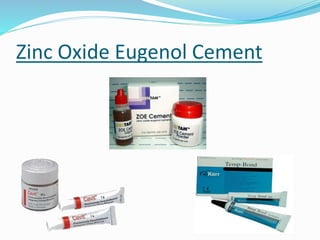
Zinc Oxide Eugenol Cement
Introduction 
 These cements have been extensively used in dentistry 
since 1890’ s 
 They are least irritant of all dental cements 
 Have an obtundant or sedative effect 
 Compatible with the hard and soft tissues of the 
mouth
Classification 
 Type 1 ZOE – for temporary cementation 
 Type 2 ZOE – permanent cementation 
 Type 3 ZOE – temporary filling material , thermal 
insulation 
 Type 4 ZOE – Cavity liners
Composition 
 Powder 
Zinc oxide – 69% Principle ingredient 
White rosin – 
29.3% 
Reduce brittleness 
Zinc stearate – 1% Accelerator , plasticizer 
Zinc acetate – 
0.7% 
Accelerator , improves strength 
Magnesium oxide Added in some powders
 Liquid: 
 Eugenol – 85% - reacts with zinc oxide 
 Olive oil – 15% - plasticizer
Setting reaction 
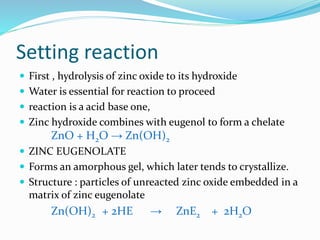
 First , hydrolysis of zinc oxide to its hydroxide 
 Water is essential for reaction to proceed 
 reaction is a acid base one, 
 Zinc hydroxide combines with eugenol to form a chelate 
ZnO + H2O → Zn(OH)2 
 ZINC EUGENOLATE 
 Forms an amorphous gel, which later tends to crystallize. 
 Structure : particles of unreacted zinc oxide embedded in a 
matrix of zinc eugenolate 
Zn(OH)2 + 2HE → ZnE2 + 2H2O
Manipulation 
 p/l ratio 4:1 to 6:1 by wt 
 the bulk - incorporated into the liquid -spatulated 
thoroughly in a circular motion - a stiff bladed spatula 
 Small increments - until the mix is complete – 
consistency
 Setting time - 4-10 mins 
 Complete setting reaction between zinc oxide and eugenol 
takes about 12 hrs 
Factors affecting setting time: 
 Particle size – smaller particle size, set faster 
 Accelerators – alcohol , glacial acetic acid , and small 
amounts of water 
 Retarders – glycol, glycerine 
 Temperature – high temperature , accelerate setting 
 Powder/ liquid ratio – higher the ratio, faster the set
Physical properties 
 Relatively week cements 
 Compressive strength : Ranges from 3-4mpa to 50- 
55mpa 
 Tensile strength : 0.32 to 5.8mpa 
 Modules of elasticity : 0.22 – 5.4 mpa 
 Excellent thermal conductivity 
 Solubility of the set cement is high - disintegrate in 
oral fluids - Solubility is reduced by increasing p/l 
ratio
Biological properties 
 Least irritating of all dental cements 
 Ph is 6.6 – 8 
 Pulp response is termed as mild 
 They inhibit the growth of bacteria , have an anodyne 
or soothing effect on pulp , in deep cavities, hence 
reduces pain
Modified Materials 
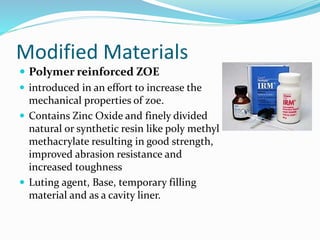
 Polymer reinforced ZOE 
 introduced in an effort to increase the 
mechanical properties of zoe. 
 Contains Zinc Oxide and finely divided 
natural or synthetic resin like poly methyl 
methacrylate resulting in good strength, 
improved abrasion resistance and 
increased toughness 
 Luting agent, Base, temporary filling 
material and as a cavity liner.
 EBA and alumina modified ZOE cement 
 Powder : 
 ZnO 70% 
 Alumina 30% 
 Liquid: 
 EBA 62.5% 
 Eugenol 37.5% 
Properties are better than unmodified zoe 
Compressive strength increased 55 mpa 
Tensile strength – 4.1mpa 
Modulus of elasticity – 2.5 gpa 
Solubility and disintegration – 0.05% wt
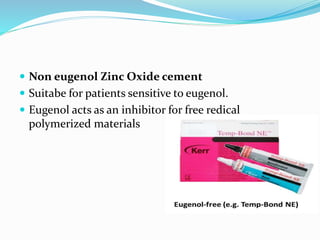
 Non eugenol Zinc Oxide cement 
 Suitabe for patients sensitive to eugenol. 
 Eugenol acts as an inhibitor for free redical 
polymerized materials
 ZOE based periodontal pack 
 It protects the wound from 
mechanical trauma and 
stabilize the surgical site. 
 It also prevents post operative 
hemorrhage and infection; 
decreases tooth 
hypersensitivity in first few 
hours after suurgery.
Conclusion 
 Though cements are used in small quantities in oral 
cavity, it should be used with at most care, as it is very 
important. There are innumerable cements present 
with different properties, one should know all the 
properties to use it in order to give a successful 
restoration to the patient
References 
 PHILLIPS , SCIENCE OF DENTAL MATERIALS 
 11TH EDITION 
 CRAIG’ S RESTORAIVE DENTAL MATERIALS 
 12TH EDITION 
 STURDEVANTS ART AND SCIENCE OF OPERATIVE 
DENTISTRY 
 5TH EDITION 
 DENTAL CLINICS OF NORTH AMERICA 
 JULY 2007 51:3 SAUNDERS 
 DENTAL CLINICS OF NORTH AMERICA 
 OCTOBER 1983 27:4 SAUNDERS
THANK YOU

Dental Cements

  • 1.
    Cements (Zinc Phosphate Zinc Polycarboxylate & Zinc Oxide Eugenol) PRESENTED BY: ARPIT VIRADIYA GUIDED BY: DR.SANDEEP METGUD DR.DEEPALI AGRAWAL
  • 2.
    Contents • ZincPhosphate Cement • Introduction • Composition • Setting Reaction • Working & Setting Time • Physical Properties • Retention • Biological Properties • Manipulation • Applications • Zinc Polycarboxylate Cement • Introduction • Composition • Chemical Reaction • Bonding to Tooth Structure • Working & Setting Time • Mechanical Properties • Biological Consideration • Manipulation • Applications • Zinc Oxide Eugenol Cement • Introduction • Classification • Composition • Setting Reaction • Manipulation • Physical Properties • Biological Properties • Polymer reinforced ZOE • EBA and Alumina reinforced ZOE • Non Eugenol ZOE • Summary & Conclusin • References
  • 3.
  • 4.
    Introduction • Oldestof the luting cement • Longest clinical track record • Serves as a standard with which newer materials can be compared • Supplied as a powder and liquid.
  • 5.
    Composition  POWDER  Zinc oxide - 90%  Magnesium oxide – 9-10 %  Bismuth trioxide, Barium oxide – traces sintered at temperatures between 1000deg Celsius and 1400 deg Celsius -> cake -> fine powder particle size -> setting time
  • 6.
     Liquid Phosphoric acid  Water  Aluminium Phosphate  Zinc Phosphate (some times) Water controls the ionization reaction of acid - in turn influence the rate of acid base reaction Acid content of the liquid - 33% approximately.
  • 7.
    SETTING REACTION When the powder is mixed with liquid , the phosphoric acid attacks the surface of the particles - releases zinc ions into the liquid – aluminium, which already forms a complex with the phosphoric acid , reacts with zinc - zinc alumino phosphate gel on the surface of the remaining portions of the particles.  Water is critical to the reaction.  ZnO + H3PO4  Zn3(Po4)2 + H2O
  • 8.
     Changes incomposition and reaction rates might occur due to degradation of the liquid or water evaporation from the liquid  Liquid degradation effects are exhibited as clouding of the liquid  Loss of water from acid increases the setting time
  • 9.
    Working and SettingTimes  Mixing time of 1.5 – 2 mins  Setting time – 2.5 – 8 mins  The following procedures can extend the setting time  Reducing P/L ratio  Mixing in increments  Prolonging the spatulation of last increment.  Cooling the glass slab
  • 10.
    Physical Properties Compressive strength :104MPa  Tensile strength:5.5MPa  Thermal conductivity : 3.11 mcal.cm/cm2.sec.K  Low water solubility 0.04wt%  More soluble in dilute organic acids  Modulus of elasticity:13.7GPa  Quiet stiff & resistant to elastic deformation Loss/Gain water content compressive tensile strength.
  • 11.
    Retention Doesn’t involvereaction with surrounding hard tissue/restorative material No chemical interactions Mechanical bonding at interfaces
  • 12.
    Biological Properties Acidity of cement is quite high during the time of application - presence of phosphoric acid 2 min after the start of mixing , Ph is 2 increases rapidly reaches about 5.5 in 24 hrs  Pulpal damage can occur during first few hours.  High heat production during setting of the cement can also cause pulpal injury.
  • 13.
    Manipulation  Incorporatepowder - liquid  Recommended p/l ratio – 1.4gm - 0.5ml  A cool mixing slab prolongs the working and setting time Liquid dispensed onto the slab evaporation
  • 14.
     Powder -severalincrements  spatulated : 15 – 20 secs  smaller quantities - first few increments – working - setting time.  middle of the mixing – larger amounts of powder– to further saturate the liquid with newly formed zinc phosphate.  Finally , smaller increments are added – so that the desired ultimate consistency of the cement is not exceeded  begins & ends with small increments
  • 15.
    Applications  Lutingpermanent restorations  Bases  Cementation of orthodontic bands  Provisional restoration
  • 16.
  • 17.
    Introduction  Zincpolyacrylate cement  First - adhesive bond to tooth structure.  Supplied as  Powder and liquid
  • 18.
    Composition  Powder Zinc oxide – 72% Basic ingredient Magnesium oxide – 7% Modifier , aids in sintering Other oxides like bismuth and aluminium Stannous fluoride Increase strength, modifies setting time, imparts anticariogenic properties
  • 19.
     Liquid Liqueous solution of polyacrylic acid (32-48%) Or  Copolymer of acrylic acid with other unsaturated carboxylic acids (itaconic , maleic , tricarballylic acids)  Molecular weight – 25,000 – 50,000
  • 20.
    Chemical reaction When acid comes in contact with powder , acid reacts and releases zinc, magnesium, and tin ions  They bond to the polymer chain , through the carboxyl groups  These ions also react with carboxylic groups of adjacent poly acid chains  Cross inked salts are formed
  • 21.
    Bonding to toothstructure  Poly acrylic acid reacts with calcium ions via carboxyl groups on the surface of enamel or dentin.  Bond strength greater on enamel than dentin.  Enamel 3.4-13.1MPA Dentin 2.07MPA
  • 22.
    Working and Settingtime  Working time : 2.5 min  Setting time : 6-9 min  Lowering the temperature of chemical reaction can increase the setting time.
  • 23.
    Mechanical Properties Comprssive strength : 55-67 Mpa  Tensile strength : 2.4-4.4 Gpa  Modules of elasticity is lower then zinc phosphate cement 5.1GPa  More soluble than zinc phosphate cement 0.06%  More soluble in organic acids.  Not as brittle as zinc phosphate cement  Excess removal is difficult.
  • 24.
    Biological Consideration Pulpal response termed as mild  Ph of liquid is 1- 1.7  Freshly mixed cement – 3-4  After 24 hrs – 5 -6
  • 25.
    Manipulation  Acooled glass slab / powder  1.5 parts of powder to 1 part of liquid by weight  Liquid not dispensed , before the start  Loss of water, increases viscosity  Powder is rapidly incorporated into the liquid in large quantities  Mixing time is with in 30 – 60 sec ,with half to all of powder incorporated at once to provide the maximum length of working time  Surface - glossy , acid present to provide sufficient carboxylic groups to bond.
  • 26.
  • 27.
    Applications  Primarilyfor luting permanent restorations  As bases and liners  Cementation in orthodontic treatment
  • 28.
  • 29.
    Introduction  Thesecements have been extensively used in dentistry since 1890’ s  They are least irritant of all dental cements  Have an obtundant or sedative effect  Compatible with the hard and soft tissues of the mouth
  • 30.
    Classification  Type1 ZOE – for temporary cementation  Type 2 ZOE – permanent cementation  Type 3 ZOE – temporary filling material , thermal insulation  Type 4 ZOE – Cavity liners
  • 31.
    Composition  Powder Zinc oxide – 69% Principle ingredient White rosin – 29.3% Reduce brittleness Zinc stearate – 1% Accelerator , plasticizer Zinc acetate – 0.7% Accelerator , improves strength Magnesium oxide Added in some powders
  • 32.
     Liquid: Eugenol – 85% - reacts with zinc oxide  Olive oil – 15% - plasticizer
  • 33.
    Setting reaction First , hydrolysis of zinc oxide to its hydroxide  Water is essential for reaction to proceed  reaction is a acid base one,  Zinc hydroxide combines with eugenol to form a chelate ZnO + H2O → Zn(OH)2  ZINC EUGENOLATE  Forms an amorphous gel, which later tends to crystallize.  Structure : particles of unreacted zinc oxide embedded in a matrix of zinc eugenolate Zn(OH)2 + 2HE → ZnE2 + 2H2O
  • 34.
    Manipulation  p/lratio 4:1 to 6:1 by wt  the bulk - incorporated into the liquid -spatulated thoroughly in a circular motion - a stiff bladed spatula  Small increments - until the mix is complete – consistency
  • 36.
     Setting time- 4-10 mins  Complete setting reaction between zinc oxide and eugenol takes about 12 hrs Factors affecting setting time:  Particle size – smaller particle size, set faster  Accelerators – alcohol , glacial acetic acid , and small amounts of water  Retarders – glycol, glycerine  Temperature – high temperature , accelerate setting  Powder/ liquid ratio – higher the ratio, faster the set
  • 37.
    Physical properties Relatively week cements  Compressive strength : Ranges from 3-4mpa to 50- 55mpa  Tensile strength : 0.32 to 5.8mpa  Modules of elasticity : 0.22 – 5.4 mpa  Excellent thermal conductivity  Solubility of the set cement is high - disintegrate in oral fluids - Solubility is reduced by increasing p/l ratio
  • 38.
    Biological properties Least irritating of all dental cements  Ph is 6.6 – 8  Pulp response is termed as mild  They inhibit the growth of bacteria , have an anodyne or soothing effect on pulp , in deep cavities, hence reduces pain
  • 39.
    Modified Materials Polymer reinforced ZOE  introduced in an effort to increase the mechanical properties of zoe.  Contains Zinc Oxide and finely divided natural or synthetic resin like poly methyl methacrylate resulting in good strength, improved abrasion resistance and increased toughness  Luting agent, Base, temporary filling material and as a cavity liner.
  • 40.
     EBA andalumina modified ZOE cement  Powder :  ZnO 70%  Alumina 30%  Liquid:  EBA 62.5%  Eugenol 37.5% Properties are better than unmodified zoe Compressive strength increased 55 mpa Tensile strength – 4.1mpa Modulus of elasticity – 2.5 gpa Solubility and disintegration – 0.05% wt
  • 41.
     Non eugenolZinc Oxide cement  Suitabe for patients sensitive to eugenol.  Eugenol acts as an inhibitor for free redical polymerized materials
  • 42.
     ZOE basedperiodontal pack  It protects the wound from mechanical trauma and stabilize the surgical site.  It also prevents post operative hemorrhage and infection; decreases tooth hypersensitivity in first few hours after suurgery.
  • 43.
    Conclusion  Thoughcements are used in small quantities in oral cavity, it should be used with at most care, as it is very important. There are innumerable cements present with different properties, one should know all the properties to use it in order to give a successful restoration to the patient
  • 44.
    References  PHILLIPS, SCIENCE OF DENTAL MATERIALS  11TH EDITION  CRAIG’ S RESTORAIVE DENTAL MATERIALS  12TH EDITION  STURDEVANTS ART AND SCIENCE OF OPERATIVE DENTISTRY  5TH EDITION  DENTAL CLINICS OF NORTH AMERICA  JULY 2007 51:3 SAUNDERS  DENTAL CLINICS OF NORTH AMERICA  OCTOBER 1983 27:4 SAUNDERS
  • 45.