DENTAL AMALGAM
DR ASHWINI M PATIL
Reader
Navodaya dental college
Raichur
⚫Amalgam—Analloycontaining mercury.
⚫Dental amalgam—Analloy that is formed by reacting
mercury with silver, copper, and tin, and which may
also contain palladium, zinc, and other elements to
improve handling characteristics and clinical
performance.
⚫Dental amalgamalloy (alloy fordental
amalgam)—Analloyof silver, copper, tin, and other
elements that is processed in the form of powder
particlesoras a compressed pellet.
amalgam alloys
irregularly
shaped
as
spherical
particles
as a
mixture of
both lathe-
cut and
spherical
particles
composition of amalgam alloy:
⚫Low-Copper Alloys
Silver-tin alloys are quite brittle and difficult to blend
uniformly unless a small amount of copper is
substituted for silver. Within the limited range of
coppersolubility, an increased coppercontent hardens
and strengthens the silvertin alloy.
High-Copper Alloys
⚫The first high-copperalloy
This modification raises thecoppercontent to 11.8%
byweight. This is often called “dispersed-phasealloy”
or “admixed high-copperalloy.”
⚫A second typeof high-copperalloy
This processyieldsa singlecomposition system. The
coppercontentof thisgroupof alloyscan beas
high as 30% byweight.
Gallium-Based Alloys
In an attempttoeliminate mercury from direct
metallicrestorative materials.
gallium , has been considered as a substitute
which is also a liquid when alloyed with indium
and tin at room temperature. Like mercury, this
metal element can be triturated with alloys for
high-copperamalgam.
POWDER CONFIGURATION
⚫the physical configuration and condition of the
particles will have a significant influence on the
setting process.
Lathe-Cut Powder versus Spherical
Powder
⚫Amalgams made from lathe-cut powdersoradmixed
powders tend to resist condensation better than
amalgams made entirely from spherical
powders.(why?)
⚫Spherical alloys require less mercury than typical
lathe-cutalloys(why?)
Particle Size
⚫Smaller particles greatly increase the surface area per
unitvolumeof the powder. A powdercontaining tiny
particles requires agreateramountof mercury to form
an acceptableamalgam.
⚫During carving, the larger particles may be pulled out
of the matrix, producing a rough surface. Such a
surface is probably moresusceptibletocorrosion than
a smooth surface. A smalleraverage particlesize tends
to produce a more rapid hardening of the amalgam
with greaterearly strength.
⚫The physical propertiesof the hardened amalgam depend on
the relative percentagesof each of the microstructural
phases.
⚫The greater the numberof unconsumed Ag-Sn particles
retained in the final structure, the strongertheamalgam will
be.
⚫The γ2 phase is the weakest and least stable in a corrosive
environment and may suffer corrosion attack especially in
crevicesof the restorations.
⚫ the addition of more than 6% of copper by weight can
reduceoreliminate theγ2 phase by formation of the Cu-Sn
phase.
Clinical manipulation of amalgam
for restorations
⚫The amountof alloyand mercury to be used can be
described as the mercury/alloy ratio.
⚫The mercury content of the lathe-cut alloy is about
50% byweightand that forspherical alloys is 42% by
weight.
Triturators
⚫A trituratorshould be used at the speed recommended
by thealloy manufacturer.
⚫For a given alloy and mercury/ alloy ratio, increased
trituration timeand/orspeed shorten theworking and
setting times.
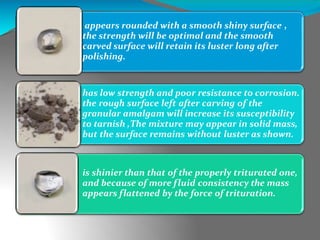
appears rounded with a smooth shiny surface ,
the strength will be optimal and the smooth
carved surface will retain its luster long after
polishing.
has low strength and poor resistance to corrosion.
the rough surface left after carving of the
granular amalgam will increase its susceptibility
to tarnish ,The mixture may appear in solid mass,
but the surface remains without luster as shown.
is shinier than that of the properly triturated one,
and because of more fluid consistency the mass
appears flattened by the force of trituration.
Condensation
⚫The goal of condensation is to compact the alloy into the
prepared cavity so that the greatest possible density is
attained, This results from a reductionof excess mercuryand
porositywithin the setamalgam.
⚫The field of operation must be keptabsolutelydry during
condensation.
⚫ Sufficient pressureshould be used toremovevoidsand to
adapt the material to thewalls.
⚫The longer the time thatelapses between mixing and
condensation, theweaker theamalgam will be(why?)
Carving and finishing
⚫The objectiveof carving is tosimulate theanatomy
ratherthan to reproduceextremely fine
details.(why?)
⚫Carving should not be started until theamalgam is
hard enough to offer resistance to the carving
instrument. (why? )
PROPERTIES OF AMALGAM
1-dimensional stability
⚫Amalgamcan expand orcontract, depending on its
manipulation.
⚫ Severecontractioncan lead to microleakage , plaque
accumulation, and secondarycaries.
⚫Excessive expansion can produce pressure on the pulp and
postoperativesensitivity. Protrusionof a filling can also result
from excessiveexpansion.
⚫expansion will occur if sufficient mercury is present in the
mix.
⚫manipulation with less mercury in the mix, as occurs for
lower mercury/alloy ratios and higher condensation
pressures, will favorcontraction. In addition, manipulative
procedures that accelerate setting and consumption of
mercuryalso favorcontraction, including longertrituration
timesand useof smalleralloy particles.
⚫What isdelayed expansionorsecondary
expansion?
⚫When a zinc-containing, low-copperor high-copper
amalgam is contaminated by moistureduring
triturationorcondensation, a largeexpansion can take
place. This expansion usually starts 3 to 5 days after
placement and may continue for months, reaching
valuesgreater than 400 μm/cm (4%) .
2-strength
⚫The strengthof amalgam is more than adequate
under compressive loads. However, amalgam is
muchweaker in tension than in compression.
⚫Morecommonare defects at the margins of
amalgams.
factors
affecting
amalgam
strength :
Trituration
Mercury
Content
Condensation
Porosity
Amalgam
Hardening
Rate
3-creep
⚫occurswhen a solid material slowlydeforms plastically
underthe influence of stresses.
⚫Creep rate has been found tocorrelatewith marginal
breakdown of conventional low-copperamalgams;
that is, the higher theamountof creep, thegreater is
thedegree of marginal deterioration.
4-tarnish and corrosion resistance
⚫tendency toward tarnish, does notaffector hange the
mechanical propertiesof theamalgam.
⚫ Corrosion, on theother hand, has a negativeeffecton the
properties.
⚫Every effort should be made to produce a smooth,
homogeneous surface on a restoration in order to
minimize tarnish and corrosion.
⚫ Whenevera gold restoration is placed in contactwith an
amalgam, corrosion of the amalgam can be expected as a
result of the large differences in electromotive force
(EMF) of the two materials. The corrosion process can
liberate free mercury, which can contaminateand weaken
the gold restoration. Biological effects such as galvanism
can also result.
Clinical performance of amalgam
restorations
⚫Amalgam does not adhere to the tooth structure. At best it
affordsonlya reasonablycloseadaptation to thewallsof the
prepared cavity. For this reason cavity varnishes are used to
reduce thegross leakage thatoccursaround a new filling.
⚫The useof dentin bonding agents with amalgam is another
relatively new method toreduce microleakage.
⚫If theamalgam is properly inserted, leakagedecreases as the
restorationages in the mouth.(how?)
marginal breakdown
⚫Although theditching of a margin may not have progressed
to the pointwhere secondarycaries may havedeveloped, the
restoration is unsightly and further deterioration may be
anticipated.
Survival of amalgam restorations
⚫ The median survival times forposterioramalgam
restorationswere 7 to 15 years in general practices. Larger,
morecomplex restorations fall within the lowerrange.
Repaired amalgam restorations
⚫The important factorrelated to thequalityof theamalgam
repair is the interfacial bond between the new and the
existing amalgam.
⚫The surface of an old amalgam to be bonded should be
roughened to removecorrosionand salivacontaminantsand
freed of loosedebris.
⚫ When a freshly triturated amalgam is condensed directly
onto the roughened surfaceof an existing amalgam, the
flexural strength of the repaired structurecan reach 50% of
thatof unrepaired amalgam.
⚫Making a sloton theexisting amalgam toestablish
mechanical interlocking between the two materialsalso
improves thequalityof the repair joint.
⚫Another repair option for areas that exhibit minor marginal
breakdown—gaps thatare 250 μm or less in width—is toetch
the enamel adjacent to the restoration and, after rinsing and
drying the marginal gap area, sealing the gap with a dentin
bonding adhesive.
⚫When secondarycaries is diagnosed, it inevitably requires
the replacement of the restoration, but an alternative
treatment is to remove part of the restoration to the full
depth at the siteof thedefect.
⚫The repair should be attempted only if the area
involved is one that will not be subjected to high
stresses orone in which the two restorationparts
areadequatelysupported and retained.
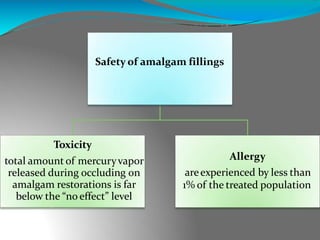
Safety of amalgam fillings
Toxicity
total amount of mercuryvapor
released during occluding on
amalgam restorations is far
below the “no effect” level
Allergy
areexperienced by less than
1% of the treated population
Mercury hygiene in dental offices
⚫Theoperatory should bewell ventilated.
⚫ All excess should becollected and stored in well-sealed
containers.
⚫Properdisposal through reputabledental vendors is
mandatory topreventenvironment pollution.
⚫ The useof an ultrasonicamalgam condenser is not
recommended.
⚫Instrumentscan be used thatyield a time-weighted average
for mercuryexposure tosample theair in theoperatory.
⚫Film badges are also available that can be worn by office
personnel in a mannersimilar toradiation exposure badges.
⚫Biological determinationscan be performed on officestaff to
measure mercury levels in blood or urine.

dentalamalgam.pptx

  • 1.
    DENTAL AMALGAM DR ASHWINIM PATIL Reader Navodaya dental college Raichur
  • 2.
    ⚫Amalgam—Analloycontaining mercury. ⚫Dental amalgam—Analloythat is formed by reacting mercury with silver, copper, and tin, and which may also contain palladium, zinc, and other elements to improve handling characteristics and clinical performance. ⚫Dental amalgamalloy (alloy fordental amalgam)—Analloyof silver, copper, tin, and other elements that is processed in the form of powder particlesoras a compressed pellet.
  • 3.
  • 4.
    composition of amalgamalloy: ⚫Low-Copper Alloys Silver-tin alloys are quite brittle and difficult to blend uniformly unless a small amount of copper is substituted for silver. Within the limited range of coppersolubility, an increased coppercontent hardens and strengthens the silvertin alloy.
  • 5.
    High-Copper Alloys ⚫The firsthigh-copperalloy This modification raises thecoppercontent to 11.8% byweight. This is often called “dispersed-phasealloy” or “admixed high-copperalloy.” ⚫A second typeof high-copperalloy This processyieldsa singlecomposition system. The coppercontentof thisgroupof alloyscan beas high as 30% byweight.
  • 6.
    Gallium-Based Alloys In anattempttoeliminate mercury from direct metallicrestorative materials. gallium , has been considered as a substitute which is also a liquid when alloyed with indium and tin at room temperature. Like mercury, this metal element can be triturated with alloys for high-copperamalgam.
  • 7.
    POWDER CONFIGURATION ⚫the physicalconfiguration and condition of the particles will have a significant influence on the setting process.
  • 8.
    Lathe-Cut Powder versusSpherical Powder ⚫Amalgams made from lathe-cut powdersoradmixed powders tend to resist condensation better than amalgams made entirely from spherical powders.(why?) ⚫Spherical alloys require less mercury than typical lathe-cutalloys(why?)
  • 9.
    Particle Size ⚫Smaller particlesgreatly increase the surface area per unitvolumeof the powder. A powdercontaining tiny particles requires agreateramountof mercury to form an acceptableamalgam. ⚫During carving, the larger particles may be pulled out of the matrix, producing a rough surface. Such a surface is probably moresusceptibletocorrosion than a smooth surface. A smalleraverage particlesize tends to produce a more rapid hardening of the amalgam with greaterearly strength.
  • 10.
    ⚫The physical propertiesofthe hardened amalgam depend on the relative percentagesof each of the microstructural phases. ⚫The greater the numberof unconsumed Ag-Sn particles retained in the final structure, the strongertheamalgam will be. ⚫The γ2 phase is the weakest and least stable in a corrosive environment and may suffer corrosion attack especially in crevicesof the restorations. ⚫ the addition of more than 6% of copper by weight can reduceoreliminate theγ2 phase by formation of the Cu-Sn phase.
  • 11.
    Clinical manipulation ofamalgam for restorations ⚫The amountof alloyand mercury to be used can be described as the mercury/alloy ratio. ⚫The mercury content of the lathe-cut alloy is about 50% byweightand that forspherical alloys is 42% by weight.
  • 12.
    Triturators ⚫A trituratorshould beused at the speed recommended by thealloy manufacturer. ⚫For a given alloy and mercury/ alloy ratio, increased trituration timeand/orspeed shorten theworking and setting times.
  • 13.
    appears rounded witha smooth shiny surface , the strength will be optimal and the smooth carved surface will retain its luster long after polishing. has low strength and poor resistance to corrosion. the rough surface left after carving of the granular amalgam will increase its susceptibility to tarnish ,The mixture may appear in solid mass, but the surface remains without luster as shown. is shinier than that of the properly triturated one, and because of more fluid consistency the mass appears flattened by the force of trituration.
  • 14.
    Condensation ⚫The goal ofcondensation is to compact the alloy into the prepared cavity so that the greatest possible density is attained, This results from a reductionof excess mercuryand porositywithin the setamalgam. ⚫The field of operation must be keptabsolutelydry during condensation. ⚫ Sufficient pressureshould be used toremovevoidsand to adapt the material to thewalls. ⚫The longer the time thatelapses between mixing and condensation, theweaker theamalgam will be(why?)
  • 15.
    Carving and finishing ⚫Theobjectiveof carving is tosimulate theanatomy ratherthan to reproduceextremely fine details.(why?) ⚫Carving should not be started until theamalgam is hard enough to offer resistance to the carving instrument. (why? )
  • 17.
    PROPERTIES OF AMALGAM 1-dimensionalstability ⚫Amalgamcan expand orcontract, depending on its manipulation. ⚫ Severecontractioncan lead to microleakage , plaque accumulation, and secondarycaries. ⚫Excessive expansion can produce pressure on the pulp and postoperativesensitivity. Protrusionof a filling can also result from excessiveexpansion.
  • 18.
    ⚫expansion will occurif sufficient mercury is present in the mix. ⚫manipulation with less mercury in the mix, as occurs for lower mercury/alloy ratios and higher condensation pressures, will favorcontraction. In addition, manipulative procedures that accelerate setting and consumption of mercuryalso favorcontraction, including longertrituration timesand useof smalleralloy particles.
  • 19.
    ⚫What isdelayed expansionorsecondary expansion? ⚫Whena zinc-containing, low-copperor high-copper amalgam is contaminated by moistureduring triturationorcondensation, a largeexpansion can take place. This expansion usually starts 3 to 5 days after placement and may continue for months, reaching valuesgreater than 400 μm/cm (4%) .
  • 20.
    2-strength ⚫The strengthof amalgamis more than adequate under compressive loads. However, amalgam is muchweaker in tension than in compression. ⚫Morecommonare defects at the margins of amalgams.
  • 21.
  • 22.
    3-creep ⚫occurswhen a solidmaterial slowlydeforms plastically underthe influence of stresses. ⚫Creep rate has been found tocorrelatewith marginal breakdown of conventional low-copperamalgams; that is, the higher theamountof creep, thegreater is thedegree of marginal deterioration.
  • 23.
    4-tarnish and corrosionresistance ⚫tendency toward tarnish, does notaffector hange the mechanical propertiesof theamalgam. ⚫ Corrosion, on theother hand, has a negativeeffecton the properties. ⚫Every effort should be made to produce a smooth, homogeneous surface on a restoration in order to minimize tarnish and corrosion. ⚫ Whenevera gold restoration is placed in contactwith an amalgam, corrosion of the amalgam can be expected as a result of the large differences in electromotive force (EMF) of the two materials. The corrosion process can liberate free mercury, which can contaminateand weaken the gold restoration. Biological effects such as galvanism can also result.
  • 24.
    Clinical performance ofamalgam restorations ⚫Amalgam does not adhere to the tooth structure. At best it affordsonlya reasonablycloseadaptation to thewallsof the prepared cavity. For this reason cavity varnishes are used to reduce thegross leakage thatoccursaround a new filling. ⚫The useof dentin bonding agents with amalgam is another relatively new method toreduce microleakage. ⚫If theamalgam is properly inserted, leakagedecreases as the restorationages in the mouth.(how?)
  • 25.
    marginal breakdown ⚫Although theditchingof a margin may not have progressed to the pointwhere secondarycaries may havedeveloped, the restoration is unsightly and further deterioration may be anticipated.
  • 26.
    Survival of amalgamrestorations ⚫ The median survival times forposterioramalgam restorationswere 7 to 15 years in general practices. Larger, morecomplex restorations fall within the lowerrange.
  • 27.
    Repaired amalgam restorations ⚫Theimportant factorrelated to thequalityof theamalgam repair is the interfacial bond between the new and the existing amalgam. ⚫The surface of an old amalgam to be bonded should be roughened to removecorrosionand salivacontaminantsand freed of loosedebris. ⚫ When a freshly triturated amalgam is condensed directly onto the roughened surfaceof an existing amalgam, the flexural strength of the repaired structurecan reach 50% of thatof unrepaired amalgam.
  • 28.
    ⚫Making a slotontheexisting amalgam toestablish mechanical interlocking between the two materialsalso improves thequalityof the repair joint. ⚫Another repair option for areas that exhibit minor marginal breakdown—gaps thatare 250 μm or less in width—is toetch the enamel adjacent to the restoration and, after rinsing and drying the marginal gap area, sealing the gap with a dentin bonding adhesive. ⚫When secondarycaries is diagnosed, it inevitably requires the replacement of the restoration, but an alternative treatment is to remove part of the restoration to the full depth at the siteof thedefect.
  • 29.
    ⚫The repair shouldbe attempted only if the area involved is one that will not be subjected to high stresses orone in which the two restorationparts areadequatelysupported and retained.
  • 30.
    Safety of amalgamfillings Toxicity total amount of mercuryvapor released during occluding on amalgam restorations is far below the “no effect” level Allergy areexperienced by less than 1% of the treated population
  • 31.
    Mercury hygiene indental offices ⚫Theoperatory should bewell ventilated. ⚫ All excess should becollected and stored in well-sealed containers. ⚫Properdisposal through reputabledental vendors is mandatory topreventenvironment pollution. ⚫ The useof an ultrasonicamalgam condenser is not recommended. ⚫Instrumentscan be used thatyield a time-weighted average for mercuryexposure tosample theair in theoperatory. ⚫Film badges are also available that can be worn by office personnel in a mannersimilar toradiation exposure badges. ⚫Biological determinationscan be performed on officestaff to measure mercury levels in blood or urine.