BAHIR DAR UNIVERSITY
Ethiopian Institute of Textile and
Fashion Technology
“Advanced pretreatment process”
“Seminar on Recent development of
Mercerization”
Prepared By:- Berihun Gashu (MSc in TC)
April 2021 G.C.
Out line
Introduct
ion
o Mercerization gives cotton woven cloth a silky luster,
and is the foundation of many improved and beautiful
finishes.
o Mercerization is a finishing treatment of cotton with a
strong caustic alkaline solution in order to improve the
luster, hard and other properties.
o Mercerizing is the process of treatment of cellulosic
material with cold or hot caustic alkali under specific
conditions to improve its appearance and physical or
Physical change
o Breaking of old bond
o Improved in strength.
o Improved in luster (under tension).
o Round shape.
o Swell and opening of fiber structure.
o New bonds are formed upon washing off
NaOH.
Chemical change
o Improvement in moisture regain.
o Improvement in dye uptake.
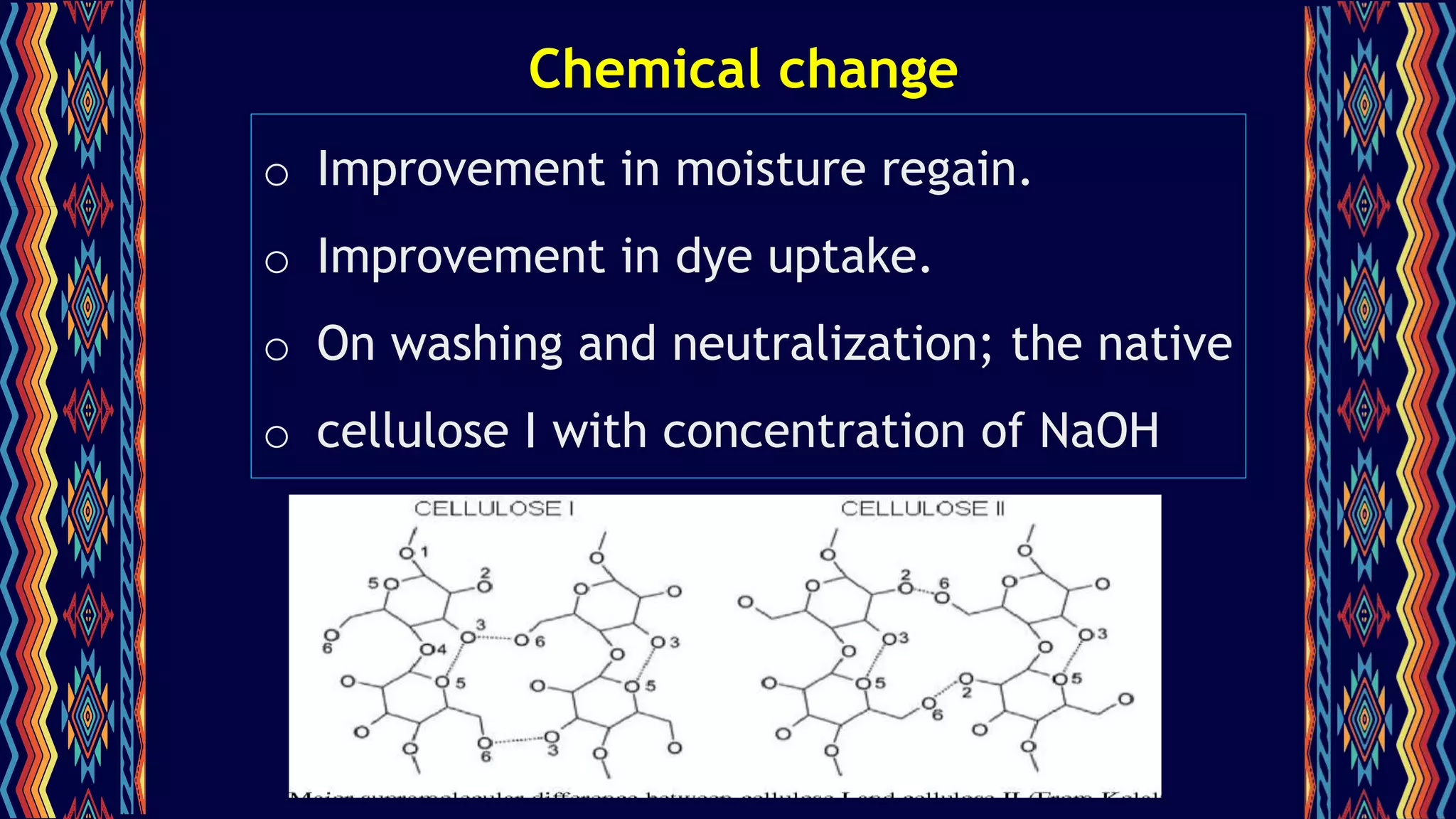
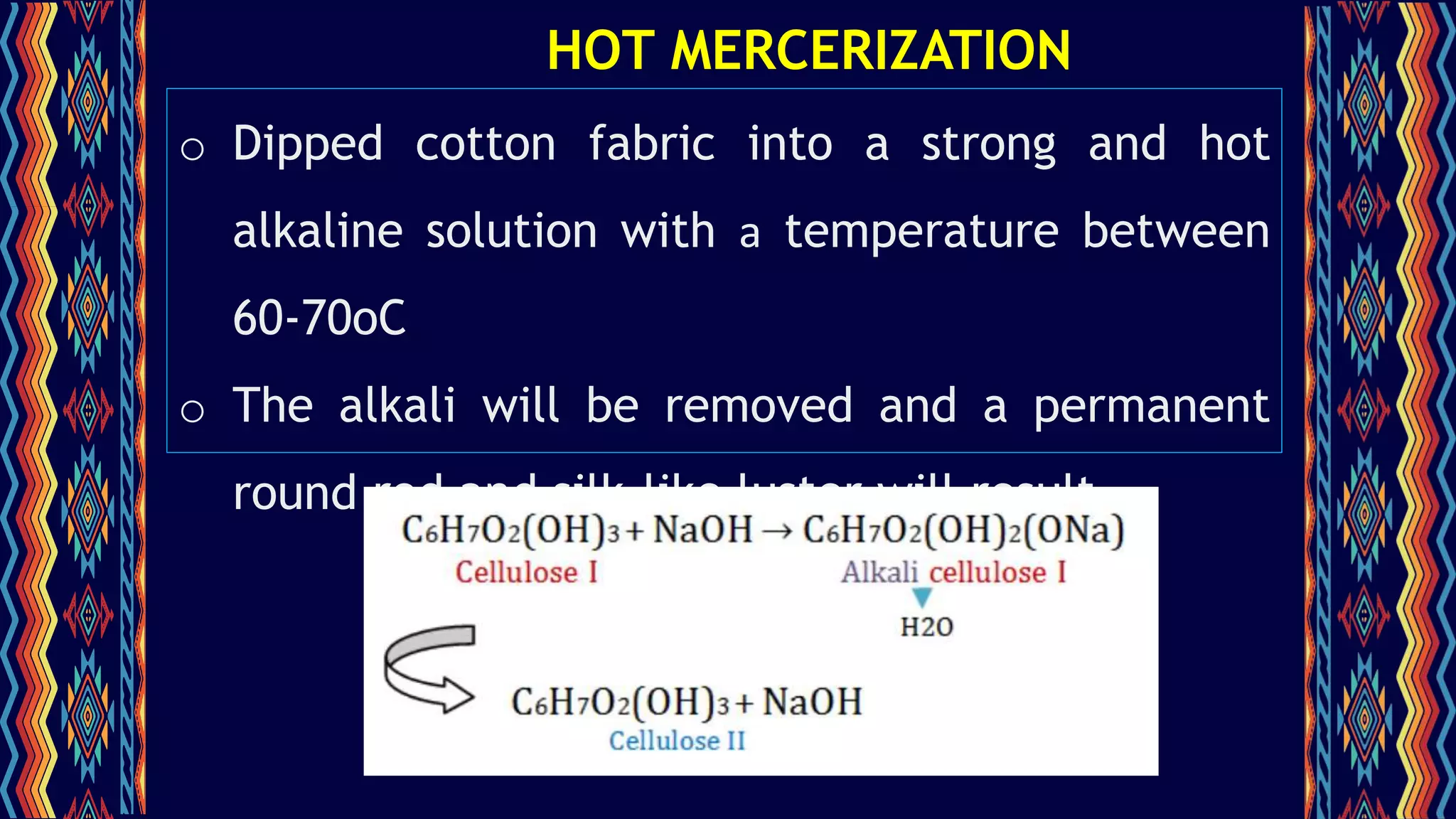
o On washing and neutralization; the native
o cellulose I with concentration of NaOH
formed cellulose II.
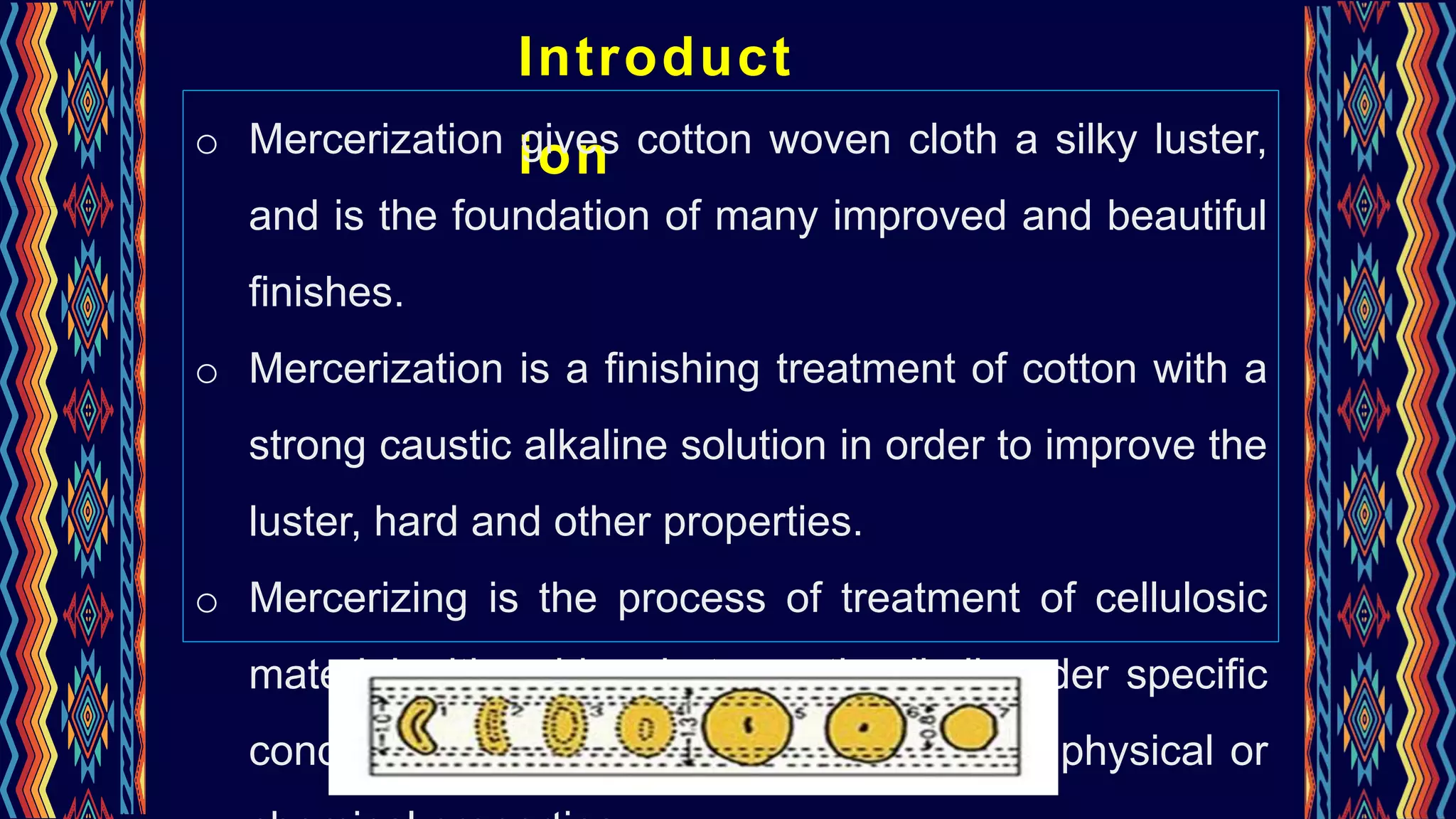
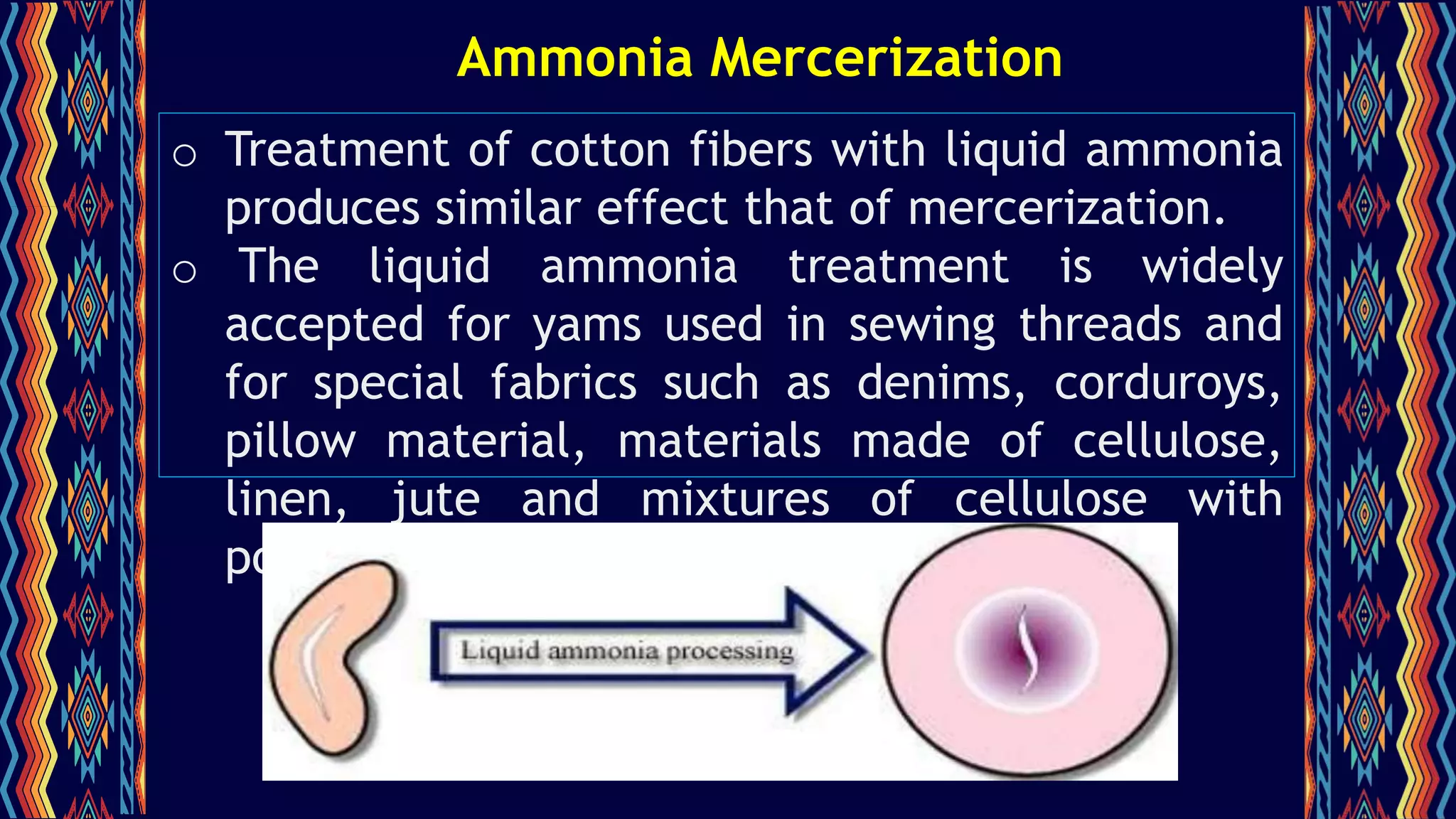
o Fiber level: (swelling, lumen changes from bean
shape to round shape, Shrinkage, etc).
o Molecular level: (Breaking of old bonds, Hydrogen
bond readjustment, Orientation (parallelization) of
molecular chains in longitudinal direction and
Orientation of the crystalline in the direction of the
fiber length).
o Increase in luster of yarn
Generally Changes during mercerization process
Recent development of
Mercerization
HOT MERCERIZATION
o Dipped cotton fabric into a strong and hot
alkaline solution with a temperature between
60-70oC
o The alkali will be removed and a permanent
round rod and silk-like luster will result.
Advantages of hot mercerizing process
oMore absorption of water, and therefore absorb
more dye.
ocolor of the dyed cloth is brighter and deeper.
oRapid penetration of alkali, level and uniform
mercerization can.
oHave better wet crease recovery than
conventionally mercerized.
o Improved core mercerization
Dis-advantage
oHigher energy consumption
oExpensive
Ammonia Mercerization
o Treatment of cotton fibers with liquid ammonia
produces similar effect that of mercerization.
o The liquid ammonia treatment is widely
accepted for yams used in sewing threads and
for special fabrics such as denims, corduroys,
pillow material, materials made of cellulose,
linen, jute and mixtures of cellulose with
polyester or nylon.
Advantage of ammonia mercerization
o Improved strength (up to
90%)
o Enhance luster
o Better dye ability
o Stability to laundering
greater thermal resistance
o To keep liquid ammonia in liquid form it
must stored below -33 OC.
o It forms explosive moisture with air.
o When leakage in machine it is highly
affected to workers.
Disadvantage
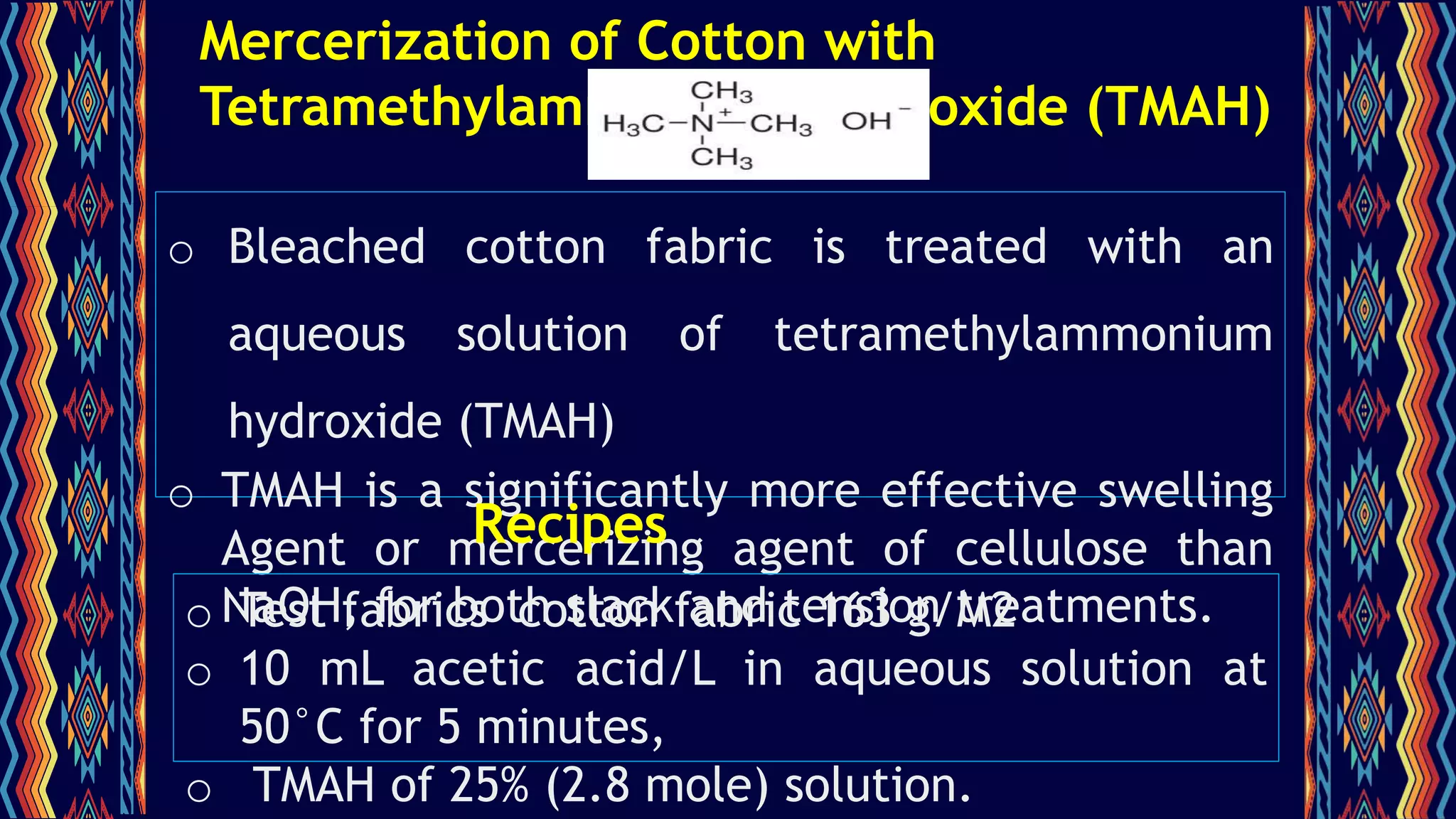
Mercerization of Cotton with
Tetramethylammonium Hydroxide (TMAH)
o Bleached cotton fabric is treated with an
aqueous solution of tetramethylammonium
hydroxide (TMAH)
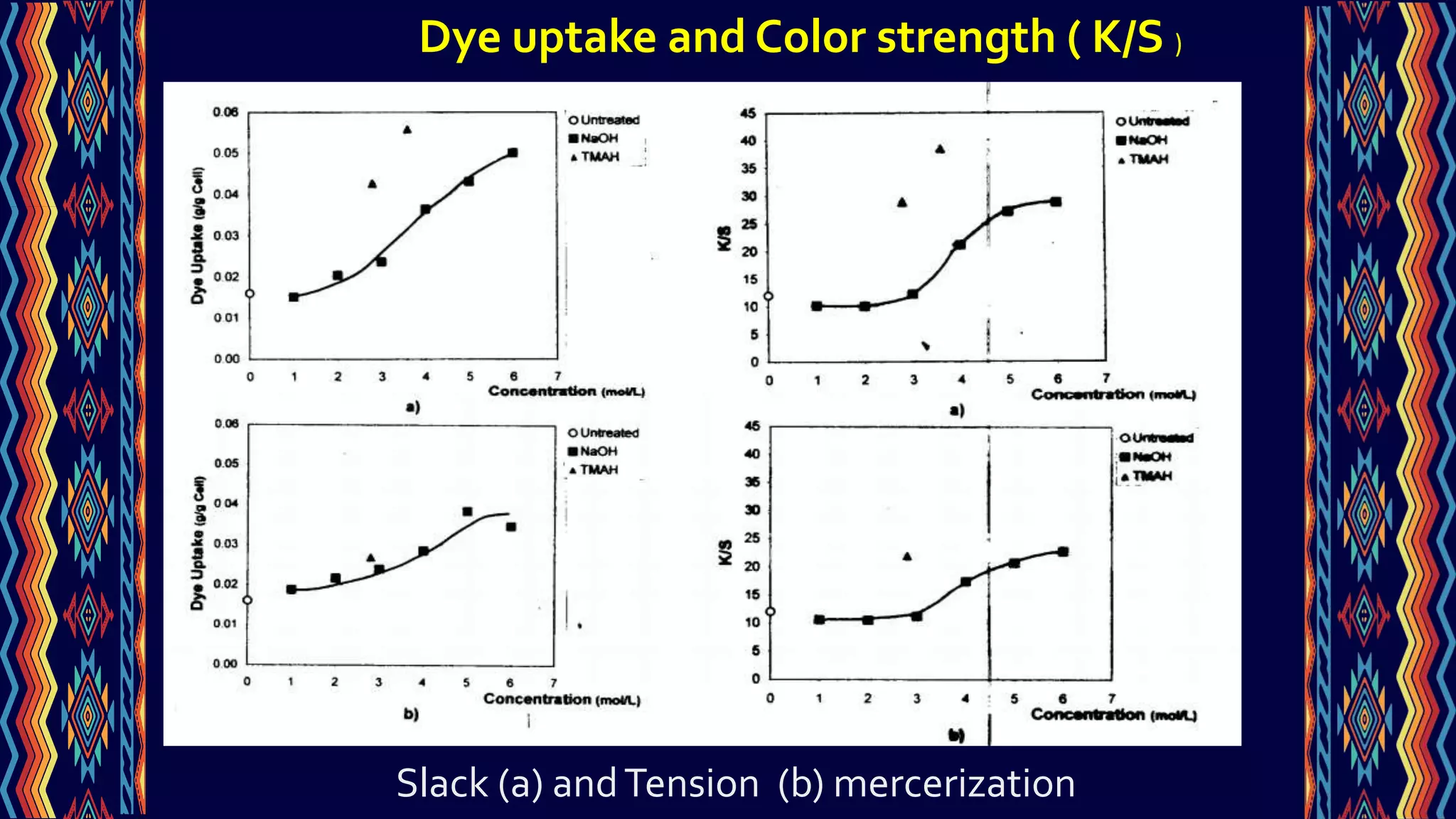
o TMAH is a significantly more effective swelling
Agent or mercerizing agent of cellulose than
NaOH, for both slack and tension treatments.
o Test fabrics cotton fabric 163 g/M2
o 10 mL acetic acid/L in aqueous solution at
50°C for 5 minutes,
o TMAH of 25% (2.8 mole) solution.
Recipes
Slack (a) andTension (b) mercerization
Dye uptake and Color strength ( K/S )
Ultrasound-Assisted Mercerizing Process of Cotton
o The current study investigates the use of
ultrasonic energy to provide a more efficient
and eco-friendly mercerizing process.
o For both conventional and ultrasound-assisted
techniques, the process variables, including
sodium hydroxide concentration, reaction
time, temperature, tensile strength and
degree of mercerization.
o A number of sodium hydroxide solutions was
prepared in different concentrations in a range of
10 % to 30 % (owf).
o The mercerization process performed using the
alkali prepared solutions with an ultrasonic bath
(2.5 l capacity, 100 W power and 40 kHz frequency)
in the presence.
o (L:R=40:1).
Mercerization process
o Ultrasonic energy shows a high potency to improve
a number of chemical processes, especially in
aqueous systems such as ultrasonic bath and textile
wet treatments like ultrasonic-assisted cleaning
process.
o The phenomena of formation and subsequent
collapse of bubbles (cavitation) can be regarded as
the main factor for rate acceleration in chemical
reactions (sonochemistry) and efficiency
improvement through cleaning.
Application Area
o Sewing and embroidery cotton yarns are
mercerized with tension in the form of hank.
o The stretched materials are used for bandages,
casual wear (originally garments for skiing),
skirts, boat covers etc.
Conclusion
o Basically for better dyeability, smooth
surface, and lustrous effect cotton fabric
mercerization is required.
o Recently developed mercerization process
enhances better efficiency than that of
conventional methods.
 Khajavi, R., Berendjchi, A., Moghaddam, M.B. and Akhani, M.,
2015. Ultrasound-assisted mercerizing process of cotton
fabric: A numerical model based on response surface
methodology (RSM). Fibers and Polymers, 16(6), pp.1281-
1288.
 Tóth,T., Borsa, J., Reicher, J., Sallay, P., Sajó, I., &Tanczos, I.
(2003). “Mercerization” of Cotton with
Tetramethylammonium Hydroxide.Textile Research Journal,
73(3), 273–278.
 https://www.sacheminc.com/tetramethylammonium-
hydroxide-tmah
 https://www.slideshare.net/FrancoMajigoi/presentation-on-
mercerization
 https://medcraveonline.com/JTEFT/JTEFT-06-00229.pdf
References
Thank
you
For your
Attention

Recent developmnt of mercerization

  • 1.
    BAHIR DAR UNIVERSITY EthiopianInstitute of Textile and Fashion Technology “Advanced pretreatment process” “Seminar on Recent development of Mercerization” Prepared By:- Berihun Gashu (MSc in TC) April 2021 G.C.
  • 2.
  • 3.
    Introduct ion o Mercerization givescotton woven cloth a silky luster, and is the foundation of many improved and beautiful finishes. o Mercerization is a finishing treatment of cotton with a strong caustic alkaline solution in order to improve the luster, hard and other properties. o Mercerizing is the process of treatment of cellulosic material with cold or hot caustic alkali under specific conditions to improve its appearance and physical or
  • 4.
    Physical change o Breakingof old bond o Improved in strength. o Improved in luster (under tension). o Round shape. o Swell and opening of fiber structure. o New bonds are formed upon washing off NaOH.
  • 5.
    Chemical change o Improvementin moisture regain. o Improvement in dye uptake. o On washing and neutralization; the native o cellulose I with concentration of NaOH formed cellulose II.
  • 6.
    o Fiber level:(swelling, lumen changes from bean shape to round shape, Shrinkage, etc). o Molecular level: (Breaking of old bonds, Hydrogen bond readjustment, Orientation (parallelization) of molecular chains in longitudinal direction and Orientation of the crystalline in the direction of the fiber length). o Increase in luster of yarn Generally Changes during mercerization process
  • 7.
  • 8.
    HOT MERCERIZATION o Dippedcotton fabric into a strong and hot alkaline solution with a temperature between 60-70oC o The alkali will be removed and a permanent round rod and silk-like luster will result.
  • 9.
    Advantages of hotmercerizing process oMore absorption of water, and therefore absorb more dye. ocolor of the dyed cloth is brighter and deeper. oRapid penetration of alkali, level and uniform mercerization can. oHave better wet crease recovery than conventionally mercerized. o Improved core mercerization Dis-advantage oHigher energy consumption oExpensive
  • 10.
    Ammonia Mercerization o Treatmentof cotton fibers with liquid ammonia produces similar effect that of mercerization. o The liquid ammonia treatment is widely accepted for yams used in sewing threads and for special fabrics such as denims, corduroys, pillow material, materials made of cellulose, linen, jute and mixtures of cellulose with polyester or nylon.
  • 11.
    Advantage of ammoniamercerization o Improved strength (up to 90%) o Enhance luster o Better dye ability o Stability to laundering greater thermal resistance o To keep liquid ammonia in liquid form it must stored below -33 OC. o It forms explosive moisture with air. o When leakage in machine it is highly affected to workers. Disadvantage
  • 12.
    Mercerization of Cottonwith Tetramethylammonium Hydroxide (TMAH) o Bleached cotton fabric is treated with an aqueous solution of tetramethylammonium hydroxide (TMAH) o TMAH is a significantly more effective swelling Agent or mercerizing agent of cellulose than NaOH, for both slack and tension treatments. o Test fabrics cotton fabric 163 g/M2 o 10 mL acetic acid/L in aqueous solution at 50°C for 5 minutes, o TMAH of 25% (2.8 mole) solution. Recipes
  • 13.
    Slack (a) andTension(b) mercerization Dye uptake and Color strength ( K/S )
  • 14.
    Ultrasound-Assisted Mercerizing Processof Cotton o The current study investigates the use of ultrasonic energy to provide a more efficient and eco-friendly mercerizing process. o For both conventional and ultrasound-assisted techniques, the process variables, including sodium hydroxide concentration, reaction time, temperature, tensile strength and degree of mercerization.
  • 15.
    o A numberof sodium hydroxide solutions was prepared in different concentrations in a range of 10 % to 30 % (owf). o The mercerization process performed using the alkali prepared solutions with an ultrasonic bath (2.5 l capacity, 100 W power and 40 kHz frequency) in the presence. o (L:R=40:1). Mercerization process
  • 16.
    o Ultrasonic energyshows a high potency to improve a number of chemical processes, especially in aqueous systems such as ultrasonic bath and textile wet treatments like ultrasonic-assisted cleaning process. o The phenomena of formation and subsequent collapse of bubbles (cavitation) can be regarded as the main factor for rate acceleration in chemical reactions (sonochemistry) and efficiency improvement through cleaning.
  • 17.
    Application Area o Sewingand embroidery cotton yarns are mercerized with tension in the form of hank. o The stretched materials are used for bandages, casual wear (originally garments for skiing), skirts, boat covers etc.
  • 18.
    Conclusion o Basically forbetter dyeability, smooth surface, and lustrous effect cotton fabric mercerization is required. o Recently developed mercerization process enhances better efficiency than that of conventional methods.
  • 19.
     Khajavi, R.,Berendjchi, A., Moghaddam, M.B. and Akhani, M., 2015. Ultrasound-assisted mercerizing process of cotton fabric: A numerical model based on response surface methodology (RSM). Fibers and Polymers, 16(6), pp.1281- 1288.  Tóth,T., Borsa, J., Reicher, J., Sallay, P., Sajó, I., &Tanczos, I. (2003). “Mercerization” of Cotton with Tetramethylammonium Hydroxide.Textile Research Journal, 73(3), 273–278.  https://www.sacheminc.com/tetramethylammonium- hydroxide-tmah  https://www.slideshare.net/FrancoMajigoi/presentation-on- mercerization  https://medcraveonline.com/JTEFT/JTEFT-06-00229.pdf References
  • 20.