Shrinkage
 Finishing
 (Cellulosic Fabric)


 PRESENTED BY:
      DILIP SINGH
   KUMAR SARVESH
   RAJEEV SHARAN
         DFT(AP-06)
Shrink Proof Finishing Technique
       using Ultra High Pressure
               Woven & knitted fabrics
Shrink Proof Finishing Technique using Ultra
High Pressure


  • “Due to the various problems of the environmental
    pollution, new techniques were examined as the
    method to decrease of the dyestuff and chemical
    agent in the dyeing and finishing processes.”
Shrink Proof Finishing Technique using Ultra
High Pressure


  • The technique of shrink proof finishing to the
    cellulosic fibre was investigated using high pressure
    over 100MPa.
  • The shrink of cellulosic fibre was controlled by high
    pressure treatment.
  • Furthermore, owing to adding urea and thiourea, the
    ratio of shrink was reduced to half values.
Shrink Proof Finishing Technique using Ultra
High Pressure

  • The results of evaluation concerning to
    comfortableness property and handling property of
    fabric showed that the water vapour permeability of
    fabric was little affected by the high pressure
    treatment and the handling properties based on pure
    bending and shearing stresses was affected by the
    high pressure treatment.
Shrink Proof Finishing Technique using Ultra
High Pressure

  Wet processing technology
  • the fabrics are pressurized with the help of high
    pressure water streams.

  DEGREE OF PERMANANCE
  • Durable finish.

  END USES
  • Active wears, sports wears and functional wears
Shrink Proof Finishing Technique using Ultra
High Pressure

  PROCESS
  • The mechanical members (high pressure water jets)
    come into contact with the textile piece and, during
    such contact, modify the structure that said piece had
    either after weaving or knitting or possibly after the
    finished article has been made, most often by a
    relative displacement of the yarns constituting the
    piece, or of the discontinuous fibres or continuous
    filaments constituting said yarns.
Corona Discharge

      Woven fabrics
Corona Discharge

• Dry processing technique

• Can withstand up to 30 washing cycles.

 PROCESS
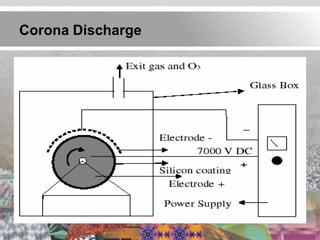
• Corona treatment consists on the application of an
  electrical discharge of high voltage (around 10.000 V)
  through air between two electrodes, using frequencies
  around 40 kHz, at normal atmospheric temperature
  and pressure, on dry cotton fabric.
Corona Discharge
Corona Discharge

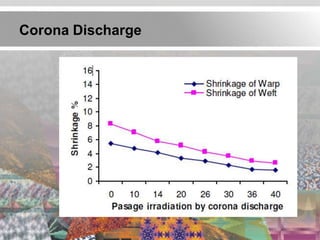
• Cotton Fabrics that treated with corona discharge
  have less shrinkage level exposed to washing process
  than untreated. Shrinkage in weft section is higher
  than warp. With respect to same structural
  characteristics of warp and weft yarns, above
  difference referred to conditions in weaving processes
  and finally synthesis. By increasing of irradiation
  (passage round), the shrinkage decreased after
  washing.
Corona Discharge
Foam Finishing

    Woven fabrics
Foam Finishing


• A wet-processing technology which uses air instead of
  water as the primary diluents has been developed.
• The foam process is currently used in plants for
  shrinkage control, durable-press finishing, and
  softener application to a variety of cotton and
  polyester/cotton blend fabrics.
Foam Finishing

PROCESS
• The process consists of mechanically foaming a
  suitably formulated finish or dye formulation and
  then applying the foam to textile fabrics. Collapse of
  the foam distributes the finish on the substrate.
• The fabric is then subjected to conventional drying
  and fixing operations.
Foam Finishing

DEGREE OF PERMANANCE
• Durable finish

ADVANTAGES
     • The main advantage of the foam process resides in the substantial
       energy savings achievable in the drying of fabrics due to the
       replacement of water with air in the finish.
     • In addition, in certain cases line speeds have been doubled.


END USES
• Active wears,    casual wears, sports wears and
  functional wears
Zero/Zero finish

Compressive shrinkage- Woven fabrics
Zero/Zero finish

• During spinning, weaving, bleaching, dyeing and
  various finishing processes, yarns and fabric are under
  a continuous tension.
• The process is Controlled Compressive Shrinkage and
  also known it as SANFORIZED.
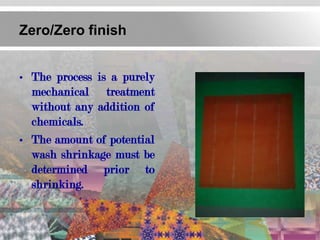
• The process is a purely mechanical treatment without
  any addition of chemicals.
Zero/Zero finish


• The process is a purely
  mechanical treatment
  without any addition of
  chemicals.
• The amount of potential
  wash shrinkage must be
  determined prior to
  shrinking.
Zero/Zero finish

• A full width sample is wash-tested according to the test
  method
• After the lengthwise and widthwise shrinkage has been
  determined, the compressive shrinkage machine can be
  adjusted accordingly
Plasma Processing

 Woven & knitted fabrics
Plasma Processing

  • Surface-sensitive method that allows selective
    modification in the nm-range.
  • By introducing energy into a gas, quasi-neutral
    plasma can be generated consisting of neutral
    particles, electrically charged particles and highly
    reactive radicals.
Plasma Processing

  PRINCIPLE
  • The plasma atmosphere consist of free electrons,
    radicals, ions, UV-radiation and a lot of different
    excited particle in dependence of the used gas.
    Different reactive species in the plasma chamber with
    the substrate surface. Cleaning, modifications or
    coating occurs dependent of the used parameter.
Plasma Processing

  Wet processing technique.
  • The plasma treatment is efficient only on a level of the
    first surface layer, no damage to the physical
    properties intrinsic to the textile are noticed.

  • DEGREE OF PERMANENCE
  • Effects of this plasma treatment on surfaces are
    significant and uniform along the length and width,
    and they last a long time.
Plasma Processing

  PROCESS
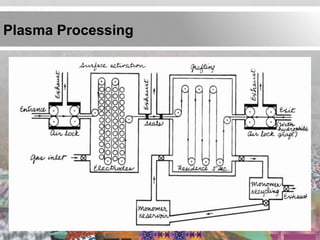
  • Textile to be functionalized is placed in a reaction
    chamber with any gas and the plasma is then
    ignited, the generated particles interact with the
    surface of the textile.
  • A gas (air, oxygen, nitrogen, argon, carbon dioxide and
    so on), injected inside a reactor at a pressure of
    approximately 0.5 mbar, is ionised by the presence of
    two electrodes between which is a high-frequency
    electric field.
Plasma Processing

  PROCESS
  • The need to create the vacuum is justified by the
    necessity to obtain a so-called cold plasma with a
    temperature no higher than 80 C. This, with the same
    energy content that can be reached at atmospheric
    pressure at a temperature of some thousands of degrees
    C, permits the treatment of fabrics even with a low
    melting point such as polypropylene and polyethylene,
    without causing any form of damage.
Plasma Processing

  PROCESS
  • In this way the surface is specifically
    structured, chemically functionalized or even coated
    with nm-thin film depending on the type of
    gas, simultaneously filling the gaps between the
    structure/construction of the fabric, and control of the
    process.
Plasma Processing

  END USES
  • It follows from the very interesting applications of the
    plasma treatment that also applications of nonwovens
    have become apparent, having a destination of use
    among other things in air and liquid filtering,
    synthetic leather, cloths, artificial limbs, biomedical
    and protective wear, footwear and sportswear.
Plasma Processing


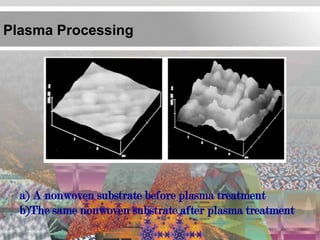
  a) A nonwoven substrate before plasma treatment
  b)The same nonwoven substrate after plasma treatment
Plasma Processing
Nano-Care

Woven fabrics
Nano-Care

• Technology that brings
  about      an     entirely
  carefree fabric with
  shrink proof, wrinkle
  resistant, water and stain
  repellent       properties,
  intended for use in
  cellulosic fibers such as
  cotton and linen
Nano-Care

DEGREE OF PERMANANCE
• Permanent finish.

END USES
• men’s, women’s and children’s trousers, active
  wear, uniform, shirting and business attire.
• residential and commercial interiors industry
  ranging from mattress fabrics to stadium seating

Shrinkage finishing for cellulosic fabrics

  • 1.
    Shrinkage Finishing (CellulosicFabric) PRESENTED BY: DILIP SINGH KUMAR SARVESH RAJEEV SHARAN DFT(AP-06)
  • 2.
    Shrink Proof FinishingTechnique using Ultra High Pressure Woven & knitted fabrics
  • 3.
    Shrink Proof FinishingTechnique using Ultra High Pressure • “Due to the various problems of the environmental pollution, new techniques were examined as the method to decrease of the dyestuff and chemical agent in the dyeing and finishing processes.”
  • 4.
    Shrink Proof FinishingTechnique using Ultra High Pressure • The technique of shrink proof finishing to the cellulosic fibre was investigated using high pressure over 100MPa. • The shrink of cellulosic fibre was controlled by high pressure treatment. • Furthermore, owing to adding urea and thiourea, the ratio of shrink was reduced to half values.
  • 5.
    Shrink Proof FinishingTechnique using Ultra High Pressure • The results of evaluation concerning to comfortableness property and handling property of fabric showed that the water vapour permeability of fabric was little affected by the high pressure treatment and the handling properties based on pure bending and shearing stresses was affected by the high pressure treatment.
  • 6.
    Shrink Proof FinishingTechnique using Ultra High Pressure Wet processing technology • the fabrics are pressurized with the help of high pressure water streams. DEGREE OF PERMANANCE • Durable finish. END USES • Active wears, sports wears and functional wears
  • 7.
    Shrink Proof FinishingTechnique using Ultra High Pressure PROCESS • The mechanical members (high pressure water jets) come into contact with the textile piece and, during such contact, modify the structure that said piece had either after weaving or knitting or possibly after the finished article has been made, most often by a relative displacement of the yarns constituting the piece, or of the discontinuous fibres or continuous filaments constituting said yarns.
  • 8.
    Corona Discharge Woven fabrics
  • 9.
    Corona Discharge • Dryprocessing technique • Can withstand up to 30 washing cycles. PROCESS • Corona treatment consists on the application of an electrical discharge of high voltage (around 10.000 V) through air between two electrodes, using frequencies around 40 kHz, at normal atmospheric temperature and pressure, on dry cotton fabric.
  • 10.
  • 11.
    Corona Discharge • CottonFabrics that treated with corona discharge have less shrinkage level exposed to washing process than untreated. Shrinkage in weft section is higher than warp. With respect to same structural characteristics of warp and weft yarns, above difference referred to conditions in weaving processes and finally synthesis. By increasing of irradiation (passage round), the shrinkage decreased after washing.
  • 12.
  • 13.
    Foam Finishing Woven fabrics
  • 14.
    Foam Finishing • Awet-processing technology which uses air instead of water as the primary diluents has been developed. • The foam process is currently used in plants for shrinkage control, durable-press finishing, and softener application to a variety of cotton and polyester/cotton blend fabrics.
  • 15.
    Foam Finishing PROCESS • Theprocess consists of mechanically foaming a suitably formulated finish or dye formulation and then applying the foam to textile fabrics. Collapse of the foam distributes the finish on the substrate. • The fabric is then subjected to conventional drying and fixing operations.
  • 16.
    Foam Finishing DEGREE OFPERMANANCE • Durable finish ADVANTAGES • The main advantage of the foam process resides in the substantial energy savings achievable in the drying of fabrics due to the replacement of water with air in the finish. • In addition, in certain cases line speeds have been doubled. END USES • Active wears, casual wears, sports wears and functional wears
  • 17.
  • 18.
    Zero/Zero finish • Duringspinning, weaving, bleaching, dyeing and various finishing processes, yarns and fabric are under a continuous tension. • The process is Controlled Compressive Shrinkage and also known it as SANFORIZED. • The process is a purely mechanical treatment without any addition of chemicals.
  • 19.
    Zero/Zero finish • Theprocess is a purely mechanical treatment without any addition of chemicals. • The amount of potential wash shrinkage must be determined prior to shrinking.
  • 20.
    Zero/Zero finish • Afull width sample is wash-tested according to the test method • After the lengthwise and widthwise shrinkage has been determined, the compressive shrinkage machine can be adjusted accordingly
  • 21.
    Plasma Processing Woven& knitted fabrics
  • 22.
    Plasma Processing • Surface-sensitive method that allows selective modification in the nm-range. • By introducing energy into a gas, quasi-neutral plasma can be generated consisting of neutral particles, electrically charged particles and highly reactive radicals.
  • 23.
    Plasma Processing PRINCIPLE • The plasma atmosphere consist of free electrons, radicals, ions, UV-radiation and a lot of different excited particle in dependence of the used gas. Different reactive species in the plasma chamber with the substrate surface. Cleaning, modifications or coating occurs dependent of the used parameter.
  • 24.
    Plasma Processing Wet processing technique. • The plasma treatment is efficient only on a level of the first surface layer, no damage to the physical properties intrinsic to the textile are noticed. • DEGREE OF PERMANENCE • Effects of this plasma treatment on surfaces are significant and uniform along the length and width, and they last a long time.
  • 25.
    Plasma Processing PROCESS • Textile to be functionalized is placed in a reaction chamber with any gas and the plasma is then ignited, the generated particles interact with the surface of the textile. • A gas (air, oxygen, nitrogen, argon, carbon dioxide and so on), injected inside a reactor at a pressure of approximately 0.5 mbar, is ionised by the presence of two electrodes between which is a high-frequency electric field.
  • 26.
    Plasma Processing PROCESS • The need to create the vacuum is justified by the necessity to obtain a so-called cold plasma with a temperature no higher than 80 C. This, with the same energy content that can be reached at atmospheric pressure at a temperature of some thousands of degrees C, permits the treatment of fabrics even with a low melting point such as polypropylene and polyethylene, without causing any form of damage.
  • 27.
    Plasma Processing PROCESS • In this way the surface is specifically structured, chemically functionalized or even coated with nm-thin film depending on the type of gas, simultaneously filling the gaps between the structure/construction of the fabric, and control of the process.
  • 28.
    Plasma Processing END USES • It follows from the very interesting applications of the plasma treatment that also applications of nonwovens have become apparent, having a destination of use among other things in air and liquid filtering, synthetic leather, cloths, artificial limbs, biomedical and protective wear, footwear and sportswear.
  • 29.
    Plasma Processing a) A nonwoven substrate before plasma treatment b)The same nonwoven substrate after plasma treatment
  • 30.
  • 31.
  • 32.
    Nano-Care • Technology thatbrings about an entirely carefree fabric with shrink proof, wrinkle resistant, water and stain repellent properties, intended for use in cellulosic fibers such as cotton and linen
  • 33.
    Nano-Care DEGREE OF PERMANANCE •Permanent finish. END USES • men’s, women’s and children’s trousers, active wear, uniform, shirting and business attire. • residential and commercial interiors industry ranging from mattress fabrics to stadium seating