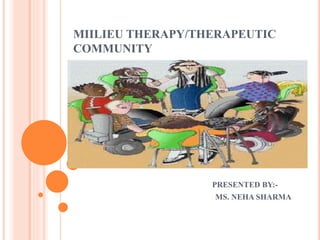















MIILIEU THERAPY/THERAPEUTIC
COMMUNITY
PRESENTED BY:-
MS. NEHA SHARMA
INTRODUCTION
MEANING
 A scientific structuring of the environment in order to
effect behavioural changes and to improve the
psychological health and functioning of the individual
(Skinner, 1979
DEFINITION
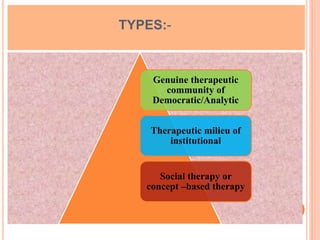
TYPES:-
Genuine therapeutic
community of
Democratic/Analytic
Therapeutic milieu of
institutional
Social therapy or
concept –based therapy
GOALS
CONT….
 Change maladaptive behaviour
into adaptive behaviour.
 Provides conducive environment
(free and favourable climate) in
which the client can talk and be
aware about his feelings, impulses
and behaviour.
CONT….
 Promotes early recovery.
 To make the clients to
understand how their
behaviour will be effected,
with the behaviour of
others.
CONT….
 To enable the client to
actively participate in his
living activities and will be
actively involved in community
Activities.
 Staff members will help the
client to to take their own
decisions
CONT….
 To improve the self-esteem.
 To promote group and social
interaction.
 The client is expected to learn
adaptive or coping techniques
CONT….
 To promote self confidence.
 To manipulate the
Environment.
 To resocialise the client
FUNCTIONS OF MILIEU THERAPY
CONT….
 1. Shelters clients physically from what they perceive as painful,
terrifying stressors.
 2. Protects clients physically from discharges of their own and
others’ maladaptive behaviours.
 3. Provides pleasant, attractive, sensory stimulation to clients.
 4. Educates clients and their families about adaptive, effective
coping
CHARACTERISTICS OF MILIEU THERAPY:
 Several strategies have been developed to counter these negative
effects. They include
 Basic physiological needs are fulfilled.
 The physical facilities are conducive to achievement of the goals
of therapy.
 Distribution of power/A democratic form of self-government
exists.
 Responsibilities are assigned according to clients capabilities.
CONT….
 Open communication
 Structured interactions
 Work- related activities.
 Community and family involvement in the treatment process
 Adaptation of the environment to meet developmental needs.
PRINCIPLES:-
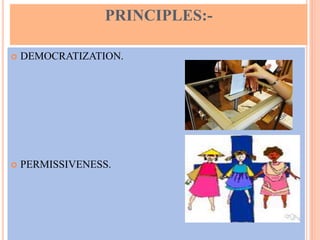
 DEMOCRATIZATION.
 PERMISSIVENESS.
CONT….
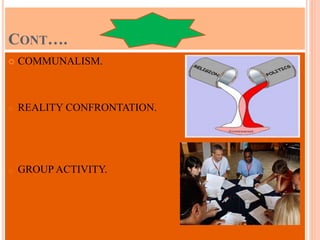
 COMMUNALISM.
o REALITY CONFRONTATION.
o GROUP ACTIVITY.
CONT….
 DECISION-MAKING.
 PATTERN OF ATTENTION.
BASIC ASSUMPTIONS
 Skinner outlined seven basic assumptions on which a therapeutic
community is based:
 The health in each individual is to be realized and encouraged
to grow.
 Every interaction is an opportunity for therapeutic
intervention.
 The client owns his or her own environment
CONT….
 Each client owns his or her behaviour.
 Peer pressure is a useful and a powerful tool.
 Inappropriate behaviours are dealt with as they occur.
 Restrictions and punishment are to be avoided.
KEY PARAMETERS IN SETTING –UP
THERAPEUTIC COMMUNITY
 SIZE OF THE UNIT:-20-30members
DURATION OF TREARMENT
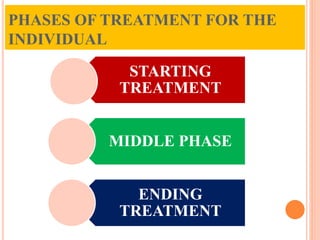
PHASES OF TREATMENT FOR THE
INDIVIDUAL
STARTING
TREATMENT
MIDDLE PHASE
ENDING
TREATMENT
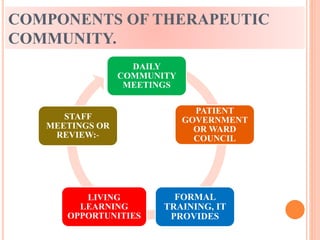
COMPONENTS OF THERAPEUTIC
COMMUNITY.
DAILY
COMMUNITY
MEETINGS
PATIENT
GOVERNMENT
OR WARD
COUNCIL
FORMAL
TRAINING, IT
PROVIDES
LIVING
LEARNING
OPPORTUNITIES
STAFF
MEETINGS OR
REVIEW:-
 Free and effective communications, interaction.
 Shared responsibilities and active involvement in
community activities.
 Understanding of roles/responsibilities, abilities,
limitations authorities.
 Manipulation of environment to fulfil their needs and
demands.
ELEMENTS OF THERAPEUTIC COMMUNITY:-
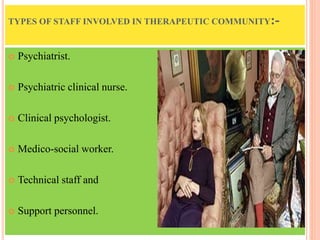
TYPES OF STAFF INVOLVED IN THERAPEUTIC COMMUNITY:-
 Psychiatrist.
 Psychiatric clinical nurse.
 Clinical psychologist.
 Medico-social worker.
 Technical staff and
 Support personnel.
CONT….
 Mental health technician.
 Occupational therapist.
 Art therapist.
 Music therapist.
 Psycho-dramatist.
 Dietician.
 Chaplin.
THE THERAPEUTIC TOPICS FOR CLIENT EDUCATION:-
 Ways to increase self-esteem.
 Stress management techniques.
 Anxiety reduction programmes.
 Normal stages of grieving and
behaviour associated with
each stage.
 Assertiveness techniques
CONT….
 Relaxation techniques.
 Effects of substance abuse.
 Problem solving techniques
and skills.
 Thought stopping/thought
switching techniques.
 Sex education.
CONT….
 Effective parenting technique
 Medical diagnosis.
o Therapies and follow-up care.
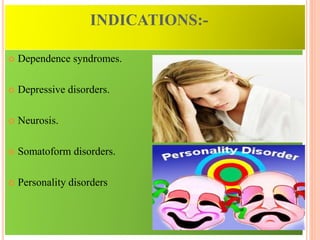
INDICATIONS:-
 Dependence syndromes.
 Depressive disorders.
 Neurosis.
 Somatoform disorders.
 Personality disorders
CONT….
 Self harming nature.
 Drug abuse.
 Violent offenders.
 Schizophrenia.
 Enduring mental illness
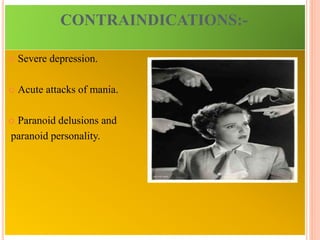
CONTRAINDICATIONS:-
 Severe depression.
 Acute attacks of mania.
 Paranoid delusions and
paranoid personality.
 Initiates good interpersonal relationships among
residents and staff members.
 Residents will gain self confidence.
 Learns to understand themselves and understands others.
 Decides themselves related to their issues and help others
to solve their problems.
 Relearns socialization skills.
ADVANTAGES OF THERAPEUTIC COMMUNITY:-
CONT….
 Promotes collective thinking and participates in social activities.
 Participates in formulation of rules and regulations of
community by actively involving in community meetings.
 Residents learn adoptive acceptable behaviour in the therapeutic
environment.
 To improve self-esteem.
 Minimizes hospital stay and disability.
CONT….
 To foster therapeutic environment.
 Provides opportunities to participate in community as well as
hospital administration.
 Residents will become less dependent and passive.
 Enhances interaction among the residents.
CONT….
 Every individual in the community (staff and residents) will be
fully aware of their roles, limitations and responsibilities.
 Residents and staff members will be involving in decision making
process actively.
 Staff will be able to provide the required information to the
residents about job oppurtunities, half-way homes, and self help
groups.
 It creates positive attitude and inculcates conduxcive approach to
live happily among residents, as it creates homely atmosphere.
CONT….
 Client becomes less dependent and passive.
 Resident also involved in making decisions related to war
management and involved in caring other residents.
 Client will be able to learn adaptive, acceptable behaviour.
 Residents will be able to control their negative emotions, e.g.
Hostility, anger.
DISADVANTAGES:-
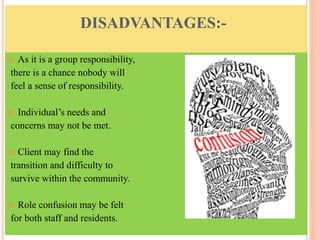
 As it is a group responsibility,
there is a chance nobody will
feel a sense of responsibility.
 Individual’s needs and
concerns may not be met.
 Client may find the
transition and difficulty to
survive within the community.
 Role confusion may be felt
for both staff and residents.
ROLE OF NURSE:-
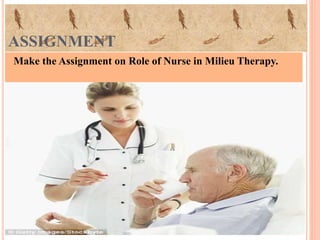
ASSIGNMENT
Make the Assignment on Role of Nurse in Milieu Therapy.
RESEARCH ABSTRACT
Effectiveness of Milieu Therapy in reducing conflicts and containment rates among
schizophrenia patients
 Objectives: To evaluate effectiveness of Milieu Therapy in reduction of conflict and
containment rates among schizophrenia patients.
 Methods: This study utilized quasi experimental non-equivalent control group pre-
post design. One hundred schizophrenia patients admitted in acute psychiatric
wards were non-randomly assigned to either of the experimental (n=50) or control
group (n=50). The experimental group received both milieu therapy and routine
hospital treatment. The Milieu Therapy intervention Included environmental
modification and structuring ward activities, establishing effective interaction with
patient, and teaching caregivers on managing conflict behavior of patient. The
control group received only routine treatment in the hospital. Outcome measures on
conflict and containment rates were evaluated for both the groups at baseline and at
2nd, 3rd and 15th day. The Patient-Staff Conflict Checklist Shift Report (PCC-SR)
was used to collect information about rates of conflict and containment.
 Results: Compared with control group, the experimental group participants showed
decrease in aggressive behavior, self-harm behavior and general rule breaking
behavior at baseline and 2nd, 3rd and 15th day (F=4.61, p < 0.004, η2=0.04;
F=11.92, p < 0.001, η2=0.11; F=6.94, p < 0.001, η2=0.06) over seven days interval.
 Conclusions: The present study findings provided evidence for the effectiveness of
integrating Milieu Therapy in psychiatric acute wards in reducing conflict behaviors
among schizophrenia patients. Milieu therapy should be considered as an integral
part of psychiatric care settings in these patients.
REFERENCES:
 TOWENSEND C. MARY, MENTAL HEALTH
NURSING,8TH EDN,PUBLISHED BY JAYPEE
PUBLICATIONS.
 WWW.PSYCHOTHERAPIES. COM.
 SREEVANI R, GUIDE TO MENTAL HEALTH AND
PSYCHIATRIC NURSING, PUBLISHED BY
JAYPEE PUBLICATIONS.
Milieu therapy

Milieu therapy

  • 1.
  • 2.
  • 3.
  • 4.
     A scientificstructuring of the environment in order to effect behavioural changes and to improve the psychological health and functioning of the individual (Skinner, 1979 DEFINITION
  • 5.
    TYPES:- Genuine therapeutic community of Democratic/Analytic Therapeuticmilieu of institutional Social therapy or concept –based therapy
  • 6.
  • 7.
    CONT….  Change maladaptivebehaviour into adaptive behaviour.  Provides conducive environment (free and favourable climate) in which the client can talk and be aware about his feelings, impulses and behaviour.
  • 8.
    CONT….  Promotes earlyrecovery.  To make the clients to understand how their behaviour will be effected, with the behaviour of others.
  • 9.
    CONT….  To enablethe client to actively participate in his living activities and will be actively involved in community Activities.  Staff members will help the client to to take their own decisions
  • 10.
    CONT….  To improvethe self-esteem.  To promote group and social interaction.  The client is expected to learn adaptive or coping techniques
  • 11.
    CONT….  To promoteself confidence.  To manipulate the Environment.  To resocialise the client
  • 12.
  • 13.
    CONT….  1. Sheltersclients physically from what they perceive as painful, terrifying stressors.  2. Protects clients physically from discharges of their own and others’ maladaptive behaviours.  3. Provides pleasant, attractive, sensory stimulation to clients.  4. Educates clients and their families about adaptive, effective coping
  • 14.
    CHARACTERISTICS OF MILIEUTHERAPY:  Several strategies have been developed to counter these negative effects. They include  Basic physiological needs are fulfilled.  The physical facilities are conducive to achievement of the goals of therapy.  Distribution of power/A democratic form of self-government exists.  Responsibilities are assigned according to clients capabilities.
  • 15.
    CONT….  Open communication Structured interactions  Work- related activities.  Community and family involvement in the treatment process  Adaptation of the environment to meet developmental needs.
  • 16.
  • 17.
    CONT….  COMMUNALISM. o REALITYCONFRONTATION. o GROUP ACTIVITY.
  • 18.
  • 19.
    BASIC ASSUMPTIONS  Skinneroutlined seven basic assumptions on which a therapeutic community is based:  The health in each individual is to be realized and encouraged to grow.  Every interaction is an opportunity for therapeutic intervention.  The client owns his or her own environment
  • 20.
    CONT….  Each clientowns his or her behaviour.  Peer pressure is a useful and a powerful tool.  Inappropriate behaviours are dealt with as they occur.  Restrictions and punishment are to be avoided.
  • 21.
    KEY PARAMETERS INSETTING –UP THERAPEUTIC COMMUNITY  SIZE OF THE UNIT:-20-30members
  • 22.
  • 23.
    PHASES OF TREATMENTFOR THE INDIVIDUAL STARTING TREATMENT MIDDLE PHASE ENDING TREATMENT
  • 24.
    COMPONENTS OF THERAPEUTIC COMMUNITY. DAILY COMMUNITY MEETINGS PATIENT GOVERNMENT ORWARD COUNCIL FORMAL TRAINING, IT PROVIDES LIVING LEARNING OPPORTUNITIES STAFF MEETINGS OR REVIEW:-
  • 25.
     Free andeffective communications, interaction.  Shared responsibilities and active involvement in community activities.  Understanding of roles/responsibilities, abilities, limitations authorities.  Manipulation of environment to fulfil their needs and demands. ELEMENTS OF THERAPEUTIC COMMUNITY:-
  • 26.
    TYPES OF STAFFINVOLVED IN THERAPEUTIC COMMUNITY:-  Psychiatrist.  Psychiatric clinical nurse.  Clinical psychologist.  Medico-social worker.  Technical staff and  Support personnel.
  • 27.
    CONT….  Mental healthtechnician.  Occupational therapist.  Art therapist.  Music therapist.  Psycho-dramatist.  Dietician.  Chaplin.
  • 28.
    THE THERAPEUTIC TOPICSFOR CLIENT EDUCATION:-  Ways to increase self-esteem.  Stress management techniques.  Anxiety reduction programmes.  Normal stages of grieving and behaviour associated with each stage.  Assertiveness techniques
  • 29.
    CONT….  Relaxation techniques. Effects of substance abuse.  Problem solving techniques and skills.  Thought stopping/thought switching techniques.  Sex education.
  • 30.
    CONT….  Effective parentingtechnique  Medical diagnosis. o Therapies and follow-up care.
  • 31.
    INDICATIONS:-  Dependence syndromes. Depressive disorders.  Neurosis.  Somatoform disorders.  Personality disorders
  • 32.
    CONT….  Self harmingnature.  Drug abuse.  Violent offenders.  Schizophrenia.  Enduring mental illness
  • 33.
    CONTRAINDICATIONS:-  Severe depression. Acute attacks of mania.  Paranoid delusions and paranoid personality.
  • 34.
     Initiates goodinterpersonal relationships among residents and staff members.  Residents will gain self confidence.  Learns to understand themselves and understands others.  Decides themselves related to their issues and help others to solve their problems.  Relearns socialization skills. ADVANTAGES OF THERAPEUTIC COMMUNITY:-
  • 35.
    CONT….  Promotes collectivethinking and participates in social activities.  Participates in formulation of rules and regulations of community by actively involving in community meetings.  Residents learn adoptive acceptable behaviour in the therapeutic environment.  To improve self-esteem.  Minimizes hospital stay and disability.
  • 36.
    CONT….  To fostertherapeutic environment.  Provides opportunities to participate in community as well as hospital administration.  Residents will become less dependent and passive.  Enhances interaction among the residents.
  • 37.
    CONT….  Every individualin the community (staff and residents) will be fully aware of their roles, limitations and responsibilities.  Residents and staff members will be involving in decision making process actively.  Staff will be able to provide the required information to the residents about job oppurtunities, half-way homes, and self help groups.  It creates positive attitude and inculcates conduxcive approach to live happily among residents, as it creates homely atmosphere.
  • 38.
    CONT….  Client becomesless dependent and passive.  Resident also involved in making decisions related to war management and involved in caring other residents.  Client will be able to learn adaptive, acceptable behaviour.  Residents will be able to control their negative emotions, e.g. Hostility, anger.
  • 39.
    DISADVANTAGES:-  As itis a group responsibility, there is a chance nobody will feel a sense of responsibility.  Individual’s needs and concerns may not be met.  Client may find the transition and difficulty to survive within the community.  Role confusion may be felt for both staff and residents.
  • 40.
  • 41.
    ASSIGNMENT Make the Assignmenton Role of Nurse in Milieu Therapy.
  • 44.
    RESEARCH ABSTRACT Effectiveness ofMilieu Therapy in reducing conflicts and containment rates among schizophrenia patients  Objectives: To evaluate effectiveness of Milieu Therapy in reduction of conflict and containment rates among schizophrenia patients.  Methods: This study utilized quasi experimental non-equivalent control group pre- post design. One hundred schizophrenia patients admitted in acute psychiatric wards were non-randomly assigned to either of the experimental (n=50) or control group (n=50). The experimental group received both milieu therapy and routine hospital treatment. The Milieu Therapy intervention Included environmental modification and structuring ward activities, establishing effective interaction with patient, and teaching caregivers on managing conflict behavior of patient. The control group received only routine treatment in the hospital. Outcome measures on conflict and containment rates were evaluated for both the groups at baseline and at 2nd, 3rd and 15th day. The Patient-Staff Conflict Checklist Shift Report (PCC-SR) was used to collect information about rates of conflict and containment.  Results: Compared with control group, the experimental group participants showed decrease in aggressive behavior, self-harm behavior and general rule breaking behavior at baseline and 2nd, 3rd and 15th day (F=4.61, p < 0.004, η2=0.04; F=11.92, p < 0.001, η2=0.11; F=6.94, p < 0.001, η2=0.06) over seven days interval.  Conclusions: The present study findings provided evidence for the effectiveness of integrating Milieu Therapy in psychiatric acute wards in reducing conflict behaviors among schizophrenia patients. Milieu therapy should be considered as an integral part of psychiatric care settings in these patients.
  • 45.
    REFERENCES:  TOWENSEND C.MARY, MENTAL HEALTH NURSING,8TH EDN,PUBLISHED BY JAYPEE PUBLICATIONS.  WWW.PSYCHOTHERAPIES. COM.  SREEVANI R, GUIDE TO MENTAL HEALTH AND PSYCHIATRIC NURSING, PUBLISHED BY JAYPEE PUBLICATIONS.