PRESENTED BY
MR.ROMAN BAJRANG
RELIANCE INSTITUTE OF NURSING
INTRODUCTION
• DEFINITION “ Laparoscopy is a type of surgical
procedure that allows a surgeon to access the
inside of the abdomen (tummy) and pelvis
without having to make large incisions in the
skin. This procedure is also known as keyhole
surgery or minimally invasive surgery.
 ACCORDING TO BRUNER & SHIDDHARTH
HISTORY
 1910 - Swedish physician Hans Christian Jacobaeus
used this procedure in man and coined the term –
LAPAROSCOPY .
 1987 - Mourett in France successfully removed a
diseased gall bladder laparoscopically .
INDICATION
Acute pelvic conditions
Tubal pregnancy
Ovarian diseases
Infertility
Staging of the malignancy
Biopsy from the tumors
In chronic pain abdomen where ultrasound,
endoscopies, barium studies are negative
lESS POST
OPERATIVE
FASTER
RECOVER
Y TIME
SHORTER
HOSPITAL
STAY
SMALLE
R SCARS
LESS
INTERNAL
SCARRING
LESS RISK OF
WOND
INFECTIOR
AND
INCISIONAL
HERNIA
BETTER
VISALIZATION
OF ANATOMY
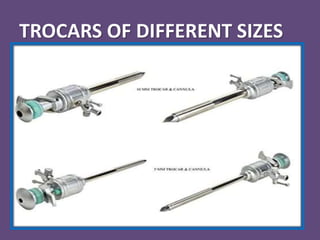
TROCARS OF DIFFERENT SIZES
1. Laparoscopy is usually done as an outpatient procedure. This means that you’ll be able
to go home the same day as your surgery. It may be performed in a hospital or an
outpatient surgical center.
2. You’ll likely be given general anesthesia for this type of surgery. This means that you’ll
sleep through the procedure and won’t feel any pain. To achieve general anesthesia, an
intravenous (IV) line is inserted in one of your veins. Through the IV, your
anesthesiologist can give you special medications and well as provide hydration with
fluids.
3. In some cases, local anesthesia is used instead. A local anesthetic numbs the area, so
even though you’ll be awake during the surgery, you won’t feel any pain.
4. During laparoscopy, the surgeon makes an incision below your belly button, and then
inserts a small tube called a cannula. The cannula is used to inflate your abdomen with
carbon dioxide gas. This gas allows your doctor to see your abdominal organs more
clearly.
5. Once your abdomen is inflated, the surgeon inserts the laparoscope through the
incision. The camera attached to the laparoscope displays the images on a screen,
allowing your organs to be viewed in real time.
PROCEDURE-
6. The number and size of incisions depends upon what specific diseases your surgeon is
attempting to confirm or rule out. Generally, you get from one to four incisions that are each
between 1 and 2 centimeters in length. These incisions allow other instruments to be inserted.
For example, your surgeon may need to use another surgical tool to perform a biopsy. During a
biopsy, they take a small sample of tissue from an organ to be evaluated.
7 . After the procedure is done, the instruments are removed. Your incisions are then closed
with stitches or surgical tape. Bandages may be placed over the incisions.
COMMONLY PRACTICED
LAPAROSCOPIC SURGERIES
Commonly practiced laparoscopic
surgeries
.Laparocopic cholecystectomy
 Laparoscopic appendicectomy
 Laparoscopic inguinal hernia repair
 Laparoscopic hysterectomy
 Laparoscopic perforation repair
 Laparoscopic splenectomy
 Laparoscopic vagotomy and
 Gastrojejunostomy
 Laparoscopic urologic surgeries
 Avoid driving a vehicle during the first 48 hours after the laparoscopic
surgery as he may feel drowsy effects of the anesthesia .
 Take rest during the day after surgery .
 After 24 hours he can do his normal works as long as he is not on any of the
narcotic medications .
 Not take bath or shower within the first 48 hours after the surgery .
 Don't do cycling Jogging or sexual intercourse.
 Not go for a swim in the ocean or in a swimming pool during the first two
days of the surgery .
 Not get into a hot tub or Jacuzzi@ at least for 2 weeks after the laparoscopy
surgery .
 Drink as much fluids as possible to prevent dehydration.
 Not eat hard foods and stay to the light liquids, like apple juice, ginger ale,
soup, toast etc to prevent stomach upsets immediately after the surgery .
 Get back to the normal diet after two to three days when the patient feels
alright .
 Drink more water to prevent constipation caused by pain medications.
AFTER CARE
 Maintain hygine and compostable place provided.
 Maintain medication provid to the night time and
wight patient.
 Mountain died instuard the good and healthy
clief indure the padsend .
 Health education.
CONCLUSION
1. Laproscopy is now the " gold standard For operative
treatment of most abdominal surgery disease .
2. Lapuoscopy has sevolutionised sunguy and in the
process influenced the Practice of anaesthesi -ology .
3. With Patient prepaidation of no pain And early
dischange anesthetic choices become vital for the
ultimate success off the procedure.
Laparoscopy

Laparoscopy

  • 2.
  • 3.
  • 4.
    • DEFINITION “Laparoscopy is a type of surgical procedure that allows a surgeon to access the inside of the abdomen (tummy) and pelvis without having to make large incisions in the skin. This procedure is also known as keyhole surgery or minimally invasive surgery.  ACCORDING TO BRUNER & SHIDDHARTH
  • 7.
    HISTORY  1910 -Swedish physician Hans Christian Jacobaeus used this procedure in man and coined the term – LAPAROSCOPY .  1987 - Mourett in France successfully removed a diseased gall bladder laparoscopically .
  • 8.
    INDICATION Acute pelvic conditions Tubalpregnancy Ovarian diseases Infertility Staging of the malignancy Biopsy from the tumors In chronic pain abdomen where ultrasound, endoscopies, barium studies are negative
  • 9.
    lESS POST OPERATIVE FASTER RECOVER Y TIME SHORTER HOSPITAL STAY SMALLE RSCARS LESS INTERNAL SCARRING LESS RISK OF WOND INFECTIOR AND INCISIONAL HERNIA BETTER VISALIZATION OF ANATOMY
  • 21.
  • 23.
    1. Laparoscopy isusually done as an outpatient procedure. This means that you’ll be able to go home the same day as your surgery. It may be performed in a hospital or an outpatient surgical center. 2. You’ll likely be given general anesthesia for this type of surgery. This means that you’ll sleep through the procedure and won’t feel any pain. To achieve general anesthesia, an intravenous (IV) line is inserted in one of your veins. Through the IV, your anesthesiologist can give you special medications and well as provide hydration with fluids. 3. In some cases, local anesthesia is used instead. A local anesthetic numbs the area, so even though you’ll be awake during the surgery, you won’t feel any pain. 4. During laparoscopy, the surgeon makes an incision below your belly button, and then inserts a small tube called a cannula. The cannula is used to inflate your abdomen with carbon dioxide gas. This gas allows your doctor to see your abdominal organs more clearly. 5. Once your abdomen is inflated, the surgeon inserts the laparoscope through the incision. The camera attached to the laparoscope displays the images on a screen, allowing your organs to be viewed in real time. PROCEDURE-
  • 24.
    6. The numberand size of incisions depends upon what specific diseases your surgeon is attempting to confirm or rule out. Generally, you get from one to four incisions that are each between 1 and 2 centimeters in length. These incisions allow other instruments to be inserted. For example, your surgeon may need to use another surgical tool to perform a biopsy. During a biopsy, they take a small sample of tissue from an organ to be evaluated. 7 . After the procedure is done, the instruments are removed. Your incisions are then closed with stitches or surgical tape. Bandages may be placed over the incisions.
  • 25.
    COMMONLY PRACTICED LAPAROSCOPIC SURGERIES Commonlypracticed laparoscopic surgeries .Laparocopic cholecystectomy  Laparoscopic appendicectomy  Laparoscopic inguinal hernia repair  Laparoscopic hysterectomy
  • 26.
     Laparoscopic perforationrepair  Laparoscopic splenectomy  Laparoscopic vagotomy and  Gastrojejunostomy  Laparoscopic urologic surgeries
  • 27.
     Avoid drivinga vehicle during the first 48 hours after the laparoscopic surgery as he may feel drowsy effects of the anesthesia .  Take rest during the day after surgery .  After 24 hours he can do his normal works as long as he is not on any of the narcotic medications .  Not take bath or shower within the first 48 hours after the surgery .  Don't do cycling Jogging or sexual intercourse.
  • 28.
     Not gofor a swim in the ocean or in a swimming pool during the first two days of the surgery .  Not get into a hot tub or Jacuzzi@ at least for 2 weeks after the laparoscopy surgery .  Drink as much fluids as possible to prevent dehydration.  Not eat hard foods and stay to the light liquids, like apple juice, ginger ale, soup, toast etc to prevent stomach upsets immediately after the surgery .  Get back to the normal diet after two to three days when the patient feels alright .  Drink more water to prevent constipation caused by pain medications.
  • 29.
    AFTER CARE  Maintainhygine and compostable place provided.  Maintain medication provid to the night time and wight patient.  Mountain died instuard the good and healthy clief indure the padsend .  Health education.
  • 31.
    CONCLUSION 1. Laproscopy isnow the " gold standard For operative treatment of most abdominal surgery disease . 2. Lapuoscopy has sevolutionised sunguy and in the process influenced the Practice of anaesthesi -ology . 3. With Patient prepaidation of no pain And early dischange anesthetic choices become vital for the ultimate success off the procedure.