LITHIUM TOXICITY
Nabina Paneru
Introduction
Lithium
◈ Lithium is a chemical substances used as mood stabilizing drugs.
◈ It has narrow therapeutic range, so it is used along with
benzodiazepines, antipsychotic drugs and antiepileptic drugs to
reduce hyperactivity.
◈ Lithium carbonate is used as a drug of choice.
◈ It is mainly available in the form of tablet, capsule, solution.
Mechanism of action
◈ Lithium alters sodium metabolism within nerve and muscle
cells and enhances the reuptake of biogenic amines
(norepinephrine and serotonin) in the brain, lowering levels
in the body and resulting in decreased hyperactivity.
◈ It may block development of sensitive dopamine receptors in
the CNS of manic patient. Lithium has both antimanic and
antidepressant properties.
Indication
◈ Is used in prevention and treatment of manic
episodes associated with bipolar disorder.
◈ As mood stabilizer lithium reduces the risk of
suicide in people with bipolar disorder.
Contraindications
◈ Individuals with hypersensitivity to the
drugs
◈ Severe cardiovascular and renal disease
◈ Severe dehydration
◈ Brain damage
◈ Pregnancy and lactation
Lithium toxicity
If serum lithium exceeds 1.5-2.5 meq/lit then lithium
toxicity occurs. There is narrow margin between
therapeutic and toxic level of lithium carbonate.
◈ The usual ranges of therapeutic serum
concentrations are:
◈ For acute mania: 1 to 1.5 meq/l
◈ Long term:0.6-1.2 meq/l
Types of lithium toxicity
Acute toxicity
When lithium is swallowed intentionally or
accidentally in higher amount
Chronic toxicity
When lithium is taken a little to much of lithium
prescription everyday
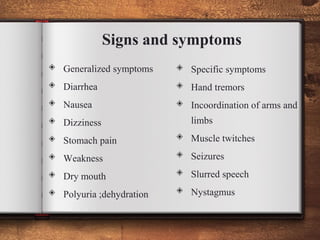
Signs and symptoms
◈ Generalized symptoms
◈ Diarrhea
◈ Nausea
◈ Dizziness
◈ Stomach pain
◈ Weakness
◈ Dry mouth
◈ Polyuria ;dehydration
◈ Specific symptoms
◈ Hand tremors
◈ Incoordination of arms and
limbs
◈ Muscle twitches
◈ Seizures
◈ Slurred speech
◈ Nystagmus
Chronic symptoms
•Slurred speech
•Tremors
•Increased reflexes
•Kidney failure
•Memory problems
•Movement disorder
•Psychosis
Aggravating factors
◈ Thiazide diuretics
◈ ACE inhibitors
◈ Calcium channel blockers
◈ NSAIDS
Management
◈ Pre – hospital care
 Stabilize life threatening conditions and initiate supportive
therapy
 Obtain intravenous access with isotonic sodium chloride
solution and administer O2
 Monitor cardiac function to assess rhythm disturbances
 Obtain all pill bottles available to the patient
Contd.
◈ Emergency department care
 GI decontamination:
- Gastric Lavage (within 1 hr of ingestion)
- Bowel irrigation with polyethylene glycol
- Use of sodium polystyrene sulfonate
 Enhanced elimination
- NS ( to restore GFR, normalize urine output)
- Hemodialysis (for those with renal failure, CHF or liver disease and
lithium level 4mEq/L in acute toxicity and level of 2.5mEq/L in chronic
toxicity in pts with symptoms)
Contd.
◈ Consultations
 Consult renal service personnel for hemodialysis
in severe toxications
 Consult psychiatric service personnel for
patients with intentional overdose
 Consult the poison control centre and a medical
toxicologist regarding appropriate treatment
NURSING CONSIDERATIONS
 Serum lithium level should be monitered once or twice a week
after initial treatment until doses and serum level are stable
 Blood sample should be drawn 12 hours after the last dose
As per the symptoms
◈ Drowsiness, dizziness, headache
 It should be ensured that the patient does not participate in
activities that required alertness until the respose has stabilized
Contd.
◈ Dry mouth,thirst
 Patient should be provided with sugarless
candy,ice,frequent sips of water
 Strict oral hygiene should be maintained
◈ GI upset, nausea ,vomiting
 Doses should be scheduled with meals to
minimize GI upset
Contd.
◈ Hand tremors
 Physician should be informed who may prescribe small
dose of beta blocker propanolol to counteract the
sideeffect
◈ Polyuria, dehydration
 Daily intake and output should be monitered along with
skin turgor
Contd.
◈ Weight gain
 Reduced calorie diet should be instructed
 Importance of maintaining adequate intake of
sodium.
Lithium toxicity

Lithium toxicity

  • 1.
  • 2.
    Introduction Lithium ◈ Lithium isa chemical substances used as mood stabilizing drugs. ◈ It has narrow therapeutic range, so it is used along with benzodiazepines, antipsychotic drugs and antiepileptic drugs to reduce hyperactivity. ◈ Lithium carbonate is used as a drug of choice. ◈ It is mainly available in the form of tablet, capsule, solution.
  • 3.
    Mechanism of action ◈Lithium alters sodium metabolism within nerve and muscle cells and enhances the reuptake of biogenic amines (norepinephrine and serotonin) in the brain, lowering levels in the body and resulting in decreased hyperactivity. ◈ It may block development of sensitive dopamine receptors in the CNS of manic patient. Lithium has both antimanic and antidepressant properties.
  • 4.
    Indication ◈ Is usedin prevention and treatment of manic episodes associated with bipolar disorder. ◈ As mood stabilizer lithium reduces the risk of suicide in people with bipolar disorder.
  • 5.
    Contraindications ◈ Individuals withhypersensitivity to the drugs ◈ Severe cardiovascular and renal disease ◈ Severe dehydration ◈ Brain damage ◈ Pregnancy and lactation
  • 6.
    Lithium toxicity If serumlithium exceeds 1.5-2.5 meq/lit then lithium toxicity occurs. There is narrow margin between therapeutic and toxic level of lithium carbonate. ◈ The usual ranges of therapeutic serum concentrations are: ◈ For acute mania: 1 to 1.5 meq/l ◈ Long term:0.6-1.2 meq/l
  • 7.
    Types of lithiumtoxicity Acute toxicity When lithium is swallowed intentionally or accidentally in higher amount Chronic toxicity When lithium is taken a little to much of lithium prescription everyday
  • 8.
    Signs and symptoms ◈Generalized symptoms ◈ Diarrhea ◈ Nausea ◈ Dizziness ◈ Stomach pain ◈ Weakness ◈ Dry mouth ◈ Polyuria ;dehydration ◈ Specific symptoms ◈ Hand tremors ◈ Incoordination of arms and limbs ◈ Muscle twitches ◈ Seizures ◈ Slurred speech ◈ Nystagmus
  • 9.
    Chronic symptoms •Slurred speech •Tremors •Increasedreflexes •Kidney failure •Memory problems •Movement disorder •Psychosis
  • 10.
    Aggravating factors ◈ Thiazidediuretics ◈ ACE inhibitors ◈ Calcium channel blockers ◈ NSAIDS
  • 11.
    Management ◈ Pre –hospital care  Stabilize life threatening conditions and initiate supportive therapy  Obtain intravenous access with isotonic sodium chloride solution and administer O2  Monitor cardiac function to assess rhythm disturbances  Obtain all pill bottles available to the patient
  • 12.
    Contd. ◈ Emergency departmentcare  GI decontamination: - Gastric Lavage (within 1 hr of ingestion) - Bowel irrigation with polyethylene glycol - Use of sodium polystyrene sulfonate  Enhanced elimination - NS ( to restore GFR, normalize urine output) - Hemodialysis (for those with renal failure, CHF or liver disease and lithium level 4mEq/L in acute toxicity and level of 2.5mEq/L in chronic toxicity in pts with symptoms)
  • 13.
    Contd. ◈ Consultations  Consultrenal service personnel for hemodialysis in severe toxications  Consult psychiatric service personnel for patients with intentional overdose  Consult the poison control centre and a medical toxicologist regarding appropriate treatment
  • 14.
    NURSING CONSIDERATIONS  Serumlithium level should be monitered once or twice a week after initial treatment until doses and serum level are stable  Blood sample should be drawn 12 hours after the last dose As per the symptoms ◈ Drowsiness, dizziness, headache  It should be ensured that the patient does not participate in activities that required alertness until the respose has stabilized
  • 15.
    Contd. ◈ Dry mouth,thirst Patient should be provided with sugarless candy,ice,frequent sips of water  Strict oral hygiene should be maintained ◈ GI upset, nausea ,vomiting  Doses should be scheduled with meals to minimize GI upset
  • 16.
    Contd. ◈ Hand tremors Physician should be informed who may prescribe small dose of beta blocker propanolol to counteract the sideeffect ◈ Polyuria, dehydration  Daily intake and output should be monitered along with skin turgor
  • 17.
    Contd. ◈ Weight gain Reduced calorie diet should be instructed  Importance of maintaining adequate intake of sodium.