


Welcome
to
Paper Presentation on
MEMS TECHNOLOGY
By
Chavan Mayuri Sanjay
Department of Electronics and Telecommunication Engineering
Annasaheb Dange College of Engineering and Technology, Ashta
OUTLINE
• MEMS Introduction
• Sensor
• Fabrication
• MEMS manufacturing technology
• Packaging
• Advantages
• Disadvantages
• Application
• Conclusion
• Reference
INTRODUCTION
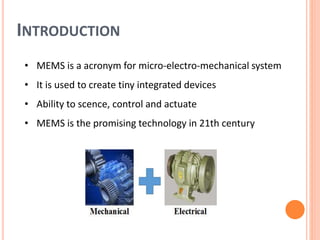
• MEMS is a acronym for micro-electro-mechanical system
• It is used to create tiny integrated devices
• Ability to scence, control and actuate
• MEMS is the promising technology in 21th century
WHY MEMS SENSOR?
• It measures physical quantity and convert into it into
electronic signal
• Used to scence changing parameter
• Small in size
• Have lower power consumption
• More sensitivity to input variation
• Less invasive due to mass production
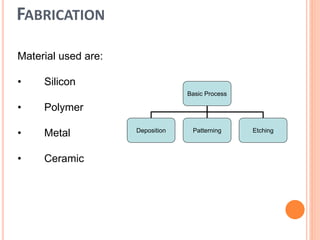
FABRICATION
Material used are:
• Silicon
• Polymer
• Metal
• Ceramic
Basic Process
Deposition Patterning Etching
MEMS MANUFACTURING TECHNOLOGY
• Bulk Micromachining
• Surface Micromachining
• LIGA
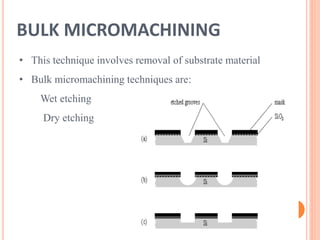
BULK MICROMACHINING
• This technique involves removal of substrate material
• Bulk micromachining techniques are:
Wet etching
Dry etching
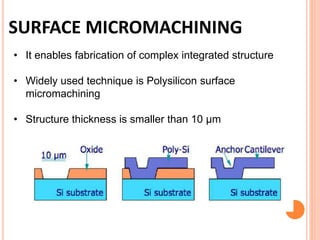
SURFACE MICROMACHINING
• It enables fabrication of complex integrated structure
• Widely used technique is Polysilicon surface
micromachining
• Structure thickness is smaller than 10 μm
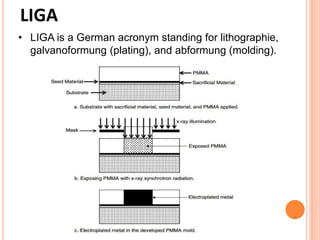
LIGA
• LIGA is a German acronym standing for lithographie,
galvanoformung (plating), and abformung (molding).
PACKAGING
• Protect the sensor from external influences and
environmental effect
• Protect the environment from presence of the sensor
• Provide controlled interface between sensors
• Standard IC Packages:
Ceramic Packages, Plastic Package, Metal Packages
ADVANTAGES
• Smaller package size
• Less power consumption
• Easy to integrate into system or modify
• Lighter weight
• Higher output signal
LIMITATIONS
• It is very small to trace out
• Expensive and Complex Packaging
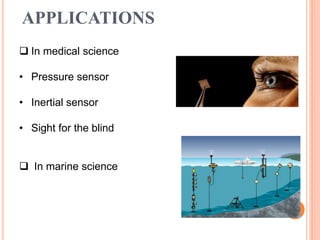
APPLICATIONS
 In medical science
• Pressure sensor
• Inertial sensor
• Sight for the blind
 In marine science
CONTINUE….
 Applications in marine military operation
 Industrial Market
 Communication
FUTURE SCOPE
• Access to Foundries
• Design, Simulation and Modeling
• Packaging and Testing
• Standardization
• Education and Training
CONCLUSION
• MEMS promises to be an effective technique of
producing sensors of high quality, at lower costs.
• Thus I can conclude that the MEMS can create a
proactive computing world, connected computing nodes
automatically, acquire and act on real-time data about a
physical environment, helping to improve lives,
promoting a better understanding of the world and
enabling people to become more productive.
REFERENCE
1. Microsensors , Muller, R.S., Howe, R.T., Senturia , S.D.,
Smith, R.L., and White, R.M. [Eds.], IEEE Press, New York,
NY, 1991.
2. Micromechanics and MEMS: Classic and Seminal Paper
to 1990, Trimmer, W.S., IEEE Press, New York, NY, 1997.
3. Journal of Micro-electro-mechanical-Systems
(http://www.ieee.org/pub_preview/mems_toc.html)
4. Journal of Micromechanics and Microengineering
(http://www.iop.org/Journals/jm)

Mems tecnology

  • 1.
    Welcome to Paper Presentation on MEMSTECHNOLOGY By Chavan Mayuri Sanjay Department of Electronics and Telecommunication Engineering Annasaheb Dange College of Engineering and Technology, Ashta
  • 2.
    OUTLINE • MEMS Introduction •Sensor • Fabrication • MEMS manufacturing technology • Packaging • Advantages • Disadvantages • Application • Conclusion • Reference
  • 3.
    INTRODUCTION • MEMS isa acronym for micro-electro-mechanical system • It is used to create tiny integrated devices • Ability to scence, control and actuate • MEMS is the promising technology in 21th century
  • 4.
    WHY MEMS SENSOR? •It measures physical quantity and convert into it into electronic signal • Used to scence changing parameter • Small in size • Have lower power consumption • More sensitivity to input variation • Less invasive due to mass production
  • 5.
    FABRICATION Material used are: •Silicon • Polymer • Metal • Ceramic Basic Process Deposition Patterning Etching
  • 6.
    MEMS MANUFACTURING TECHNOLOGY •Bulk Micromachining • Surface Micromachining • LIGA
  • 7.
    BULK MICROMACHINING • Thistechnique involves removal of substrate material • Bulk micromachining techniques are: Wet etching Dry etching
  • 8.
    SURFACE MICROMACHINING • Itenables fabrication of complex integrated structure • Widely used technique is Polysilicon surface micromachining • Structure thickness is smaller than 10 μm
  • 9.
    LIGA • LIGA isa German acronym standing for lithographie, galvanoformung (plating), and abformung (molding).
  • 10.
    PACKAGING • Protect thesensor from external influences and environmental effect • Protect the environment from presence of the sensor • Provide controlled interface between sensors • Standard IC Packages: Ceramic Packages, Plastic Package, Metal Packages
  • 11.
    ADVANTAGES • Smaller packagesize • Less power consumption • Easy to integrate into system or modify • Lighter weight • Higher output signal
  • 12.
    LIMITATIONS • It isvery small to trace out • Expensive and Complex Packaging
  • 13.
    APPLICATIONS  In medicalscience • Pressure sensor • Inertial sensor • Sight for the blind  In marine science
  • 14.
    CONTINUE….  Applications inmarine military operation  Industrial Market  Communication
  • 15.
    FUTURE SCOPE • Accessto Foundries • Design, Simulation and Modeling • Packaging and Testing • Standardization • Education and Training
  • 16.
    CONCLUSION • MEMS promisesto be an effective technique of producing sensors of high quality, at lower costs. • Thus I can conclude that the MEMS can create a proactive computing world, connected computing nodes automatically, acquire and act on real-time data about a physical environment, helping to improve lives, promoting a better understanding of the world and enabling people to become more productive.
  • 17.
    REFERENCE 1. Microsensors ,Muller, R.S., Howe, R.T., Senturia , S.D., Smith, R.L., and White, R.M. [Eds.], IEEE Press, New York, NY, 1991. 2. Micromechanics and MEMS: Classic and Seminal Paper to 1990, Trimmer, W.S., IEEE Press, New York, NY, 1997. 3. Journal of Micro-electro-mechanical-Systems (http://www.ieee.org/pub_preview/mems_toc.html) 4. Journal of Micromechanics and Microengineering (http://www.iop.org/Journals/jm)