MEMS TECHNOLOGY
BY:
JAYA NAIK
USN:4NM11EC405
DEPT OF E&C 1
CONTENTS
1.Introduction
2.Differences between IC and MEMS
3.Basic elements of MEMS
4.Manufacturing process of MEMS technology
5.RF MEMS
6.RF MEMS switches
7.Fabrication
8.Comparision of MEMS Switches with solid state
switches
9.Advantages and Disadvantages
10.Applications
11.Conclusion
12.Reference
DEPT OF E&C 2
Introduction
• Micro-Electro-Mechanical Systems
• Miniaturized mechanical and electro mechanical
elements using micro fabrication.
• Most promising Technology of 21st century.
DEPT OF E&C 3
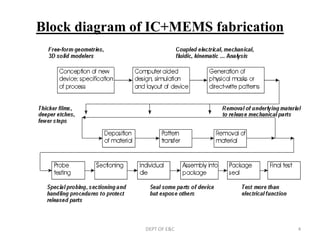
Block diagram of IC+MEMS fabrication
DEPT OF E&C 4
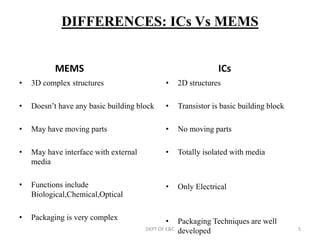
DIFFERENCES: ICs Vs MEMS
MEMS
• 3D complex structures
• Doesn’t have any basic building block
• May have moving parts
• May have interface with external
media
• Functions include
Biological,Chemical,Optical
• Packaging is very complex
ICs
• 2D structures
• Transistor is basic building block
• No moving parts
• Totally isolated with media
• Only Electrical
• Packaging Techniques are well
developedDEPT OF E&C 5
Basic Functional Elements of MEMS
DEPT OF E&C 6
Manufacturing process of MEMS
Technology
1.Photolithography
2.Silicon Micromachining
a)Bulk Micromachining
b)Surface Micromachining
3.Excimer Laser Micromachining
DEPT OF E&C 7
PHOTOLITHOGRAPHY
DEPT OF E&C 8
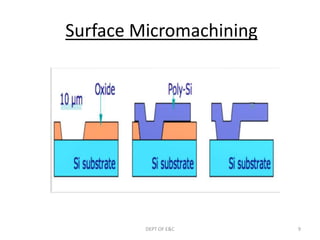
Surface Micromachining
DEPT OF E&C 9
Basic techniques of Silicon
micromachining
•Deposition of thin films
•Wet Chemical Etching
•Dry Chemical Etching
DEPT OF E&C 10
Wet Chemical Etching
DEPT OF E&C 11
Lift off
DEPT OF E&C 12
Excimer Laser Micromachining
DEPT OF E&C 13
RF MEMS
•MEMS those with RF range are RE MEMS
•Compound solid state switches have larger
insertion loss(on state) and poor electrical
isolation (off state)
•RF MEMS Switches provides lower insertion
loss, higher isolation, zero static power
consumption
DEPT OF E&C 14
RF MEMS Switches
1.RF series contact switch
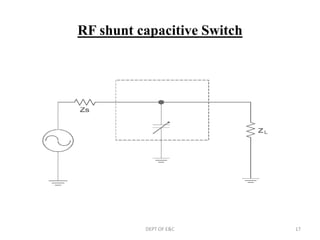
2.RF shunt capacitive switch
DEPT OF E&C 15
RF series contact Switch
DEPT OF E&C 16
RF shunt capacitive Switch
DEPT OF E&C 17
Limitations
•Series contact switches tend to fail in the open
circuit.
•Even though the bridge is collapsing and
making the contact with transmission line,
conductivity of contact metallization area
decreases until unacceptable levels of power
losses are achieved
•Shunt capacitive switches often fail due to
charge tapering, both at the surface and bulk
states of the dielectric.
DEPT OF E&C 18
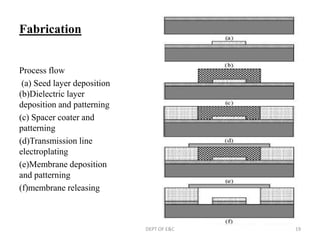
Fabrication
Process flow
(a) Seed layer deposition
(b)Dielectric layer
deposition and patterning
(c) Spacer coater and
patterning
(d)Transmission line
electroplating
(e)Membrane deposition
and patterning
(f)membrane releasing
DEPT OF E&C 19
Comparision of MEMS switches with Solid
State switches
DEPT OF E&C
;PPParameter RFRF MEMS
MEMS
PPIN DIODE FFEFET
Voltage(mA) 20-80 3-5 3-5
Current(mA) 0 0-20 0
Power
consumption
(mW)
0.5-1 5-100 -0.5-0.1
switching 1-300uS 1-100ns 1-100ns
Power
handling(W)
<1 <10 <10
20
ADVATAGES OF MEMS
•Can reduce the weight,size,power consumption
and component counts.
•Promise superior performance
•Can be built with high producibility
•New functionality
DEPT OF E&C 21
DISADVANTAGES OF MEMS:-
•Due to their size, significant power
transfer is impossible
•Due to its base material cannot be loaded
with large load
•Design standards are not well developed
•And some Reliability issues..
DEPT OF E&C 22
Applications
•In Navigation field
•Pressure sensors
•Medical field
•High frequency circuits
•Security field
DEPT OF E&C 23
Conclusion
•Low power consumption, high isolation and
ability to integrate with other elements make
MEMS switches an alternative to solid state
switches.
•MEMS is one of the promising technology
•Proper design standards have to be build.
•High performance RF MEMS switches, high
voltage MOSFET and CMOS devices can be
integrated on the same chip.
DEPT OF E&C 24
References
[1] Sazzadur Choudhury, M. Ahmadi, and W.C. Miller, “Micromechanical system
for System-on-Chip Connectivity”, IEEE Circuits and Systems, Page(s) 112-132
September 2002
[2] J. B. Muldavin, G. M. Rebeiz, "High Isolation RF MEMS Shunt Switches-Part
2: Design", IEEE Tran. On Microwave Theory and Techniques, Vol.6, Page(s):
253-276.
June 2000,
[3] P. Osterberg, H. Yie, X. Cai, J. White, and S. Senturia, “Self-consistent
simulation and modeling of RF MEMS,“ in Proc. IEEE MEMS Conf. January 1994,
Page (s)28-32.
[4] Gopinath. A and Ranklin.JB, IEEE Electronic development,” GaAs FET RF
switches “, vol. 12, Page(s) 18-37, August 2003
DEPT OF E&C 25
THANK YOU
DEPT OF E&C 26

Mems technology ppt

  • 1.
  • 2.
    CONTENTS 1.Introduction 2.Differences between ICand MEMS 3.Basic elements of MEMS 4.Manufacturing process of MEMS technology 5.RF MEMS 6.RF MEMS switches 7.Fabrication 8.Comparision of MEMS Switches with solid state switches 9.Advantages and Disadvantages 10.Applications 11.Conclusion 12.Reference DEPT OF E&C 2
  • 3.
    Introduction • Micro-Electro-Mechanical Systems •Miniaturized mechanical and electro mechanical elements using micro fabrication. • Most promising Technology of 21st century. DEPT OF E&C 3
  • 4.
    Block diagram ofIC+MEMS fabrication DEPT OF E&C 4
  • 5.
    DIFFERENCES: ICs VsMEMS MEMS • 3D complex structures • Doesn’t have any basic building block • May have moving parts • May have interface with external media • Functions include Biological,Chemical,Optical • Packaging is very complex ICs • 2D structures • Transistor is basic building block • No moving parts • Totally isolated with media • Only Electrical • Packaging Techniques are well developedDEPT OF E&C 5
  • 6.
    Basic Functional Elementsof MEMS DEPT OF E&C 6
  • 7.
    Manufacturing process ofMEMS Technology 1.Photolithography 2.Silicon Micromachining a)Bulk Micromachining b)Surface Micromachining 3.Excimer Laser Micromachining DEPT OF E&C 7
  • 8.
  • 9.
  • 10.
    Basic techniques ofSilicon micromachining •Deposition of thin films •Wet Chemical Etching •Dry Chemical Etching DEPT OF E&C 10
  • 11.
  • 12.
  • 13.
  • 14.
    RF MEMS •MEMS thosewith RF range are RE MEMS •Compound solid state switches have larger insertion loss(on state) and poor electrical isolation (off state) •RF MEMS Switches provides lower insertion loss, higher isolation, zero static power consumption DEPT OF E&C 14
  • 15.
    RF MEMS Switches 1.RFseries contact switch 2.RF shunt capacitive switch DEPT OF E&C 15
  • 16.
    RF series contactSwitch DEPT OF E&C 16
  • 17.
    RF shunt capacitiveSwitch DEPT OF E&C 17
  • 18.
    Limitations •Series contact switchestend to fail in the open circuit. •Even though the bridge is collapsing and making the contact with transmission line, conductivity of contact metallization area decreases until unacceptable levels of power losses are achieved •Shunt capacitive switches often fail due to charge tapering, both at the surface and bulk states of the dielectric. DEPT OF E&C 18
  • 19.
    Fabrication Process flow (a) Seedlayer deposition (b)Dielectric layer deposition and patterning (c) Spacer coater and patterning (d)Transmission line electroplating (e)Membrane deposition and patterning (f)membrane releasing DEPT OF E&C 19
  • 20.
    Comparision of MEMSswitches with Solid State switches DEPT OF E&C ;PPParameter RFRF MEMS MEMS PPIN DIODE FFEFET Voltage(mA) 20-80 3-5 3-5 Current(mA) 0 0-20 0 Power consumption (mW) 0.5-1 5-100 -0.5-0.1 switching 1-300uS 1-100ns 1-100ns Power handling(W) <1 <10 <10 20
  • 21.
    ADVATAGES OF MEMS •Canreduce the weight,size,power consumption and component counts. •Promise superior performance •Can be built with high producibility •New functionality DEPT OF E&C 21
  • 22.
    DISADVANTAGES OF MEMS:- •Dueto their size, significant power transfer is impossible •Due to its base material cannot be loaded with large load •Design standards are not well developed •And some Reliability issues.. DEPT OF E&C 22
  • 23.
    Applications •In Navigation field •Pressuresensors •Medical field •High frequency circuits •Security field DEPT OF E&C 23
  • 24.
    Conclusion •Low power consumption,high isolation and ability to integrate with other elements make MEMS switches an alternative to solid state switches. •MEMS is one of the promising technology •Proper design standards have to be build. •High performance RF MEMS switches, high voltage MOSFET and CMOS devices can be integrated on the same chip. DEPT OF E&C 24
  • 25.
    References [1] Sazzadur Choudhury,M. Ahmadi, and W.C. Miller, “Micromechanical system for System-on-Chip Connectivity”, IEEE Circuits and Systems, Page(s) 112-132 September 2002 [2] J. B. Muldavin, G. M. Rebeiz, "High Isolation RF MEMS Shunt Switches-Part 2: Design", IEEE Tran. On Microwave Theory and Techniques, Vol.6, Page(s): 253-276. June 2000, [3] P. Osterberg, H. Yie, X. Cai, J. White, and S. Senturia, “Self-consistent simulation and modeling of RF MEMS,“ in Proc. IEEE MEMS Conf. January 1994, Page (s)28-32. [4] Gopinath. A and Ranklin.JB, IEEE Electronic development,” GaAs FET RF switches “, vol. 12, Page(s) 18-37, August 2003 DEPT OF E&C 25
  • 26.