WELCOME…WELCOME…
A SEMINAR ON
MEMS
MICROPHONE
Jamsheed . p
ES5
NO : 13
OUT LINE…OUT LINE…
 Introduction
 MEMS technology
 Microphone structure
 Working
 Performance parameters
 Applications
 Advantages
 Conclusion
INTRODUCTIONINTRODUCTION
 MEMS technology provides a promising
implementation for microphones.
 Here, we discuss the design ,
characteristics & applications of MEMS
microphone.
MEMS TECHNOLOGYMEMS TECHNOLOGY
MEMS is a process technology used
to create tiny integrated devices or
systems that combine mechanical
and electrical components.
They are fabricated by integrated
circuit (IC) batch processing
techniques.
MEMS TECHNOLOGY …..MEMS TECHNOLOGY …..
Can range from a few micrometers to
millimeters.
These devices have the ability to
sense , control and actuate on the
micro scale and generate effects on
macro scales.
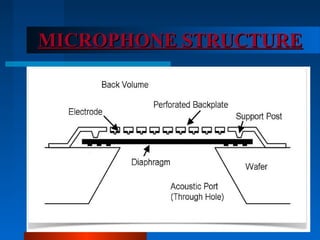
MICROPHONE STRUCTUREMICROPHONE STRUCTURE
MICROPHONE ARCHITECTUREMICROPHONE ARCHITECTURE
WORKING….WORKING….
WORKING…WORKING…
 Transduction principle is the coupled capacity
change between a fixed plate and a movable plate.
 Change in air pressure created by sound waves
cause the thin membrane to flex while the thicker
back-plate remains stationery .
 The movement of membrane creates a change in
capacitance between the membrane and back plate,
which is translated to an electrical signal by an
interface IC.
Performance parameters…Performance parameters…
Sensitivity
It is the measure of microphones response to
a given sound.
Sensitivity of microphone can be adjusted by
changing the gain.
Normally specified in dB FS (for digital mic)
or dBV (for analog mic).
Sensitivity of microphone sensor is an important
factor in determining the SNR.
Sensors with higher sensitivity increases the SNR.
Performance parameters…Performance parameters… ((cntd)cntd)
Noise floor
It is the measure of amount of noise created by
itself.
The noise floor of the microphone is its output
amplitude in the absence of sound.
Normally specified in dB FS (for digital mic)
or dBV (for analog mic).
Performance parameters…Performance parameters… ((cntd)cntd)
Signal to noise ratio
It is defined as the difference between its
sensitivity and its noise floor.
Sound pressure level
Sound pressure level is the logarithmic measure
of change in air pressure caused by sound
and specified in dB SPL .
Acoustic overload point
it is the maximum sound level that a microphone
can faithfully capture.
Performance parameters…Performance parameters… ((cntd)cntd)
Dynamic range
The dynamic range of microphone is the
difference between its acoustic
overload point and its noise floor . It is
Measured in dB.
TYPES OF MEMS MICROPHONE …TYPES OF MEMS MICROPHONE …
Analog type: which converts
sound input to corresponding voltage
output
Digital type: Gives a digit output
typically a pulse density modulation
APLLICATIONS…APLLICATIONS…
ADVANTAGES…ADVANTAGES…
 Can be manufactured using surface mount
technology
 Can withstand high temperature , vibrations
 Easily integrated with CMOS process
 Provides Improved noise cancellation
 Low power consumption
 High signal to noise ratio (70 dB)
 Very small size (1.05 mm)
CONCLUSIONCONCLUSION
 MEMS technology provides a promising
implementation for microphones.
 MEMS microphone is an excellent choice for applications
with size constraints.
ReferencesReferences
 S. D. Senturia, Microsystems Design. New York: Kluwer
Academic, 2001.
 V. P. Klimashin, “Mems technology,” Pribory i Tekhnika
Eksperimenta,
 Internet
 www.st.com/microelectronics
THANKS….THANKS….

Poly seminar-mems microphone jmsheed

  • 1.
  • 2.
    OUT LINE…OUT LINE… Introduction  MEMS technology  Microphone structure  Microphone structure  Working  Performance parameters  Applications  Advantages  Conclusion
  • 3.
    INTRODUCTIONINTRODUCTION  MEMS technologyprovides a promising implementation for microphones.  Here, we discuss the design , characteristics & applications of MEMS microphone.
  • 4.
    MEMS TECHNOLOGYMEMS TECHNOLOGY MEMSis a process technology used to create tiny integrated devices or systems that combine mechanical and electrical components. They are fabricated by integrated circuit (IC) batch processing techniques.
  • 5.
    MEMS TECHNOLOGY …..MEMSTECHNOLOGY ….. Can range from a few micrometers to millimeters. These devices have the ability to sense , control and actuate on the micro scale and generate effects on macro scales.
  • 6.
  • 7.
  • 8.
  • 9.
    WORKING…WORKING…  Transduction principleis the coupled capacity change between a fixed plate and a movable plate.  Change in air pressure created by sound waves cause the thin membrane to flex while the thicker back-plate remains stationery .  The movement of membrane creates a change in capacitance between the membrane and back plate, which is translated to an electrical signal by an interface IC.
  • 10.
    Performance parameters…Performance parameters… Sensitivity Itis the measure of microphones response to a given sound. Sensitivity of microphone can be adjusted by changing the gain. Normally specified in dB FS (for digital mic) or dBV (for analog mic). Sensitivity of microphone sensor is an important factor in determining the SNR. Sensors with higher sensitivity increases the SNR.
  • 11.
    Performance parameters…Performance parameters…((cntd)cntd) Noise floor It is the measure of amount of noise created by itself. The noise floor of the microphone is its output amplitude in the absence of sound. Normally specified in dB FS (for digital mic) or dBV (for analog mic).
  • 12.
    Performance parameters…Performance parameters…((cntd)cntd) Signal to noise ratio It is defined as the difference between its sensitivity and its noise floor. Sound pressure level Sound pressure level is the logarithmic measure of change in air pressure caused by sound and specified in dB SPL . Acoustic overload point it is the maximum sound level that a microphone can faithfully capture.
  • 13.
    Performance parameters…Performance parameters…((cntd)cntd) Dynamic range The dynamic range of microphone is the difference between its acoustic overload point and its noise floor . It is Measured in dB.
  • 14.
    TYPES OF MEMSMICROPHONE …TYPES OF MEMS MICROPHONE … Analog type: which converts sound input to corresponding voltage output Digital type: Gives a digit output typically a pulse density modulation
  • 15.
  • 16.
    ADVANTAGES…ADVANTAGES…  Can bemanufactured using surface mount technology  Can withstand high temperature , vibrations  Easily integrated with CMOS process  Provides Improved noise cancellation  Low power consumption  High signal to noise ratio (70 dB)  Very small size (1.05 mm)
  • 17.
    CONCLUSIONCONCLUSION  MEMS technologyprovides a promising implementation for microphones.  MEMS microphone is an excellent choice for applications with size constraints.
  • 18.
    ReferencesReferences  S. D.Senturia, Microsystems Design. New York: Kluwer Academic, 2001.  V. P. Klimashin, “Mems technology,” Pribory i Tekhnika Eksperimenta,  Internet  www.st.com/microelectronics
  • 19.