Memory and Knowledge
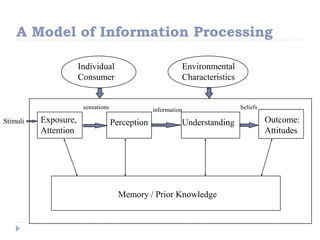
A Model of Information Processing
Exposure,
Attention
Perception Understanding Outcome:
Attitudes
sensations information
Memory / Prior Knowledge
Individual
Consumer
Environmental
Characteristics
Stimuli
beliefs
3
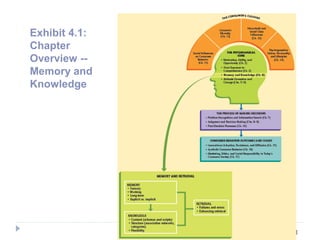
Exhibit 4.1:
Chapter
Overview --
Memory and
Knowledge
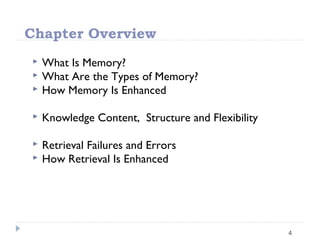
Chapter Overview
4
 What Is Memory?
 What Are the Types of Memory?
 How Memory Is Enhanced
 Knowledge Content, Structure and Flexibility
 Retrieval Failures and Errors
 How Retrieval Is Enhanced
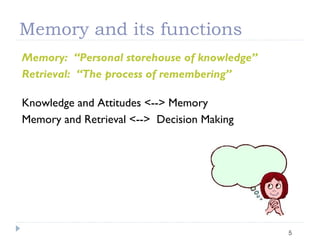
Memory and its functions
5
Memory: “Personal storehouse of knowledge”
Retrieval: “The process of remembering”
Knowledge and Attitudes <--> Memory
Memory and Retrieval <--> Decision Making
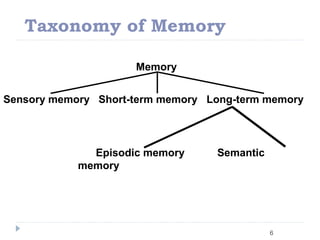
Taxonomy of Memory
6
Memory
Sensory memory Short-term memory Long-term memory
Episodic memory Semantic
memory
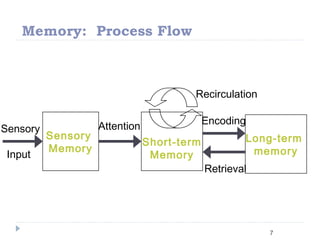
Memory: Process Flow
7
Long-term
memory
Short-term
Memory
Sensory
Input
Sensory
Memory
Attention
Encoding
Retrieval
Recirculation
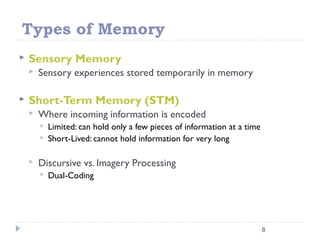
Types of Memory
 Sensory Memory
 Sensory experiences stored temporarily in memory
 Short-Term Memory (STM)
 Where incoming information is encoded
 Limited: can hold only a few pieces of information at a time
 Short-Lived: cannot hold information for very long
 Discursive vs. Imagery Processing
 Dual-Coding
8
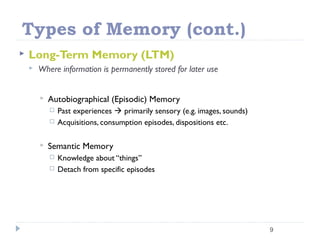
Types of Memory (cont.)
 Long-Term Memory (LTM)
 Where information is permanently stored for later use
 Autobiographical (Episodic) Memory
 Past experiences  primarily sensory (e.g. images, sounds)
 Acquisitions, consumption episodes, dispositions etc.
 Semantic Memory
 Knowledge about “things”
 Detach from specific episodes
9
10
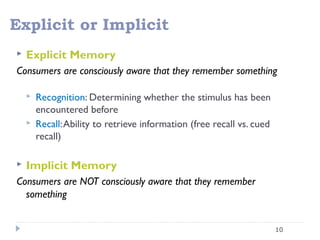
Explicit or Implicit
 Explicit Memory
Consumers are consciously aware that they remember something
 Recognition: Determining whether the stimulus has been
encountered before
 Recall:Ability to retrieve information (free recall vs. cued
recall)
 Implicit Memory
Consumers are NOT consciously aware that they remember
something
11
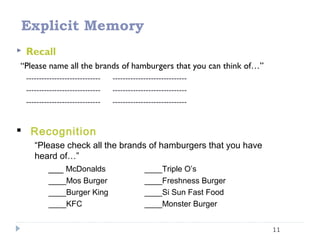
Explicit Memory
 Recall
“Please name all the brands of hamburgers that you can think of…”
----------------------------- -----------------------------
----------------------------- -----------------------------
----------------------------- -----------------------------
 Recognition
“Please check all the brands of hamburgers that you have
heard of…”
___ McDonalds ____Triple O’s
____Mos Burger ____Freshness Burger
____Burger King ____Si Sun Fast Food
____KFC ____Monster Burger
12
Implicit Memory
Free Association
◦ “What is the first word that comes
to mind when I mention
McDonalds?”
Fragment Completion
• “Fill in the blanks to make a word.”
 s _ o _
• Stem Completion
• “Fill in the blanks to make a word.”
 d i s _ _ _
How Memory Is Enhanced
 Chunking
 Grouping items to process them as a unit
 Rehearsal
 Actively reviewing information in LTM
 Recirculation
 Simple repetition of information within STM
 Elaboration
 Processing information more deeply
13
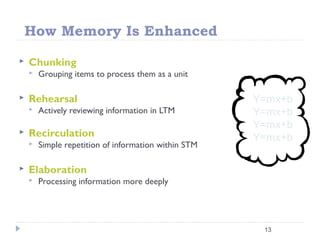
Y=mx+b
Y=mx+b
Y=mx+b
Y=mx+b
14
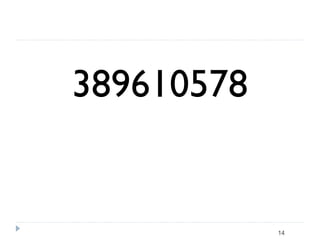
389610578
Knowledge Content: Schemas
15
The set of associations linked to a concept
 Schemas
 We have schemas for everything
 Places, people, brands, even ourselves!
 Scripts: sequence of actions
Professional Singer Idol
17
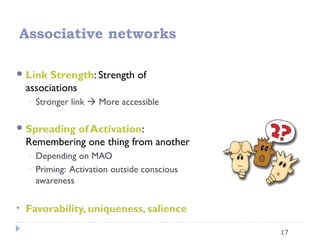
Associative networks
Link Strength: Strength of
associations
◦ Stronger link  More accessible
Spreading of Activation:
Remembering one thing from another
◦ Depending on MAO
◦ Priming: Activation outside conscious
awareness
• Favorability, uniqueness, salience
Schema example
McDonalds ?
1919
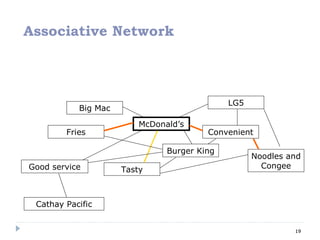
Associative Network
McDonald’s
Big Mac
Fries
Tasty
Convenient
LG5
Burger King
Noodles and
Congee
Cathay Pacific
Good service
Knowledge Content (cont.)
22
 Images
 Brand Image: A set of distinctive associations stored in a brand schema
 Brand Personality: The set of associations that reflects “human” aspects of the
brand
 Applications
 Brand Extension: Same brand name, different category – leverage the existing
schema
 Licensing: Sell the rights to your brand name
 Brand Alliance: Two brand names on one product
 Repositioning: Changing schemas, images, or personalities
 Product crisis: brand personality
Knowledge Structure
23
 Taxonomic categorization
 A system of classification
 Maximal vs. minimal similarity
 Properties: Graded and hierarchical
 Graded structure
 Category members are different in terms of how well they represent
the category
Prototypes
24
The “best example” of a category
 Example:
 Theme park:
 Canned soup:
 Cereal:
 Ketchup:
 What Affects Prototypicality
 Maximum shared associations within a category; minimum across
categories
 Frequency of experienced membership
 Pioneer / first-mover
Knowledge Structure (cont.)
25
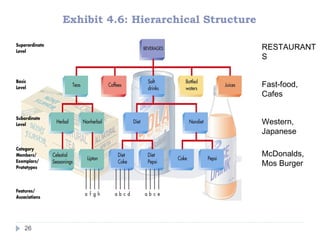
 Hierarchical Structure (e.g. Park N Shop)
 Superordinate Level
 Basic Level
 Subordinate Level
 Correlated Associations
 Associations that frequently occur together within a schema
26
Exhibit 4.6: Hierarchical Structure
RESTAURANT
S
Fast-food,
Cafes
Western,
Japanese
McDonalds,
Mos Burger
Knowledge Flexibility
 Goal-Derived Categories
 Classifying things together because they satisfy the same goals
 Different way of categorizing (as opposed to taxonomic categorization)
 E.g. things to buy for a party
 Construal Level Theory: high vs. low construal
 High construal: abstract thinking (e.g. desirability)
 Low construal: concrete thinking (e.g. feasibility)
 Factors: time; geographical distance
Why Consumers Differ in Knowledge
 Culture (different sets of associations, category members,
prototypes, etc.)
 Level of Expertise (“Ability” to process new information –
experts vs. novices)
Retrieval: Accessing information from the
semantic network
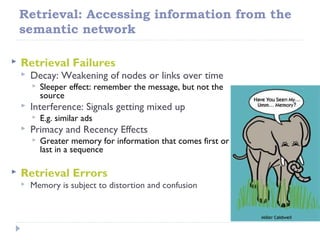
 Retrieval Failures
 Decay: Weakening of nodes or links over time
 Sleeper effect: remember the message, but not the
source
 Interference: Signals getting mixed up
 E.g. similar ads
 Primacy and Recency Effects
 Greater memory for information that comes first or
last in a sequence
 Retrieval Errors
 Memory is subject to distortion and confusion
30
Retrieval: Marketing Implications
 As a communication objective
 Increase recall of brand name, attributes, benefits, etc.
 Influencing consumer choices
 Internal search  useful input for attitudes and choice
 Advertising effectiveness
 Measures of recognition, recall, persistence
 Segmentation
 Segment the customers according to how well they can remember
31
How Retrieval Is Enhanced
Characteristics of the Stimulus
◦ Salience: e.g. multipage ads
◦ Prototypicality
◦ Redundant cues: information that go together naturally
◦ Medium in which the stimulus was processed
What the Stimulus Is LinkedTo
◦ Retrieval Cues: Stimuli that facilitate the activation of memory
◦ Internal cues
◦ External cues: e.g. brand name, logos, packages
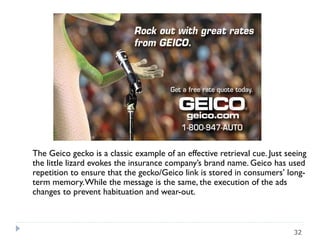
The Geico gecko is a classic example of an effective retrieval cue. Just seeing
the little lizard evokes the insurance company’s brand name. Geico has used
repetition to ensure that the gecko/Geico link is stored in consumers’ long-
term memory.While the message is the same, the execution of the ads
changes to prevent habituation and wear-out.
32
How Retrieval Is Enhanced
 How a Stimulus Is Processed in STM
 Imagery processing: processing of information in sensory form
 Discursive processing: processing of information as words
 Dual Coding: Imagery + Discursive Processing
 Consumer Characteristics
 Mood
 Expertise
33

memory and knowledge

  • 1.
  • 2.
    A Model ofInformation Processing Exposure, Attention Perception Understanding Outcome: Attitudes sensations information Memory / Prior Knowledge Individual Consumer Environmental Characteristics Stimuli beliefs
  • 3.
  • 4.
    Chapter Overview 4  WhatIs Memory?  What Are the Types of Memory?  How Memory Is Enhanced  Knowledge Content, Structure and Flexibility  Retrieval Failures and Errors  How Retrieval Is Enhanced
  • 5.
    Memory and itsfunctions 5 Memory: “Personal storehouse of knowledge” Retrieval: “The process of remembering” Knowledge and Attitudes <--> Memory Memory and Retrieval <--> Decision Making
  • 6.
    Taxonomy of Memory 6 Memory Sensorymemory Short-term memory Long-term memory Episodic memory Semantic memory
  • 7.
  • 8.
    Types of Memory Sensory Memory  Sensory experiences stored temporarily in memory  Short-Term Memory (STM)  Where incoming information is encoded  Limited: can hold only a few pieces of information at a time  Short-Lived: cannot hold information for very long  Discursive vs. Imagery Processing  Dual-Coding 8
  • 9.
    Types of Memory(cont.)  Long-Term Memory (LTM)  Where information is permanently stored for later use  Autobiographical (Episodic) Memory  Past experiences  primarily sensory (e.g. images, sounds)  Acquisitions, consumption episodes, dispositions etc.  Semantic Memory  Knowledge about “things”  Detach from specific episodes 9
  • 10.
    10 Explicit or Implicit Explicit Memory Consumers are consciously aware that they remember something  Recognition: Determining whether the stimulus has been encountered before  Recall:Ability to retrieve information (free recall vs. cued recall)  Implicit Memory Consumers are NOT consciously aware that they remember something
  • 11.
    11 Explicit Memory  Recall “Pleasename all the brands of hamburgers that you can think of…” ----------------------------- ----------------------------- ----------------------------- ----------------------------- ----------------------------- -----------------------------  Recognition “Please check all the brands of hamburgers that you have heard of…” ___ McDonalds ____Triple O’s ____Mos Burger ____Freshness Burger ____Burger King ____Si Sun Fast Food ____KFC ____Monster Burger
  • 12.
    12 Implicit Memory Free Association ◦“What is the first word that comes to mind when I mention McDonalds?” Fragment Completion • “Fill in the blanks to make a word.”  s _ o _ • Stem Completion • “Fill in the blanks to make a word.”  d i s _ _ _
  • 13.
    How Memory IsEnhanced  Chunking  Grouping items to process them as a unit  Rehearsal  Actively reviewing information in LTM  Recirculation  Simple repetition of information within STM  Elaboration  Processing information more deeply 13 Y=mx+b Y=mx+b Y=mx+b Y=mx+b
  • 14.
  • 15.
    Knowledge Content: Schemas 15 Theset of associations linked to a concept  Schemas  We have schemas for everything  Places, people, brands, even ourselves!  Scripts: sequence of actions
  • 16.
  • 17.
    17 Associative networks Link Strength:Strength of associations ◦ Stronger link  More accessible Spreading of Activation: Remembering one thing from another ◦ Depending on MAO ◦ Priming: Activation outside conscious awareness • Favorability, uniqueness, salience
  • 18.
  • 19.
  • 22.
    Knowledge Content (cont.) 22 Images  Brand Image: A set of distinctive associations stored in a brand schema  Brand Personality: The set of associations that reflects “human” aspects of the brand  Applications  Brand Extension: Same brand name, different category – leverage the existing schema  Licensing: Sell the rights to your brand name  Brand Alliance: Two brand names on one product  Repositioning: Changing schemas, images, or personalities  Product crisis: brand personality
  • 23.
    Knowledge Structure 23  Taxonomiccategorization  A system of classification  Maximal vs. minimal similarity  Properties: Graded and hierarchical  Graded structure  Category members are different in terms of how well they represent the category
  • 24.
    Prototypes 24 The “best example”of a category  Example:  Theme park:  Canned soup:  Cereal:  Ketchup:  What Affects Prototypicality  Maximum shared associations within a category; minimum across categories  Frequency of experienced membership  Pioneer / first-mover
  • 25.
    Knowledge Structure (cont.) 25 Hierarchical Structure (e.g. Park N Shop)  Superordinate Level  Basic Level  Subordinate Level  Correlated Associations  Associations that frequently occur together within a schema
  • 26.
    26 Exhibit 4.6: HierarchicalStructure RESTAURANT S Fast-food, Cafes Western, Japanese McDonalds, Mos Burger
  • 27.
    Knowledge Flexibility  Goal-DerivedCategories  Classifying things together because they satisfy the same goals  Different way of categorizing (as opposed to taxonomic categorization)  E.g. things to buy for a party  Construal Level Theory: high vs. low construal  High construal: abstract thinking (e.g. desirability)  Low construal: concrete thinking (e.g. feasibility)  Factors: time; geographical distance
  • 28.
    Why Consumers Differin Knowledge  Culture (different sets of associations, category members, prototypes, etc.)  Level of Expertise (“Ability” to process new information – experts vs. novices)
  • 29.
    Retrieval: Accessing informationfrom the semantic network  Retrieval Failures  Decay: Weakening of nodes or links over time  Sleeper effect: remember the message, but not the source  Interference: Signals getting mixed up  E.g. similar ads  Primacy and Recency Effects  Greater memory for information that comes first or last in a sequence  Retrieval Errors  Memory is subject to distortion and confusion
  • 30.
    30 Retrieval: Marketing Implications As a communication objective  Increase recall of brand name, attributes, benefits, etc.  Influencing consumer choices  Internal search  useful input for attitudes and choice  Advertising effectiveness  Measures of recognition, recall, persistence  Segmentation  Segment the customers according to how well they can remember
  • 31.
    31 How Retrieval IsEnhanced Characteristics of the Stimulus ◦ Salience: e.g. multipage ads ◦ Prototypicality ◦ Redundant cues: information that go together naturally ◦ Medium in which the stimulus was processed What the Stimulus Is LinkedTo ◦ Retrieval Cues: Stimuli that facilitate the activation of memory ◦ Internal cues ◦ External cues: e.g. brand name, logos, packages
  • 32.
    The Geico geckois a classic example of an effective retrieval cue. Just seeing the little lizard evokes the insurance company’s brand name. Geico has used repetition to ensure that the gecko/Geico link is stored in consumers’ long- term memory.While the message is the same, the execution of the ads changes to prevent habituation and wear-out. 32
  • 33.
    How Retrieval IsEnhanced  How a Stimulus Is Processed in STM  Imagery processing: processing of information in sensory form  Discursive processing: processing of information as words  Dual Coding: Imagery + Discursive Processing  Consumer Characteristics  Mood  Expertise 33