Chapter 15 Consumer Influence and the Diffusion of Innovations
Chapter Outline What Is Opinion Leadership? Dynamics of the Opinion Leadership Process The Motivation Behind Opinion Leadership Measurement of Opinion Leadership The Interpersonal Flow of Communication Diffusion of Innovations The Adoption Process
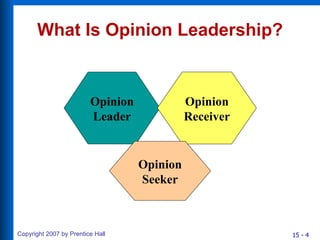
Opinion Leadership The process by which one person (the  opinion leader ) informally influences the consumption actions or attitudes of others who may be  opinion seekers  or  opinion recipients.
What Is Opinion Leadership? Opinion Leader Opinion Receiver Opinion Seeker
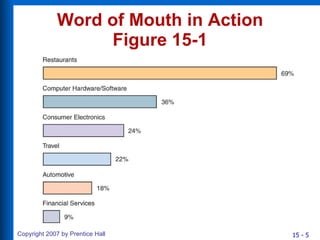
Word of Mouth in Action Figure 15-1
Discussion Question Who are the most influential opinion leaders to college-aged people? Why are they influential?
Dynamics of the  Opinion Leadership Process Credibility Positive and Negative Product Information Information and Advice Opinion Leadership Is Category-Specific Opinion Leadership Is a Two-way Street
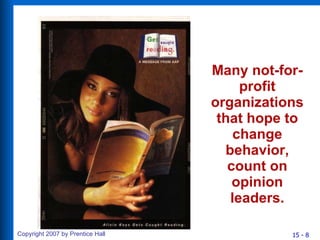
Many not-for-profit organizations that hope to change behavior, count on opinion leaders.
Motivations Behind Opinion Leadership The Needs of Opinion Leaders The Needs of Opinion Receivers Purchase Pals Surrogate Buyers versus Opinion Leaders Self-involvement Social involvement Product involvement Message involvement Issues
Motivations Behind Opinion Leadership The Needs of Opinion Leaders The Needs of Opinion Receivers Purchase Pals Surrogate Buyers versus Opinion Leaders New product or new usage information Reduction of perceived risk Reduction of search time Receiving the approval of the opinion leader Issues
Motivations Behind Opinion Leadership The Needs of Opinion Leaders The Needs of Opinion Receivers Purchase Pals Surrogate Buyers versus Opinion Leaders Actually accompany consumers on shopping trips Used 25 percent of the time for purchases of electronic equipment Issues
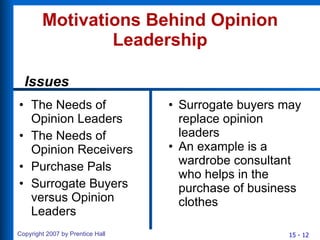
Motivations Behind Opinion Leadership The Needs of Opinion Leaders The Needs of Opinion Receivers Purchase Pals Surrogate Buyers versus Opinion Leaders Surrogate buyers may replace opinion leaders An example is a wardrobe consultant who helps in the purchase of business clothes Issues
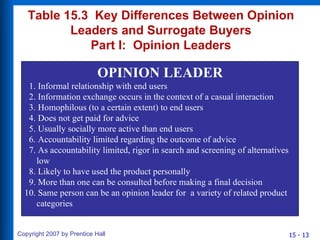
Table 15.3  Key Differences Between Opinion Leaders and Surrogate Buyers Part I:  Opinion Leaders OPINION LEADER 1. Informal relationship with end users 2. Information exchange occurs in the context of a casual interaction 3. Homophilous (to a certain extent) to end users 4. Does not get paid for advice 5. Usually socially more active than end users 6. Accountability limited regarding the outcome of advice 7. As accountability limited, rigor in search and screening of alternatives low 8. Likely to have used the product personally 9. More than one can be consulted before making a final decision 10. Same person can be an opinion leader for  a variety of related product categories
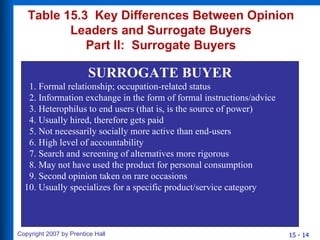
Table 15.3  Key Differences Between Opinion Leaders and Surrogate Buyers Part II:  Surrogate Buyers SURROGATE BUYER 1. Formal relationship; occupation-related status 2. Information exchange in the form of formal instructions/advice 3. Heterophilus to end users (that is, is the source of power) 4. Usually hired, therefore gets paid 5. Not necessarily socially more active than end-users 6. High level of accountability 7. Search and screening of alternatives more rigorous 8. May not have used the product for personal consumption 9. Second opinion taken on rare occasions 10. Usually specializes for a specific product/service category
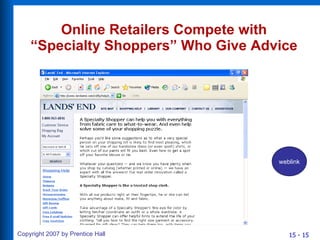
Online Retailers Compete with “Specialty Shoppers” Who Give Advice weblink
Measurement of Opinion Leadership Self-Designating Method Sociometric Method Key Informant Method Objective Method
Discussion Question Who do you know, personally, that you would consider an opinion leader? What is it about that person that makes them an opinion leader?  What personality traits might they have which prompt their status?
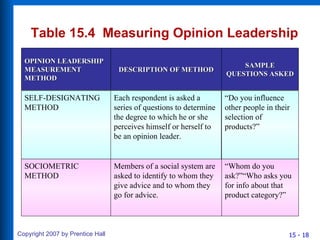
Table 15.4  Measuring Opinion Leadership SELF-DESIGNATING METHOD “ Do you influence other people in their selection of products?” Each respondent is asked a series of questions to determine the degree to which he or she perceives himself or herself to be an opinion leader. OPINION LEADERSHIP MEASUREMENT METHOD SAMPLE QUESTIONS ASKED DESCRIPTION OF METHOD SOCIOMETRIC METHOD Members of a social system are asked to identify to whom they give advice and to whom they go for advice. “ Whom do you ask?”“Who asks you for info about that product category?”
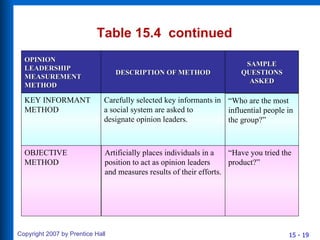
Table 15.4  continued OPINION LEADERSHIP MEASUREMENT METHOD SAMPLE QUESTIONS ASKED DESCRIPTION OF METHOD KEY INFORMANT METHOD “ Who are the most influential people in the group?” Carefully selected key informants in a social system are asked to designate opinion leaders. Artificially places individuals in a position to act as opinion leaders and measures results of their efforts. “ Have you tried the product?” OBJECTIVE METHOD
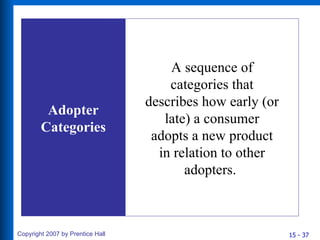
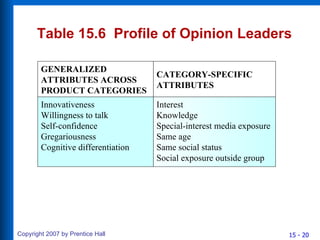
Table 15.6  Profile of Opinion Leaders GENERALIZED ATTRIBUTES ACROSS PRODUCT CATEGORIES CATEGORY-SPECIFIC ATTRIBUTES Innovativeness Willingness to talk Self-confidence Gregariousness Cognitive differentiation Interest Knowledge Special-interest media exposure Same age Same social status Social exposure outside group
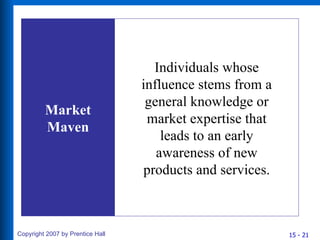
Market Maven Individuals whose influence stems from a general knowledge or market expertise that leads to an early awareness of new products and services.
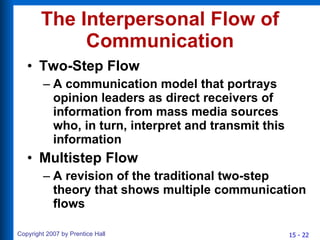
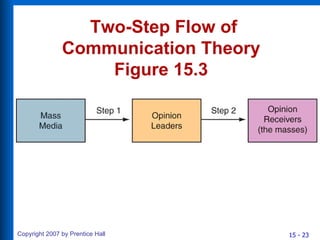
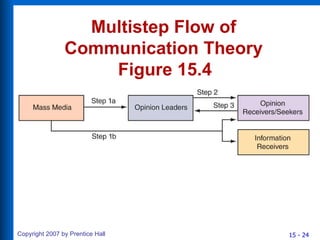
The Interpersonal Flow of Communication Two-Step Flow A communication model that portrays opinion leaders as direct receivers of information from mass media sources who, in turn, interpret and transmit this information Multistep Flow A revision of the traditional two-step theory that shows multiple communication flows
Two-Step Flow of Communication Theory  Figure 15.3
Multistep Flow of Communication Theory Figure 15.4
Issues in Opinion Leadership and Marketing Strategy Advertisements Stimulating Opinion Leadership Word of Mouth May Be Uncontrollable eGo Bikes Video
Marketers Seek to Take Control of the Opinion Leadership Process Creating products with built-in buzz potential Strategy designed to stimulate buzz Viral marketing Weblogs
At Blogwise You Can Find a Blog on Almost Any Topic weblink
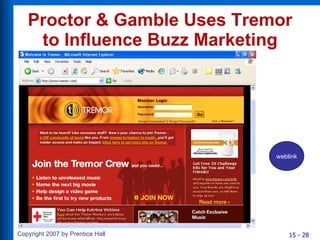
Proctor & Gamble Uses Tremor to Influence Buzz Marketing weblink
Diffusion Process The process by which the acceptance of an innovation is spread by communication to members of social system over a period of time.
Adoption Process The stages through which an individual consumer passes in arriving at a decision to try (or not to try), to continue using (or discontinue using) a new product.
Elements of the Diffusion Process The Innovation The Channels of Communication The Social System Time
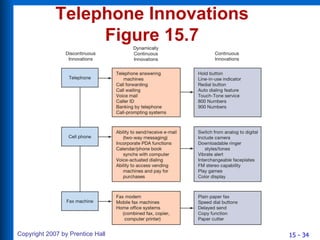
Defining Innovations Firm-oriented definitions Product is “new” to the company Product-oriented definitions Continuous Dynamically continuous Discontinuous Market-oriented definitions Based on consumer exposure Consumer-oriented definitions Consumer judges it as “new”
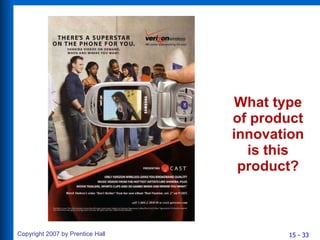
What type of product innovation is this product?
Telephone Innovations Figure 15.7
Product Characteristics That Influence Diffusion Relative Advantage Compatibility Complexity Trialability Observability
Time and Diffusion Purchase Time Adopter Categories Rate of Adoption
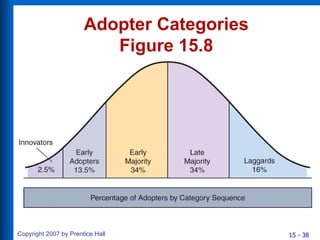
Adopter Categories A sequence of categories that describes how early (or late) a consumer adopts a new product in relation to other adopters.
Adopter Categories Figure 15.8
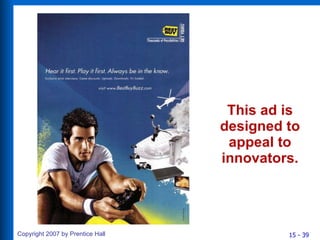
This ad is designed to appeal to innovators.
Discussion Question Which adaptor category are you? Does it differ with different product categories? How about your parents, what category are they? Is age a factor in innovation behavior?
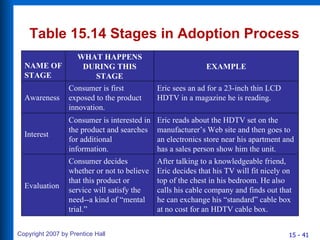
Table 15.14 Stages in Adoption Process NAME OF STAGE WHAT HAPPENS DURING THIS STAGE EXAMPLE Awareness Consumer is first exposed to the product innovation. Eric sees an ad for a 23-inch thin LCD HDTV in a magazine he is reading. Interest Consumer is interested in the product and searches for additional information. Eric reads about the HDTV set on the manufacturer’s Web site and then goes to an electronics store near his apartment and has a sales person show him the unit. Evaluation Consumer decides whether or not to believe that this product or service will satisfy the need--a kind of “mental trial.” After talking to a knowledgeable friend, Eric decides that his TV will fit nicely on top of the chest in his bedroom. He also calls his cable company and finds out that he can exchange his “standard” cable box at no cost for an HDTV cable box.
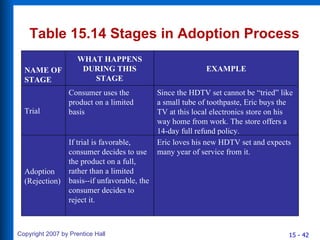
Table 15.14 Stages in Adoption Process Trial Consumer uses the product on a limited basis Since the HDTV set cannot be “tried” like a small tube of toothpaste, Eric buys the TV at this local electronics store on his way home from work. The store offers a 14-day full refund policy. Adoption (Rejection) If trial is favorable, consumer decides to use the product on a full, rather than a limited basis--if unfavorable, the consumer decides to reject it. Eric loves his new HDTV set and expects many year of service from it.  NAME OF STAGE WHAT HAPPENS DURING THIS STAGE EXAMPLE
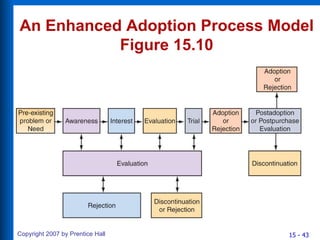
An Enhanced Adoption Process Model Figure 15.10
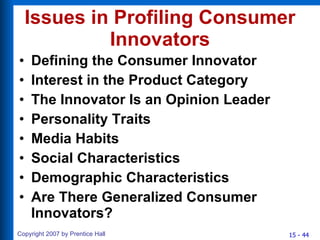
Issues in Profiling Consumer Innovators Defining the Consumer Innovator Interest in the Product Category The Innovator Is an Opinion Leader Personality Traits Media Habits Social Characteristics Demographic Characteristics Are There Generalized Consumer Innovators?

Chapter 15 Conumer Influence

  • 1.
    Chapter 15 ConsumerInfluence and the Diffusion of Innovations
  • 2.
    Chapter Outline WhatIs Opinion Leadership? Dynamics of the Opinion Leadership Process The Motivation Behind Opinion Leadership Measurement of Opinion Leadership The Interpersonal Flow of Communication Diffusion of Innovations The Adoption Process
  • 3.
    Opinion Leadership Theprocess by which one person (the opinion leader ) informally influences the consumption actions or attitudes of others who may be opinion seekers or opinion recipients.
  • 4.
    What Is OpinionLeadership? Opinion Leader Opinion Receiver Opinion Seeker
  • 5.
    Word of Mouthin Action Figure 15-1
  • 6.
    Discussion Question Whoare the most influential opinion leaders to college-aged people? Why are they influential?
  • 7.
    Dynamics of the Opinion Leadership Process Credibility Positive and Negative Product Information Information and Advice Opinion Leadership Is Category-Specific Opinion Leadership Is a Two-way Street
  • 8.
    Many not-for-profit organizationsthat hope to change behavior, count on opinion leaders.
  • 9.
    Motivations Behind OpinionLeadership The Needs of Opinion Leaders The Needs of Opinion Receivers Purchase Pals Surrogate Buyers versus Opinion Leaders Self-involvement Social involvement Product involvement Message involvement Issues
  • 10.
    Motivations Behind OpinionLeadership The Needs of Opinion Leaders The Needs of Opinion Receivers Purchase Pals Surrogate Buyers versus Opinion Leaders New product or new usage information Reduction of perceived risk Reduction of search time Receiving the approval of the opinion leader Issues
  • 11.
    Motivations Behind OpinionLeadership The Needs of Opinion Leaders The Needs of Opinion Receivers Purchase Pals Surrogate Buyers versus Opinion Leaders Actually accompany consumers on shopping trips Used 25 percent of the time for purchases of electronic equipment Issues
  • 12.
    Motivations Behind OpinionLeadership The Needs of Opinion Leaders The Needs of Opinion Receivers Purchase Pals Surrogate Buyers versus Opinion Leaders Surrogate buyers may replace opinion leaders An example is a wardrobe consultant who helps in the purchase of business clothes Issues
  • 13.
    Table 15.3 Key Differences Between Opinion Leaders and Surrogate Buyers Part I: Opinion Leaders OPINION LEADER 1. Informal relationship with end users 2. Information exchange occurs in the context of a casual interaction 3. Homophilous (to a certain extent) to end users 4. Does not get paid for advice 5. Usually socially more active than end users 6. Accountability limited regarding the outcome of advice 7. As accountability limited, rigor in search and screening of alternatives low 8. Likely to have used the product personally 9. More than one can be consulted before making a final decision 10. Same person can be an opinion leader for a variety of related product categories
  • 14.
    Table 15.3 Key Differences Between Opinion Leaders and Surrogate Buyers Part II: Surrogate Buyers SURROGATE BUYER 1. Formal relationship; occupation-related status 2. Information exchange in the form of formal instructions/advice 3. Heterophilus to end users (that is, is the source of power) 4. Usually hired, therefore gets paid 5. Not necessarily socially more active than end-users 6. High level of accountability 7. Search and screening of alternatives more rigorous 8. May not have used the product for personal consumption 9. Second opinion taken on rare occasions 10. Usually specializes for a specific product/service category
  • 15.
    Online Retailers Competewith “Specialty Shoppers” Who Give Advice weblink
  • 16.
    Measurement of OpinionLeadership Self-Designating Method Sociometric Method Key Informant Method Objective Method
  • 17.
    Discussion Question Whodo you know, personally, that you would consider an opinion leader? What is it about that person that makes them an opinion leader? What personality traits might they have which prompt their status?
  • 18.
    Table 15.4 Measuring Opinion Leadership SELF-DESIGNATING METHOD “ Do you influence other people in their selection of products?” Each respondent is asked a series of questions to determine the degree to which he or she perceives himself or herself to be an opinion leader. OPINION LEADERSHIP MEASUREMENT METHOD SAMPLE QUESTIONS ASKED DESCRIPTION OF METHOD SOCIOMETRIC METHOD Members of a social system are asked to identify to whom they give advice and to whom they go for advice. “ Whom do you ask?”“Who asks you for info about that product category?”
  • 19.
    Table 15.4 continued OPINION LEADERSHIP MEASUREMENT METHOD SAMPLE QUESTIONS ASKED DESCRIPTION OF METHOD KEY INFORMANT METHOD “ Who are the most influential people in the group?” Carefully selected key informants in a social system are asked to designate opinion leaders. Artificially places individuals in a position to act as opinion leaders and measures results of their efforts. “ Have you tried the product?” OBJECTIVE METHOD
  • 20.
    Table 15.6 Profile of Opinion Leaders GENERALIZED ATTRIBUTES ACROSS PRODUCT CATEGORIES CATEGORY-SPECIFIC ATTRIBUTES Innovativeness Willingness to talk Self-confidence Gregariousness Cognitive differentiation Interest Knowledge Special-interest media exposure Same age Same social status Social exposure outside group
  • 21.
    Market Maven Individualswhose influence stems from a general knowledge or market expertise that leads to an early awareness of new products and services.
  • 22.
    The Interpersonal Flowof Communication Two-Step Flow A communication model that portrays opinion leaders as direct receivers of information from mass media sources who, in turn, interpret and transmit this information Multistep Flow A revision of the traditional two-step theory that shows multiple communication flows
  • 23.
    Two-Step Flow ofCommunication Theory Figure 15.3
  • 24.
    Multistep Flow ofCommunication Theory Figure 15.4
  • 25.
    Issues in OpinionLeadership and Marketing Strategy Advertisements Stimulating Opinion Leadership Word of Mouth May Be Uncontrollable eGo Bikes Video
  • 26.
    Marketers Seek toTake Control of the Opinion Leadership Process Creating products with built-in buzz potential Strategy designed to stimulate buzz Viral marketing Weblogs
  • 27.
    At Blogwise YouCan Find a Blog on Almost Any Topic weblink
  • 28.
    Proctor & GambleUses Tremor to Influence Buzz Marketing weblink
  • 29.
    Diffusion Process Theprocess by which the acceptance of an innovation is spread by communication to members of social system over a period of time.
  • 30.
    Adoption Process Thestages through which an individual consumer passes in arriving at a decision to try (or not to try), to continue using (or discontinue using) a new product.
  • 31.
    Elements of theDiffusion Process The Innovation The Channels of Communication The Social System Time
  • 32.
    Defining Innovations Firm-orienteddefinitions Product is “new” to the company Product-oriented definitions Continuous Dynamically continuous Discontinuous Market-oriented definitions Based on consumer exposure Consumer-oriented definitions Consumer judges it as “new”
  • 33.
    What type ofproduct innovation is this product?
  • 34.
  • 35.
    Product Characteristics ThatInfluence Diffusion Relative Advantage Compatibility Complexity Trialability Observability
  • 36.
    Time and DiffusionPurchase Time Adopter Categories Rate of Adoption
  • 37.
    Adopter Categories Asequence of categories that describes how early (or late) a consumer adopts a new product in relation to other adopters.
  • 38.
  • 39.
    This ad isdesigned to appeal to innovators.
  • 40.
    Discussion Question Whichadaptor category are you? Does it differ with different product categories? How about your parents, what category are they? Is age a factor in innovation behavior?
  • 41.
    Table 15.14 Stagesin Adoption Process NAME OF STAGE WHAT HAPPENS DURING THIS STAGE EXAMPLE Awareness Consumer is first exposed to the product innovation. Eric sees an ad for a 23-inch thin LCD HDTV in a magazine he is reading. Interest Consumer is interested in the product and searches for additional information. Eric reads about the HDTV set on the manufacturer’s Web site and then goes to an electronics store near his apartment and has a sales person show him the unit. Evaluation Consumer decides whether or not to believe that this product or service will satisfy the need--a kind of “mental trial.” After talking to a knowledgeable friend, Eric decides that his TV will fit nicely on top of the chest in his bedroom. He also calls his cable company and finds out that he can exchange his “standard” cable box at no cost for an HDTV cable box.
  • 42.
    Table 15.14 Stagesin Adoption Process Trial Consumer uses the product on a limited basis Since the HDTV set cannot be “tried” like a small tube of toothpaste, Eric buys the TV at this local electronics store on his way home from work. The store offers a 14-day full refund policy. Adoption (Rejection) If trial is favorable, consumer decides to use the product on a full, rather than a limited basis--if unfavorable, the consumer decides to reject it. Eric loves his new HDTV set and expects many year of service from it. NAME OF STAGE WHAT HAPPENS DURING THIS STAGE EXAMPLE
  • 43.
    An Enhanced AdoptionProcess Model Figure 15.10
  • 44.
    Issues in ProfilingConsumer Innovators Defining the Consumer Innovator Interest in the Product Category The Innovator Is an Opinion Leader Personality Traits Media Habits Social Characteristics Demographic Characteristics Are There Generalized Consumer Innovators?