REFERENCE
GROUPS &
WORD OF
MOUTH
CONSUMER BEHAVIOR
Astrid.Andrew.Aza.Celine.Feby
REFERENCE GROUPS
Groups that serve as sources of comparison, influence and
norms for peoples’ opinions, values and behaviors.
Types of Reference Group:
•  Family (the most important) à provides children with the skills,
knowledge, attitudes and experiences neccessary to function as
consumers (the process called consumer socialization)
•  Social class
•  Culture
•  Subculture
WORD-OF-MOUTH
Communications where satisfied customers tell other
people how much they like a business, product, service or
event.
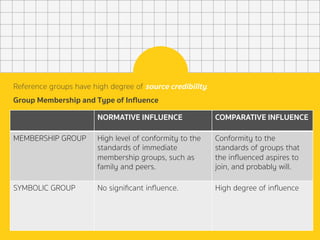
NORMATIVE INFLUENCE COMPARATIVE INFLUENCE
MEMBERSHIP GROUP High level of conformity to the
standards of immediate
membership groups, such as
family and peers.
Conformity to the
standards of groups that
the influenced aspires to
join, and probably will.
SYMBOLIC GROUP No significant influence. High degree of influence
Reference groups have high degree of source credibility.
Group Membership and Type of Influence
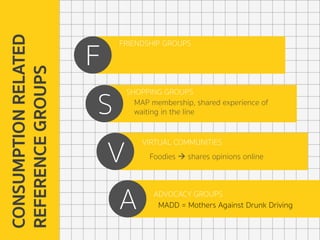
CONSUMPTIONRELATED
REFERENCEGROUPS
F
S
V
A
MAP membership, shared experience of
waiting in the line
SHOPPING GROUPS
FRIENDSHIP GROUPS
VIRTUAL COMMUNITIES
Foodies à shares opinions online
MADD = Mothers Against Drunk Driving
ADVOCACY GROUPS
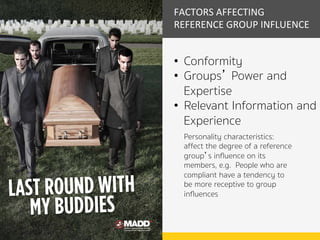
FACTORS	AFFECTING	
REFERENCE	GROUP	INFLUENCE	
•  Conformity
•  Groups’ Power and
Expertise
•  Relevant Information and
Experience
Personality characteristics:
affect the degree of a reference
group’s influence on its
members, e.g. People who are
compliant have a tendency to
be more receptive to group
influences
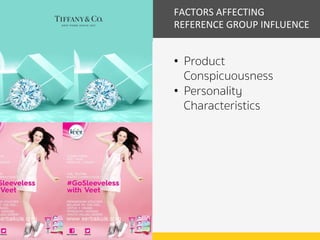
FACTORS	AFFECTING	
REFERENCE	GROUP	INFLUENCE	
•  Product
Conspicuousness
•  Personality
Characteristics
Endorsers and Spokesperson
4 Key Findings on the Relationship between the
Effectiveness of the Messages and Spokespersons
they feature.
Celebrities
Celebrity Testimonial
Celebrity Endorsment
Celebrity Actor
Celebrity Spokesperson
•  Salesperson Credibility (sales insurance)
•  Vendor Credibility (AMAZON review on products
they sell)
•  Medium Credibilty
•  Effects on Time on Source Credibility à message
featuring high-credibility spokesperson must be
repeated regularly if they are to mantain high
level of persuasiveness.
Word of Mouth
Is when you share your experience to a certain
product or service to to others.
Opinion Leader
In which a person can influence others, who might
be opinion seeker or receipents .
Characteristic:
• Highly knowledgeable in a certain area
• A person who is confident, out-going and sociable
• They have a specialized knowledge tht enable them to
give an effective recomendations to thers.
• Opinion leaders and its receiver belong to the same
socio economic
How to measure opinion leaders?
Self-designating method employs a self administered questionare that require
respondents to evaluate the extent to which they have provided others with
information about specific brand or influence some decision.
Sociometric Method measure person-to-person communications about a product or
brand among members of community.
Respondents are asked to identify:
• Provide advice / information about the product /brand understudy
• Provide advice / information about the same product /brand
Key Informant Method a person who is keenly knowledgeable about the nature of
social communications among members of specific groups.
e.g: researchers
Klout Scores measure people influence online based on their abilities to generate
engagement and feedback of what they post.
e.g: blogger, etc
1. Social Network (online) a virtual communities where people share
information about themselves with others.
2. Brand Communities is a specialized , non geographically bound
community formed on the basis of attachment to a product or brand.
3. Weblogs another medium for a discussion or informational site
published on the internet and consisting of dicrete entries or post.
Strategic Application of Word-of-Mouth
How to Stimulate Word-of-Mouth?
•  Giving free samples then ask for opinion (simple example)
•  Emphasizing on viral marketing and the use of buzz
agents.
Viral Marketing
à Marketing technique that uses pre-
exiasting social networks and other
technologies to produce increases in
brand awareness or other marketing
objectives.
à How? Through enncouraging
individuals to pass along email
messages or other content online.
Buzz Agents
à Consumers who promote products and generally
receive free product samples but not monetary
payments.
à Companies usually select those targeted consumers
that likely to be effective word-of-mouth communicators
à E.g Samsung Nation : an online loyalty program,
offer rewards to consumers who talk up Samsung. They
will play games on the website, win virtual points and
get others to join. Those who are most active in posting
online comments earn “Twitterati” badges.
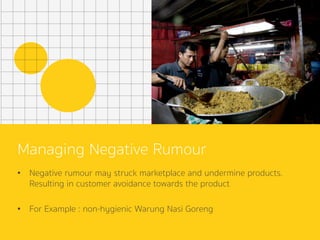
•  Negative rumour may struck marketplace and undermine products.
Resulting in customer avoidance towards the product
•  For Example : non-hygienic Warung Nasi Goreng
Managing Negative Rumour
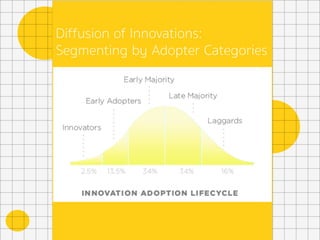
Diffusion of Innovations:
Segmenting by Adopter Categories
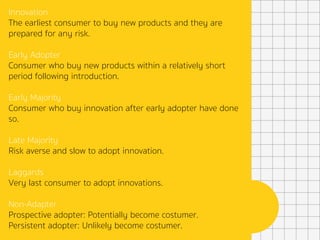
Innovation
The earliest consumer to buy new products and they are
prepared for any risk.
Early Adopter
Consumer who buy new products within a relatively short
period following introduction.
Early Majority
Consumer who buy innovation after early adopter have done
so.
Late Majority
Risk averse and slow to adopt innovation.
Laggards
Very last consumer to adopt innovations.
Non-Adapter
Prospective adopter: Potentially become costumer.
Persistent adopter: Unlikely become costumer.
THANK YOU

Reference Groups and Word of Mouth

  • 1.
    REFERENCE GROUPS & WORD OF MOUTH CONSUMERBEHAVIOR Astrid.Andrew.Aza.Celine.Feby
  • 2.
    REFERENCE GROUPS Groups thatserve as sources of comparison, influence and norms for peoples’ opinions, values and behaviors. Types of Reference Group: •  Family (the most important) à provides children with the skills, knowledge, attitudes and experiences neccessary to function as consumers (the process called consumer socialization) •  Social class •  Culture •  Subculture
  • 3.
    WORD-OF-MOUTH Communications where satisfiedcustomers tell other people how much they like a business, product, service or event.
  • 4.
    NORMATIVE INFLUENCE COMPARATIVEINFLUENCE MEMBERSHIP GROUP High level of conformity to the standards of immediate membership groups, such as family and peers. Conformity to the standards of groups that the influenced aspires to join, and probably will. SYMBOLIC GROUP No significant influence. High degree of influence Reference groups have high degree of source credibility. Group Membership and Type of Influence
  • 5.
    CONSUMPTIONRELATED REFERENCEGROUPS F S V A MAP membership, sharedexperience of waiting in the line SHOPPING GROUPS FRIENDSHIP GROUPS VIRTUAL COMMUNITIES Foodies à shares opinions online MADD = Mothers Against Drunk Driving ADVOCACY GROUPS
  • 6.
    FACTORS AFFECTING REFERENCE GROUP INFLUENCE •  Conformity •  Groups’Power and Expertise •  Relevant Information and Experience Personality characteristics: affect the degree of a reference group’s influence on its members, e.g. People who are compliant have a tendency to be more receptive to group influences
  • 7.
  • 8.
    Endorsers and Spokesperson 4Key Findings on the Relationship between the Effectiveness of the Messages and Spokespersons they feature.
  • 9.
  • 10.
    •  Salesperson Credibility(sales insurance) •  Vendor Credibility (AMAZON review on products they sell) •  Medium Credibilty •  Effects on Time on Source Credibility à message featuring high-credibility spokesperson must be repeated regularly if they are to mantain high level of persuasiveness.
  • 11.
    Word of Mouth Iswhen you share your experience to a certain product or service to to others. Opinion Leader In which a person can influence others, who might be opinion seeker or receipents . Characteristic: • Highly knowledgeable in a certain area • A person who is confident, out-going and sociable • They have a specialized knowledge tht enable them to give an effective recomendations to thers. • Opinion leaders and its receiver belong to the same socio economic
  • 12.
    How to measureopinion leaders? Self-designating method employs a self administered questionare that require respondents to evaluate the extent to which they have provided others with information about specific brand or influence some decision. Sociometric Method measure person-to-person communications about a product or brand among members of community. Respondents are asked to identify: • Provide advice / information about the product /brand understudy • Provide advice / information about the same product /brand Key Informant Method a person who is keenly knowledgeable about the nature of social communications among members of specific groups. e.g: researchers Klout Scores measure people influence online based on their abilities to generate engagement and feedback of what they post. e.g: blogger, etc
  • 13.
    1. Social Network(online) a virtual communities where people share information about themselves with others. 2. Brand Communities is a specialized , non geographically bound community formed on the basis of attachment to a product or brand. 3. Weblogs another medium for a discussion or informational site published on the internet and consisting of dicrete entries or post. Strategic Application of Word-of-Mouth
  • 14.
    How to StimulateWord-of-Mouth? •  Giving free samples then ask for opinion (simple example) •  Emphasizing on viral marketing and the use of buzz agents.
  • 15.
    Viral Marketing à Marketing techniquethat uses pre- exiasting social networks and other technologies to produce increases in brand awareness or other marketing objectives. à How? Through enncouraging individuals to pass along email messages or other content online.
  • 16.
    Buzz Agents à Consumers whopromote products and generally receive free product samples but not monetary payments. à Companies usually select those targeted consumers that likely to be effective word-of-mouth communicators à E.g Samsung Nation : an online loyalty program, offer rewards to consumers who talk up Samsung. They will play games on the website, win virtual points and get others to join. Those who are most active in posting online comments earn “Twitterati” badges.
  • 17.
    •  Negative rumourmay struck marketplace and undermine products. Resulting in customer avoidance towards the product •  For Example : non-hygienic Warung Nasi Goreng Managing Negative Rumour
  • 18.
  • 19.
    Innovation The earliest consumerto buy new products and they are prepared for any risk. Early Adopter Consumer who buy new products within a relatively short period following introduction. Early Majority Consumer who buy innovation after early adopter have done so. Late Majority Risk averse and slow to adopt innovation. Laggards Very last consumer to adopt innovations. Non-Adapter Prospective adopter: Potentially become costumer. Persistent adopter: Unlikely become costumer.
  • 20.