3 - 1
Learning and Memory
Chapter 3
Learning
• Learning is the process of acquiring new information
and knowledge about products and services for
application to future behaviour.
• Memory enables past experiences and learning to
influence current behavior.
• learning plays an important role in preference
formation
3 - 2
3 - 3
The Learning Process
• Products as reminders of life experiences
• Products + memory = brand equity/loyalty
• Learning: A relatively permanent change in
behaviour caused by experience
• Incidental learning
• Ongoing process
3 - 4
Behavioural Learning Theories
• Learning = responses to external events
• “Black box”
• Observable behaviour
• Classical conditioning and instrumental
conditioning
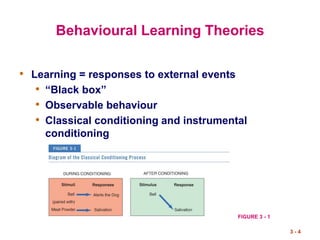
FIGURE 3 - 1
3 - 5
Types of Behavioural Learning Theories
Classical conditioning: a stimulus that elicits a response is
paired with another stimulus that initially does not elicit a
response on its own.
Instrumental conditioning (also, operant conditioning): the
individual learns to perform behaviours that produce positive
outcomes and to avoid those that yield negative outcomes.
3 - 6
Classical Conditioning
• Ivan Pavlov
• Unconditioned stimulus paired with a conditioned
response
• CS + UCS = response
• Over time: CS = response
• Brand names as CS
• Credit card as CS
3 - 7
Repetition
• Repetition increases
learning
• More exposure results
in greater brand
awareness
• Less exposure can
result in decay
• When exposure
decreases extinction
results
• But….too much exposure
leads to advertising wear
out
3 - 8
Classical Conditioning
Stimulus generalization: Tendency for stimuli similar to
a conditioned stimulus (keys jangling resemble bell)
to evoke similar, unconditioned responses.
• Family branding
• Product line extensions
• Licensing
• Look-alike packaging
• Stimulus discrimination: Only buy the brand names
• Think about it: Do you buy a less-expensive product
because it looks like the brand name item?
3 - 9
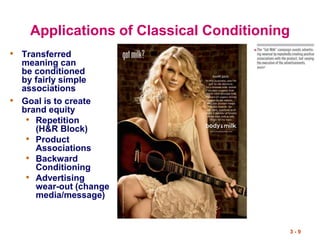
Applications of Classical Conditioning
• Transferred
meaning can
be conditioned
by fairly simple
associations
• Goal is to create
brand equity
• Repetition
(H&R Block)
• Product
Associations
• Backward
Conditioning
• Advertising
wear-out (change
media/message)
3 - 10
Instrumental Conditioning
• Behaviours = positive outcomes or negative
outcomes
• Deliberate behaviour to obtain a goal
• Positive reinforcement
• Frequency marketing, thank you letters, rebates,
follow-up phone calls
• Negative reinforcement
• Punishment
• Shaping: Desired behaviour learned over time
3 - 11
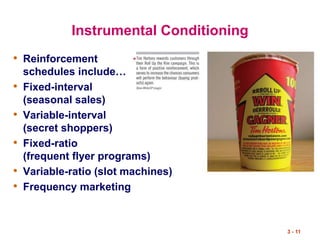
Instrumental Conditioning
• Reinforcement
schedules include…
• Fixed-interval
(seasonal sales)
• Variable-interval
(secret shoppers)
• Fixed-ratio
(frequent flyer programs)
• Variable-ratio (slot machines)
• Frequency marketing
3 - 12
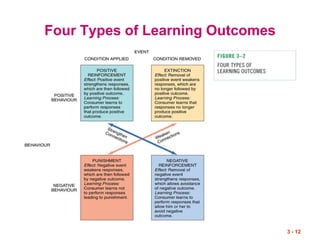
Four Types of Learning Outcomes
3 - 13
Cognitive Learning Theories:
Observational Learning
• Internal mental processes
• We watch others and note reinforcements they
receive for behaviours
• Vicarious learning
• Socially desirable models/celebrities who use or do
not use their products
3 - 14
Observational Learning
• Modelling: Imitating others’ behaviour
(celebrities/athletes)
• Much violence is exposed on television
• Children modelled brutal behaviours following a
violent demonstration of an adult punching a ‘Bobo
Doll’
3 - 15
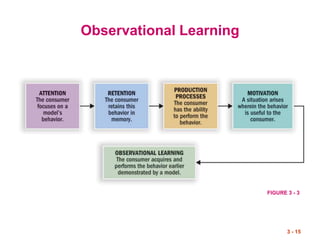
Observational Learning
FIGURE 3 - 3
3 - 16
Role of Memory in Learning
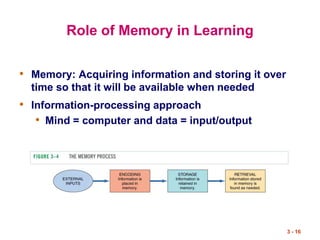
• Memory: Acquiring information and storing it over
time so that it will be available when needed
• Information-processing approach
• Mind = computer and data = input/output
3 - 17
Encoding
• We encode information to help us retain it later
• Sensory meaning - colours, shapes
• Semantic meaning - symbolic associations
• Personal relevance
• Episodic/flashbulb memories
• Product information conveyed as a narrative
• Low-involvement products tend to have
descriptive, snappy names
3 - 18
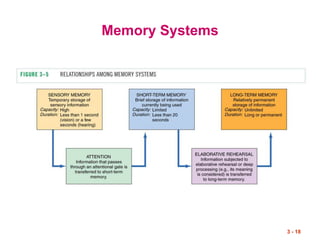
Memory Systems
3 - 19
Chunking
• Informational unit in short-term (STM) memory
• Brand names
• Area code and telephone number
• Phone numbers were designed with three or 4
“chunks” for optimum recall
3 - 20
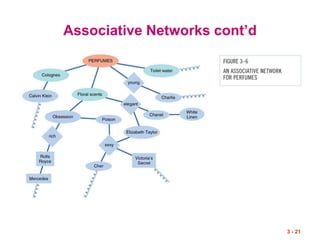
Associative Networks
• Activation models of memory
• Associative network of related information
• Knowledge structures of interconnected nodes
• Hierarchical processing model
3 - 21
Associative Networks cont’d
3 - 22
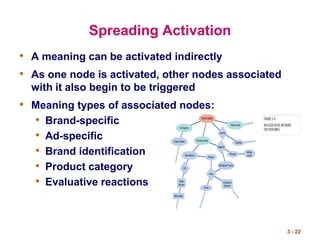
Spreading Activation
• A meaning can be activated indirectly
• As one node is activated, other nodes associated
with it also begin to be triggered
• Meaning types of associated nodes:
• Brand-specific
• Ad-specific
• Brand identification
• Product category
• Evaluative reactions
3 - 23
Levels of Knowledge
• Individual nodes = meaning concepts
• Two (or more) connected nodes = proposition
(complex meaning)
• Two or more propositions = schema
• We more readily encode info that is consistent
with an existing schema
• Service scripts
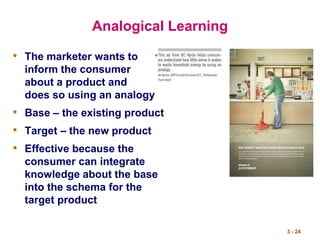
Analogical Learning
• The marketer wants to
inform the consumer
about a product and
does so using an analogy
• Base – the existing product
• Target – the new product
• Effective because the
consumer can integrate
knowledge about the base
into the schema for the
target product
3 - 24
3 - 25
Retrieval for Purchase Decisions
• Retrieval is the process of accessing information from long-
term memory factors
• Situational factors
• Consumer attention; pioneering brand; descriptive brand
names
• Viewing environment (continuous activity; commercial order
in sequence)
• Post-experience advertising effects
3 - 26
Retrieval for Purchase Decisions
• Appropriate factors/cues for retrieval
• State-dependent retrieval/mood congruence effect
• Familiarity
• Salience and Recall effect (mystery ads)
• Visual memory versus verbal memory
• Think about it: Are your vivid memories visual or
verbal? Do you have flashback memories?
3 - 27
Factors Influencing Forgetting
• Decay
• Interference
• Retroactive versus proactive
• Part-list cueing effect
3 - 28
Products as Memory Makers
• Furniture, visual art and photos call forth memories
of the past
• Autobiographical memories
• Power of nostalgia
• Retro brands
• Nostalgia Index
3 - 29
Measuring Memory for Marketing Stimuli
• Recognition vs. recall
• The Starch Test
• Problems with memory measures
• Response biases
• Memory lapses
• Memory or facts vs. feelings
3 - 30
Discussion
• In his 2005 book Blink: The Power of Thinking
Without Thinking, author Malcolm Gladwell argues
that hallowed marketing research techniques like
focus groups aren’t effective because we usually
react to products quickly and without much
conscious thought so it’s better just to solicit
consumers’ first impressions rather than getting
them to think at length about why they buy.
• Think about it: What’s your position on this
issue?

Learning and memory

  • 1.
    3 - 1 Learningand Memory Chapter 3
  • 2.
    Learning • Learning isthe process of acquiring new information and knowledge about products and services for application to future behaviour. • Memory enables past experiences and learning to influence current behavior. • learning plays an important role in preference formation 3 - 2
  • 3.
    3 - 3 TheLearning Process • Products as reminders of life experiences • Products + memory = brand equity/loyalty • Learning: A relatively permanent change in behaviour caused by experience • Incidental learning • Ongoing process
  • 4.
    3 - 4 BehaviouralLearning Theories • Learning = responses to external events • “Black box” • Observable behaviour • Classical conditioning and instrumental conditioning FIGURE 3 - 1
  • 5.
    3 - 5 Typesof Behavioural Learning Theories Classical conditioning: a stimulus that elicits a response is paired with another stimulus that initially does not elicit a response on its own. Instrumental conditioning (also, operant conditioning): the individual learns to perform behaviours that produce positive outcomes and to avoid those that yield negative outcomes.
  • 6.
    3 - 6 ClassicalConditioning • Ivan Pavlov • Unconditioned stimulus paired with a conditioned response • CS + UCS = response • Over time: CS = response • Brand names as CS • Credit card as CS
  • 7.
    3 - 7 Repetition •Repetition increases learning • More exposure results in greater brand awareness • Less exposure can result in decay • When exposure decreases extinction results • But….too much exposure leads to advertising wear out
  • 8.
    3 - 8 ClassicalConditioning Stimulus generalization: Tendency for stimuli similar to a conditioned stimulus (keys jangling resemble bell) to evoke similar, unconditioned responses. • Family branding • Product line extensions • Licensing • Look-alike packaging • Stimulus discrimination: Only buy the brand names • Think about it: Do you buy a less-expensive product because it looks like the brand name item?
  • 9.
    3 - 9 Applicationsof Classical Conditioning • Transferred meaning can be conditioned by fairly simple associations • Goal is to create brand equity • Repetition (H&R Block) • Product Associations • Backward Conditioning • Advertising wear-out (change media/message)
  • 10.
    3 - 10 InstrumentalConditioning • Behaviours = positive outcomes or negative outcomes • Deliberate behaviour to obtain a goal • Positive reinforcement • Frequency marketing, thank you letters, rebates, follow-up phone calls • Negative reinforcement • Punishment • Shaping: Desired behaviour learned over time
  • 11.
    3 - 11 InstrumentalConditioning • Reinforcement schedules include… • Fixed-interval (seasonal sales) • Variable-interval (secret shoppers) • Fixed-ratio (frequent flyer programs) • Variable-ratio (slot machines) • Frequency marketing
  • 12.
    3 - 12 FourTypes of Learning Outcomes
  • 13.
    3 - 13 CognitiveLearning Theories: Observational Learning • Internal mental processes • We watch others and note reinforcements they receive for behaviours • Vicarious learning • Socially desirable models/celebrities who use or do not use their products
  • 14.
    3 - 14 ObservationalLearning • Modelling: Imitating others’ behaviour (celebrities/athletes) • Much violence is exposed on television • Children modelled brutal behaviours following a violent demonstration of an adult punching a ‘Bobo Doll’
  • 15.
    3 - 15 ObservationalLearning FIGURE 3 - 3
  • 16.
    3 - 16 Roleof Memory in Learning • Memory: Acquiring information and storing it over time so that it will be available when needed • Information-processing approach • Mind = computer and data = input/output
  • 17.
    3 - 17 Encoding •We encode information to help us retain it later • Sensory meaning - colours, shapes • Semantic meaning - symbolic associations • Personal relevance • Episodic/flashbulb memories • Product information conveyed as a narrative • Low-involvement products tend to have descriptive, snappy names
  • 18.
  • 19.
    3 - 19 Chunking •Informational unit in short-term (STM) memory • Brand names • Area code and telephone number • Phone numbers were designed with three or 4 “chunks” for optimum recall
  • 20.
    3 - 20 AssociativeNetworks • Activation models of memory • Associative network of related information • Knowledge structures of interconnected nodes • Hierarchical processing model
  • 21.
    3 - 21 AssociativeNetworks cont’d
  • 22.
    3 - 22 SpreadingActivation • A meaning can be activated indirectly • As one node is activated, other nodes associated with it also begin to be triggered • Meaning types of associated nodes: • Brand-specific • Ad-specific • Brand identification • Product category • Evaluative reactions
  • 23.
    3 - 23 Levelsof Knowledge • Individual nodes = meaning concepts • Two (or more) connected nodes = proposition (complex meaning) • Two or more propositions = schema • We more readily encode info that is consistent with an existing schema • Service scripts
  • 24.
    Analogical Learning • Themarketer wants to inform the consumer about a product and does so using an analogy • Base – the existing product • Target – the new product • Effective because the consumer can integrate knowledge about the base into the schema for the target product 3 - 24
  • 25.
    3 - 25 Retrievalfor Purchase Decisions • Retrieval is the process of accessing information from long- term memory factors • Situational factors • Consumer attention; pioneering brand; descriptive brand names • Viewing environment (continuous activity; commercial order in sequence) • Post-experience advertising effects
  • 26.
    3 - 26 Retrievalfor Purchase Decisions • Appropriate factors/cues for retrieval • State-dependent retrieval/mood congruence effect • Familiarity • Salience and Recall effect (mystery ads) • Visual memory versus verbal memory • Think about it: Are your vivid memories visual or verbal? Do you have flashback memories?
  • 27.
    3 - 27 FactorsInfluencing Forgetting • Decay • Interference • Retroactive versus proactive • Part-list cueing effect
  • 28.
    3 - 28 Productsas Memory Makers • Furniture, visual art and photos call forth memories of the past • Autobiographical memories • Power of nostalgia • Retro brands • Nostalgia Index
  • 29.
    3 - 29 MeasuringMemory for Marketing Stimuli • Recognition vs. recall • The Starch Test • Problems with memory measures • Response biases • Memory lapses • Memory or facts vs. feelings
  • 30.
    3 - 30 Discussion •In his 2005 book Blink: The Power of Thinking Without Thinking, author Malcolm Gladwell argues that hallowed marketing research techniques like focus groups aren’t effective because we usually react to products quickly and without much conscious thought so it’s better just to solicit consumers’ first impressions rather than getting them to think at length about why they buy. • Think about it: What’s your position on this issue?