Chapter Seven:
Post-purchase processes,
customer satisfaction and
    consumer loyalty

                        7-1
Post-purchase processes, customer satisfaction
            and consumer loyalty
 Final consideration in the consumer decision
                making process


                                           7-2
Postpurchase processes, customer
   satisfaction and consumer loyalty
• Postpurchase process
• Postpurchase dissonance
• Why product use is important to
  marketers
• Why product disposal is important to
  consumers
• Concept of customer satisfaction
• Concept of consumer loyalty
                                         7-3
Postpurchase processes
• Postpurchase dissonance
• Product use and non-use
• Disposal
• Purchase evaluation
• Customer satisfaction, repeat purchase
 behaviour and consumer loyalty


                                      7-4
Post purchase dissonance
• Some purchases are followed by post
  purchase dissonance
• Probability of post purchase dissonance
  and the magnitude of dissonance is a
  function of the:
  –   degree of commitment and/or whether the
      decision can be revoked
  –   importance of the decision to the consumer
  –   difficulty of choosing among the alternatives
  –   individual’s tendency to experience anxiety


                                                 7-5
Post-purchase consumer behavior


                                  7-6
Postpurchase Dissonance

After the purchase is made, the consumer may utilize one
or more of the following to reduce dissonance:

     Increase the desirability of the brand purchased

     Decrease the desirability of rejected alternatives

     Decrease the importance of the purchase decision

     Reverse the purchase decision (return before use)


                                                           7-7
Postpurchase Dissonance


Consumption guilt - when
guilt feelings are aroused by
the product/service use.
Marketers need to focus on
validating the consumption
for “high guilt” products.

                             Indulging in chocolate for some can cause
                             consumption guilt


                                                                     7-8
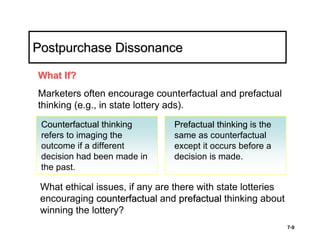
Postpurchase Dissonance

What If?
Marketers often encourage counterfactual and prefactual
thinking (e.g., in state lottery ads).
 Counterfactual thinking        Prefactual thinking is the
 refers to imaging the          same as counterfactual
 outcome if a different         except it occurs before a
 decision had been made in      decision is made.
 the past.

 What ethical issues, if any are there with state lotteries
 encouraging counterfactual and prefactual thinking about
 winning the lottery?
                                                              7-9
Product use and non-use
• Product use
  – use innovativeness
  – regional variations
  – multiple vs single use
• Packaging
• Defective products
  – product recalls


                                7-10
Product-usage index for VCR,
     microwave and PC


                               7-11
Product Use and Nonuse
                       Product Use
Marketers need to understand how consumers use their
products.

Use innovativeness refers to a
consumer using a product in a new
way.

Marketers who discover new uses
for their products can greatly
expand sales.
                                     Classic example of how use
                                     innovativeness helped A&M
                                     increase sales!
                                                              7-12
Applications in Consumer Behavior


The Arm & Hammer
web site provides
another avenue for
marketers to
communicate new
uses!


                               Courtesy Church & Dwight Co., Inc.


                                                                    7-13
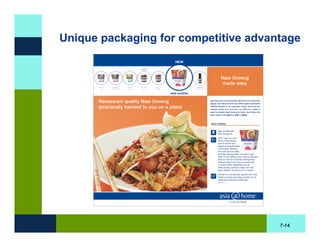
Unique packaging for competitive advantage


                                      7-14
Product Use and Nonuse
                        Product Use
Many firms attempt to obtain relevant information on
product usage via surveys using standard questionnaires.

Surveys can provide useful information, but often deeper
insights can be produced via

   • observation

   • depth interviews, and

   • case studies

                                                           7-15
Product Use and Nonuse
                         Product Use
Retailers can frequently take advantage of the fact that
the use of one product may require or suggest the use
of other products, e.g., dresses and shoes.

Retailers can promote such items

   • jointly
   • display them together, or
   • train sales personnel to make
     relevant complementary sales Displaying complementary products
                                     together

                                                                7-16
Product Use and Nonuse
                          Product Use
Stringent product liability laws have made firms
responsible for harm caused by products not only

    when the product is used as specified by the
   manufacturer, but

     in any reasonably foreseeable use of the
   products.

When marketers discover confusion about proper use,
they should engage in communications to increase the
chances of proper use.
                                                       7-17
Product Use and Nonuse
                      Product Nonuse
Product nonuse occurs when a consumer actively
acquires a product that is not used or used only sparingly
relative to its potential use.

The division between the initial purchase decision and the
decision to consume is particularly strong with catalog and
online purchases.


                                                              7-18
Incidence of product recalls in Australia
 Year        Consumer    Food       Therapeutic   Motor
             goods                                vehicles
 2005-6      187         69         325           156

 2004-5      160         62         381           155

 2003-4      165         80         436           128

 2002-3      179         81         448            99

 2001-2      209         73         265            95

 2000-1      111         36         172           115
 1999-2000    95         55         141            89

Ref: www.recalls.gov.au/stats_recall.php

                                                        7-19
Disposition

Disposition of product or product container may occur
before, during, or after use. Or, for products that are
completely consumed, no disposition may be involved.
A physical product often continues to
exist even though it may no longer
meet a consumer’s needs.
Exploding demand and short product
spans for high-tech items is creating a
growing concern over e-waste.
                                          Refrigerator dump site in the United Kingdom


                                                                                         7-20
Product-disposal alternatives


                                7-21
Product disposal and
            marketing strategy
• Recycling
  – product
  – package

• Trade-ins
   – to motivate replacement

• Second-hand markets
  – E.g. textbooks, clothes
  – ‘Cash converters’


                                  7-22
Disposition
        Product Disposition and Marketing Strategy
 Five major ways disposition decisions that can affect a
 firm’s marketing strategy:

1. Reluctance to purchase a new item until they have
   “gotten their money’s worth” from the old one.
2. Requiring disposition to occur before acquiring a
   replacement due to space or financial limitations.


                                                           7-23
Disposition

        Product Disposition and Marketing Strategy
3. Consumer selling, trading, or giving away used
   products may result in a large used-product market.
4. Many consumers are concerned with waste and how
   their purchase decisions affect waste.
5. Environmentally sound disposition decisions benefit
   society as a whole, including the firms that are part of
   that society.


                                                              7-24
Purchase evaluation

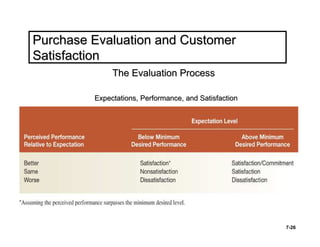
• Evaluation of a purchase is
 influenced by:

  – Expectations
  – Perceived   performance


                                7-25
Purchase Evaluation and Customer
Satisfaction
              The Evaluation Process

         Expectations, Performance, and Satisfaction


                                                       7-26
Expectations, performance and satisfaction


                                      7-27
Purchase Evaluation and Customer
Satisfaction
                   The Evaluation Process
Determinants of Satisfaction and Dissatisfaction

  Instrumental performance relates to the physical functioning of
the product.

 Symbolic performance relates to aesthetic or image-
enhancement performance.

 Affective performance is the emotional response that owning or
using the product or outlet provides


                                                               7-28
Dissatisfaction responses
• Possible outcomes of a negative purchase
  evaluation:


  1. Taking no action
  2. Switching brands, products or stores
  3. Warning friends and colleagues


                                             7-29
Dissatisfaction Responses


                            7-30
Actions taken by consumers in
response to product dissatisfaction


                                      7-31
Dimensions of performance
• Customers switch ‘away’ from service
  providers rather than ‘to’ providers.
• In one study the reasons were:
   –   Core service failure (44%)
   –   Service encounter failures (34%)
   –   Inconvenience (21%)
   –   Response to service failures (17%)
   –   Attraction to competitors (10%)
   –   Ethical problems (7%)
   –   Involuntary switching (6%)


                                            7-32
Four types of response styles associated
with dissatisfaction have been identified:
• Passives (14%)
  –   Seldom take action, younger group, don’t see a benefit from
      complaining

• Voices (37%)
  –   Seldom take private or public action, usually complain directly to
      the firm, older group, believe they are providing a social benefit

• Irates (21%)
  –   Take above average levels of private response and average
      levels of direct action, but low levels of public action

• Activists (28%)
  –   Likely to get involved in private, direct and public action, believe
      they are providing social benefits by complaining


                                                                      7-33
Marketing strategy and dissatisfied
            consumers
• Marketers need to satisfy consumer
  expectations by:
  1. creating reasonable expectations
     through promotional efforts
  2. maintaining consistent quality so
     that these reasonable
     expectations are fulfilled


                                       7-34
Dissatisfaction Responses

     Marketing Strategy and Dissatisfied Consumers

 When a consumer is dissatisfied, the most favorable
 consequence is for the person to communicate this
 dissatisfaction to the firm but to no one else.

 Unfortunately, many individuals do not communicate their
 dissatisfaction to the firm involved.

 Companies often make it difficult to complain or are
 unresponsive to complaints.


                                                        7-35
Dissatisfaction Responses

     Marketing Strategy and Dissatisfied Consumers

Toll free call centers and hotlines are one approach used by
many companies.

Consumers increasingly expect to be able to express
complaints via email - firms that respond quickly to such
complaints can great increase customer satisfaction.


                                                            7-36
Importance of customer satisfaction

• The business of business is getting and
  keeping customers.
  (Drucker, 1979)

• Delivering high-quality service and high
  customer satisfaction is closely linked to
  profits, cost savings, and market share.
  (PIMS, Profit Impact of Market Share, 1970s)


                                             7-37
Customers Satisfaction, Repeat Purchases,
and Customer Commitment
          Customer Satisfaction Outcomes


                                            7-38
Customers Satisfaction, Repeat Purchases,
and Customer Commitment
              Creating Committed Customers
       Is Increasingly the Focus of Marketing Strategy


                                                         7-39
Customers Satisfaction, Repeat Purchases,
and Customer Commitment
Repeat purchasers continue to buy the same
brand though they do not have an emotional
attachment to it.

Switching costs are the costs of finding,
evaluating, and adopting another solution.

Brand loyalty involves commitment to the brand –
it is a biased behavioral response expressed over
time.

                                                7-40
Customers Satisfaction, Repeat Purchases,
and Customer Commitment
Repeat Purchasers, Committed Customers, and Profits

A churn is a turnover in a firm’s customer base.

Reducing churn is a major objective of many firms today.


It typically costs more to obtain a new customer than
to retain an existing one, and new customers generally
are not as profitable as longer-term customers!


                                                           7-41
Customers Satisfaction, Repeat Purchases,
and Customer Commitment
   Sources of Increased Customer Profitability over Time


                                                           7-42
Customers Satisfaction, Repeat Purchases,
  and Customer Commitment
  Repeat Purchasers, Committed Customers, and Marketing
  Strategy
Developing a marketing strategy for a particular segment includes
identifying specific objectives to be pursued, such as

     1. Attracting new users to the product category
     2. Capturing competitors’ current customers
     3. Encouraging current customers to use more
     4. Encouraging current customers to become repeat
        purchasers
     5. Encouraging current customers to become committed
        customers

                                                                    7-43
Repeat purchase behaviour
Note the difference between:

• Brand loyalty
  – Implies a psychological commitment to the brand


   and

• Repeat purchase behaviour
  – simply involves the frequent repurchase of the
    brand

                                                     7-44
Brand loyalty is
• Biased
• A behavioural response
• Expressed over time
• A consumer selects a brand over
  alternative brands
• A function of psychological processes


                                          7-45
Value of customer loyalty
1. Increased purchases of the existing product
2. Cross-purchases of your other products
3. Price premium due to their appreciation of
   your added-value services
4. Reduced operating cost because of
   familiarity with your service system
5. Positive word-of-mouth that refers other
   customers to your firm


                                              7-46
“Loyal customers expect a good price,
  but they crave value most of all.”
                    (Palmer, 1996)


                                   7-47
• Rule No. 1
 The customer is always right.

• Rule No.2
 If the customer is not right, then refer to
 Rule No. 1!


                                               7-48
Customers Satisfaction, Repeat Purchases,
and Customer Commitment
 Relationship Marketing
 Relationship marketing is an attempt to develop an ongoing,
 expanding exchange relationship with a firm’s customers.
 Relationship marketing involves:
       • databases
       • customized mass communications, and
       • advanced employee training and motivation


                                                               7-49
Customers Satisfaction, Repeat Purchases,
and Customer Commitment
Relationship Marketing

Customer loyalty programs, such as frequent-flier
programs, are designed to generate repeat purchases.
However, they do not necessarily create committed
customers.

 Generating committed
 customers requires a
 customer-focused attitude
 in the firm.


                                                       7-50
Relationship marketing
Five key elements:
1. Developing a core product/service on which
   to build
2. Customising the relationship to the
   individual customer
3. Augmenting the core product/service with
   extra benefits
4. Pricing in a manner that encourages loyalty
5. Marketing to employees so that they
   perform well for customers

                                            7-51
Using technology
• Modern information technology makes
 possible these close, ‘customised’
 relationships that add customer perceived-
 value to the product/service
  – E.g. preferred seats on a airline,
  – Type of hotel suite
  – Car servicing details


                                         7-52
Measuring customer satisfaction
1. Qualitative measurement techniques


2. Focus groups


3. Monitoring surveys


                                        7-53
Summary of key topics in the
            chapter:
We have discussed:
• The post purchase process
• The post purchase dissonance
• Why product use is important to marketers
• Why product disposal is important to
  consumers
• Concept of customer satisfaction
• Concept of consumer loyalty


                                              7-54

BB Chapter Seven : Post Purchase Processes, Customer Satisfaction and Loyalty

  • 1.
    Chapter Seven: Post-purchase processes, customersatisfaction and consumer loyalty 7-1
  • 2.
    Post-purchase processes, customersatisfaction and consumer loyalty Final consideration in the consumer decision making process 7-2
  • 3.
    Postpurchase processes, customer satisfaction and consumer loyalty • Postpurchase process • Postpurchase dissonance • Why product use is important to marketers • Why product disposal is important to consumers • Concept of customer satisfaction • Concept of consumer loyalty 7-3
  • 4.
    Postpurchase processes • Postpurchasedissonance • Product use and non-use • Disposal • Purchase evaluation • Customer satisfaction, repeat purchase behaviour and consumer loyalty 7-4
  • 5.
    Post purchase dissonance •Some purchases are followed by post purchase dissonance • Probability of post purchase dissonance and the magnitude of dissonance is a function of the: – degree of commitment and/or whether the decision can be revoked – importance of the decision to the consumer – difficulty of choosing among the alternatives – individual’s tendency to experience anxiety 7-5
  • 6.
  • 7.
    Postpurchase Dissonance After thepurchase is made, the consumer may utilize one or more of the following to reduce dissonance: Increase the desirability of the brand purchased Decrease the desirability of rejected alternatives Decrease the importance of the purchase decision Reverse the purchase decision (return before use) 7-7
  • 8.
    Postpurchase Dissonance Consumption guilt- when guilt feelings are aroused by the product/service use. Marketers need to focus on validating the consumption for “high guilt” products. Indulging in chocolate for some can cause consumption guilt 7-8
  • 9.
    Postpurchase Dissonance What If? Marketersoften encourage counterfactual and prefactual thinking (e.g., in state lottery ads). Counterfactual thinking Prefactual thinking is the refers to imaging the same as counterfactual outcome if a different except it occurs before a decision had been made in decision is made. the past. What ethical issues, if any are there with state lotteries encouraging counterfactual and prefactual thinking about winning the lottery? 7-9
  • 10.
    Product use andnon-use • Product use – use innovativeness – regional variations – multiple vs single use • Packaging • Defective products – product recalls 7-10
  • 11.
    Product-usage index forVCR, microwave and PC 7-11
  • 12.
    Product Use andNonuse Product Use Marketers need to understand how consumers use their products. Use innovativeness refers to a consumer using a product in a new way. Marketers who discover new uses for their products can greatly expand sales. Classic example of how use innovativeness helped A&M increase sales! 7-12
  • 13.
    Applications in ConsumerBehavior The Arm & Hammer web site provides another avenue for marketers to communicate new uses! Courtesy Church & Dwight Co., Inc. 7-13
  • 14.
    Unique packaging forcompetitive advantage 7-14
  • 15.
    Product Use andNonuse Product Use Many firms attempt to obtain relevant information on product usage via surveys using standard questionnaires. Surveys can provide useful information, but often deeper insights can be produced via • observation • depth interviews, and • case studies 7-15
  • 16.
    Product Use andNonuse Product Use Retailers can frequently take advantage of the fact that the use of one product may require or suggest the use of other products, e.g., dresses and shoes. Retailers can promote such items • jointly • display them together, or • train sales personnel to make relevant complementary sales Displaying complementary products together 7-16
  • 17.
    Product Use andNonuse Product Use Stringent product liability laws have made firms responsible for harm caused by products not only when the product is used as specified by the manufacturer, but in any reasonably foreseeable use of the products. When marketers discover confusion about proper use, they should engage in communications to increase the chances of proper use. 7-17
  • 18.
    Product Use andNonuse Product Nonuse Product nonuse occurs when a consumer actively acquires a product that is not used or used only sparingly relative to its potential use. The division between the initial purchase decision and the decision to consume is particularly strong with catalog and online purchases. 7-18
  • 19.
    Incidence of productrecalls in Australia Year Consumer Food Therapeutic Motor goods vehicles 2005-6 187 69 325 156 2004-5 160 62 381 155 2003-4 165 80 436 128 2002-3 179 81 448 99 2001-2 209 73 265 95 2000-1 111 36 172 115 1999-2000 95 55 141 89 Ref: www.recalls.gov.au/stats_recall.php 7-19
  • 20.
    Disposition Disposition of productor product container may occur before, during, or after use. Or, for products that are completely consumed, no disposition may be involved. A physical product often continues to exist even though it may no longer meet a consumer’s needs. Exploding demand and short product spans for high-tech items is creating a growing concern over e-waste. Refrigerator dump site in the United Kingdom 7-20
  • 21.
  • 22.
    Product disposal and marketing strategy • Recycling – product – package • Trade-ins – to motivate replacement • Second-hand markets – E.g. textbooks, clothes – ‘Cash converters’ 7-22
  • 23.
    Disposition Product Disposition and Marketing Strategy Five major ways disposition decisions that can affect a firm’s marketing strategy: 1. Reluctance to purchase a new item until they have “gotten their money’s worth” from the old one. 2. Requiring disposition to occur before acquiring a replacement due to space or financial limitations. 7-23
  • 24.
    Disposition Product Disposition and Marketing Strategy 3. Consumer selling, trading, or giving away used products may result in a large used-product market. 4. Many consumers are concerned with waste and how their purchase decisions affect waste. 5. Environmentally sound disposition decisions benefit society as a whole, including the firms that are part of that society. 7-24
  • 25.
    Purchase evaluation • Evaluationof a purchase is influenced by: – Expectations – Perceived performance 7-25
  • 26.
    Purchase Evaluation andCustomer Satisfaction The Evaluation Process Expectations, Performance, and Satisfaction 7-26
  • 27.
  • 28.
    Purchase Evaluation andCustomer Satisfaction The Evaluation Process Determinants of Satisfaction and Dissatisfaction Instrumental performance relates to the physical functioning of the product. Symbolic performance relates to aesthetic or image- enhancement performance. Affective performance is the emotional response that owning or using the product or outlet provides 7-28
  • 29.
    Dissatisfaction responses • Possibleoutcomes of a negative purchase evaluation: 1. Taking no action 2. Switching brands, products or stores 3. Warning friends and colleagues 7-29
  • 30.
  • 31.
    Actions taken byconsumers in response to product dissatisfaction 7-31
  • 32.
    Dimensions of performance •Customers switch ‘away’ from service providers rather than ‘to’ providers. • In one study the reasons were: – Core service failure (44%) – Service encounter failures (34%) – Inconvenience (21%) – Response to service failures (17%) – Attraction to competitors (10%) – Ethical problems (7%) – Involuntary switching (6%) 7-32
  • 33.
    Four types ofresponse styles associated with dissatisfaction have been identified: • Passives (14%) – Seldom take action, younger group, don’t see a benefit from complaining • Voices (37%) – Seldom take private or public action, usually complain directly to the firm, older group, believe they are providing a social benefit • Irates (21%) – Take above average levels of private response and average levels of direct action, but low levels of public action • Activists (28%) – Likely to get involved in private, direct and public action, believe they are providing social benefits by complaining 7-33
  • 34.
    Marketing strategy anddissatisfied consumers • Marketers need to satisfy consumer expectations by: 1. creating reasonable expectations through promotional efforts 2. maintaining consistent quality so that these reasonable expectations are fulfilled 7-34
  • 35.
    Dissatisfaction Responses Marketing Strategy and Dissatisfied Consumers When a consumer is dissatisfied, the most favorable consequence is for the person to communicate this dissatisfaction to the firm but to no one else. Unfortunately, many individuals do not communicate their dissatisfaction to the firm involved. Companies often make it difficult to complain or are unresponsive to complaints. 7-35
  • 36.
    Dissatisfaction Responses Marketing Strategy and Dissatisfied Consumers Toll free call centers and hotlines are one approach used by many companies. Consumers increasingly expect to be able to express complaints via email - firms that respond quickly to such complaints can great increase customer satisfaction. 7-36
  • 37.
    Importance of customersatisfaction • The business of business is getting and keeping customers. (Drucker, 1979) • Delivering high-quality service and high customer satisfaction is closely linked to profits, cost savings, and market share. (PIMS, Profit Impact of Market Share, 1970s) 7-37
  • 38.
    Customers Satisfaction, RepeatPurchases, and Customer Commitment Customer Satisfaction Outcomes 7-38
  • 39.
    Customers Satisfaction, RepeatPurchases, and Customer Commitment Creating Committed Customers Is Increasingly the Focus of Marketing Strategy 7-39
  • 40.
    Customers Satisfaction, RepeatPurchases, and Customer Commitment Repeat purchasers continue to buy the same brand though they do not have an emotional attachment to it. Switching costs are the costs of finding, evaluating, and adopting another solution. Brand loyalty involves commitment to the brand – it is a biased behavioral response expressed over time. 7-40
  • 41.
    Customers Satisfaction, RepeatPurchases, and Customer Commitment Repeat Purchasers, Committed Customers, and Profits A churn is a turnover in a firm’s customer base. Reducing churn is a major objective of many firms today. It typically costs more to obtain a new customer than to retain an existing one, and new customers generally are not as profitable as longer-term customers! 7-41
  • 42.
    Customers Satisfaction, RepeatPurchases, and Customer Commitment Sources of Increased Customer Profitability over Time 7-42
  • 43.
    Customers Satisfaction, RepeatPurchases, and Customer Commitment Repeat Purchasers, Committed Customers, and Marketing Strategy Developing a marketing strategy for a particular segment includes identifying specific objectives to be pursued, such as 1. Attracting new users to the product category 2. Capturing competitors’ current customers 3. Encouraging current customers to use more 4. Encouraging current customers to become repeat purchasers 5. Encouraging current customers to become committed customers 7-43
  • 44.
    Repeat purchase behaviour Notethe difference between: • Brand loyalty – Implies a psychological commitment to the brand and • Repeat purchase behaviour – simply involves the frequent repurchase of the brand 7-44
  • 45.
    Brand loyalty is •Biased • A behavioural response • Expressed over time • A consumer selects a brand over alternative brands • A function of psychological processes 7-45
  • 46.
    Value of customerloyalty 1. Increased purchases of the existing product 2. Cross-purchases of your other products 3. Price premium due to their appreciation of your added-value services 4. Reduced operating cost because of familiarity with your service system 5. Positive word-of-mouth that refers other customers to your firm 7-46
  • 47.
    “Loyal customers expecta good price, but they crave value most of all.” (Palmer, 1996) 7-47
  • 48.
    • Rule No.1 The customer is always right. • Rule No.2 If the customer is not right, then refer to Rule No. 1! 7-48
  • 49.
    Customers Satisfaction, RepeatPurchases, and Customer Commitment Relationship Marketing Relationship marketing is an attempt to develop an ongoing, expanding exchange relationship with a firm’s customers. Relationship marketing involves: • databases • customized mass communications, and • advanced employee training and motivation 7-49
  • 50.
    Customers Satisfaction, RepeatPurchases, and Customer Commitment Relationship Marketing Customer loyalty programs, such as frequent-flier programs, are designed to generate repeat purchases. However, they do not necessarily create committed customers. Generating committed customers requires a customer-focused attitude in the firm. 7-50
  • 51.
    Relationship marketing Five keyelements: 1. Developing a core product/service on which to build 2. Customising the relationship to the individual customer 3. Augmenting the core product/service with extra benefits 4. Pricing in a manner that encourages loyalty 5. Marketing to employees so that they perform well for customers 7-51
  • 52.
    Using technology • Moderninformation technology makes possible these close, ‘customised’ relationships that add customer perceived- value to the product/service – E.g. preferred seats on a airline, – Type of hotel suite – Car servicing details 7-52
  • 53.
    Measuring customer satisfaction 1.Qualitative measurement techniques 2. Focus groups 3. Monitoring surveys 7-53
  • 54.
    Summary of keytopics in the chapter: We have discussed: • The post purchase process • The post purchase dissonance • Why product use is important to marketers • Why product disposal is important to consumers • Concept of customer satisfaction • Concept of consumer loyalty 7-54