MEMORY
AP Psychology
Facts or Falsehoods: Memory
1.
2.
3.
4.
5.
6.
7.

8.

Memory storage is never automatic, it always takes effort.
When people go around a circle saying their names, their poorest
memories are for what was said by the person just before them.
Memory aids are no more useful than simple rehearsal of
information.
Only a few people have photographic memory.
Although our capacity for storing information is large, we are still
limited in the number of memories we can form.
When people learn something while intoxicated, they recall it best
when they are intoxicated again.
The hour before sleep is a good time to commit information to
memory.
How confident eyewitnesses are about what they saw is an
important predictor of their accuracy.
2
Learning Objectives
• Students will be able to:
– Describe the three types of memory.
– Compare and contrast the information processing
model of memory vs. the working model of
memory.

3
Three Types of Memory Overview

What is more important:
experiences or memory of
experiences?

4
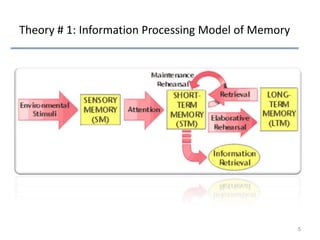
Theory # 1: Information Processing Model of Memory

5
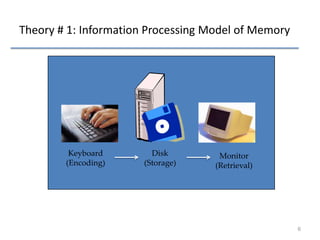
Theory # 1: Information Processing Model of Memory

Keyboard
(Encoding)

Disk
(Storage)

Monitor
(Retrieval)

6
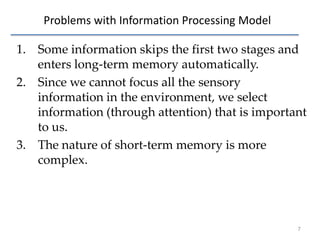
Problems with Information Processing Model
1. Some information skips the first two stages and
enters long-term memory automatically.
2. Since we cannot focus all the sensory
information in the environment, we select
information (through attention) that is important
to us.
3. The nature of short-term memory is more
complex.

7
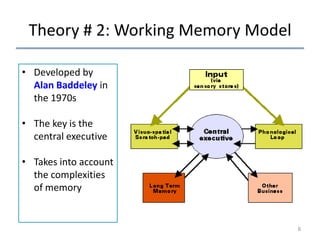
Theory # 2: Working Memory Model
• Developed by
Alan Baddeley in
the 1970s
• The key is the
central executive
• Takes into account
the complexities
of memory

8
Learning Objectives in Review
• Students will be able to:
– Describe the three types of memory.
– Compare and contrast the information processing
model of memory vs. the working model of
memory.

9
Section Assessment
In one sentence summarize the difference
between the information processing model and
the working memory model.

10
Learning Objectives
• Students will be able to:
– Describe the process of encoding as it relates to
memory.

11
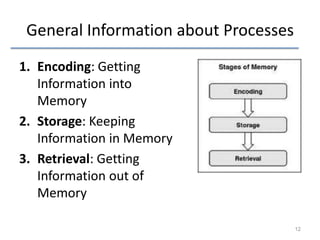
General Information about Processes
1. Encoding: Getting
Information into
Memory
2. Storage: Keeping
Information in Memory
3. Retrieval: Getting
Information out of
Memory
12
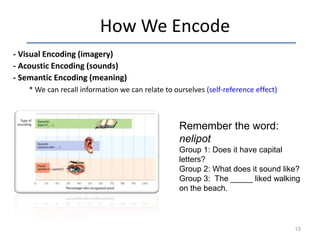
How We Encode
- Visual Encoding (imagery)
- Acoustic Encoding (sounds)
- Semantic Encoding (meaning)
* We can recall information we can relate to ourselves (self-reference effect)

Remember the word:
nelipot
Group 1: Does it have capital
letters?
Group 2: What does it sound like?
Group 3: The _____ liked walking
on the beach.

13
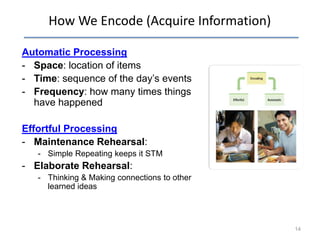
How We Encode (Acquire Information)
Automatic Processing
- Space: location of items
- Time: sequence of the day’s events
- Frequency: how many times things
have happened
Effortful Processing
- Maintenance Rehearsal:
- Simple Repeating keeps it STM

- Elaborate Rehearsal:
- Thinking & Making connections to other
learned ideas

14
Using Mnemonic Devices to Encode
MNEMONIC DEVICES
Memory aids that use organizational devices or imagery to recall memories

1. METHOD OF LOCI
- Imagine walking through familiar locations and linking each place with
what is to be remembered; used by actors to remember lines
2. PEG-WORD
- Remember a list through a jingle (1- bun, 2- shoe, 3- tree)
3. ACRONYMS
* HOMES = Huron, Ontario, Michigan, Erie, Superior
* ROY G. BIV = Red, Orange, Yellow, Green, Blue, Indigo, Violet

15
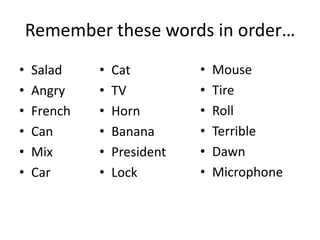
Remember these words in order…
•
•
•
•
•
•

Salad
Angry
French
Can
Mix
Car

•
•
•
•
•
•

Cat
TV
Horn
Banana
President
Lock

•
•
•
•
•
•

Mouse
Tire
Roll
Terrible
Dawn
Microphone
Encoding Test
• Recall as many presidents as you
can in ANY order.
•
•
•
•
•
•
•
•
•
•
•
•
•
•
•
•
•
•

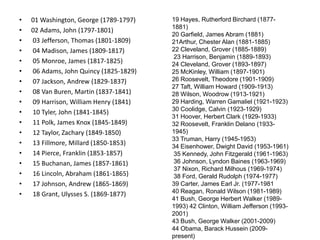
01 Washington, George (1789-1797)
02 Adams, John (1797-1801)
03 Jefferson, Thomas (1801-1809)
04 Madison, James (1809-1817)
05 Monroe, James (1817-1825)
06 Adams, John Quincy (1825-1829)
07 Jackson, Andrew (1829-1837)
08 Van Buren, Martin (1837-1841)
09 Harrison, William Henry (1841)
10 Tyler, John (1841-1845)
11 Polk, James Knox (1845-1849)
12 Taylor, Zachary (1849-1850)
13 Fillmore, Millard (1850-1853)
14 Pierce, Franklin (1853-1857)
15 Buchanan, James (1857-1861)
16 Lincoln, Abraham (1861-1865)
17 Johnson, Andrew (1865-1869)
18 Grant, Ulysses S. (1869-1877)

19 Hayes, Rutherford Birchard (18771881)
20 Garfield, James Abram (1881)
21Arthur, Chester Alan (1881-1885)
22 Cleveland, Grover (1885-1889)
23 Harrison, Benjamin (1889-1893)
24 Cleveland, Grover (1893-1897)
25 McKinley, William (1897-1901)
26 Roosevelt, Theodore (1901-1909)
27 Taft, William Howard (1909-1913)
28 Wilson, Woodrow (1913-1921)
29 Harding, Warren Gamaliel (1921-1923)
30 Coolidge, Calvin (1923-1929)
31 Hoover, Herbert Clark (1929-1933)
32 Roosevelt, Franklin Delano (19331945)
33 Truman, Harry (1945-1953)
34 Eisenhower, Dwight David (1953-1961)
35 Kennedy, John Fitzgerald (1961-1963)
36 Johnson, Lyndon Baines (1963-1969)
37 Nixon, Richard Milhous (1969-1974)
38 Ford, Gerald Rudolph (1974-1977)
39 Carter, James Earl Jr. (1977-1981
40 Reagan, Ronald Wilson (1981-1989)
41 Bush, George Herbert Walker (19891993) 42 Clinton, William Jefferson (19932001)
43 Bush, George Walker (2001-2009)
44 Obama, Barack Hussein (2009present)
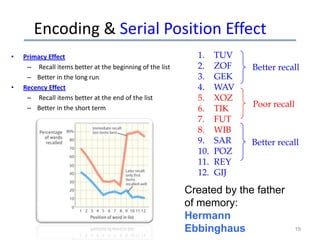
Encoding & Serial Position Effect
•

•

Primacy Effect
– Recall items better at the beginning of the list
– Better in the long run
Recency Effect
– Recall items better at the end of the list
– Better in the short term

1.
2.
3.
4.
5.
6.
7.
8.
9.
10.
11.
12.

TUV
ZOF
GEK
WAV
XOZ
TIK
FUT
WIB
SAR
POZ
REY
GIJ

Better recall

Poor recall

Better recall

Created by the father
of memory:
Hermann
Ebbinghaus

19
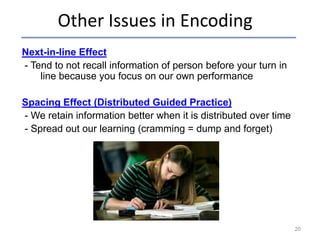
Other Issues in Encoding
Next-in-line Effect
- Tend to not recall information of person before your turn in
line because you focus on our own performance
Spacing Effect (Distributed Guided Practice)
- We retain information better when it is distributed over time
- Spread out our learning (cramming = dump and forget)

20
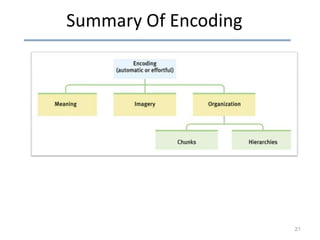
Summary Of Encoding

21
Learning Objectives in Review
• Students will be able to:
– Describe the process of encoding as it relates to
memory.

22
Section Assessment
1.

When a list of words is learned in order, the words most likely to be
forgotten are those that are:
(A) At the beginning of the list
(B) At the end of the list
(C) In the middle of the list
(D) Hardest to pronounce
(E) Easiest to spell

2.

According to the information-possessing view of memory, the first
process of memory involves:
(A)
(B)
(C)
(D)
(E)

Retrieval
Storage
Rehearsal
Encoding
Transfer

23
Learning Objectives
• Students will be able to:
– Describe the characteristics of storage in the three
stages of memory.
– Identify flashbulb memory and long-term
potentiation.

24
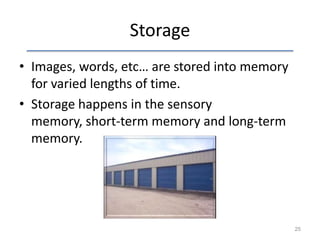
Storage
• Images, words, etc… are stored into memory
for varied lengths of time.
• Storage happens in the sensory
memory, short-term memory and long-term
memory.

25
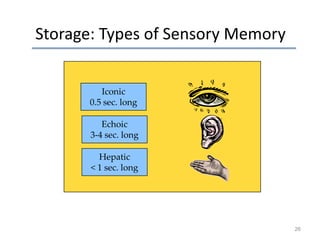
Storage: Types of Sensory Memory
Sensory
Iconic
Memory
0.5 sec. long

Echoic
3-4 sec. long
Hepatic
< 1 sec. long

26
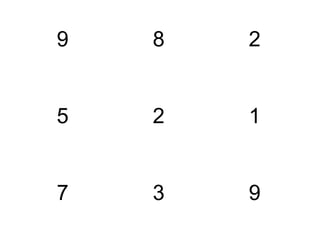
9

8

2

5

2

1

7

3

9
Storage: Short-term Memory
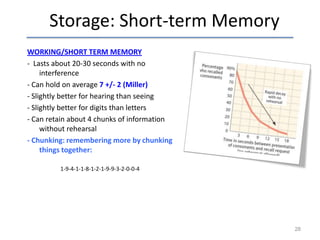
WORKING/SHORT TERM MEMORY
- Lasts about 20-30 seconds with no
interference
- Can hold on average 7 +/- 2 (Miller)
- Slightly better for hearing than seeing
- Slightly better for digits than letters
- Can retain about 4 chunks of information
without rehearsal
- Chunking: remembering more by chunking
things together:
1-9-4-1-1-8-1-2-1-9-9-3-2-0-0-4

28
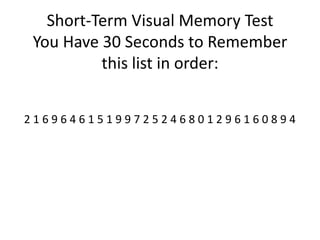
Short-Term Visual Memory Test
You Have 30 Seconds to Remember
this list in order:
216964615199725246801296160894
Results
• 4-9 = Average
• 10-19 = extraordinary
• 20-30 = brilliant
* Nancy Shulins, Memory Professor
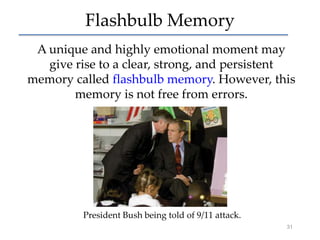
Flashbulb Memory
A unique and highly emotional moment may
give rise to a clear, strong, and persistent
memory called flashbulb memory. However, this
memory is not free from errors.

President Bush being told of 9/11 attack.
31
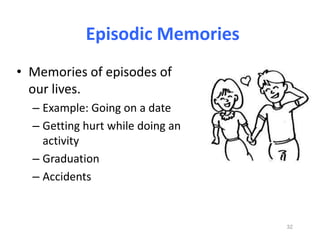
Episodic Memories
• Memories of episodes of
our lives.
– Example: Going on a date
– Getting hurt while doing an
activity
– Graduation
– Accidents

32
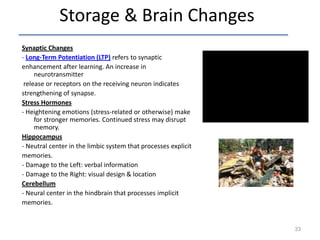
Storage & Brain Changes
Synaptic Changes
- Long-Term Potentiation (LTP) refers to synaptic
enhancement after learning. An increase in
neurotransmitter
release or receptors on the receiving neuron indicates
strengthening of synapse.
Stress Hormones
- Heightening emotions (stress-related or otherwise) make
for stronger memories. Continued stress may disrupt
memory.
Hippocampus
- Neutral center in the limbic system that processes explicit
memories.
- Damage to the Left: verbal information
- Damage to the Right: visual design & location
Cerebellum
- Neural center in the hindbrain that processes implicit
memories.

33
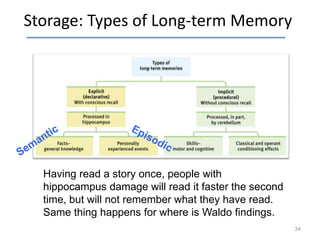
Storage: Types of Long-term Memory

Having read a story once, people with
hippocampus damage will read it faster the second
time, but will not remember what they have read.
Same thing happens for where is Waldo findings.
34
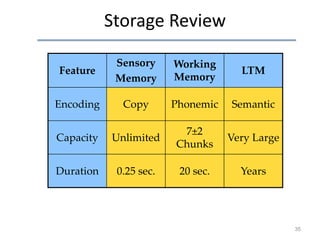
Storage Review
Feature

Sensory
Memory

Working
Memory

LTM

Encoding

Copy

Phonemic

Semantic

Capacity

Unlimited

7±2
Chunks

Very Large

Duration

0.25 sec.

20 sec.

Years

35
Learning Objectives in Review
• Students will be able to:
– Describe the characteristics of storage in the three
stages of memory.
– Identify flashbulb memory and long-term
potentiation.

36
Section Assessment
1.

According to George A. Miller the amount of information that can be stored in
short term memory is:
(A) 2
(B) 4
(C) 5
(D) 7
(E) 9
2. If you had damage to your hippocampus, which of the following would you MOST
likely have trouble completing?
(A) Riding a bicycle down the street
(B) Copying a word down from the board
(C) Learning a stranger’s name for the first time
(D) Finishing the line to a very common song that someone sings the first two
lines to
37
Learning Objectives
• Students will be able to:
– Describe the characteristics of retrieval in
memory.
– Identify how priming aids in memory recall.

38
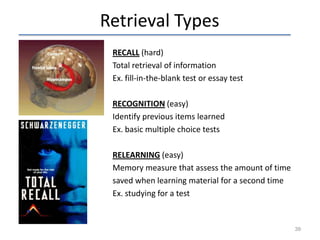
Retrieval Types
RECALL (hard)
Total retrieval of information
Ex. fill-in-the-blank test or essay test
RECOGNITION (easy)
Identify previous items learned
Ex. basic multiple choice tests
RELEARNING (easy)
Memory measure that assess the amount of time
saved when learning material for a second time
Ex. studying for a test

39
Retrieval Types Test
Group A: Write down
the names of the Seven
Dwarfs
1. __________
2. __________
3. __________
4. __________
5. __________
6. __________
7. __________

Group B: Pick the Correct Names of
the Seven Dwarfs
(A) Happy
(B) Dopey
(C) Bashful
(D) Dapper
(E) Wheezy
(F) Doc
(G) Grumpy
(H) Lovey
(I) Sneezy
(J) Sleepy

40
Retrieval Cues
PRIMING
Activate an association such as “smoke”
CONTEXT EFFECTS
* Context Dependent Memory
Being in a place to recall memories
Students do better on tests if they study in the
same place they take the test. Eyewitness
goes back to where they saw the crime occur.

water

smell
fire
smoke

Fire Truck

heat

hose

truck
red

MOOD & MEMORY
* State Dependent Memory
Same emotional/Physical state of when the
memory was first stored. (Drunks losing keys)
MOOD CONGRUENT MEMORY
* Happy memories are easier to retrieve when a
person is happy.

41
Group A
• You are going to look briefly at a picture and
then answer some questions about it. The
picture is a rough sketch of a poster for a
costume ball. Do not dwell on the picture.
Look at it only long enough to “take it all in”
once. After this, you will answer YES or NO to
a series of questions.

42
Group B
• You are going to look briefly at a picture and
then answer some questions about it. The
picture is a rough sketch of a poster for a
trained seal act. Do not dwell on the picture.
Look at it only long enough to “take it all in”
once. After this, you will answer YES or NO to
a series of questions.

43
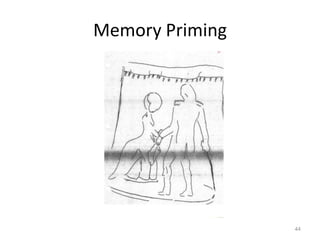
Memory Priming

44
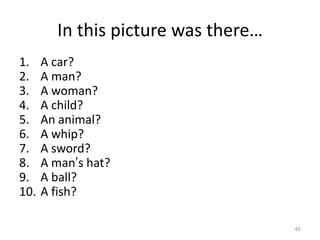
In this picture was there…
1.
2.
3.
4.
5.
6.
7.
8.
9.
10.

A car?
A man?
A woman?
A child?
An animal?
A whip?
A sword?
A man’s hat?
A ball?
A fish?
45
Conclusion
• Top Down processing – you go beyond the
sensory information to try to make meaning
out of ambiguity in your world
• What you expect (your experiences and your
perceptual set) drives this process
• Your memory was primed, so you saw what
you were meant to see

46
Learning Objectives in Review
• Students will be able to:
– Describe the characteristics of retrieval in
memory.
– Identify how priming aids in memory recall.

47
Section Assessment
1.

Complete this analogy: Fill-in-the-blank test questions are to multiplechoice questions as:
(A) encoding is to storage
(B) storage is to encoding
(C) recognition is to recall
(D) recall is to recognition

2.

In an effort to remember the name of the classmate who sat behind her
in fifth grade, Martina mentally recited the names of other classmates
who sat near her. Martina's effort to refresh her memory by activating
related associations is an example of:
(A)
(B)
(C)
(D)

Priming
Déjà vu
Encoding
Relearning
48
Learning Objectives
• Students will be able to:
– Distinguish between the different types of
forgetting.
– Define the misinformation effect.
– Contrast different types of amnesia.

49
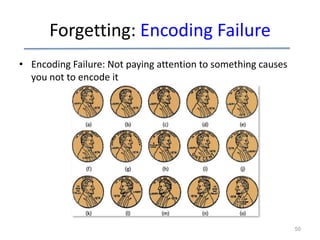
Forgetting: Encoding Failure
• Encoding Failure: Not paying attention to something causes
you not to encode it

50
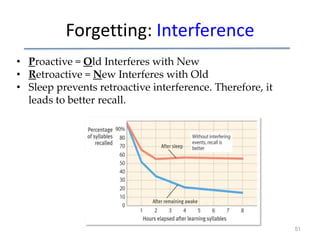
Forgetting: Interference
• Proactive = Old Interferes with New
• Retroactive = New Interferes with Old
• Sleep prevents retroactive interference. Therefore, it
leads to better recall.

51
Forgetting: Storage Decay
• Ebbinghaus’ Forgetting Curve
• We will retain about 1/3 of what we learned in the long-term

52
Forgetting: Retrieval Failure
• Tip of the Tongue Phenomenon: Unable to recall information
because it has been misplaced in the long-term memory.

53
Forgetting: Other Theories
• Repression: Freud’s idea that a defense mechanism banishes
anxiety-arousing thoughts, feelings, and memories from
consciousness.
– Sometimes referred to as Motivated Forgetting
– Most often reported in sexual abuse cases
– Limited support for this theory

54
Misinformation & Imagination Effects
Dr. Loftus
Memory Research Guru

Misinformation Effect: Incorporating
misleading information into one’s memory
of an event.
Eyewitness reconstruct their memories
when questioned about the event.
Group A: How fast were the cars going
when they hit each other?

Group B: How fast were the cars going
when they smashed into each other?
Broken Glass? (%)

A week later they were asked: Was there
any broken glass? Group B (smashed into)
reported more broken glass that Group A
(hit).

50
40

32

30
20

14

10
0
Group A (hit)

Group B (Smashed into)
Verb

55
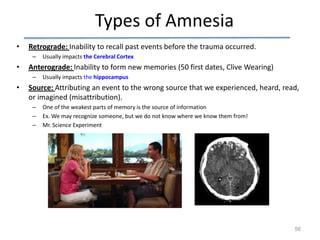
Types of Amnesia
•

Retrograde: Inability to recall past events before the trauma occurred.
–

•

Anterograde: Inability to form new memories (50 first dates, Clive Wearing)
–

•

Usually impacts the Cerebral Cortex
Usually impacts the hippocampus

Source: Attributing an event to the wrong source that we experienced, heard, read,
or imagined (misattribution).
–
–
–

One of the weakest parts of memory is the source of information
Ex. We may recognize someone, but we do not know where we know them from!
Mr. Science Experiment

56
Learning Objectives
• Students will be able to:
– Distinguish between the different types of
forgetting.
– Define the misinformation effect.
– Contrast different types of amnesia.

57

Ap memory ss

  • 1.
  • 2.
    Facts or Falsehoods:Memory 1. 2. 3. 4. 5. 6. 7. 8. Memory storage is never automatic, it always takes effort. When people go around a circle saying their names, their poorest memories are for what was said by the person just before them. Memory aids are no more useful than simple rehearsal of information. Only a few people have photographic memory. Although our capacity for storing information is large, we are still limited in the number of memories we can form. When people learn something while intoxicated, they recall it best when they are intoxicated again. The hour before sleep is a good time to commit information to memory. How confident eyewitnesses are about what they saw is an important predictor of their accuracy. 2
  • 3.
    Learning Objectives • Studentswill be able to: – Describe the three types of memory. – Compare and contrast the information processing model of memory vs. the working model of memory. 3
  • 4.
    Three Types ofMemory Overview What is more important: experiences or memory of experiences? 4
  • 5.
    Theory # 1:Information Processing Model of Memory 5
  • 6.
    Theory # 1:Information Processing Model of Memory Keyboard (Encoding) Disk (Storage) Monitor (Retrieval) 6
  • 7.
    Problems with InformationProcessing Model 1. Some information skips the first two stages and enters long-term memory automatically. 2. Since we cannot focus all the sensory information in the environment, we select information (through attention) that is important to us. 3. The nature of short-term memory is more complex. 7
  • 8.
    Theory # 2:Working Memory Model • Developed by Alan Baddeley in the 1970s • The key is the central executive • Takes into account the complexities of memory 8
  • 9.
    Learning Objectives inReview • Students will be able to: – Describe the three types of memory. – Compare and contrast the information processing model of memory vs. the working model of memory. 9
  • 10.
    Section Assessment In onesentence summarize the difference between the information processing model and the working memory model. 10
  • 11.
    Learning Objectives • Studentswill be able to: – Describe the process of encoding as it relates to memory. 11
  • 12.
    General Information aboutProcesses 1. Encoding: Getting Information into Memory 2. Storage: Keeping Information in Memory 3. Retrieval: Getting Information out of Memory 12
  • 13.
    How We Encode -Visual Encoding (imagery) - Acoustic Encoding (sounds) - Semantic Encoding (meaning) * We can recall information we can relate to ourselves (self-reference effect) Remember the word: nelipot Group 1: Does it have capital letters? Group 2: What does it sound like? Group 3: The _____ liked walking on the beach. 13
  • 14.
    How We Encode(Acquire Information) Automatic Processing - Space: location of items - Time: sequence of the day’s events - Frequency: how many times things have happened Effortful Processing - Maintenance Rehearsal: - Simple Repeating keeps it STM - Elaborate Rehearsal: - Thinking & Making connections to other learned ideas 14
  • 15.
    Using Mnemonic Devicesto Encode MNEMONIC DEVICES Memory aids that use organizational devices or imagery to recall memories 1. METHOD OF LOCI - Imagine walking through familiar locations and linking each place with what is to be remembered; used by actors to remember lines 2. PEG-WORD - Remember a list through a jingle (1- bun, 2- shoe, 3- tree) 3. ACRONYMS * HOMES = Huron, Ontario, Michigan, Erie, Superior * ROY G. BIV = Red, Orange, Yellow, Green, Blue, Indigo, Violet 15
  • 16.
    Remember these wordsin order… • • • • • • Salad Angry French Can Mix Car • • • • • • Cat TV Horn Banana President Lock • • • • • • Mouse Tire Roll Terrible Dawn Microphone
  • 17.
    Encoding Test • Recallas many presidents as you can in ANY order.
  • 18.
    • • • • • • • • • • • • • • • • • • 01 Washington, George(1789-1797) 02 Adams, John (1797-1801) 03 Jefferson, Thomas (1801-1809) 04 Madison, James (1809-1817) 05 Monroe, James (1817-1825) 06 Adams, John Quincy (1825-1829) 07 Jackson, Andrew (1829-1837) 08 Van Buren, Martin (1837-1841) 09 Harrison, William Henry (1841) 10 Tyler, John (1841-1845) 11 Polk, James Knox (1845-1849) 12 Taylor, Zachary (1849-1850) 13 Fillmore, Millard (1850-1853) 14 Pierce, Franklin (1853-1857) 15 Buchanan, James (1857-1861) 16 Lincoln, Abraham (1861-1865) 17 Johnson, Andrew (1865-1869) 18 Grant, Ulysses S. (1869-1877) 19 Hayes, Rutherford Birchard (18771881) 20 Garfield, James Abram (1881) 21Arthur, Chester Alan (1881-1885) 22 Cleveland, Grover (1885-1889) 23 Harrison, Benjamin (1889-1893) 24 Cleveland, Grover (1893-1897) 25 McKinley, William (1897-1901) 26 Roosevelt, Theodore (1901-1909) 27 Taft, William Howard (1909-1913) 28 Wilson, Woodrow (1913-1921) 29 Harding, Warren Gamaliel (1921-1923) 30 Coolidge, Calvin (1923-1929) 31 Hoover, Herbert Clark (1929-1933) 32 Roosevelt, Franklin Delano (19331945) 33 Truman, Harry (1945-1953) 34 Eisenhower, Dwight David (1953-1961) 35 Kennedy, John Fitzgerald (1961-1963) 36 Johnson, Lyndon Baines (1963-1969) 37 Nixon, Richard Milhous (1969-1974) 38 Ford, Gerald Rudolph (1974-1977) 39 Carter, James Earl Jr. (1977-1981 40 Reagan, Ronald Wilson (1981-1989) 41 Bush, George Herbert Walker (19891993) 42 Clinton, William Jefferson (19932001) 43 Bush, George Walker (2001-2009) 44 Obama, Barack Hussein (2009present)
  • 19.
    Encoding & SerialPosition Effect • • Primacy Effect – Recall items better at the beginning of the list – Better in the long run Recency Effect – Recall items better at the end of the list – Better in the short term 1. 2. 3. 4. 5. 6. 7. 8. 9. 10. 11. 12. TUV ZOF GEK WAV XOZ TIK FUT WIB SAR POZ REY GIJ Better recall Poor recall Better recall Created by the father of memory: Hermann Ebbinghaus 19
  • 20.
    Other Issues inEncoding Next-in-line Effect - Tend to not recall information of person before your turn in line because you focus on our own performance Spacing Effect (Distributed Guided Practice) - We retain information better when it is distributed over time - Spread out our learning (cramming = dump and forget) 20
  • 21.
  • 22.
    Learning Objectives inReview • Students will be able to: – Describe the process of encoding as it relates to memory. 22
  • 23.
    Section Assessment 1. When alist of words is learned in order, the words most likely to be forgotten are those that are: (A) At the beginning of the list (B) At the end of the list (C) In the middle of the list (D) Hardest to pronounce (E) Easiest to spell 2. According to the information-possessing view of memory, the first process of memory involves: (A) (B) (C) (D) (E) Retrieval Storage Rehearsal Encoding Transfer 23
  • 24.
    Learning Objectives • Studentswill be able to: – Describe the characteristics of storage in the three stages of memory. – Identify flashbulb memory and long-term potentiation. 24
  • 25.
    Storage • Images, words,etc… are stored into memory for varied lengths of time. • Storage happens in the sensory memory, short-term memory and long-term memory. 25
  • 26.
    Storage: Types ofSensory Memory Sensory Iconic Memory 0.5 sec. long Echoic 3-4 sec. long Hepatic < 1 sec. long 26
  • 27.
  • 28.
    Storage: Short-term Memory WORKING/SHORTTERM MEMORY - Lasts about 20-30 seconds with no interference - Can hold on average 7 +/- 2 (Miller) - Slightly better for hearing than seeing - Slightly better for digits than letters - Can retain about 4 chunks of information without rehearsal - Chunking: remembering more by chunking things together: 1-9-4-1-1-8-1-2-1-9-9-3-2-0-0-4 28
  • 29.
    Short-Term Visual MemoryTest You Have 30 Seconds to Remember this list in order: 216964615199725246801296160894
  • 30.
    Results • 4-9 =Average • 10-19 = extraordinary • 20-30 = brilliant * Nancy Shulins, Memory Professor
  • 31.
    Flashbulb Memory A uniqueand highly emotional moment may give rise to a clear, strong, and persistent memory called flashbulb memory. However, this memory is not free from errors. President Bush being told of 9/11 attack. 31
  • 32.
    Episodic Memories • Memoriesof episodes of our lives. – Example: Going on a date – Getting hurt while doing an activity – Graduation – Accidents 32
  • 33.
    Storage & BrainChanges Synaptic Changes - Long-Term Potentiation (LTP) refers to synaptic enhancement after learning. An increase in neurotransmitter release or receptors on the receiving neuron indicates strengthening of synapse. Stress Hormones - Heightening emotions (stress-related or otherwise) make for stronger memories. Continued stress may disrupt memory. Hippocampus - Neutral center in the limbic system that processes explicit memories. - Damage to the Left: verbal information - Damage to the Right: visual design & location Cerebellum - Neural center in the hindbrain that processes implicit memories. 33
  • 34.
    Storage: Types ofLong-term Memory Having read a story once, people with hippocampus damage will read it faster the second time, but will not remember what they have read. Same thing happens for where is Waldo findings. 34
  • 35.
  • 36.
    Learning Objectives inReview • Students will be able to: – Describe the characteristics of storage in the three stages of memory. – Identify flashbulb memory and long-term potentiation. 36
  • 37.
    Section Assessment 1. According toGeorge A. Miller the amount of information that can be stored in short term memory is: (A) 2 (B) 4 (C) 5 (D) 7 (E) 9 2. If you had damage to your hippocampus, which of the following would you MOST likely have trouble completing? (A) Riding a bicycle down the street (B) Copying a word down from the board (C) Learning a stranger’s name for the first time (D) Finishing the line to a very common song that someone sings the first two lines to 37
  • 38.
    Learning Objectives • Studentswill be able to: – Describe the characteristics of retrieval in memory. – Identify how priming aids in memory recall. 38
  • 39.
    Retrieval Types RECALL (hard) Totalretrieval of information Ex. fill-in-the-blank test or essay test RECOGNITION (easy) Identify previous items learned Ex. basic multiple choice tests RELEARNING (easy) Memory measure that assess the amount of time saved when learning material for a second time Ex. studying for a test 39
  • 40.
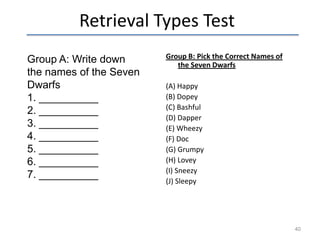
    Retrieval Types Test GroupA: Write down the names of the Seven Dwarfs 1. __________ 2. __________ 3. __________ 4. __________ 5. __________ 6. __________ 7. __________ Group B: Pick the Correct Names of the Seven Dwarfs (A) Happy (B) Dopey (C) Bashful (D) Dapper (E) Wheezy (F) Doc (G) Grumpy (H) Lovey (I) Sneezy (J) Sleepy 40
  • 41.
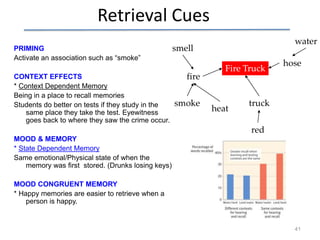
    Retrieval Cues PRIMING Activate anassociation such as “smoke” CONTEXT EFFECTS * Context Dependent Memory Being in a place to recall memories Students do better on tests if they study in the same place they take the test. Eyewitness goes back to where they saw the crime occur. water smell fire smoke Fire Truck heat hose truck red MOOD & MEMORY * State Dependent Memory Same emotional/Physical state of when the memory was first stored. (Drunks losing keys) MOOD CONGRUENT MEMORY * Happy memories are easier to retrieve when a person is happy. 41
  • 42.
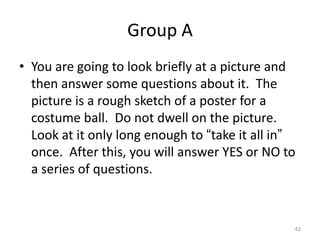
    Group A • Youare going to look briefly at a picture and then answer some questions about it. The picture is a rough sketch of a poster for a costume ball. Do not dwell on the picture. Look at it only long enough to “take it all in” once. After this, you will answer YES or NO to a series of questions. 42
  • 43.
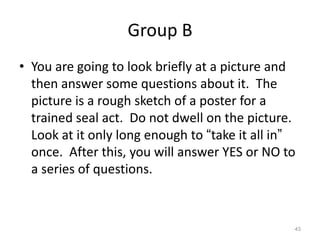
    Group B • Youare going to look briefly at a picture and then answer some questions about it. The picture is a rough sketch of a poster for a trained seal act. Do not dwell on the picture. Look at it only long enough to “take it all in” once. After this, you will answer YES or NO to a series of questions. 43
  • 44.
  • 45.
    In this picturewas there… 1. 2. 3. 4. 5. 6. 7. 8. 9. 10. A car? A man? A woman? A child? An animal? A whip? A sword? A man’s hat? A ball? A fish? 45
  • 46.
    Conclusion • Top Downprocessing – you go beyond the sensory information to try to make meaning out of ambiguity in your world • What you expect (your experiences and your perceptual set) drives this process • Your memory was primed, so you saw what you were meant to see 46
  • 47.
    Learning Objectives inReview • Students will be able to: – Describe the characteristics of retrieval in memory. – Identify how priming aids in memory recall. 47
  • 48.
    Section Assessment 1. Complete thisanalogy: Fill-in-the-blank test questions are to multiplechoice questions as: (A) encoding is to storage (B) storage is to encoding (C) recognition is to recall (D) recall is to recognition 2. In an effort to remember the name of the classmate who sat behind her in fifth grade, Martina mentally recited the names of other classmates who sat near her. Martina's effort to refresh her memory by activating related associations is an example of: (A) (B) (C) (D) Priming Déjà vu Encoding Relearning 48
  • 49.
    Learning Objectives • Studentswill be able to: – Distinguish between the different types of forgetting. – Define the misinformation effect. – Contrast different types of amnesia. 49
  • 50.
    Forgetting: Encoding Failure •Encoding Failure: Not paying attention to something causes you not to encode it 50
  • 51.
    Forgetting: Interference • Proactive= Old Interferes with New • Retroactive = New Interferes with Old • Sleep prevents retroactive interference. Therefore, it leads to better recall. 51
  • 52.
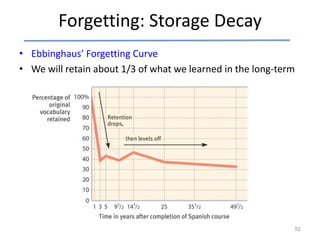
    Forgetting: Storage Decay •Ebbinghaus’ Forgetting Curve • We will retain about 1/3 of what we learned in the long-term 52
  • 53.
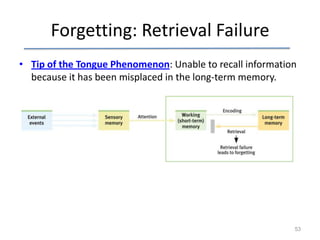
    Forgetting: Retrieval Failure •Tip of the Tongue Phenomenon: Unable to recall information because it has been misplaced in the long-term memory. 53
  • 54.
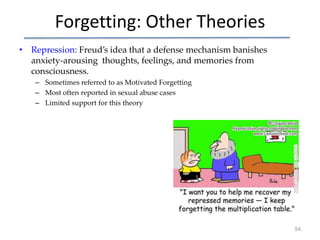
    Forgetting: Other Theories •Repression: Freud’s idea that a defense mechanism banishes anxiety-arousing thoughts, feelings, and memories from consciousness. – Sometimes referred to as Motivated Forgetting – Most often reported in sexual abuse cases – Limited support for this theory 54
  • 55.
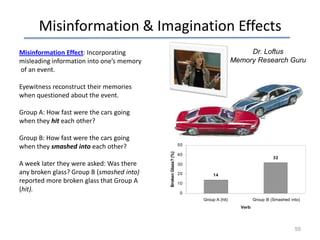
    Misinformation & ImaginationEffects Dr. Loftus Memory Research Guru Misinformation Effect: Incorporating misleading information into one’s memory of an event. Eyewitness reconstruct their memories when questioned about the event. Group A: How fast were the cars going when they hit each other? Group B: How fast were the cars going when they smashed into each other? Broken Glass? (%) A week later they were asked: Was there any broken glass? Group B (smashed into) reported more broken glass that Group A (hit). 50 40 32 30 20 14 10 0 Group A (hit) Group B (Smashed into) Verb 55
  • 56.
    Types of Amnesia • Retrograde:Inability to recall past events before the trauma occurred. – • Anterograde: Inability to form new memories (50 first dates, Clive Wearing) – • Usually impacts the Cerebral Cortex Usually impacts the hippocampus Source: Attributing an event to the wrong source that we experienced, heard, read, or imagined (misattribution). – – – One of the weakest parts of memory is the source of information Ex. We may recognize someone, but we do not know where we know them from! Mr. Science Experiment 56
  • 57.
    Learning Objectives • Studentswill be able to: – Distinguish between the different types of forgetting. – Define the misinformation effect. – Contrast different types of amnesia. 57

Editor's Notes

  • #3 (1) F (2) T (3) F (4) F (5) F (6) T (7) T (8) F
  • #5 867-5309 Jenny’ phone number800-588-2300 empire floors
  • #14 Encoding Test in 30 secondsRead the story about washing the clothes from the book
  • #16 Show Feats of Memory (Parts I &amp; II)
  • #20 Presidents Encoding Test
  • #24 C, D
  • #27 Activity: Sensory Memory Test, Demo: Hands in Front of Face (many fingers)Activity Psych Sim 5?
  • #28 Most people can recall with a line, but not the whole thing.
  • #29 Activity: 5, 7, 10, 12 Numbers and RecallActivity: Farmer’s Recall
  • #34 Video: Clive WearingDiscuss Antrograde and Retrograde Amnesia
  • #35 Rajan Video &amp; Counting Pi
  • #38 D
  • #40 Activity: Recall Names of the Capitals (TOT)
  • #41 Activity: Recall Names of the Capitals (TOT)
  • #42 Activity: Sleep, Awake, Aardvark, Etc…Activity: Priming Tripoli or A Hair/HareActivity: Remember details better if you have an expectation (kites)Activity: Polly-Anna Principle (if time allows)
  • #49 D, A