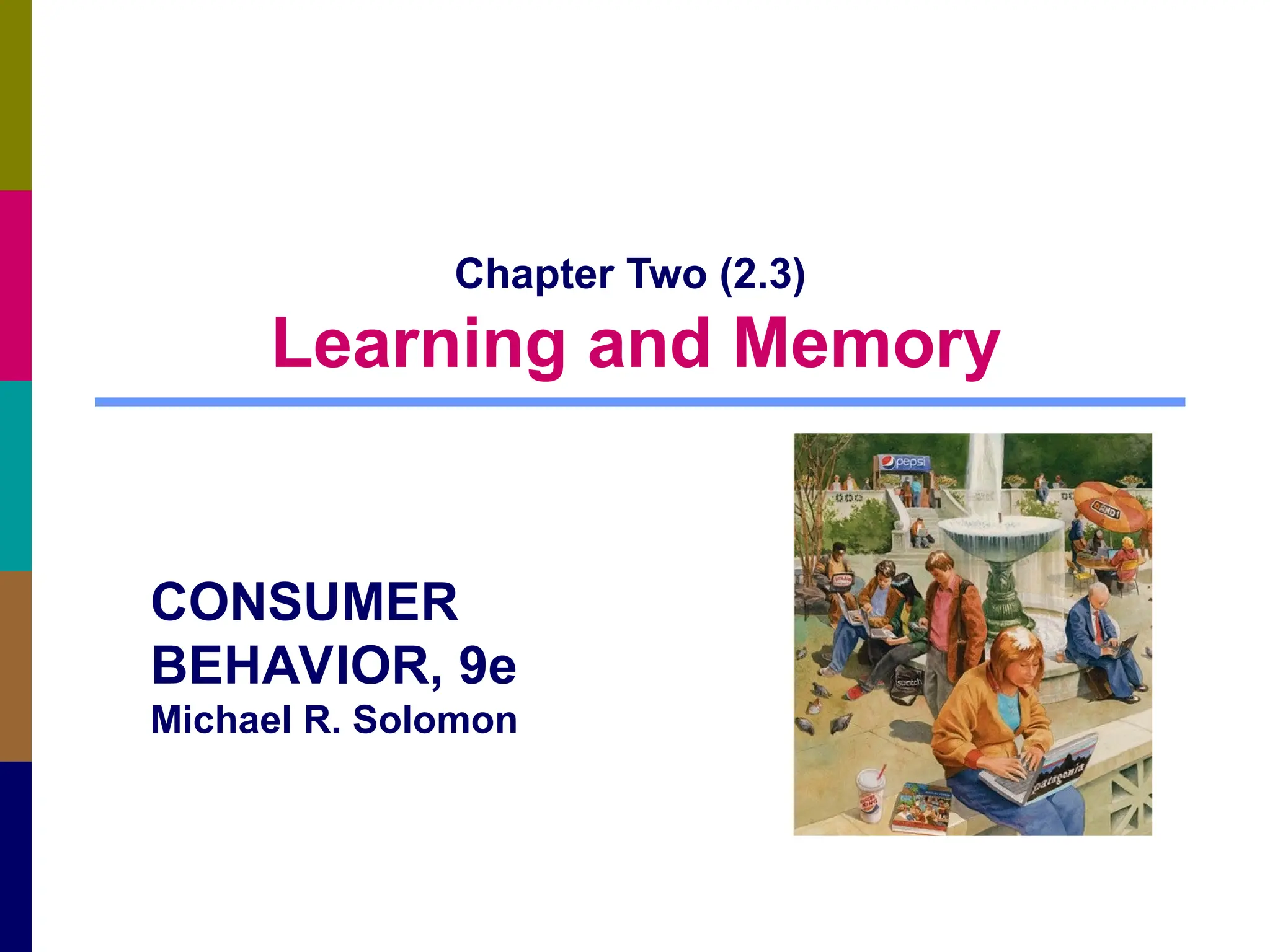
Chapter Two (2.3)
Learning and Memory
CONSUMER
BEHAVIOR, 9e
Michael R. Solomon
Learning Objectives
When you finish this chapter, you should
understand why:
• It’s important for marketers to understand
how consumers learn about products and
services.
• Conditioning results in learning.
• Learned associations can generalize to other
things and why this is important to
marketers.
Learning Objectives (continued)
When you finish this chapter, you should
understand why:
• There is a difference between classical and
instrumental conditioning.
• We learn by observing others’ behavior.
• Memory systems work.
Learning Objectives (continued)
When you finish this chapter, you should
understand why:
• The other products we associate with an
individual product influences how we will
remember it.
• Products help us to retrieve memories from
our past.
• Marketers measure our memories about
products and ads.
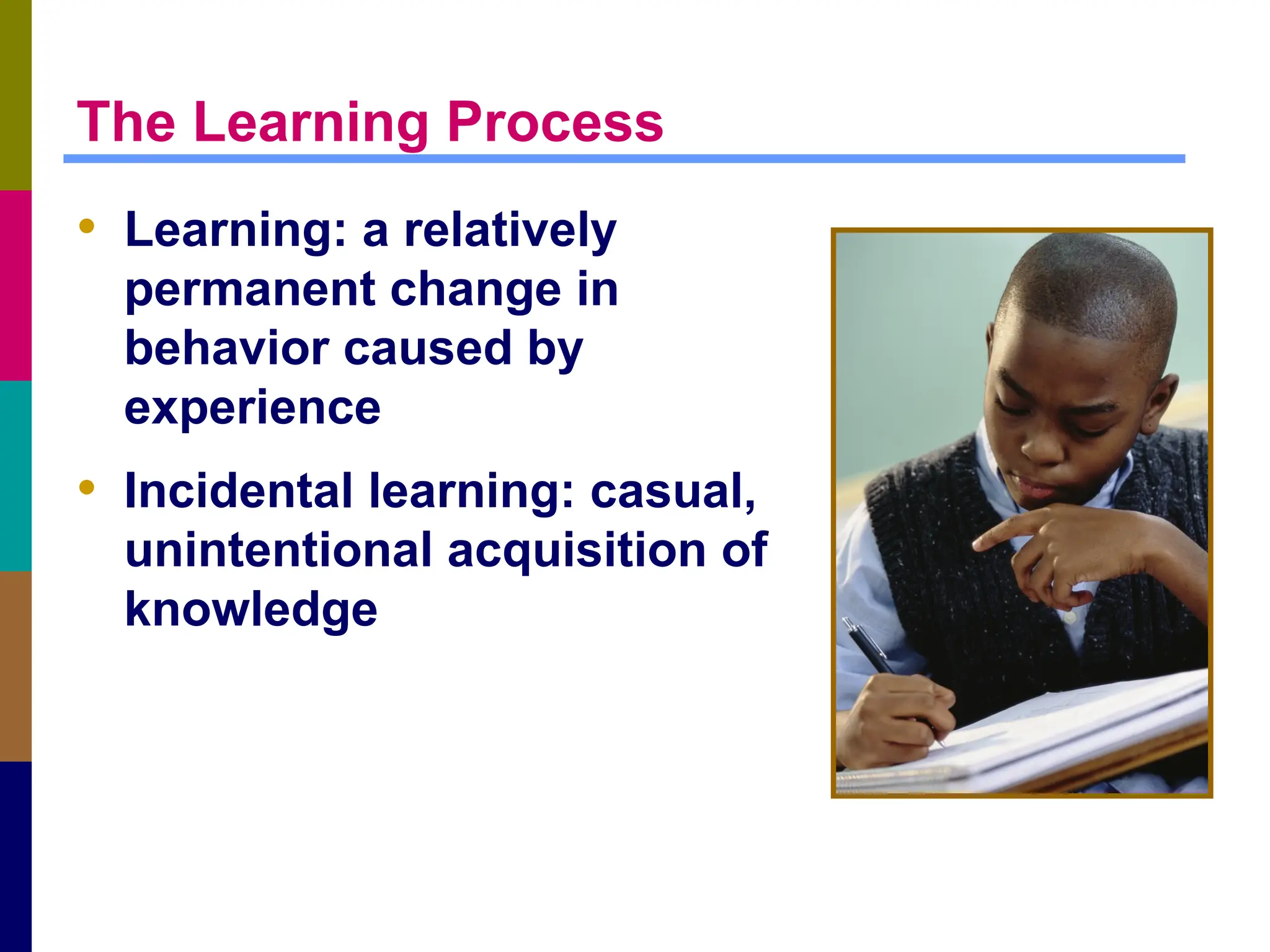
The Learning Process
• Learning: a relatively
permanent change in
behavior caused by
experience
• Incidental learning: casual,
unintentional acquisition of
knowledge
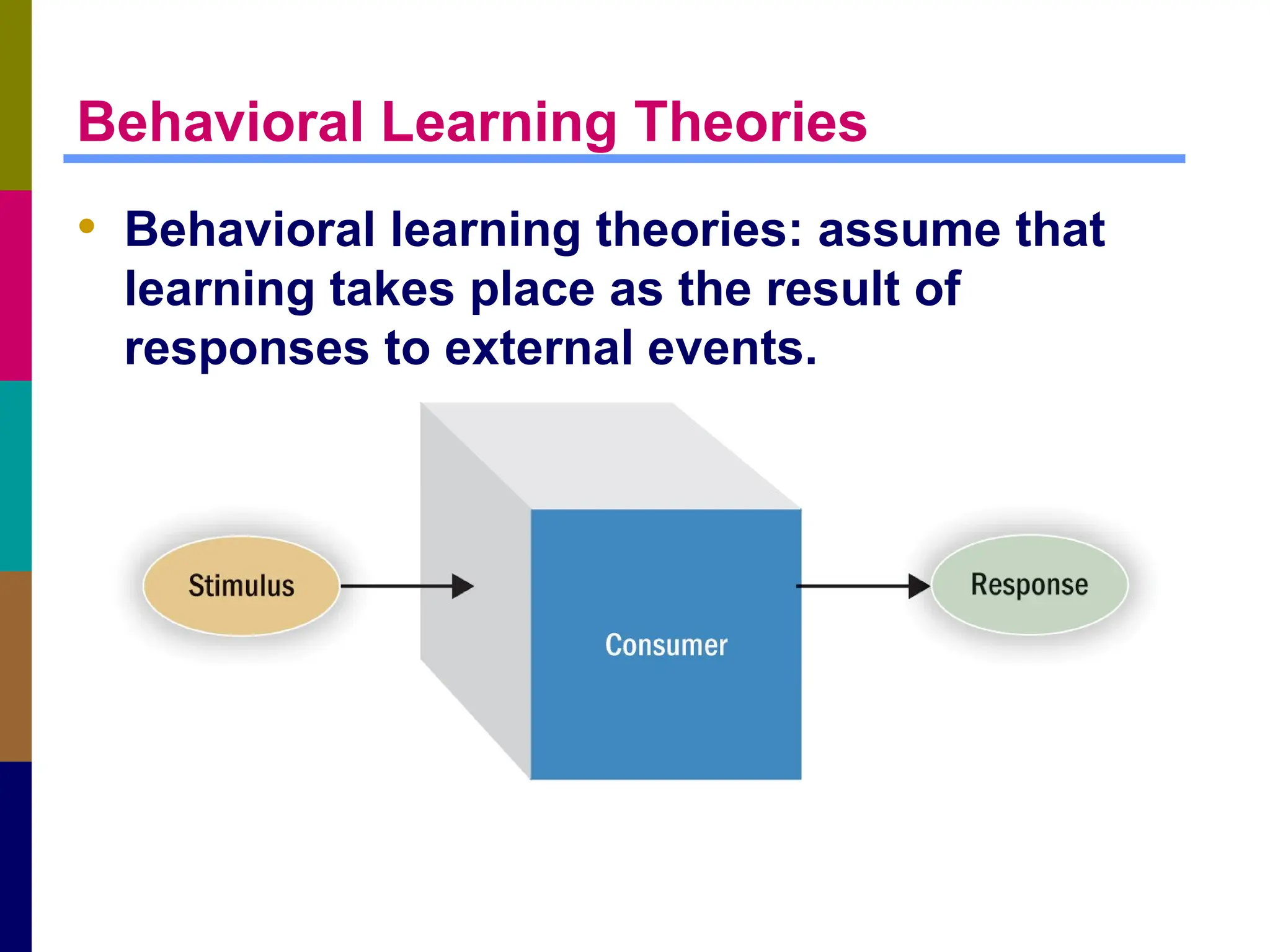
Behavioral Learning Theories
• Behavioral learning theories: assume that
learning takes place as the result of
responses to external events.
Types of Behavioral Learning Theories
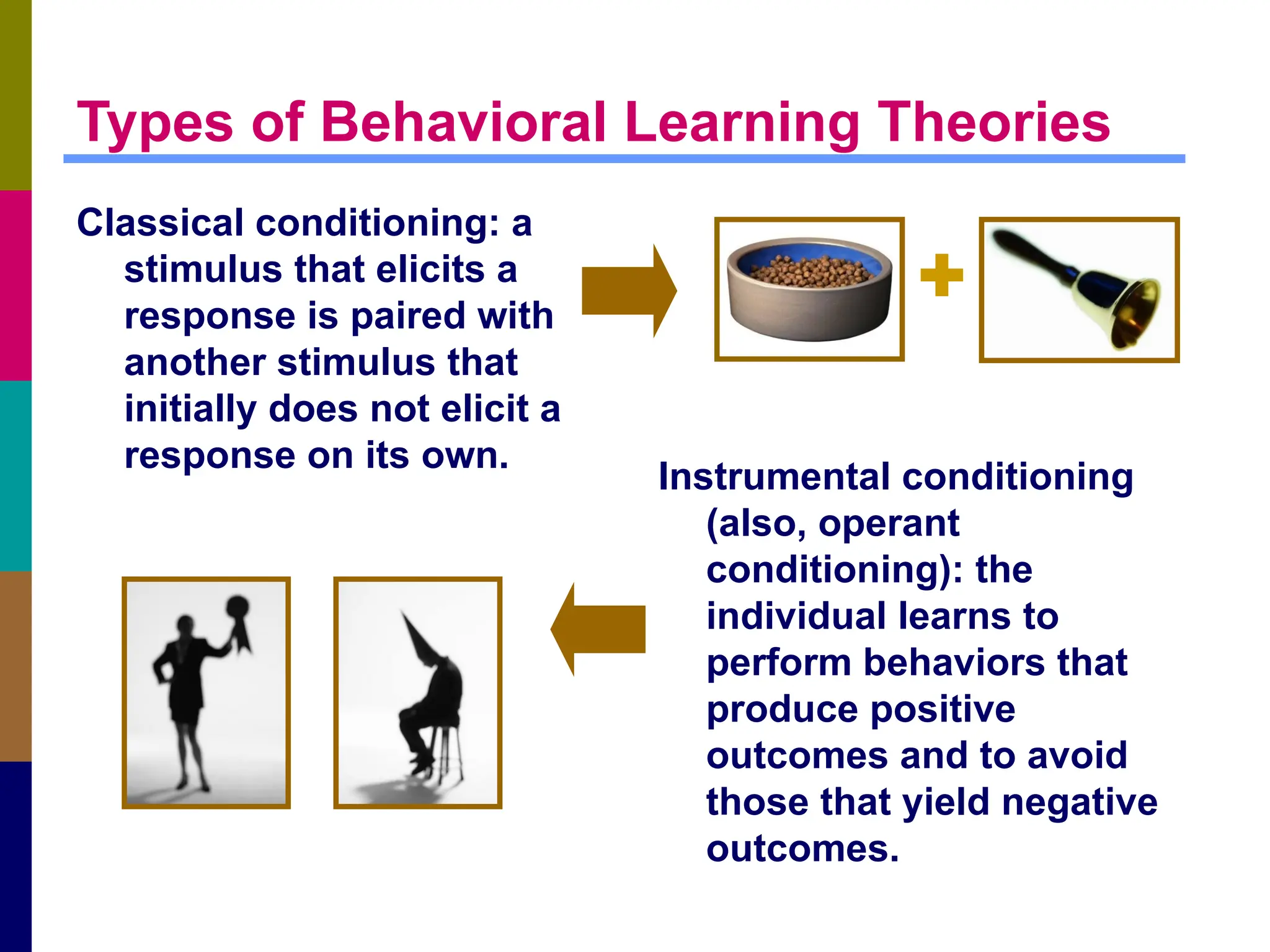
Classical conditioning: a
stimulus that elicits a
response is paired with
another stimulus that
initially does not elicit a
response on its own.
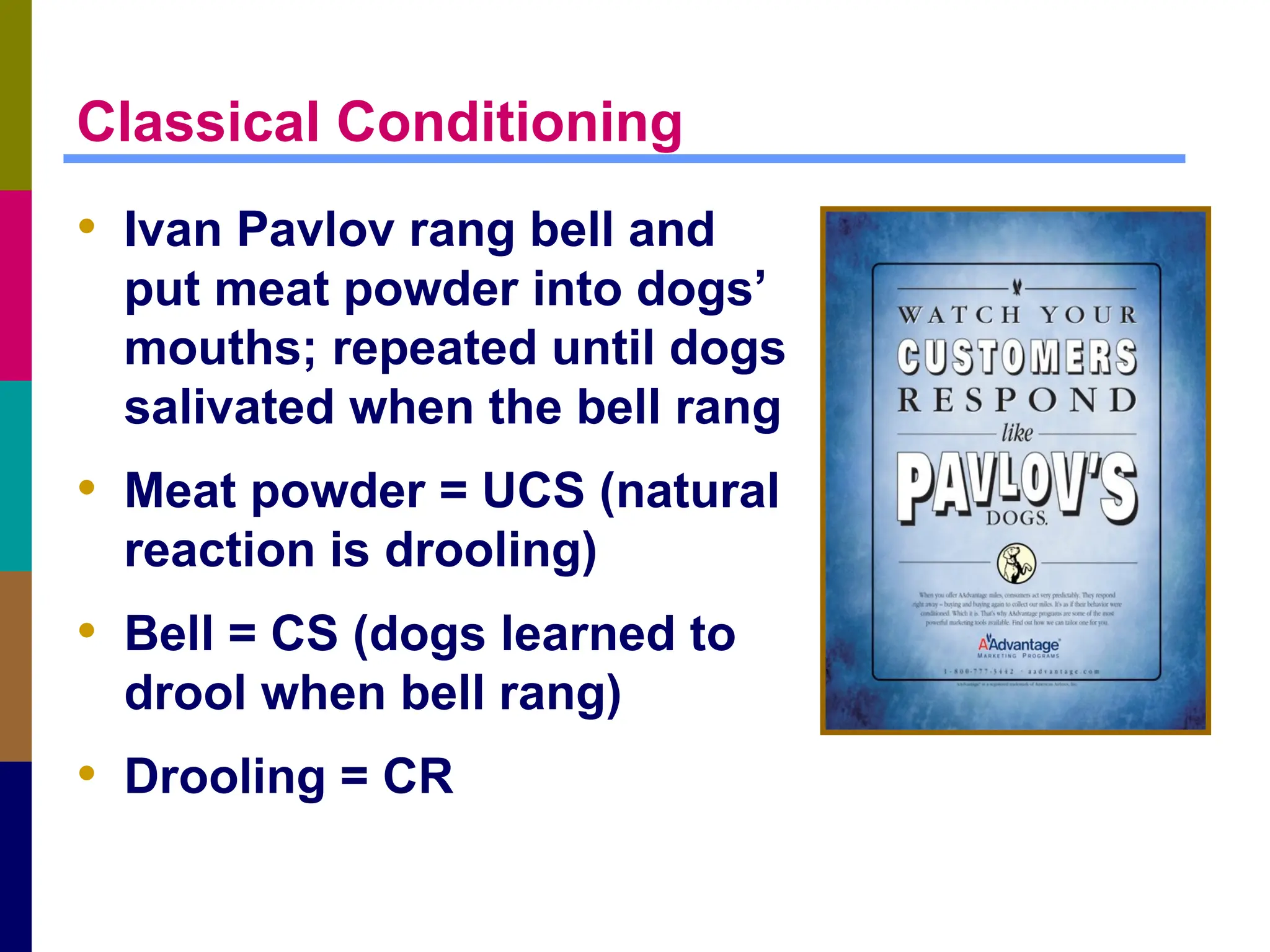
Instrumental conditioning
(also, operant
conditioning): the
individual learns to
perform behaviors that
produce positive
outcomes and to avoid
those that yield negative
outcomes.
Classical Conditioning
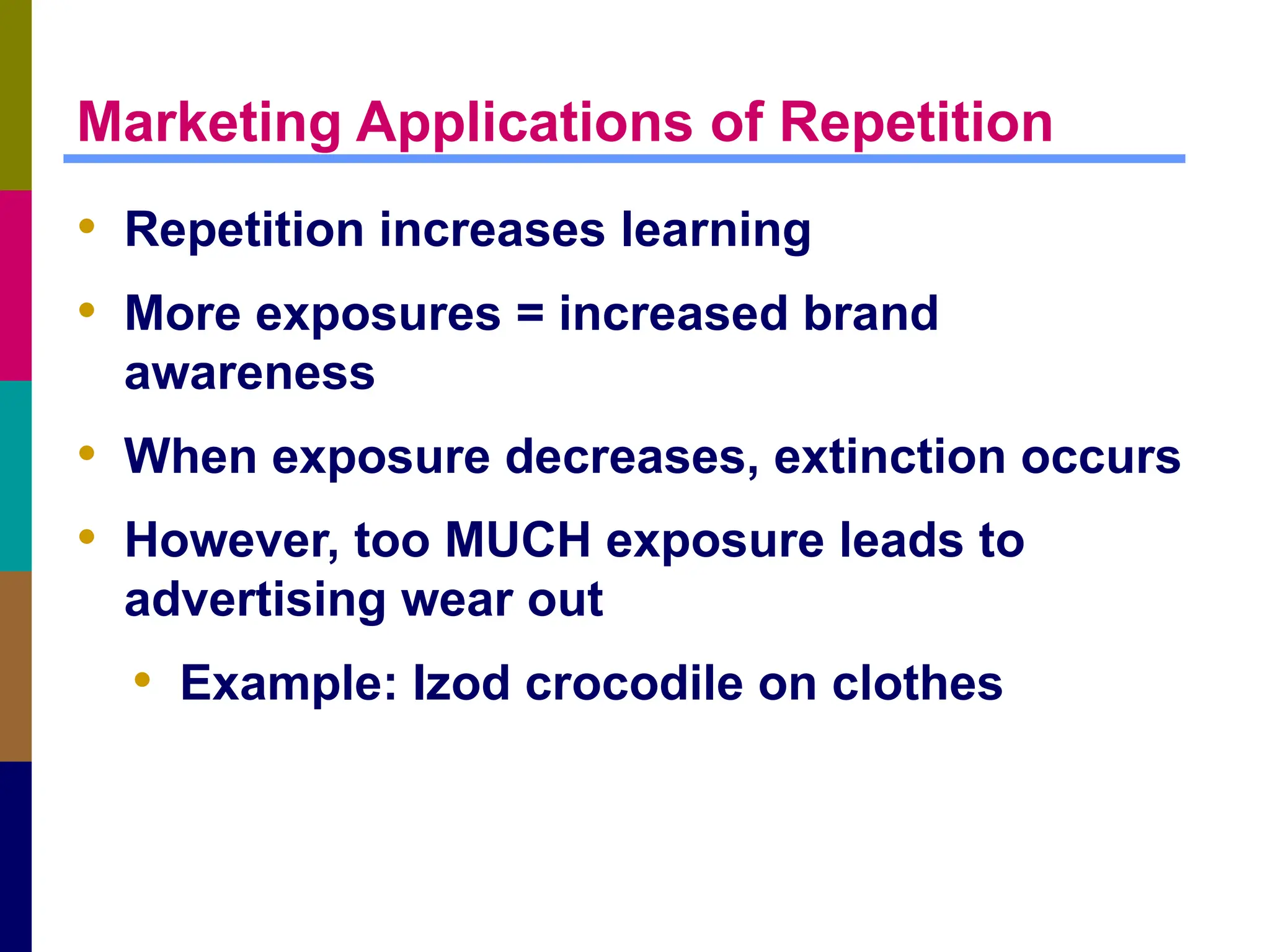
• Ivan Pavlov rang bell and
put meat powder into dogs’
mouths; repeated until dogs
salivated when the bell rang
• Meat powder = UCS (natural
reaction is drooling)
• Bell = CS (dogs learned to
drool when bell rang)
• Drooling = CR
Marketing Applications of Repetition
• Repetition increases learning
• More exposures = increased brand
awareness
• When exposure decreases, extinction occurs
• However, too MUCH exposure leads to
advertising wear out
• Example: Izod crocodile on clothes
Marketing Applications of
Stimulus Generalization
• Stimulus generalization: tendency for stimuli
similar to a conditioned stimulus to evoke
similar, unconditioned responses.
• Family branding
• Product line extensions
• Licensing
• Look-alike packaging
Discussion
• Some advertisers use well-known songs to
promote their products. They often pay more
for the song than for original compositions.
How do you react when one of your favorite
songs turns up in a commercial?
• Why do advertisers do this? How does this
relate to learning theory?
• If you worked for an ad agency, how would
you select songs for your clients?
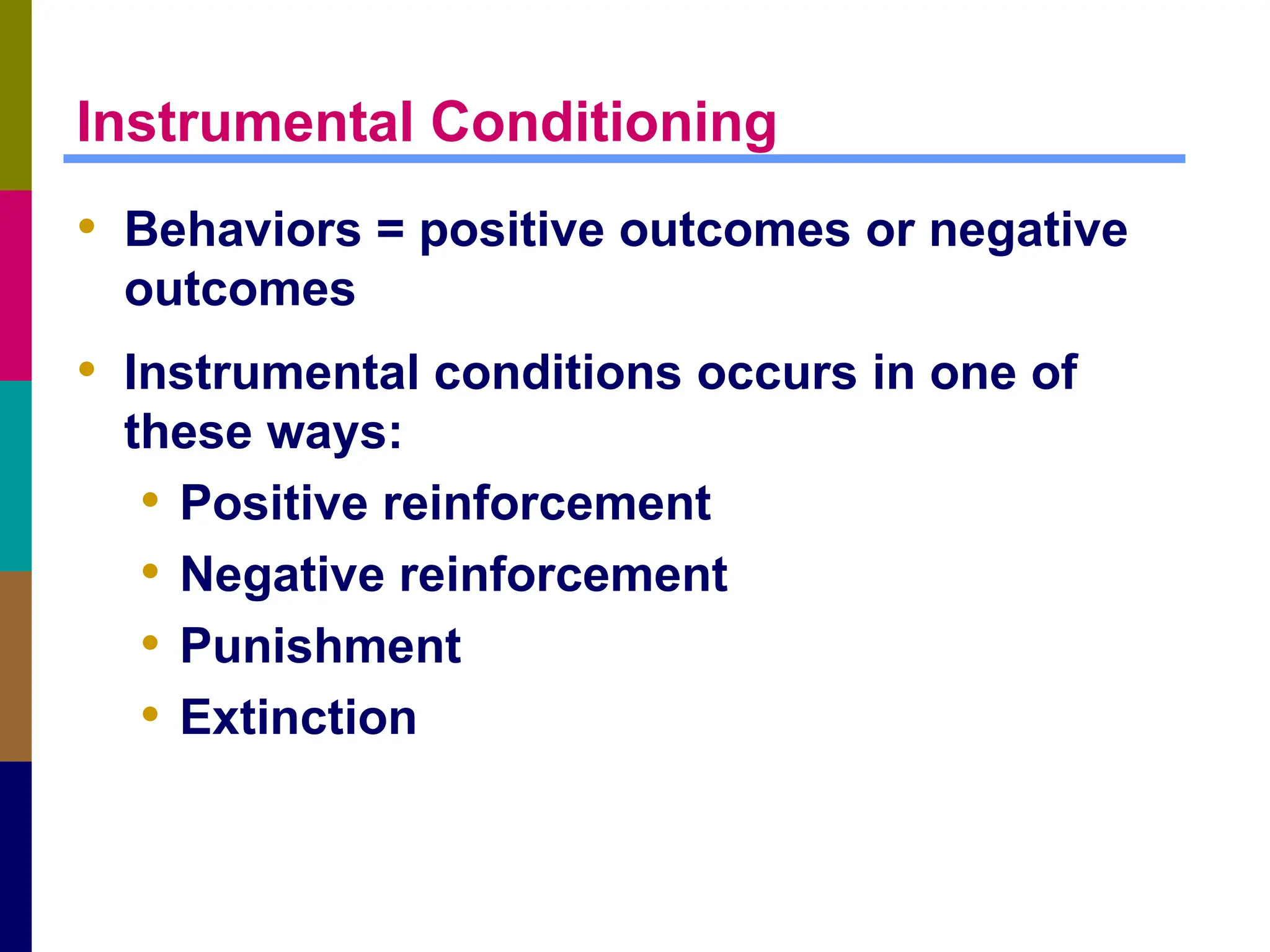
Instrumental Conditioning
• Behaviors = positive outcomes or negative
outcomes
• Instrumental conditions occurs in one of
these ways:
• Positive reinforcement
• Negative reinforcement
• Punishment
• Extinction
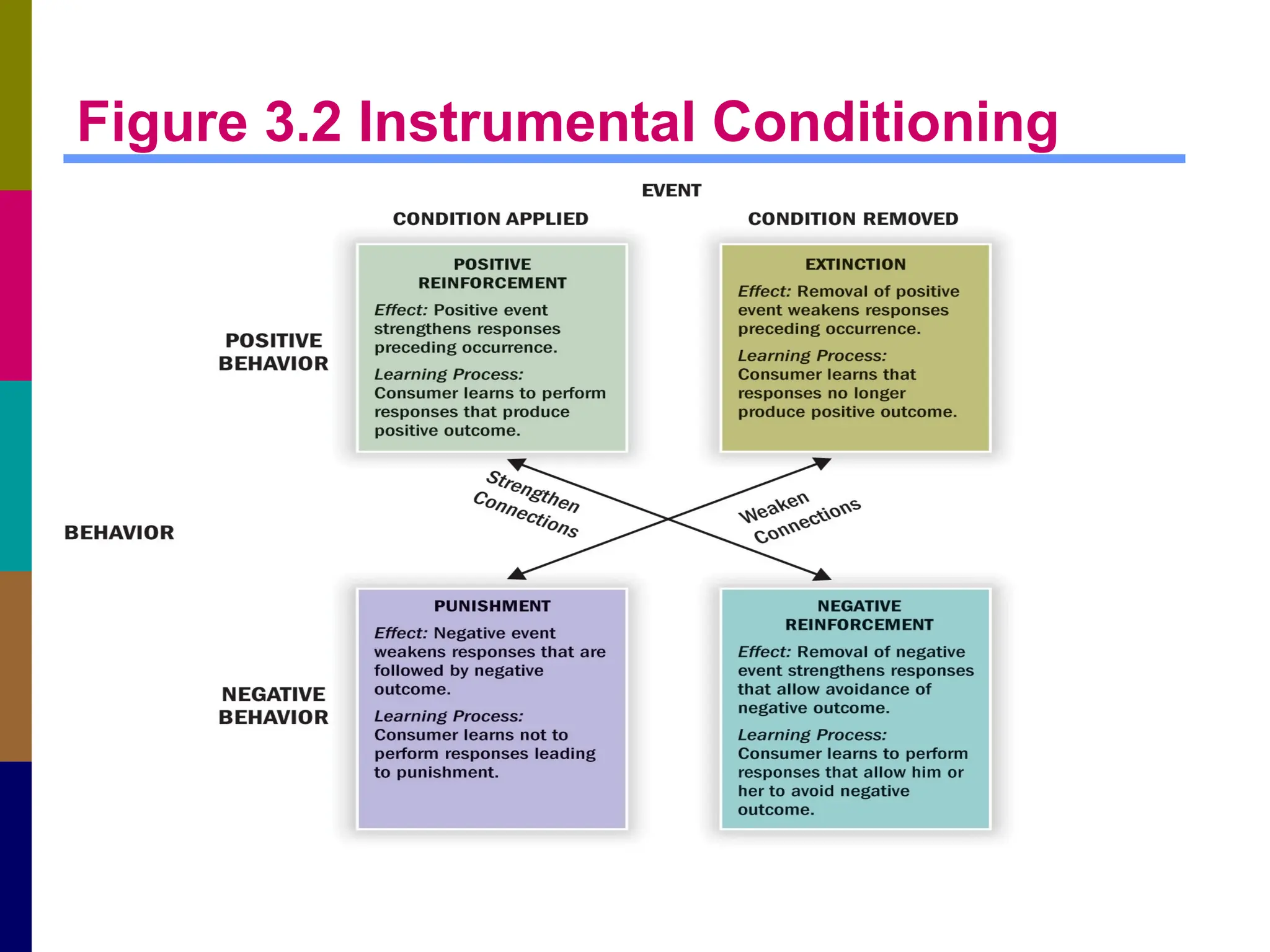
Figure 3.2 Instrumental Conditioning
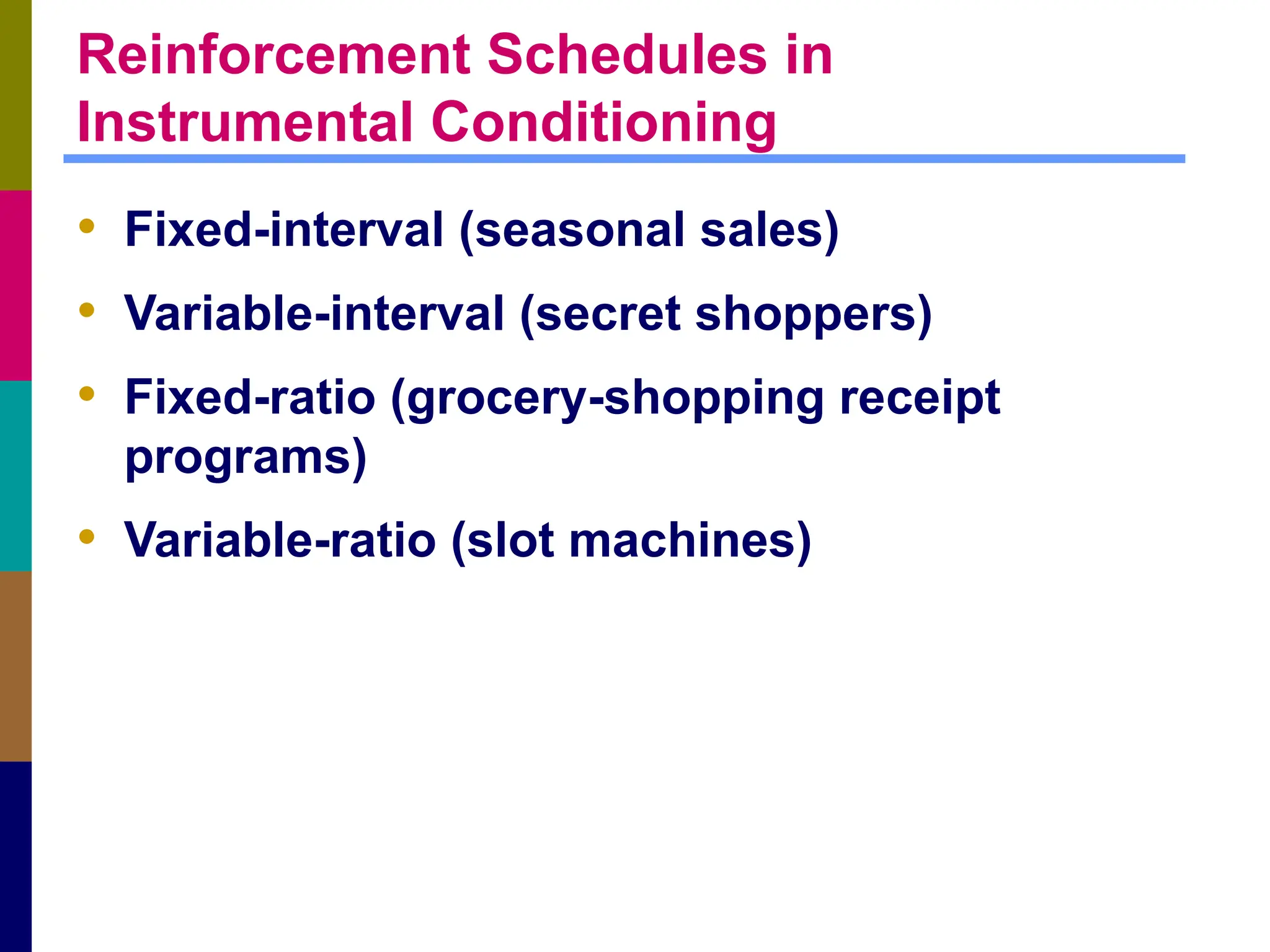
Reinforcement Schedules in
Instrumental Conditioning
• Fixed-interval (seasonal sales)
• Variable-interval (secret shoppers)
• Fixed-ratio (grocery-shopping receipt
programs)
• Variable-ratio (slot machines)
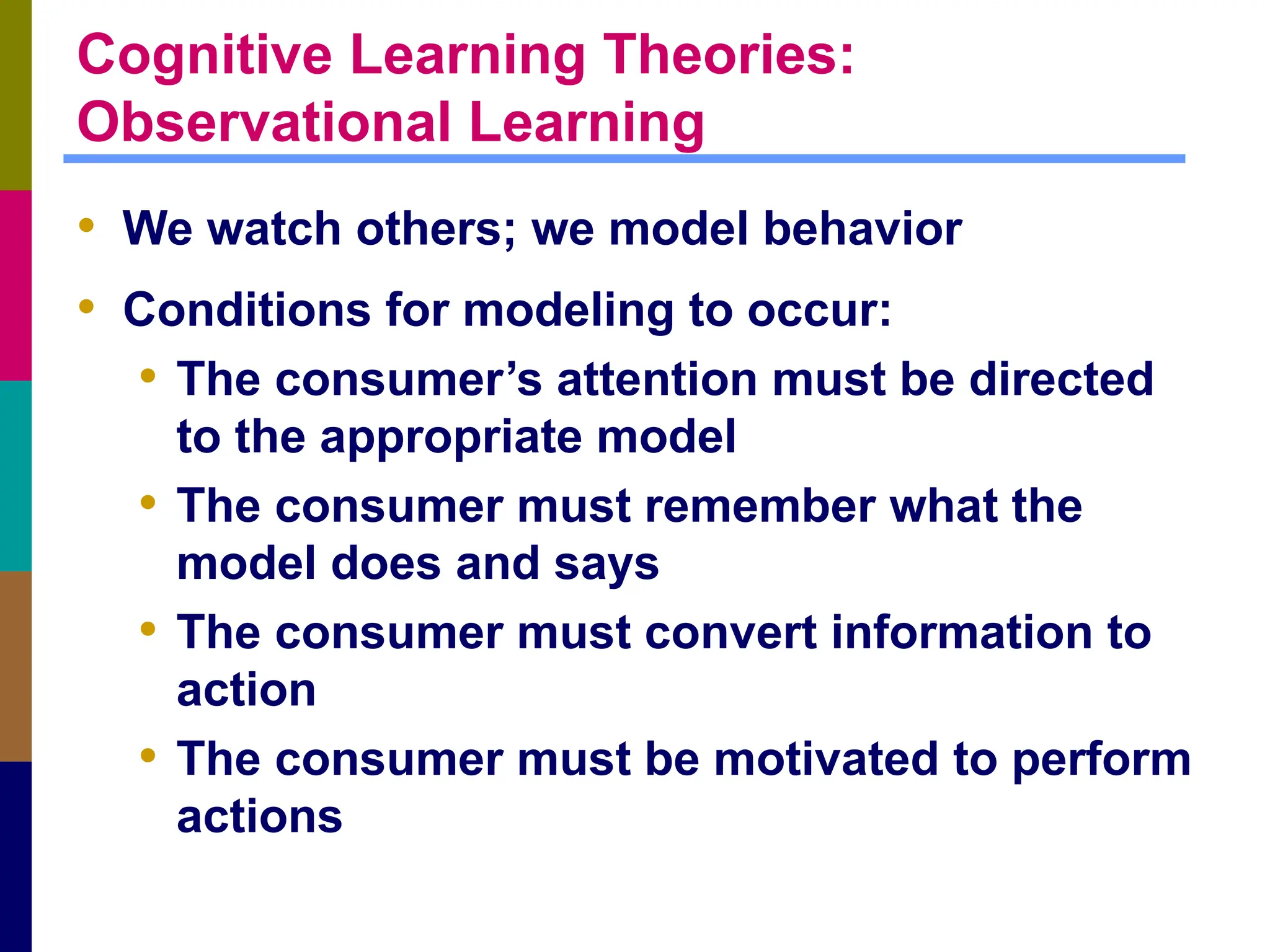
Cognitive Learning Theories:
Observational Learning
• We watch others; we model behavior
• Conditions for modeling to occur:
• The consumer’s attention must be directed
to the appropriate model
• The consumer must remember what the
model does and says
• The consumer must convert information to
action
• The consumer must be motivated to perform
actions
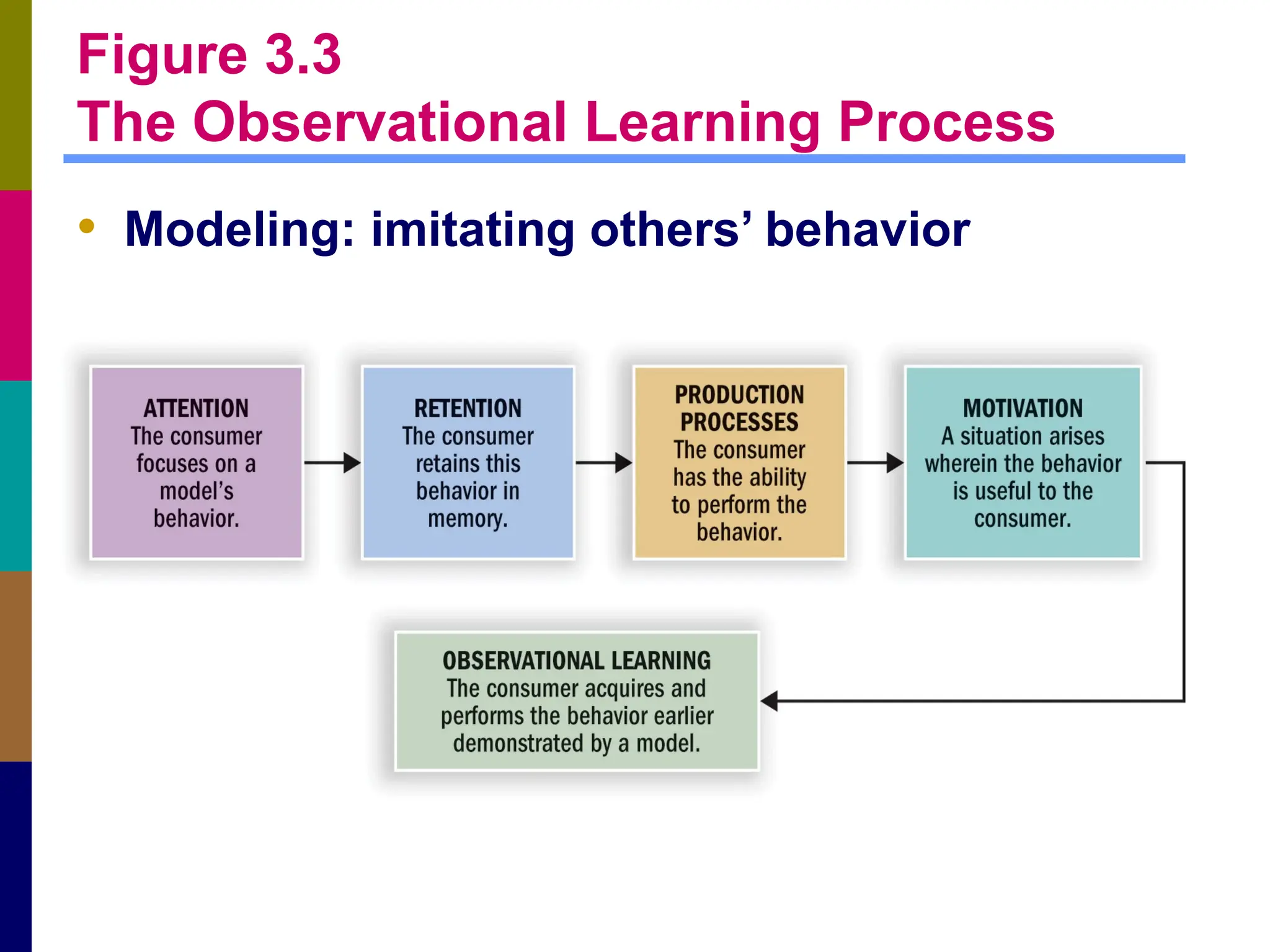
Figure 3.3
The Observational Learning Process
• Modeling: imitating others’ behavior
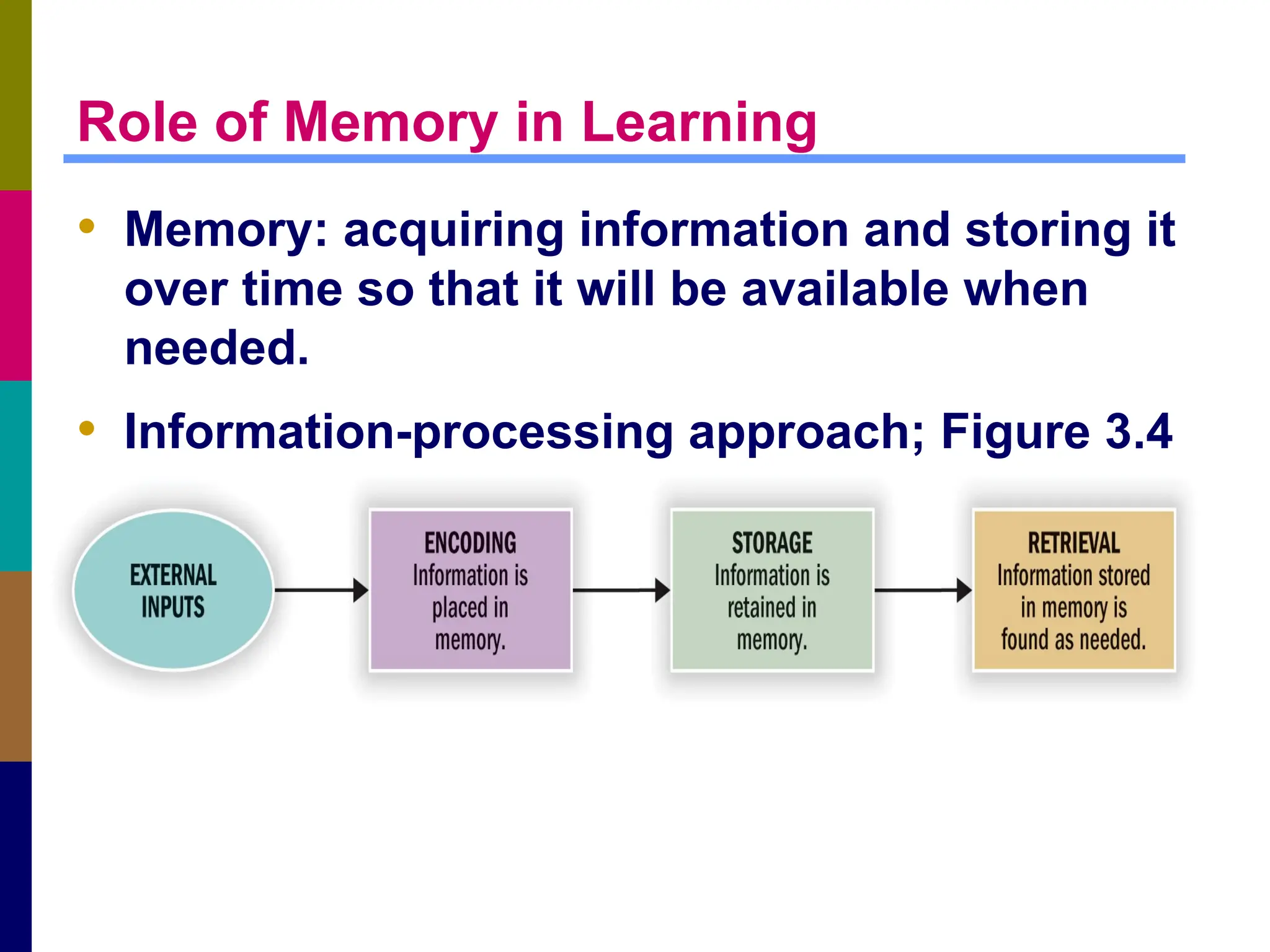
Role of Memory in Learning
• Memory: acquiring information and storing it
over time so that it will be available when
needed.
• Information-processing approach; Figure 3.4
• Mind = computer and data = input/output
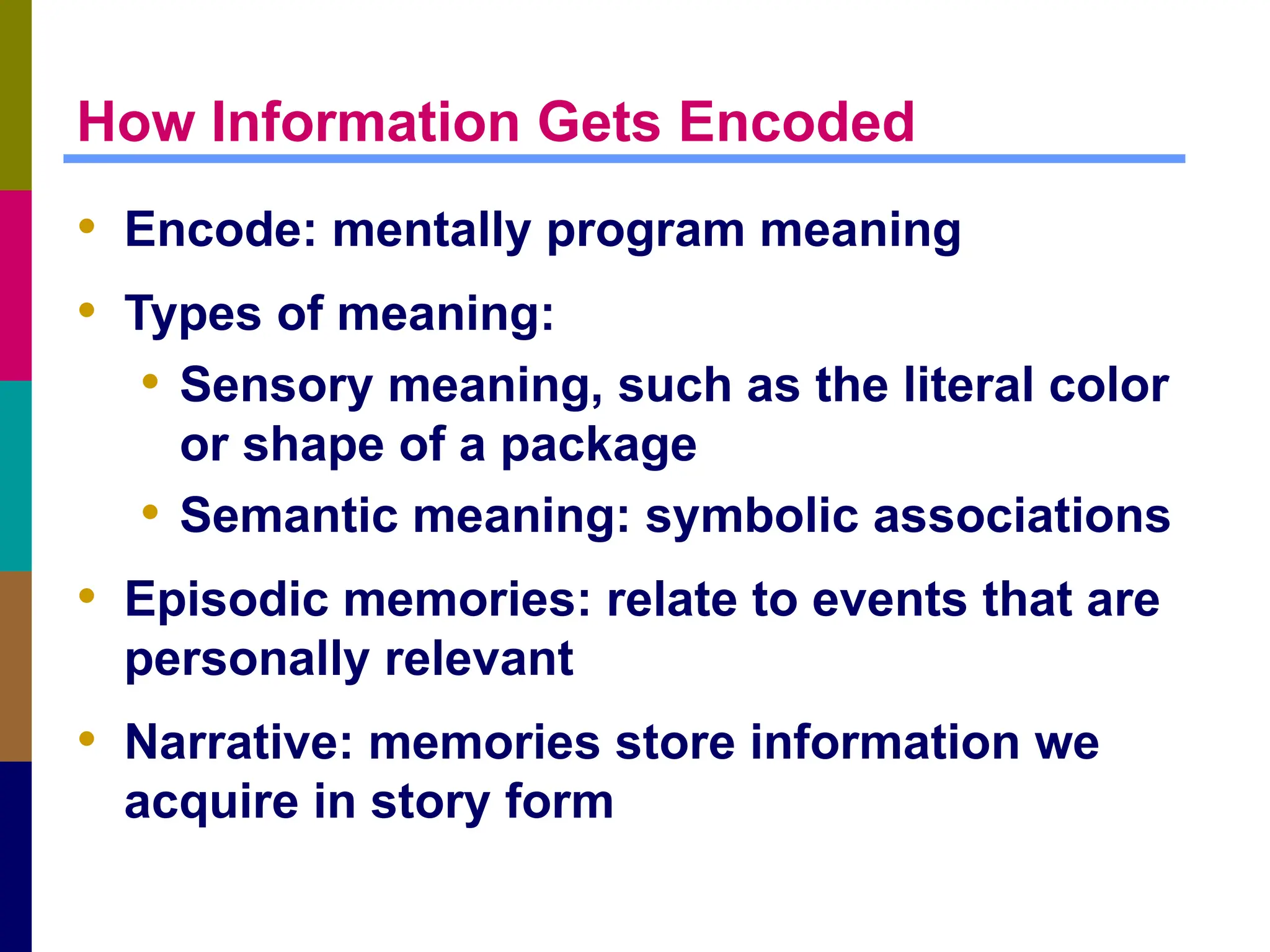
How Information Gets Encoded
• Encode: mentally program meaning
• Types of meaning:
• Sensory meaning, such as the literal color
or shape of a package
• Semantic meaning: symbolic associations
• Episodic memories: relate to events that are
personally relevant
• Narrative: memories store information we
acquire in story form
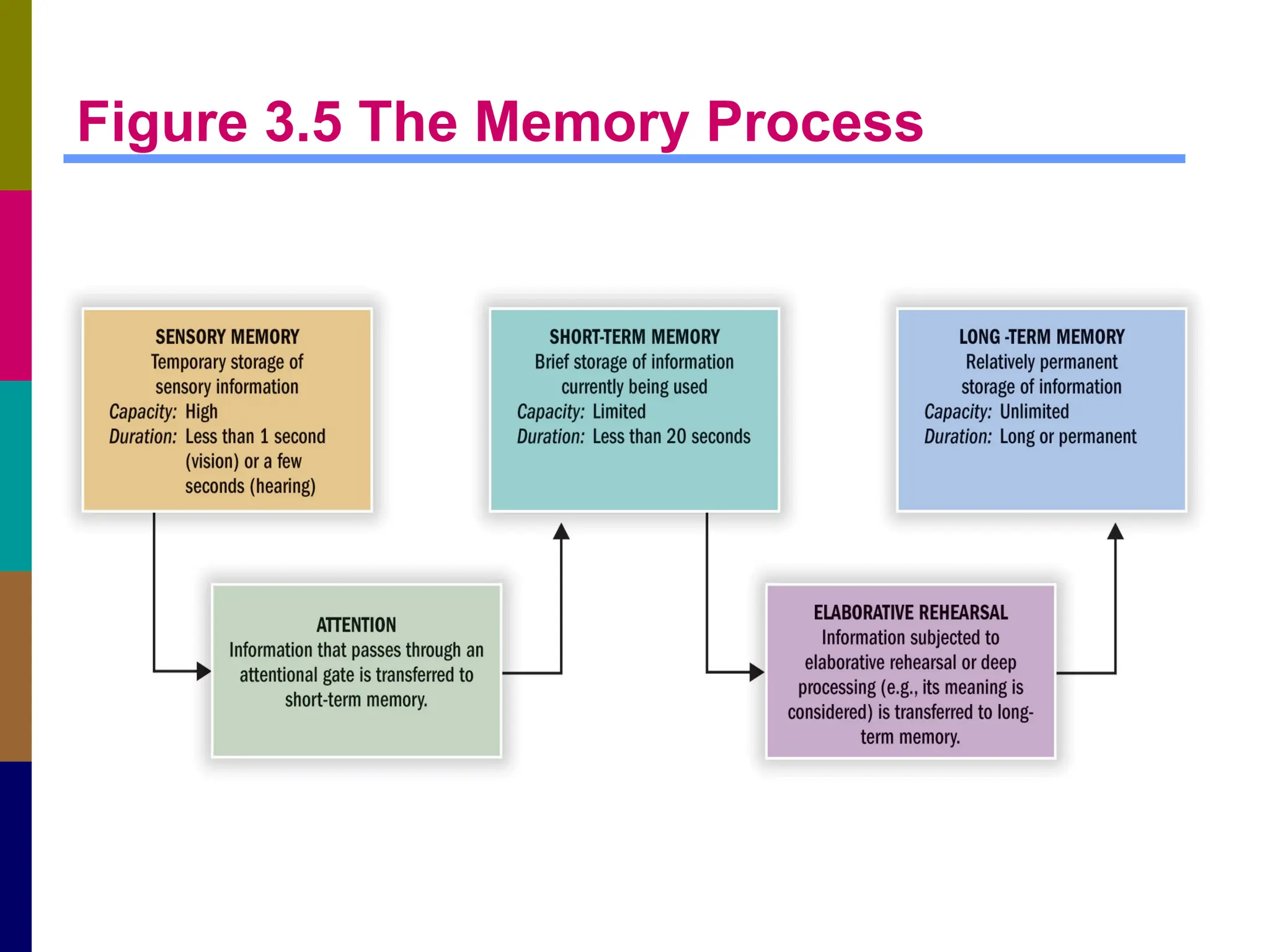
Figure 3.5 The Memory Process
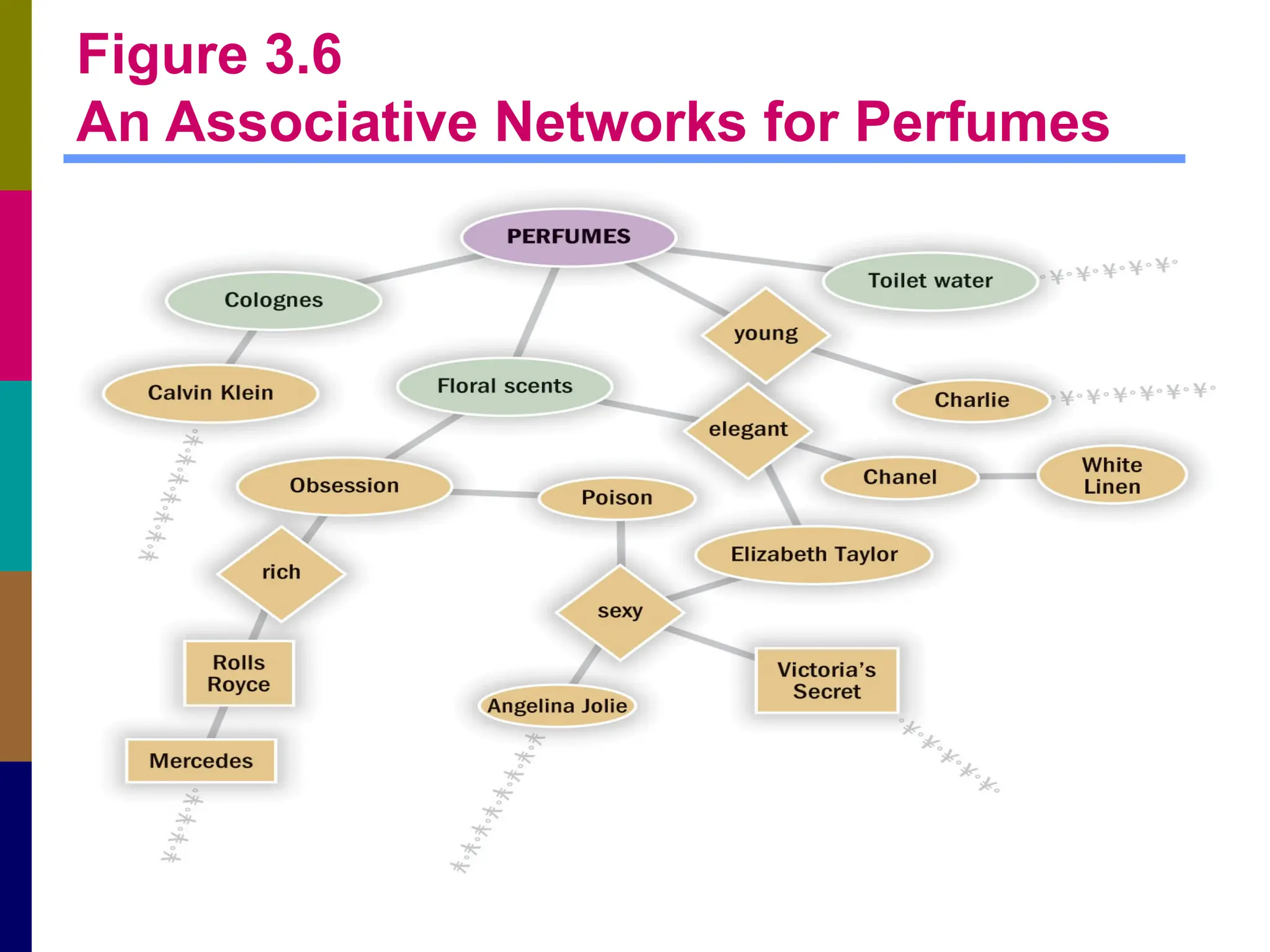
Figure 3.6
An Associative Networks for Perfumes
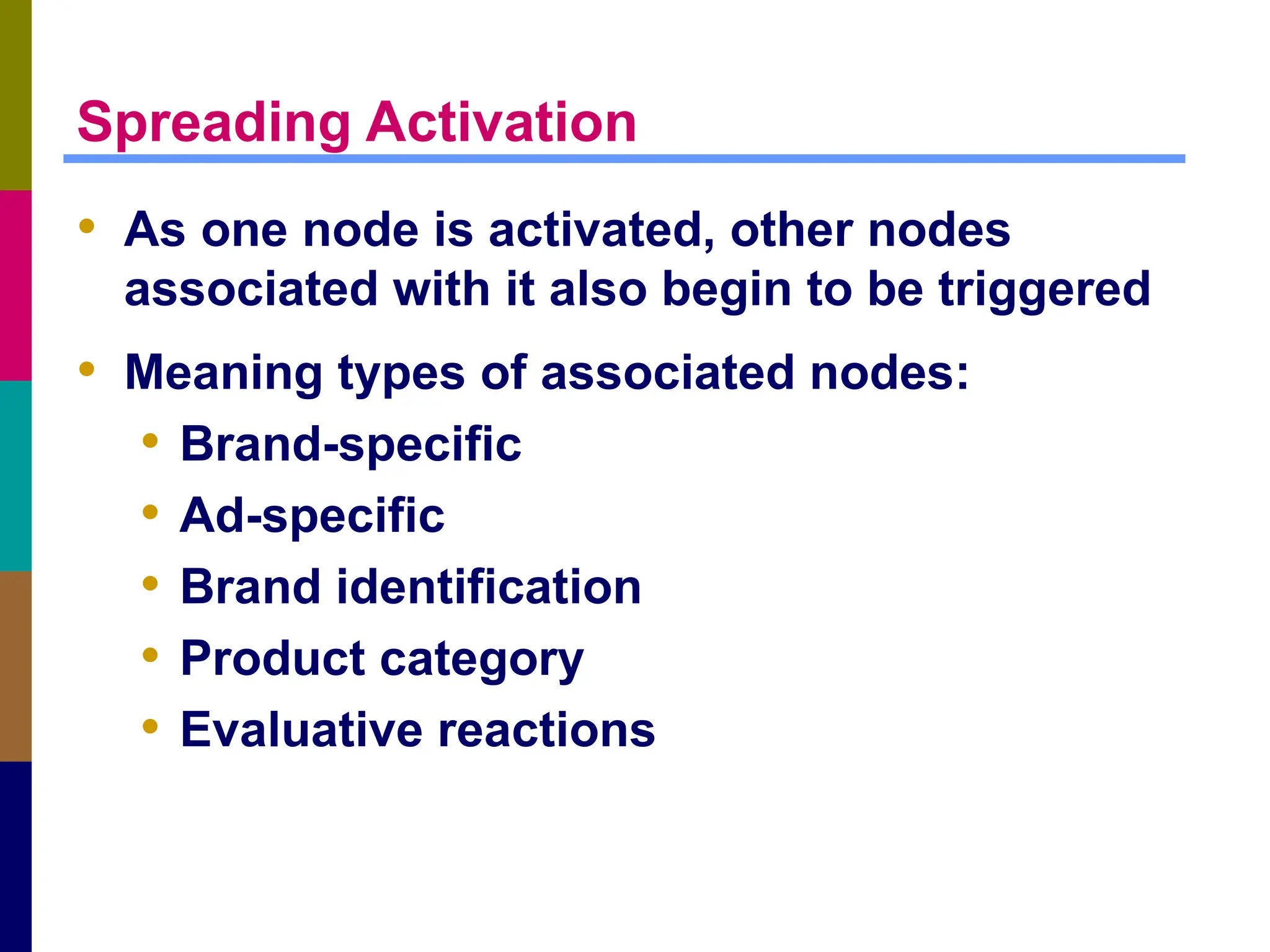
Spreading Activation
• As one node is activated, other nodes
associated with it also begin to be triggered
• Meaning types of associated nodes:
• Brand-specific
• Ad-specific
• Brand identification
• Product category
• Evaluative reactions
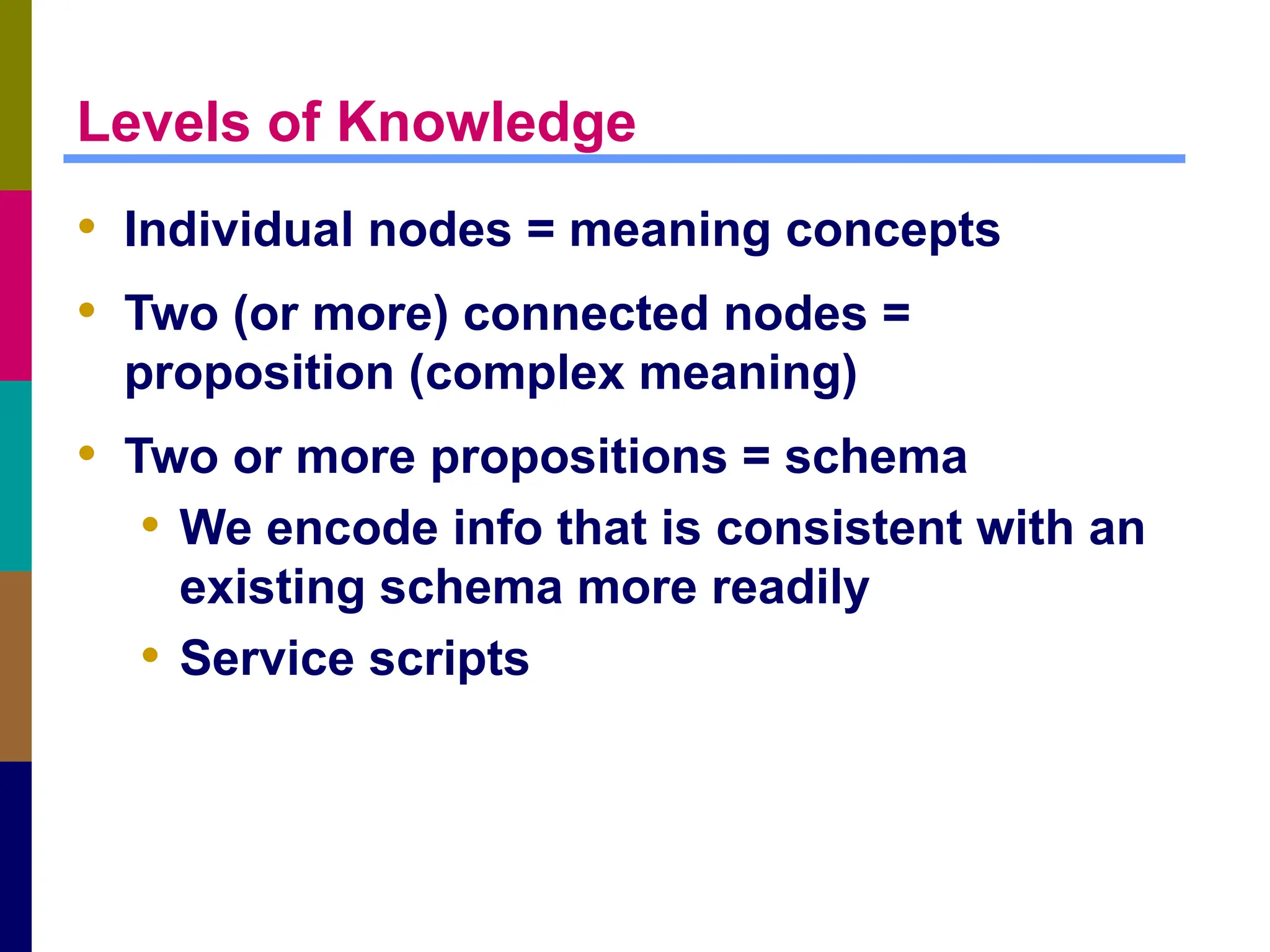
Levels of Knowledge
• Individual nodes = meaning concepts
• Two (or more) connected nodes =
proposition (complex meaning)
• Two or more propositions = schema
• We encode info that is consistent with an
existing schema more readily
• Service scripts
Retrieval for Purchase Decisions
• Retrieving information often requires
appropriate factors and cues:
• Physiological factors
• Situational factors
• Consumer attention; pioneering brand;
descriptive brand names
• Viewing environment (continuous
activity; commercial order in sequence)
• Post experience advertising effects
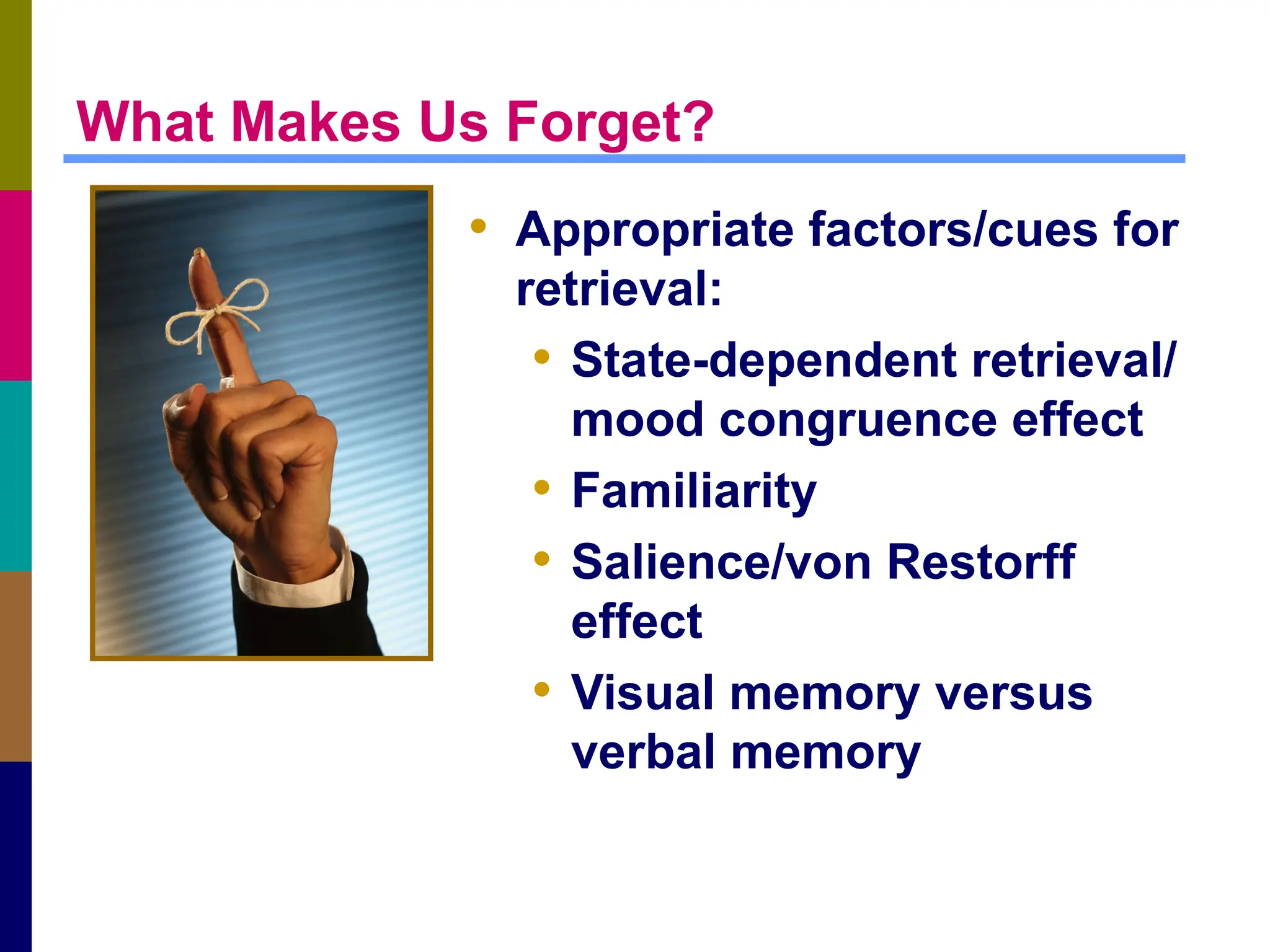
What Makes Us Forget?
• Appropriate factors/cues for
retrieval:
• State-dependent retrieval/
mood congruence effect
• Familiarity
• Salience/von Restorff
effect
• Visual memory versus
verbal memory
Measuring Memory for Marketing Stimuli
• Recognition versus recall
• Problems with memory measures
• Response biases
• Memory lapses
• Omitting
• Averaging
• Telescoping
• Illusion of truth effect
The Marketing Power of Nostalgia
• Marketers may
resurrect popular
characters to evoke
fond memories of
the past
• Nostalgia
• Retro brand
Discussion
• What “retro brands” are targeted to you?
Were these brands that were once used by
your parents?
• What newer brands focus on nostalgia, even
though they never existed before?
Chapter Summary
• Marketers need to know how consumers
learn in order to develop effective messages.
• Conditioning results in learning and learned
associations can generalize to other things.
• Learning can be accomplished through
classical and instrumental conditioning and
through observing the behavior of others.
• We use memory systems to store and
retrieve information.
2.3 Learning & Memory like the hdbbd.ppt

  • 1.
    Chapter Two (2.3) Learningand Memory CONSUMER BEHAVIOR, 9e Michael R. Solomon
  • 2.
    Learning Objectives When youfinish this chapter, you should understand why: • It’s important for marketers to understand how consumers learn about products and services. • Conditioning results in learning. • Learned associations can generalize to other things and why this is important to marketers.
  • 3.
    Learning Objectives (continued) Whenyou finish this chapter, you should understand why: • There is a difference between classical and instrumental conditioning. • We learn by observing others’ behavior. • Memory systems work.
  • 4.
    Learning Objectives (continued) Whenyou finish this chapter, you should understand why: • The other products we associate with an individual product influences how we will remember it. • Products help us to retrieve memories from our past. • Marketers measure our memories about products and ads.
  • 5.
    The Learning Process •Learning: a relatively permanent change in behavior caused by experience • Incidental learning: casual, unintentional acquisition of knowledge
  • 6.
    Behavioral Learning Theories •Behavioral learning theories: assume that learning takes place as the result of responses to external events.
  • 7.
    Types of BehavioralLearning Theories Classical conditioning: a stimulus that elicits a response is paired with another stimulus that initially does not elicit a response on its own. Instrumental conditioning (also, operant conditioning): the individual learns to perform behaviors that produce positive outcomes and to avoid those that yield negative outcomes.
  • 8.
    Classical Conditioning • IvanPavlov rang bell and put meat powder into dogs’ mouths; repeated until dogs salivated when the bell rang • Meat powder = UCS (natural reaction is drooling) • Bell = CS (dogs learned to drool when bell rang) • Drooling = CR
  • 9.
    Marketing Applications ofRepetition • Repetition increases learning • More exposures = increased brand awareness • When exposure decreases, extinction occurs • However, too MUCH exposure leads to advertising wear out • Example: Izod crocodile on clothes
  • 10.
    Marketing Applications of StimulusGeneralization • Stimulus generalization: tendency for stimuli similar to a conditioned stimulus to evoke similar, unconditioned responses. • Family branding • Product line extensions • Licensing • Look-alike packaging
  • 11.
    Discussion • Some advertisersuse well-known songs to promote their products. They often pay more for the song than for original compositions. How do you react when one of your favorite songs turns up in a commercial? • Why do advertisers do this? How does this relate to learning theory? • If you worked for an ad agency, how would you select songs for your clients?
  • 12.
    Instrumental Conditioning • Behaviors= positive outcomes or negative outcomes • Instrumental conditions occurs in one of these ways: • Positive reinforcement • Negative reinforcement • Punishment • Extinction
  • 13.
  • 14.
    Reinforcement Schedules in InstrumentalConditioning • Fixed-interval (seasonal sales) • Variable-interval (secret shoppers) • Fixed-ratio (grocery-shopping receipt programs) • Variable-ratio (slot machines)
  • 15.
    Cognitive Learning Theories: ObservationalLearning • We watch others; we model behavior • Conditions for modeling to occur: • The consumer’s attention must be directed to the appropriate model • The consumer must remember what the model does and says • The consumer must convert information to action • The consumer must be motivated to perform actions
  • 16.
    Figure 3.3 The ObservationalLearning Process • Modeling: imitating others’ behavior
  • 17.
    Role of Memoryin Learning • Memory: acquiring information and storing it over time so that it will be available when needed. • Information-processing approach; Figure 3.4 • Mind = computer and data = input/output
  • 18.
    How Information GetsEncoded • Encode: mentally program meaning • Types of meaning: • Sensory meaning, such as the literal color or shape of a package • Semantic meaning: symbolic associations • Episodic memories: relate to events that are personally relevant • Narrative: memories store information we acquire in story form
  • 19.
    Figure 3.5 TheMemory Process
  • 20.
    Figure 3.6 An AssociativeNetworks for Perfumes
  • 21.
    Spreading Activation • Asone node is activated, other nodes associated with it also begin to be triggered • Meaning types of associated nodes: • Brand-specific • Ad-specific • Brand identification • Product category • Evaluative reactions
  • 22.
    Levels of Knowledge •Individual nodes = meaning concepts • Two (or more) connected nodes = proposition (complex meaning) • Two or more propositions = schema • We encode info that is consistent with an existing schema more readily • Service scripts
  • 23.
    Retrieval for PurchaseDecisions • Retrieving information often requires appropriate factors and cues: • Physiological factors • Situational factors • Consumer attention; pioneering brand; descriptive brand names • Viewing environment (continuous activity; commercial order in sequence) • Post experience advertising effects
  • 24.
    What Makes UsForget? • Appropriate factors/cues for retrieval: • State-dependent retrieval/ mood congruence effect • Familiarity • Salience/von Restorff effect • Visual memory versus verbal memory
  • 25.
    Measuring Memory forMarketing Stimuli • Recognition versus recall • Problems with memory measures • Response biases • Memory lapses • Omitting • Averaging • Telescoping • Illusion of truth effect
  • 26.
    The Marketing Powerof Nostalgia • Marketers may resurrect popular characters to evoke fond memories of the past • Nostalgia • Retro brand
  • 27.
    Discussion • What “retrobrands” are targeted to you? Were these brands that were once used by your parents? • What newer brands focus on nostalgia, even though they never existed before?
  • 28.
    Chapter Summary • Marketersneed to know how consumers learn in order to develop effective messages. • Conditioning results in learning and learned associations can generalize to other things. • Learning can be accomplished through classical and instrumental conditioning and through observing the behavior of others. • We use memory systems to store and retrieve information.