Chapter Seven Customer-Driven Marketing Strategy Creating Value for Target Customers
Customer-Driven Marketing Strategy: Creating Value for Target Customers Customer-Driven Marketing Strategy Market Segmentation Market Targeting Differentiation and Positioning  Topic Outline
Market segmentation  is the process that companies use to divide large, heterogeneous markets into small markets that can be reached more efficiently and effectively with products and services that match their unique needs Market Segmentation
Segmenting consumer markets Segmenting business markets Segmenting international markets Requirements for effective segmentation Market Segmentation
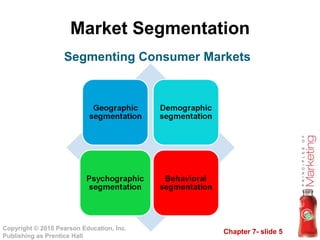
Market Segmentation Segmenting Consumer Markets
Market Segmentation Geographic segmentation  divides the market into different geographical units such as nations, regions, states, counties, or cities Segmenting Consumer Markets
Market Segmentation Demographic segmentation  divides the market into groups based on variables such as age, gender, family size, family life cycle, income, occupation, education, religion, race, generation, and nationality Segmenting Consumer Markets
Market Segmentation Age and life-cycle stage segmentation  is the process of offering different products or using different marketing approaches for different age and life-cycle groups Gender segmentation  divides the market based on sex (male or female)
Market Segmentation Income segmentation  divides the market into affluent or low-income consumers Psychographic segmentation  divides buyers into different groups based on social class, lifestyle, or personality traits Segmenting Consumer Markets
Market Segmentation Behavioral segmentation  divides buyers into groups based on their knowledge, attitudes, uses, or responses to a product Occasions Benefits sought User status Usage rate Loyalty status Segmenting Consumer Markets
Market Segmentation Multiple segmentation  is used to identify smaller, better-defined target groups Geodemographic segmentation  is an example of multivariable segmentation that divides groups into consumer lifestyle patterns Using Multiple Segmentation Bases
Market Segmentation PRIZM NE classifies every American household into 66 unique segments organized into 14 different social groups These groups segment people and locations into marketable groups of like-minded consumers that exhibit unique characteristics and buying behavior based on a host of demographic factors Using Multiple Segmentation Bases
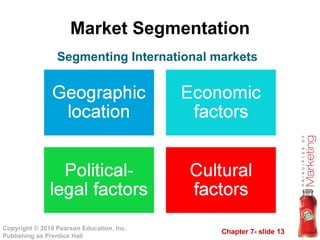
Market Segmentation Segmenting International markets
Market Segmentation Intermarket segmentation  divides consumers into groups with similar needs and buying behaviors even though they are located in different countries Segmenting Business Markets
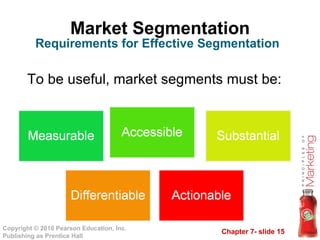
Market Segmentation To be useful, market segments must be: Requirements for Effective Segmentation
Market Targeting  Target market consists of a set of buyers who share common needs or characteristics that the company decides to serve Selecting Target Market Segments
Market Targeting Segment size and growth Segment structural attractiveness Company objectives and  resources Evaluating Market Segments .
Market Targeting Undifferentiated  marketing targets the whole market with one offer Mass marketing Focuses on common needs rather than what’s different Target Marketing Strategies
Market Targeting Differentiated marketing  targets several different market segments and designs separate offers for each Goal is to achieve higher sales and stronger position More expensive than undifferentiated marketing Target Marketing Strategies
Market Targeting Concentrated marketing targets a small share of a large market Limited company resources Knowledge of the market More effective and efficient Target Market Strategies
Marketing Targeting Micromarketing  is the practice of tailoring products and marketing programs to suit the tastes of specific individuals and locations Local marketing Individual marketing Target Market Strategies
Market Targeting Local marketing  involves tailoring brands and promotion to the needs and wants of local customer groups Cities Neighborhoods Stores Target Market Strategies
Market Targeting Individual marketing  involves tailoring products and marketing programs to the needs and preferences of individual customers Also known as: One-to-one marketing Mass customization Markets-of-one marketing Target Market Strategies
Market Targeting Depends on: Company resources Product variability Product life-cycle stage Market variability Competitor’s marketing strategies Choosing a Targeting Strategy
Market Targeting Benefits customers with specific needs Concern for vulnerable segments Children Alcohol Cigarettes Internet abuses Socially Responsible Target Marketing
Product position  is the way the product is defined by consumers on important attributes—the place the product occupies in consumers’ minds relative to competing products Perceptions Impressions Feelings Differentiation and Positioning
Positioning maps show consumer perceptions of their brands versus competing products on important buying dimensions Differentiation and Positioning
Differentiation and Positioning Identifying a set of possible competitive advantages to build a position Choosing the right competitive advantages Selecting an overall positioning strategy Developing a positioning statement Choosing a Differentiation and Positioning Strategy
Differentiation and Positioning Competitive advantage  is an advantage over competitors gained by offering consumers greater value, either through lower prices or by providing more benefits that justify higher prices Identifying Possible Value Differences and Competitive Advantages
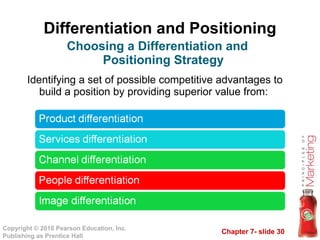
Differentiation and Positioning Identifying a set of possible competitive advantages to build a position by providing superior value from: Choosing a Differentiation and Positioning Strategy
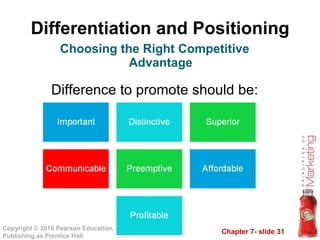
Differentiation and Positioning Difference to promote should be: Choosing the Right Competitive Advantage
Differentiation and Positioning Value proposition is the full mix of benefits upon which a brand is positioned Selecting an Overall Positioning Strategy
Differentiation and Positioning To (target segment and need) our (brand) is (concept) that (point of difference) Developing a Positioning Statement
Choosing the positioning is often easier than implementing the position. Communication and Delivering the Chosen Position

Module 4 identifying market segments and selecting targeting markets

  • 1.
    Chapter Seven Customer-DrivenMarketing Strategy Creating Value for Target Customers
  • 2.
    Customer-Driven Marketing Strategy:Creating Value for Target Customers Customer-Driven Marketing Strategy Market Segmentation Market Targeting Differentiation and Positioning Topic Outline
  • 3.
    Market segmentation is the process that companies use to divide large, heterogeneous markets into small markets that can be reached more efficiently and effectively with products and services that match their unique needs Market Segmentation
  • 4.
    Segmenting consumer marketsSegmenting business markets Segmenting international markets Requirements for effective segmentation Market Segmentation
  • 5.
  • 6.
    Market Segmentation Geographicsegmentation divides the market into different geographical units such as nations, regions, states, counties, or cities Segmenting Consumer Markets
  • 7.
    Market Segmentation Demographicsegmentation divides the market into groups based on variables such as age, gender, family size, family life cycle, income, occupation, education, religion, race, generation, and nationality Segmenting Consumer Markets
  • 8.
    Market Segmentation Ageand life-cycle stage segmentation is the process of offering different products or using different marketing approaches for different age and life-cycle groups Gender segmentation divides the market based on sex (male or female)
  • 9.
    Market Segmentation Incomesegmentation divides the market into affluent or low-income consumers Psychographic segmentation divides buyers into different groups based on social class, lifestyle, or personality traits Segmenting Consumer Markets
  • 10.
    Market Segmentation Behavioralsegmentation divides buyers into groups based on their knowledge, attitudes, uses, or responses to a product Occasions Benefits sought User status Usage rate Loyalty status Segmenting Consumer Markets
  • 11.
    Market Segmentation Multiplesegmentation is used to identify smaller, better-defined target groups Geodemographic segmentation is an example of multivariable segmentation that divides groups into consumer lifestyle patterns Using Multiple Segmentation Bases
  • 12.
    Market Segmentation PRIZMNE classifies every American household into 66 unique segments organized into 14 different social groups These groups segment people and locations into marketable groups of like-minded consumers that exhibit unique characteristics and buying behavior based on a host of demographic factors Using Multiple Segmentation Bases
  • 13.
    Market Segmentation SegmentingInternational markets
  • 14.
    Market Segmentation Intermarketsegmentation divides consumers into groups with similar needs and buying behaviors even though they are located in different countries Segmenting Business Markets
  • 15.
    Market Segmentation Tobe useful, market segments must be: Requirements for Effective Segmentation
  • 16.
    Market Targeting Target market consists of a set of buyers who share common needs or characteristics that the company decides to serve Selecting Target Market Segments
  • 17.
    Market Targeting Segmentsize and growth Segment structural attractiveness Company objectives and resources Evaluating Market Segments .
  • 18.
    Market Targeting Undifferentiated marketing targets the whole market with one offer Mass marketing Focuses on common needs rather than what’s different Target Marketing Strategies
  • 19.
    Market Targeting Differentiatedmarketing targets several different market segments and designs separate offers for each Goal is to achieve higher sales and stronger position More expensive than undifferentiated marketing Target Marketing Strategies
  • 20.
    Market Targeting Concentratedmarketing targets a small share of a large market Limited company resources Knowledge of the market More effective and efficient Target Market Strategies
  • 21.
    Marketing Targeting Micromarketing is the practice of tailoring products and marketing programs to suit the tastes of specific individuals and locations Local marketing Individual marketing Target Market Strategies
  • 22.
    Market Targeting Localmarketing involves tailoring brands and promotion to the needs and wants of local customer groups Cities Neighborhoods Stores Target Market Strategies
  • 23.
    Market Targeting Individualmarketing involves tailoring products and marketing programs to the needs and preferences of individual customers Also known as: One-to-one marketing Mass customization Markets-of-one marketing Target Market Strategies
  • 24.
    Market Targeting Dependson: Company resources Product variability Product life-cycle stage Market variability Competitor’s marketing strategies Choosing a Targeting Strategy
  • 25.
    Market Targeting Benefitscustomers with specific needs Concern for vulnerable segments Children Alcohol Cigarettes Internet abuses Socially Responsible Target Marketing
  • 26.
    Product position is the way the product is defined by consumers on important attributes—the place the product occupies in consumers’ minds relative to competing products Perceptions Impressions Feelings Differentiation and Positioning
  • 27.
    Positioning maps showconsumer perceptions of their brands versus competing products on important buying dimensions Differentiation and Positioning
  • 28.
    Differentiation and PositioningIdentifying a set of possible competitive advantages to build a position Choosing the right competitive advantages Selecting an overall positioning strategy Developing a positioning statement Choosing a Differentiation and Positioning Strategy
  • 29.
    Differentiation and PositioningCompetitive advantage is an advantage over competitors gained by offering consumers greater value, either through lower prices or by providing more benefits that justify higher prices Identifying Possible Value Differences and Competitive Advantages
  • 30.
    Differentiation and PositioningIdentifying a set of possible competitive advantages to build a position by providing superior value from: Choosing a Differentiation and Positioning Strategy
  • 31.
    Differentiation and PositioningDifference to promote should be: Choosing the Right Competitive Advantage
  • 32.
    Differentiation and PositioningValue proposition is the full mix of benefits upon which a brand is positioned Selecting an Overall Positioning Strategy
  • 33.
    Differentiation and PositioningTo (target segment and need) our (brand) is (concept) that (point of difference) Developing a Positioning Statement
  • 34.
    Choosing the positioningis often easier than implementing the position. Communication and Delivering the Chosen Position