
CONSUMER LEARNING
By Balachandar K
 “Learning is defined as the process by which individuals
acquire the purchase and consumption knowledge and
experience that they apply to future related behavior”
 “It is a relatively permanent change in behavior caused by
experience”
 Learning is a process. It’s the result of Knowledge or
Experience. It serves as the feedback and affects future
behavior.
 Learning can be intentional or incidental.
ELEMENTS OF LEARNING
 Motivation: Unfulfilled needs leads to motivation. Motives
serves to stimulated learning.
 Cues: Stimulus that directs the motives. Marketers must
provides cues that don’t upset their expectation.
 Response: How individual react to drive or cue – how they
behave – constitute their response.
 Reinforcement: Reinforcement increases the likelihood that
a specific response will occur in the future as the result of
particular cues or stimuli.
LEARNING THEORIES
 Behavioral Learning
 Cognitive Learning
BEHAVIORAL LEARNING THEORIES
 Classical Conditioning:-
 IVAN PAVLOV EXPERIMENT
DIAGRAMMATIC REPRESENTATION OF CLASSICAL
CONDITIONING
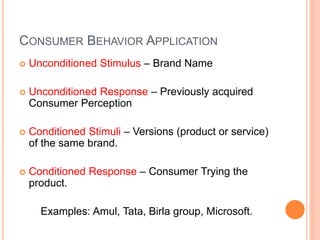
CONSUMER BEHAVIOR APPLICATION
 Unconditioned Stimulus – Brand Name
 Unconditioned Response – Previously acquired
Consumer Perception
 Conditioned Stimuli – Versions (product or service)
of the same brand.
 Conditioned Response – Consumer Trying the
product.
Examples: Amul, Tata, Birla group, Microsoft.
COGNITIVE ASSOCIATIVE LEARNING
 From this viewpoint, classical conditioning is not
reflexive action, but rather the acquisition of new
knowledge.
 Optimal Conditioning – Creating strong association
between the conditioned stimulus(new product from
same brand) and unconditioned stimulus(Brand
name).
HOW IT SHOULD BE DONE:-
 Step 1:- Forward conditioning – CS should precede US.
 Step 2:- Repeated pairing of CS and US.
 Step 3:- CS and US should logically blend together
 Step 4:- CS that is novel and unfamiliar
 Step 5:- US that is biologically or symbolically salient.
This model is called Neo Pavlovian Conditioning
 In Neo Pavlovian theory, consumers are viewed as
Information seekers (who use logical and
perceptual relationship among events). They do
have preconceptions.
 Conditioning is the learning that results from
exposure to relationship among events.
 Exposure creates expectations.
STRATEGIC APPLICATIONS OF CLASSICAL
CONDITIONING
 Repetition
 Stimulus Generalization
 Stimulus Discrimination
REPETITION
 HSBC AD 1
 HSBC AD 2
 More repetition will lead to Advertisement wear out.
 Substantive Variations should be given to
consumers.
 For same products develop two ads stressing two
different attributes in a product.
 Three hit theory: Three repetitions are required
 To make consumer aware of the product/ service.
 To show consumers relevance to the product
 To remind benefits
 Repetition depends on the competitive ads. If more
competitors are there, consumer may forget your
product.
STIMULUS GENERALIZATION
 Learning depends not only by repetition but also on
the ability of individuals to generalize.
 Marketing Applications:-
 Product Line, Form and Category Extensions.
 Family Branding
 Licensing
PRODUCT FORM EXAMPLE
Dove Shampoo and Conditioner, Colgate Paste and
Mouthwash. Laptop and Desktops
PRODUCT LINE EXAMPLE – P&G
PRODUCT CATEGORY EXTENSION
FAMILY BRANDING
LICENSING
STIMULUS DISCRIMINATION
 Opposite to Stimulus Generalization and that
results in the selection of specific stimulus from
among the similar stimulus.
 It’s key in developing positioning strategy. To create
a distinctive image in the minds of the customers
about your product.
PRODUCT DIFFERENTIATION
OPERANT CONDITIONING
 Learning occur through trail and error basis.
 VIDEO.
 According to B.F.Skinner, “Individual learning
occurs in a controlled environment in which
individuals are rewarded for choosing an
appropriate behavior”.
REINFORCEMENT OF BEHAVIOR
 Positive reinforcement – Events that strengthen the
likelihood of a specific response.
 Ex: Using Shampoo – if you feel good, you will buy it
again.
 Negative reinforcement – Unpleasant or Negative
outcome that also serves to encourage a specific
behavior.
 Ex: The Atlantic – Are you missing what is important?
 The Economist – Get a world view.
FEAR APPEAL IN ADS
 VIDEO
 Ads related to toothpaste, mouthwash, headache
use negative reinforcement.
 Punishment should not be confused with negative
reinforcement.
EXTINCTION AND FORGETTING
 Extinction – When a learned response is not longer
reinforced, it diminishes to the point of extinction.
 Eg) UTI bank to Axis bank. Where extinction is highly
necessary.
 Forgetting is often related to passage of time.
 Eg) Visited a restaurant long back.
MARKETING APPLICATIONS
 Customer Satisfaction:
 Relationship Marketing.
 Reinforcement Schedules
 Total ( or Continuous)
 Systematic ( or Fixed Ratio) – every nth time.
 Random (or Variable) – lotteries, sweepstakes, gambling.
 Shaping – Reinforcement performed before the desired
consumer behavior actually takes place.
 Eg) Test drive, Discounts for few products in the showroom
which tends people to buy non discounted products.
MASSED VS DISTRIBUTED LEARNING
OBSERVATIONAL LEARNING
 Also called as Modeling or Vicarious Learning
EXAMPLES OF LEARNING IN DAILY LIFE
 Classical Conditioning – Soap, Paste, Food.
 Operant Conditioning
 Positive reinforcement – Dad buys a cycle for getting
first mark.
 Negative reinforcement – Dad ask you to get good
marks or study well else you will not get good college or
job.
 Punishment – Dad beats you for coming late to home.
 Observational Learning
 You want to wear dress like the hero who comes in the
movie.
COGNITIVE LEARNING THEORIES
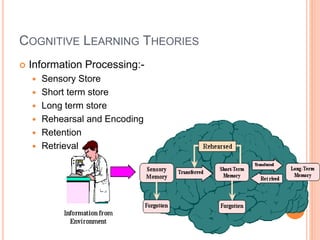
 Information Processing:-
 Sensory Store
 Short term store
 Long term store
 Rehearsal and Encoding
 Retention
 Retrieval
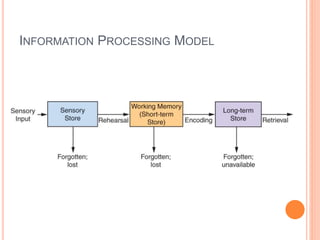
INFORMATION PROCESSING MODEL
SENSORY STORE - EXAMPLES
 Retains in the memory for 2 – 3 seconds.
 Using new soap, paste, advertisement music,
pamphlet, fragrance of a retail shop.
SHORT TERM STORE
 Looking phone number while dialing.
 If the Short term memory does rehearsal then it
reaches Long term memory.
 Transfer process takes 2 – 10 seconds, and lost in
30 seconds if not Rehearsed.
WHICH ONE IS EASY TO LEARN?
MEMORIZE THESE LETTERS IN 15 SECONDS –
ENCODING & CHUNKING EXAMPLE
 BGI TAE LTE GDO ETL
Now try this one,
BIG EAT LET DOG THE
Encoding makes it easy to retain information. ( E in
Dell, McD in McDonald.)
Chunking is recoding the information which was
encoded earlier.
RETENTION
 Information is stored in long-term memory
 Episodically: by the order in which it is acquired
 Semantically: according to significant concepts
 Total package of associations is called a schema
CONSUMER INVOLVEMENT AND PASSIVE LEARNING
 High involvement consumer
 Low involvement consumer
CENTRAL AND PERIPHERAL ROUTES OF
PERSUASION
HEMISPHERIC LATERALIZATION
OUTCOMES AND MEASURES
 Measurement:-
 RECOGNITION TEST– AIDED
 RECALL TEST – UNAIDED
BRAND LOYALTY AND BRAND EQUITY
 Brand loyalty factors:-
 Personal degree of risk aversion or variety seeking
 Brand reputation and availability of substitutes
 Social group influences.
 Loyalty types:
 No loyalty
 Covetous loyalty – no purchase/ strong association
 Inertia loyalty - purchase/ no strong emotional
attachment
 Premium loyalty – high attachment and high purchase
BRAND EQUITY
 Brand equity refers to the value inherent in a well
known brand name.
 Well known brand names are referred to as
Megabrands.
 Co branding – two brand names featured on a
single product.

Consumer learning

  • 1.
  • 2.
     “Learning isdefined as the process by which individuals acquire the purchase and consumption knowledge and experience that they apply to future related behavior”  “It is a relatively permanent change in behavior caused by experience”  Learning is a process. It’s the result of Knowledge or Experience. It serves as the feedback and affects future behavior.  Learning can be intentional or incidental.
  • 3.
    ELEMENTS OF LEARNING Motivation: Unfulfilled needs leads to motivation. Motives serves to stimulated learning.  Cues: Stimulus that directs the motives. Marketers must provides cues that don’t upset their expectation.  Response: How individual react to drive or cue – how they behave – constitute their response.  Reinforcement: Reinforcement increases the likelihood that a specific response will occur in the future as the result of particular cues or stimuli.
  • 4.
    LEARNING THEORIES  BehavioralLearning  Cognitive Learning
  • 5.
    BEHAVIORAL LEARNING THEORIES Classical Conditioning:-  IVAN PAVLOV EXPERIMENT
  • 6.
    DIAGRAMMATIC REPRESENTATION OFCLASSICAL CONDITIONING
  • 7.
    CONSUMER BEHAVIOR APPLICATION Unconditioned Stimulus – Brand Name  Unconditioned Response – Previously acquired Consumer Perception  Conditioned Stimuli – Versions (product or service) of the same brand.  Conditioned Response – Consumer Trying the product. Examples: Amul, Tata, Birla group, Microsoft.
  • 8.
    COGNITIVE ASSOCIATIVE LEARNING From this viewpoint, classical conditioning is not reflexive action, but rather the acquisition of new knowledge.  Optimal Conditioning – Creating strong association between the conditioned stimulus(new product from same brand) and unconditioned stimulus(Brand name).
  • 9.
    HOW IT SHOULDBE DONE:-  Step 1:- Forward conditioning – CS should precede US.  Step 2:- Repeated pairing of CS and US.  Step 3:- CS and US should logically blend together  Step 4:- CS that is novel and unfamiliar  Step 5:- US that is biologically or symbolically salient. This model is called Neo Pavlovian Conditioning
  • 10.
     In NeoPavlovian theory, consumers are viewed as Information seekers (who use logical and perceptual relationship among events). They do have preconceptions.  Conditioning is the learning that results from exposure to relationship among events.  Exposure creates expectations.
  • 11.
    STRATEGIC APPLICATIONS OFCLASSICAL CONDITIONING  Repetition  Stimulus Generalization  Stimulus Discrimination
  • 12.
    REPETITION  HSBC AD1  HSBC AD 2  More repetition will lead to Advertisement wear out.  Substantive Variations should be given to consumers.  For same products develop two ads stressing two different attributes in a product.
  • 13.
     Three hittheory: Three repetitions are required  To make consumer aware of the product/ service.  To show consumers relevance to the product  To remind benefits  Repetition depends on the competitive ads. If more competitors are there, consumer may forget your product.
  • 14.
    STIMULUS GENERALIZATION  Learningdepends not only by repetition but also on the ability of individuals to generalize.  Marketing Applications:-  Product Line, Form and Category Extensions.  Family Branding  Licensing
  • 15.
    PRODUCT FORM EXAMPLE DoveShampoo and Conditioner, Colgate Paste and Mouthwash. Laptop and Desktops
  • 16.
  • 17.
  • 18.
  • 19.
  • 20.
    STIMULUS DISCRIMINATION  Oppositeto Stimulus Generalization and that results in the selection of specific stimulus from among the similar stimulus.  It’s key in developing positioning strategy. To create a distinctive image in the minds of the customers about your product.
  • 21.
  • 22.
    OPERANT CONDITIONING  Learningoccur through trail and error basis.  VIDEO.  According to B.F.Skinner, “Individual learning occurs in a controlled environment in which individuals are rewarded for choosing an appropriate behavior”.
  • 23.
    REINFORCEMENT OF BEHAVIOR Positive reinforcement – Events that strengthen the likelihood of a specific response.  Ex: Using Shampoo – if you feel good, you will buy it again.  Negative reinforcement – Unpleasant or Negative outcome that also serves to encourage a specific behavior.  Ex: The Atlantic – Are you missing what is important?  The Economist – Get a world view.
  • 24.
    FEAR APPEAL INADS  VIDEO  Ads related to toothpaste, mouthwash, headache use negative reinforcement.  Punishment should not be confused with negative reinforcement.
  • 25.
    EXTINCTION AND FORGETTING Extinction – When a learned response is not longer reinforced, it diminishes to the point of extinction.  Eg) UTI bank to Axis bank. Where extinction is highly necessary.  Forgetting is often related to passage of time.  Eg) Visited a restaurant long back.
  • 26.
    MARKETING APPLICATIONS  CustomerSatisfaction:  Relationship Marketing.  Reinforcement Schedules  Total ( or Continuous)  Systematic ( or Fixed Ratio) – every nth time.  Random (or Variable) – lotteries, sweepstakes, gambling.  Shaping – Reinforcement performed before the desired consumer behavior actually takes place.  Eg) Test drive, Discounts for few products in the showroom which tends people to buy non discounted products.
  • 27.
  • 28.
    OBSERVATIONAL LEARNING  Alsocalled as Modeling or Vicarious Learning
  • 29.
    EXAMPLES OF LEARNINGIN DAILY LIFE  Classical Conditioning – Soap, Paste, Food.  Operant Conditioning  Positive reinforcement – Dad buys a cycle for getting first mark.  Negative reinforcement – Dad ask you to get good marks or study well else you will not get good college or job.  Punishment – Dad beats you for coming late to home.  Observational Learning  You want to wear dress like the hero who comes in the movie.
  • 30.
    COGNITIVE LEARNING THEORIES Information Processing:-  Sensory Store  Short term store  Long term store  Rehearsal and Encoding  Retention  Retrieval
  • 31.
  • 32.
    SENSORY STORE -EXAMPLES  Retains in the memory for 2 – 3 seconds.  Using new soap, paste, advertisement music, pamphlet, fragrance of a retail shop.
  • 33.
    SHORT TERM STORE Looking phone number while dialing.  If the Short term memory does rehearsal then it reaches Long term memory.  Transfer process takes 2 – 10 seconds, and lost in 30 seconds if not Rehearsed.
  • 34.
    WHICH ONE ISEASY TO LEARN?
  • 35.
    MEMORIZE THESE LETTERSIN 15 SECONDS – ENCODING & CHUNKING EXAMPLE  BGI TAE LTE GDO ETL Now try this one, BIG EAT LET DOG THE Encoding makes it easy to retain information. ( E in Dell, McD in McDonald.) Chunking is recoding the information which was encoded earlier.
  • 36.
    RETENTION  Information isstored in long-term memory  Episodically: by the order in which it is acquired  Semantically: according to significant concepts  Total package of associations is called a schema
  • 37.
    CONSUMER INVOLVEMENT ANDPASSIVE LEARNING  High involvement consumer  Low involvement consumer CENTRAL AND PERIPHERAL ROUTES OF PERSUASION HEMISPHERIC LATERALIZATION
  • 38.
    OUTCOMES AND MEASURES Measurement:-  RECOGNITION TEST– AIDED  RECALL TEST – UNAIDED
  • 39.
    BRAND LOYALTY ANDBRAND EQUITY  Brand loyalty factors:-  Personal degree of risk aversion or variety seeking  Brand reputation and availability of substitutes  Social group influences.  Loyalty types:  No loyalty  Covetous loyalty – no purchase/ strong association  Inertia loyalty - purchase/ no strong emotional attachment  Premium loyalty – high attachment and high purchase
  • 40.
    BRAND EQUITY  Brandequity refers to the value inherent in a well known brand name.  Well known brand names are referred to as Megabrands.  Co branding – two brand names featured on a single product.