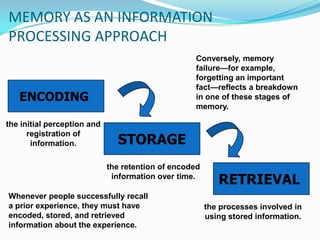
MEMORY AS AN INFORMATION
PROCESSING APPROACH
                                                   Conversely, memory
                                                   failure—for example,
                                                   forgetting an important
                                                   fact—reflects a breakdown
   ENCODING                                        in one of these stages of
                                                   memory.

the initial perception and

                               STORAGE
      registration of
       information.

                             the retention of encoded
                              information over time.
                                                           RETRIEVAL
Whenever people successfully recall
a prior experience, they must have                      the processes involved in
encoded, stored, and retrieved                          using stored information.
information about the experience.
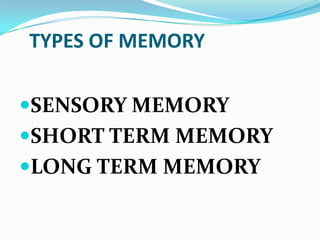
TYPES OF MEMORY

SENSORY MEMORY
SHORT TERM MEMORY
LONG TERM MEMORY
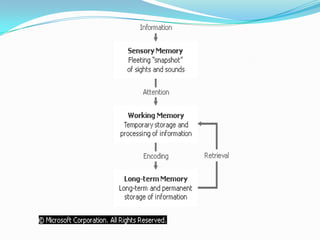
SENSORY MEMORY
 are momentary recordings of information in
  our sensor systems. In fact, most information
  only lasts a few seconds and is replaced with
  something else that captures our attention.
 Recorded from
   Iconic memory – visual
   Echoic memory – auditory
 Transfer to short term memory is controlled by
 attention
SHORT TERM / WORKING MEMORY
 Psychologists originally used the term short-term
  memory to refer to the ability to hold information
  in mind over a brief period of time.
 The term working memory is now commonly used
  to refer to a broader system that both stores
  information briefly and allows manipulation and
  use of the stored information.
 Limited amount of information for a brief period
  of time.
 Roughly seven plus minus two
SHORT TERM / WORKING MEMORY
 Information is held from 15 to 20 seconds and
  if not transferred to long term memory it is
  lost primarily through interference and decay.
 Memories are transferred       to   long   term
  memory through rehearsal.
 If you need to store more, you may be helped
  by the use of CHUNKING, or grouping items
  into categories which will be easier to store
  and to retrieve later. The successful formation
 of a chunk is known as CLOSURE.
LONG TERM MEMORY
 Generally, long-term memory describes a
  system in the brain that can store vast
  amounts of information on a relatively
  enduring basis.
 When you play basketball, remember that
 you had lunch at Jack in the Box
 yesterday, recall your first birthday party at a
 club, play the Wii, or sing your favorite
 song, you draw on information and skills
 stored in long-term memory.
LONG TERM MEMORY
 Holds very large amount of information for long
  periods of time.
 Information in the long term memory become
  relatively permanent.
 Three kinds of Long Term Memory:
    Episodic - refers to memories of specific
     episodes in one’s life and episodic memories
     are connected with a specific time and place.
    Semantic - refers to our general knowledge of
     the world and all of the facts we know
    Procedural - refers to the skills that humans
     possess
THEORIES OF FORGETTING
 Interference Theory – the ability to learn new
  information is disrupted by what we have
  learned before and what we will learn in the
 future.
   Proactive – when previous learning interferes with
    later learning
   Retroactive – when later learning disrupts earlier
    learning
 Decay Theory – if information is not used with
  time, forgetting occurs
 Repression - refers to forgetting an unpleasant
  event or piece of information due to its
  threatening quality.
OTHER CONCEPTS
 Déjà Vu and Jamais Vu
   The sense of déjà vu (French for “seen
    before”) is the strange sensation of having
    been somewhere before, or experienced
    your current situation before, even though
    you know you have not.
   The sense of jamais vu (French for “never
    seen”) arises when people feel they are
    experiencing something for the first
    time, even though they know they must
    have experienced it before.
OTHER CONCEPTS
 Flashbulb memory
    is an unusually vivid memory of an especially
     emotional or dramatic past event.
    May also be associated with vivid emotional
     experiences in one’s own life: the death of a family
     member or close friend, the birth of a baby, being in a
     car accident, and so on.
 Tip-of-the-tongue state.
    Refers to the situation in which a person tries to
     retrieve a relatively familiar word, name, or fact, but
     cannot quite do so.
OTHER CONCEPTS
 Eidetic imagery or photographic memory
   the ability to recall every detail after
    looking at a picture or page for a few
    seconds
   Persons with this unusual form of
    memory must be able to hold visual
    images much longer and form very
    numerous associations in a short time
 Mnemonist
AMNESIA
 Inability to recall information
 Types
   Anterograde    amnesia – inability to
    remember information/ events after the
    accident or brain injury
   Retrograde amnesia – inability to
    remember information/ events that
    occurred prior to the accident
BRAIN DAMAGE & ALZHEIMER’S DISEASE

  Brain Damage
   Tumors, strokes, surgery can produce
   various types of memory impairment
  Alzheimer’s Disease
   A progressive mental deterioration
   that occurs most commonly in old
   age.
IMPROVING MEMORY
 Chunking
 Mnemonic Devices
 Overlearning
 Organization of text materials
 Organization of lecture notes
 Method of Loci
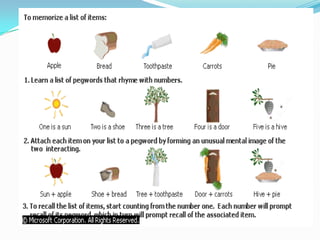
 Peg Word Method
 PQ4R Method -
  Preview, Questions, Read, Reflect, Recite, Review
 Spaced Learning
Memory

Memory

  • 2.
    MEMORY AS ANINFORMATION PROCESSING APPROACH Conversely, memory failure—for example, forgetting an important fact—reflects a breakdown ENCODING in one of these stages of memory. the initial perception and STORAGE registration of information. the retention of encoded information over time. RETRIEVAL Whenever people successfully recall a prior experience, they must have the processes involved in encoded, stored, and retrieved using stored information. information about the experience.
  • 4.
    TYPES OF MEMORY SENSORYMEMORY SHORT TERM MEMORY LONG TERM MEMORY
  • 5.
    SENSORY MEMORY  aremomentary recordings of information in our sensor systems. In fact, most information only lasts a few seconds and is replaced with something else that captures our attention.  Recorded from  Iconic memory – visual  Echoic memory – auditory  Transfer to short term memory is controlled by attention
  • 6.
    SHORT TERM /WORKING MEMORY  Psychologists originally used the term short-term memory to refer to the ability to hold information in mind over a brief period of time.  The term working memory is now commonly used to refer to a broader system that both stores information briefly and allows manipulation and use of the stored information.  Limited amount of information for a brief period of time.  Roughly seven plus minus two
  • 7.
    SHORT TERM /WORKING MEMORY  Information is held from 15 to 20 seconds and if not transferred to long term memory it is lost primarily through interference and decay.  Memories are transferred to long term memory through rehearsal.  If you need to store more, you may be helped by the use of CHUNKING, or grouping items into categories which will be easier to store and to retrieve later. The successful formation of a chunk is known as CLOSURE.
  • 8.
    LONG TERM MEMORY Generally, long-term memory describes a system in the brain that can store vast amounts of information on a relatively enduring basis.  When you play basketball, remember that you had lunch at Jack in the Box yesterday, recall your first birthday party at a club, play the Wii, or sing your favorite song, you draw on information and skills stored in long-term memory.
  • 9.
    LONG TERM MEMORY Holds very large amount of information for long periods of time.  Information in the long term memory become relatively permanent.  Three kinds of Long Term Memory:  Episodic - refers to memories of specific episodes in one’s life and episodic memories are connected with a specific time and place.  Semantic - refers to our general knowledge of the world and all of the facts we know  Procedural - refers to the skills that humans possess
  • 10.
    THEORIES OF FORGETTING Interference Theory – the ability to learn new information is disrupted by what we have learned before and what we will learn in the future.  Proactive – when previous learning interferes with later learning  Retroactive – when later learning disrupts earlier learning  Decay Theory – if information is not used with time, forgetting occurs  Repression - refers to forgetting an unpleasant event or piece of information due to its threatening quality.
  • 11.
    OTHER CONCEPTS  DéjàVu and Jamais Vu  The sense of déjà vu (French for “seen before”) is the strange sensation of having been somewhere before, or experienced your current situation before, even though you know you have not.  The sense of jamais vu (French for “never seen”) arises when people feel they are experiencing something for the first time, even though they know they must have experienced it before.
  • 12.
    OTHER CONCEPTS  Flashbulbmemory  is an unusually vivid memory of an especially emotional or dramatic past event.  May also be associated with vivid emotional experiences in one’s own life: the death of a family member or close friend, the birth of a baby, being in a car accident, and so on.  Tip-of-the-tongue state.  Refers to the situation in which a person tries to retrieve a relatively familiar word, name, or fact, but cannot quite do so.
  • 13.
    OTHER CONCEPTS  Eideticimagery or photographic memory  the ability to recall every detail after looking at a picture or page for a few seconds  Persons with this unusual form of memory must be able to hold visual images much longer and form very numerous associations in a short time  Mnemonist
  • 14.
    AMNESIA  Inability torecall information  Types  Anterograde amnesia – inability to remember information/ events after the accident or brain injury  Retrograde amnesia – inability to remember information/ events that occurred prior to the accident
  • 15.
    BRAIN DAMAGE &ALZHEIMER’S DISEASE  Brain Damage  Tumors, strokes, surgery can produce various types of memory impairment  Alzheimer’s Disease  A progressive mental deterioration that occurs most commonly in old age.
  • 16.
    IMPROVING MEMORY  Chunking Mnemonic Devices  Overlearning  Organization of text materials  Organization of lecture notes  Method of Loci  Peg Word Method  PQ4R Method - Preview, Questions, Read, Reflect, Recite, Review  Spaced Learning