MEMORY
Memory
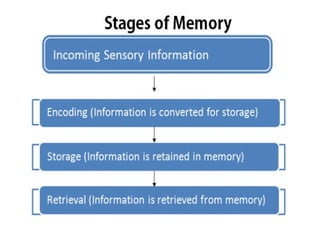
Memory is the process by
which we encode, store, and
retrieve information.
Three-System MemoryTheory
Sensory memory
 Sensory memory the initial, momentary
storage of information, lasting only an
instant
 types are dependent on the source of
sensory information (eidetic memory,
echoic memory)
 can store information for only a very
short time, but its precision is high
 can be destroyed or replaced with a new
one
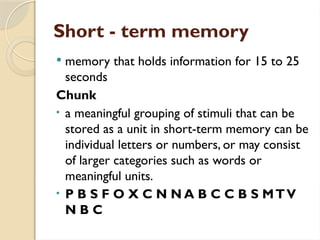
Short - term memory
 memory that holds information for 15 to 25
seconds
Chunk
• a meaningful grouping of stimuli that can be
stored as a unit in short-term memory can be
individual letters or numbers, or may consist
of larger categories such as words or
meaningful units.
• P B S F O X C N N A B C C B S MTV
N B C
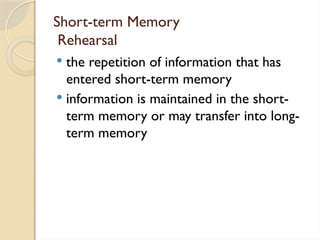
Short-term Memory
Rehearsal
 the repetition of information that has
entered short-term memory
 information is maintained in the short-
term memory or may transfer into long-
term memory
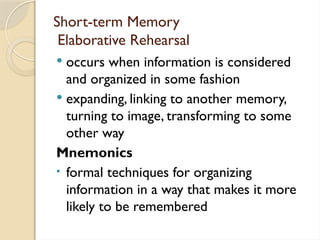
Short-term Memory
Elaborative Rehearsal
 occurs when information is considered
and organized in some fashion
 expanding, linking to another memory,
turning to image, transforming to some
other way
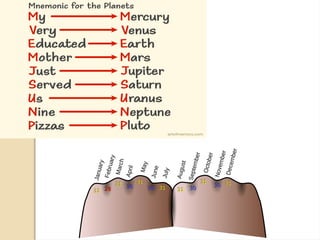
Mnemonics
• formal techniques for organizing
information in a way that makes it more
likely to be remembered
Working Memory
 Some theorists view short - term
memory as a working memory, in which
information is retrieved and manipulated.
In this view, it is a central executive
processor involved in reasoning and
decision- making.
 It is a set of temporary memory stores
that actively manipulate and rehearse
information
Working Memory
3 systems
 visual store (visual and spatial
information)
 verbal store (speech, words, numbers)
 episodic buffer (episodes or events)
 It uses significant amount of cognitive
resources during its operation. In turn, it
makes us less aware of our surrounding
 Gets effected by stress.
Long - term memory
 memory that stores information on a
relatively permanent basis, although it may
be difficult to retrieve
Serial position effect
 the ability to recall information in a list
depends on where in the list an item
appears
 primacy effect: items presented early in
the list are remembered better
 recency effect: items presented late in a
list are remembered.
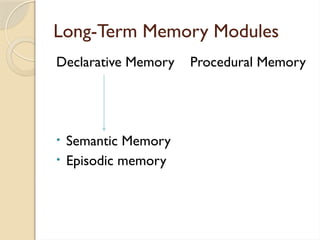
Long-Term Memory Modules
Declarative Memory Procedural Memory
• Semantic Memory
• Episodic memory
Declarative Memory
 Memory for factual information: names,
faces, dates and the like.
 Information about things
1.Semantic Memory
 Memory for general knowledge and facts
about the world as well as memory for
the rules of logic that are used infer other
facts
2. Episodic Memory
 Memory for events that occur in a
particular time, place, or context
 More detailed
Procedural Memory
 Memory for skills and habits, such as
riding a bike or hitting a baseball; also
referred to as non-declarative memory.
 About how to do things.
Semantic Networks
• mental representations of clusters of
interconnected information
•
activating one memory triggers the
activation of related memories
Neuroscience of memory
 Hippocampus: aids in the initial
encoding of information
 Cerebral Cortex: where information is
stored
 Amygdala: involved with memories
involving emotion
Explicit memory
 Memory for information we can readily
express and are aware of having
 This information can be intentionally
recalled
Implicit memory
 Memory for information that we cannot
readily express and may not be aware of
having.
 Cannot be intentionally retrieved
Flashbulb memories
 Vivid memories of dramatic event
 May occur because of strong emotional
content
 Examples: such as 8th
October, September
11 etc.
Recalling Long-Term Memory
Tip-of-the-tongue phenomenon
 The inability to recall information that
one realizes one knows - a result of the
difficulty of retrieving information from
long-term memory.
 Retrieval Cue: is a stimulus that allows
us to recall more easily information that
is in long-term memory
Recall; Recognition
 memory task in which specific
information must be retrieved.
 memory task in which individuals are
presented with a stimulus and asked
whether they have been exposed to it in
the past or to identify it from a list of
alternative.
Levels-of-processingTheory
 emphasizes the degree to which new
material is mentally analyzed
 the amount of information processing
that occurs when material is initially
encountered is central in determining
how much of the information is ultimately
remembered
Levels-of-processingTheory
 Shallow Level: information is processed in
physical and sensory aspects.
 Intermediate Level: information is
translated to meaningful units.
 Deepest Level: information is analyzed in
terms of meaning (wider context,
associations.
 the deeper the initial level of processing of
information is, the longer the information will
be retained
Why We Forget
 Decay: loss of information in memory
because of nonuse
 Interference: the phenomenon by which
information in memory disrupts the recall
of other information
 Cue-dependent forgetting: forgetting
that occurs when there are insufficient
retrieval cues to revive information that is
in memory
The Before and After of Forgetting
 Proactive interference: interference in
which information learned earlier disrupts
the recall of newer material.
 Retroactive interference: interference
in which there is difficulty in the recall of
information learned earlier because of
later exposure to different material.
Memory Dysfunctions
 Alzheimer’s disease: A progressive
brain disorder that heads to a gradual and
irreversible decline in cognitive abilities.
 Amnesia: memory loss that occurs
without other mental difficulties.
 Retrograde amnesia: memory is lost for
occurrences prior to a certain event.
 Anterograde amnesia: memory is lost for
events that follow an injury.
HOW TO IMPROVEYOUR
MEMORY
??????

MEMORY.pptx for psychology students in deep learning

  • 1.
  • 2.
    Memory Memory is theprocess by which we encode, store, and retrieve information.
  • 4.
    Three-System MemoryTheory Sensory memory Sensory memory the initial, momentary storage of information, lasting only an instant  types are dependent on the source of sensory information (eidetic memory, echoic memory)  can store information for only a very short time, but its precision is high  can be destroyed or replaced with a new one
  • 5.
    Short - termmemory  memory that holds information for 15 to 25 seconds Chunk • a meaningful grouping of stimuli that can be stored as a unit in short-term memory can be individual letters or numbers, or may consist of larger categories such as words or meaningful units. • P B S F O X C N N A B C C B S MTV N B C
  • 6.
    Short-term Memory Rehearsal  therepetition of information that has entered short-term memory  information is maintained in the short- term memory or may transfer into long- term memory
  • 7.
    Short-term Memory Elaborative Rehearsal occurs when information is considered and organized in some fashion  expanding, linking to another memory, turning to image, transforming to some other way Mnemonics • formal techniques for organizing information in a way that makes it more likely to be remembered
  • 9.
    Working Memory  Sometheorists view short - term memory as a working memory, in which information is retrieved and manipulated. In this view, it is a central executive processor involved in reasoning and decision- making.  It is a set of temporary memory stores that actively manipulate and rehearse information
  • 10.
    Working Memory 3 systems visual store (visual and spatial information)  verbal store (speech, words, numbers)  episodic buffer (episodes or events)  It uses significant amount of cognitive resources during its operation. In turn, it makes us less aware of our surrounding  Gets effected by stress.
  • 11.
    Long - termmemory  memory that stores information on a relatively permanent basis, although it may be difficult to retrieve
  • 12.
    Serial position effect the ability to recall information in a list depends on where in the list an item appears  primacy effect: items presented early in the list are remembered better  recency effect: items presented late in a list are remembered.
  • 13.
    Long-Term Memory Modules DeclarativeMemory Procedural Memory • Semantic Memory • Episodic memory
  • 14.
    Declarative Memory  Memoryfor factual information: names, faces, dates and the like.  Information about things
  • 15.
    1.Semantic Memory  Memoryfor general knowledge and facts about the world as well as memory for the rules of logic that are used infer other facts
  • 16.
    2. Episodic Memory Memory for events that occur in a particular time, place, or context  More detailed
  • 17.
    Procedural Memory  Memoryfor skills and habits, such as riding a bike or hitting a baseball; also referred to as non-declarative memory.  About how to do things.
  • 18.
    Semantic Networks • mentalrepresentations of clusters of interconnected information • activating one memory triggers the activation of related memories
  • 19.
    Neuroscience of memory Hippocampus: aids in the initial encoding of information  Cerebral Cortex: where information is stored  Amygdala: involved with memories involving emotion
  • 20.
    Explicit memory  Memoryfor information we can readily express and are aware of having  This information can be intentionally recalled
  • 21.
    Implicit memory  Memoryfor information that we cannot readily express and may not be aware of having.  Cannot be intentionally retrieved
  • 22.
    Flashbulb memories  Vividmemories of dramatic event  May occur because of strong emotional content  Examples: such as 8th October, September 11 etc.
  • 23.
    Recalling Long-Term Memory Tip-of-the-tonguephenomenon  The inability to recall information that one realizes one knows - a result of the difficulty of retrieving information from long-term memory.  Retrieval Cue: is a stimulus that allows us to recall more easily information that is in long-term memory
  • 24.
    Recall; Recognition  memorytask in which specific information must be retrieved.  memory task in which individuals are presented with a stimulus and asked whether they have been exposed to it in the past or to identify it from a list of alternative.
  • 25.
    Levels-of-processingTheory  emphasizes thedegree to which new material is mentally analyzed  the amount of information processing that occurs when material is initially encountered is central in determining how much of the information is ultimately remembered
  • 26.
    Levels-of-processingTheory  Shallow Level:information is processed in physical and sensory aspects.  Intermediate Level: information is translated to meaningful units.  Deepest Level: information is analyzed in terms of meaning (wider context, associations.  the deeper the initial level of processing of information is, the longer the information will be retained
  • 27.
    Why We Forget Decay: loss of information in memory because of nonuse  Interference: the phenomenon by which information in memory disrupts the recall of other information  Cue-dependent forgetting: forgetting that occurs when there are insufficient retrieval cues to revive information that is in memory
  • 28.
    The Before andAfter of Forgetting  Proactive interference: interference in which information learned earlier disrupts the recall of newer material.  Retroactive interference: interference in which there is difficulty in the recall of information learned earlier because of later exposure to different material.
  • 29.
    Memory Dysfunctions  Alzheimer’sdisease: A progressive brain disorder that heads to a gradual and irreversible decline in cognitive abilities.  Amnesia: memory loss that occurs without other mental difficulties.  Retrograde amnesia: memory is lost for occurrences prior to a certain event.  Anterograde amnesia: memory is lost for events that follow an injury.
  • 30.