MEMORY
DR HARI RAM SEDAI
1ST
YEAR RESIDENT
PSYCHIATRY/NMCTH
Content
INTRODUCTION
THEORIES OF MEMORY
LONG TERM MEMORY
NEUROANATOMY
FORGETTING
IMPROVING MEMORY
Introduction
• Memory refers to encoding, storage, and retrieval of information
Ryburn 1956
• “The power that we have to store our experiences, and to bring
them back into the filed of consciousness some time after the
experience have occurred ”
Theories of Memory
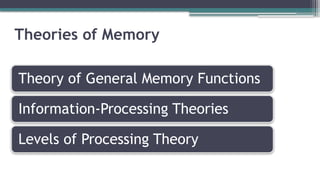
Theory of General Memory Functions
Information-Processing Theories
Levels of Processing Theory
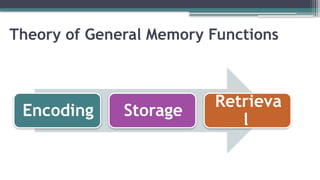
Theory of General Memory Functions
Encoding Storage
Retrieva
l
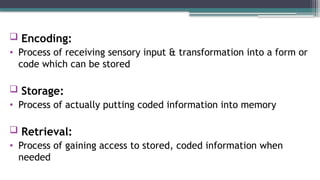
 Encoding:
• Process of receiving sensory input & transformation into a form or
code which can be stored
 Storage:
• Process of actually putting coded information into memory
 Retrieval:
• Process of gaining access to stored, coded information when
needed
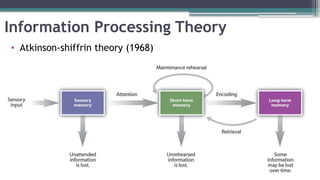
Information Processing Theory
• Atkinson-shiffrin theory (1968)
Sensory Register
• Storage function of sensory channels
• Step that information passes through before reaching STM
• Information can be held for a very brief time
• Most of the information lost
• If we pay attention to and recognize some of information, it is passed to
STM
Visual: Holds for 1 second (Sperling), can hold 11 to 16 items
(Averbach and Sperling), in form of faint image called iconic image
Auditory: Holds for 4-5 seconds (Darwin et al)
Short-Term Memory (STM)
• Hold information for up to 30 seconds
• Storage capacity about 7 items, plus or minus 2 (Miller)
• Increased by process called chunking
• Combining several items into chunk can retain several of these
chunks of information in STM
• Much information stored in STM is lost as it is displaced by
incoming items of information
• Some of information is neither lost nor retrieved but passed into
LTM through rehearsal
Rehearsal
• Keeping of information in centre of attention by repeating them
silently or aloud
• Amount of rehearsal given to items is important in the transfer of
information from STM to LTM (Rundus,1971)
• More the item is rehearsed more likely it is to become a part of
long term memory
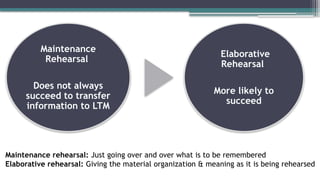
Maintenance
Rehearsal
Does not always
succeed to transfer
information to LTM
Elaborative
Rehearsal
More likely to
succeed
Maintenance rehearsal: Just going over and over what is to be remembered
Elaborative rehearsal: Giving the material organization & meaning as it is being rehearsed
Long-Term Memory
• May last for days, months, years or lifetime
• No known limit for storage capacity
• Contains words, sentences, ideas, concepts and life experiences
• Some theorists believe, there is no true forgetting from LTM
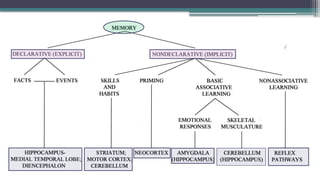
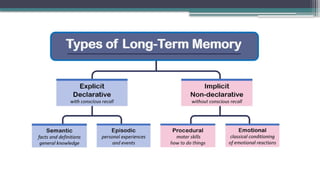
 Types:
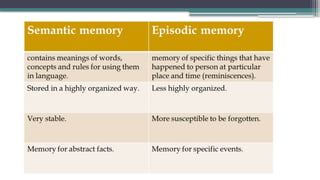
• Semantic: Contains meaning of words, concepts and rules for
using them in language.
• Episodic: Memories of specific things happened to a person
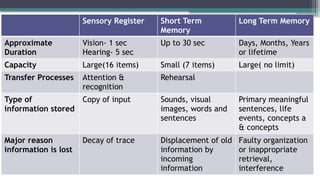
Sensory Register Short Term
Memory
Long Term Memory
Approximate
Duration
Vision- 1 sec
Hearing- 5 sec
Up to 30 sec Days, Months, Years
or lifetime
Capacity Large(16 items) Small (7 items) Large( no limit)
Transfer Processes Attention &
recognition
Rehearsal
Type of
information stored
Copy of input Sounds, visual
images, words and
sentences
Primary meaningful
sentences, life
events, concepts a
& concepts
Major reason
information is lost
Decay of trace Displacement of old
information by
incoming
information
Faulty organization
or inappropriate
retrieval,
interference
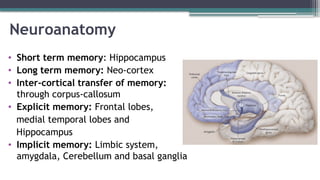
Neuroanatomy
• Short term memory: Hippocampus
• Long term memory: Neo-cortex
• Inter-cortical transfer of memory:
through corpus-callosum
• Explicit memory: Frontal lobes,
medial temporal lobes and
Hippocampus
• Implicit memory: Limbic system,
amygdala, Cerebellum and basal ganglia
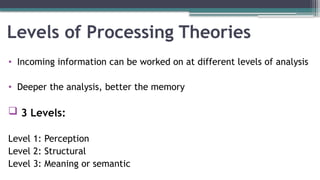
Levels of Processing Theories
• Incoming information can be worked on at different levels of analysis
• Deeper the analysis, better the memory
 3 Levels:
Level 1: Perception
Level 2: Structural
Level 3: Meaning or semantic
• Analysis to deep level of meaning gives best memory
• Many of happenings in our daily routines are not processed
deeply
• Simply repeating information (maintenance rehearsal) not
enough for good memory
• For deeper levels, rehearsal must be at meaning level
(elaborative)
LONG TERM MEMORY
 Organization:
Tip of the tongue (TOT) Phenomenon:
• Described by Brown and McNeil (1966)
• Phenomenon of failing to retrieve a word from memory combined
with partial recall
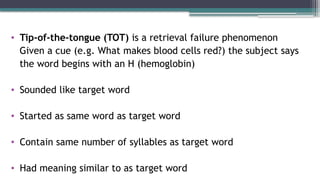
• Tip-of-the-tongue (TOT) is a retrieval failure phenomenon
Given a cue (e.g. What makes blood cells red?) the subject says
the word begins with an H (hemoglobin)
• Sounded like target word
• Started as same word as target word
• Contain same number of syllables as target word
• Had meaning similar to as target word
Types of Long Term Memory
Semantic Memory
Episodic Memory
Semantic Memory
• Consists of knowledge about word’s meaning, their relation to one
another and rules for using them in communication and thinking
• Makes our use of language possible
• Stable, little forgetting of words of our language and rules for
using them
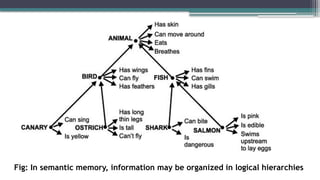
• Some experiments (Collins and Quillian) indicated that information
is stored in logical hierarchies, from general to specific ones
• Makes it possible to make logical inferences from information
stored in semantic memory
Fig: In semantic memory, information may be organized in logical hierarchies
Episodic Memory
• Consists of long-term memories of specific things that happened to
us at particular times and places
• Organized according to dates of significant occurrences in our life
• Less organized, more susceptible to be forgotten than semantic
memory
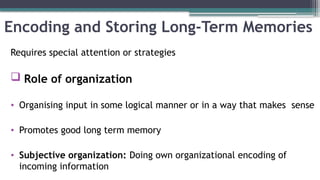
Encoding and Storing Long-Term Memories
Requires special attention or strategies
 Role of organization
• Organising input in some logical manner or in a way that makes sense
• Promotes good long term memory
• Subjective organization: Doing own organizational encoding of
incoming information
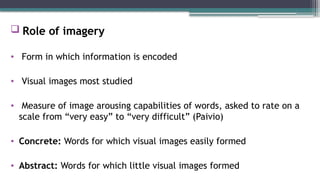
 Role of imagery
• Form in which information is encoded
• Visual images most studied
• Measure of image arousing capabilities of words, asked to rate on a
scale from “very easy” to “very difficult” (Paivio)
• Concrete: Words for which visual images easily formed
• Abstract: Words for which little visual images formed
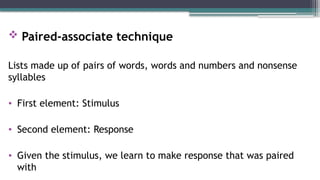
 Paired-associate technique
Lists made up of pairs of words, words and numbers and nonsense
syllables
• First element: Stimulus
• Second element: Response
• Given the stimulus, we learn to make response that was paired
with
 Role of constructive processes
• During encoding, the ‘to be remembered’ information is modified,
so that what is encoded and stored is only the gist or meaning of
complex information
• Inferences are used
Example:
“The driver of the car was seen drinking before he was involved in an
accident”
 Retrieval from long-term memory
• Information coded and stored in LTM, must be retrieved, if it has to
be used
• Retrieval cues and reconstructive processes
• Retrieval cues: is a stimulus, internal or external, that activates
information stored in LTM
 State dependent memory
• Importance of having retrieval cues encoded with to-be-
remembered information
• If people encode and store information in particular emotional or
drugged state, they may not be able to retrieve information when
in another emotional state or no longer under influence of drug
• But when put back into original emotional or drugged state,
memory can be retrieved (Ho el al)
 Reconstructive processes
• Modification of already stored input
• Sometime called confabulation in case of people with memory
disorders who stored very little and try to fill in memory gaps
during retrieval
Forgetting
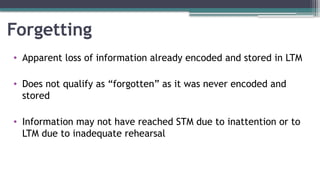
• Apparent loss of information already encoded and stored in LTM
• Does not qualify as “forgotten” as it was never encoded and
stored
• Information may not have reached STM due to inattention or to
LTM due to inadequate rehearsal
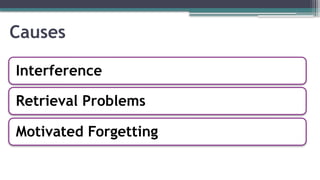
Causes
Interference
Retrieval Problems
Motivated Forgetting
Interference
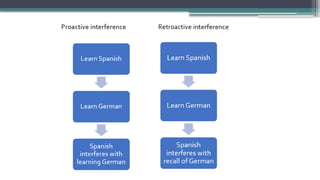
• Proactive interference: Old memories interfere with new learning
• Retroactive interference: New memories interfere with retrieval
of old material
 Retrieval Problems/Cue Dependent Forgetting
• Without appropriate retrieval cues, search for items stored in LTM
may not be found and people tend to forget
• We may give up remembering it but may recall it later while we
are doing something else
• New activity, new situations may give set of appropriate
reminders or retrieval cues
• Emotional factors can play role in retrieval failure
 Motivated Forgetting
• Difficulties in retrieval of unpleasant, anxiety-provoking information
stored in LTM
• Sigmund Freud stated “The forgetting in all cases is proved to be
founded as a motive of displeasure” in his book ”Psychopathology of
Everyday Life”
• Hinted concept of repression
• Repression: Tendency of people to have difficulty retrieving anxiety-
provoking or threatening information
Improving Memory
• Planning a study schedule to stick to.
• Rehearsal –elaborative rehearsal.
• Subjective organization: Making material personally meaningful;
retrieval cues
• Feedback-test
• Reviewing before exam
• Mnemonics
• Numbers and letter peg systems
• Remembering names and faces
• Chunking
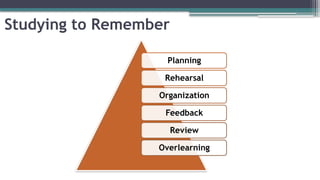
Studying to Remember
Planning
Rehearsal
Organization
Feedback
Review
Overlearning
References
• Introduction to psychology C.T Morgan 7th edition
• General psychology 21st edition, S.K Mangal
• Kaplan & Sadock's comprehensive text book of psychiatry
11th edition

MEMORY

  • 1.
    MEMORY DR HARI RAMSEDAI 1ST YEAR RESIDENT PSYCHIATRY/NMCTH
  • 2.
    Content INTRODUCTION THEORIES OF MEMORY LONGTERM MEMORY NEUROANATOMY FORGETTING IMPROVING MEMORY
  • 3.
    Introduction • Memory refersto encoding, storage, and retrieval of information Ryburn 1956 • “The power that we have to store our experiences, and to bring them back into the filed of consciousness some time after the experience have occurred ”
  • 4.
    Theories of Memory Theoryof General Memory Functions Information-Processing Theories Levels of Processing Theory
  • 5.
    Theory of GeneralMemory Functions Encoding Storage Retrieva l
  • 6.
     Encoding: • Processof receiving sensory input & transformation into a form or code which can be stored  Storage: • Process of actually putting coded information into memory  Retrieval: • Process of gaining access to stored, coded information when needed
  • 7.
    Information Processing Theory •Atkinson-shiffrin theory (1968)
  • 8.
    Sensory Register • Storagefunction of sensory channels • Step that information passes through before reaching STM • Information can be held for a very brief time • Most of the information lost • If we pay attention to and recognize some of information, it is passed to STM
  • 9.
    Visual: Holds for1 second (Sperling), can hold 11 to 16 items (Averbach and Sperling), in form of faint image called iconic image Auditory: Holds for 4-5 seconds (Darwin et al)
  • 10.
    Short-Term Memory (STM) •Hold information for up to 30 seconds • Storage capacity about 7 items, plus or minus 2 (Miller) • Increased by process called chunking • Combining several items into chunk can retain several of these chunks of information in STM
  • 11.
    • Much informationstored in STM is lost as it is displaced by incoming items of information • Some of information is neither lost nor retrieved but passed into LTM through rehearsal
  • 12.
    Rehearsal • Keeping ofinformation in centre of attention by repeating them silently or aloud • Amount of rehearsal given to items is important in the transfer of information from STM to LTM (Rundus,1971) • More the item is rehearsed more likely it is to become a part of long term memory
  • 13.
    Maintenance Rehearsal Does not always succeedto transfer information to LTM Elaborative Rehearsal More likely to succeed Maintenance rehearsal: Just going over and over what is to be remembered Elaborative rehearsal: Giving the material organization & meaning as it is being rehearsed
  • 14.
    Long-Term Memory • Maylast for days, months, years or lifetime • No known limit for storage capacity • Contains words, sentences, ideas, concepts and life experiences • Some theorists believe, there is no true forgetting from LTM
  • 15.
     Types: • Semantic:Contains meaning of words, concepts and rules for using them in language. • Episodic: Memories of specific things happened to a person
  • 16.
    Sensory Register ShortTerm Memory Long Term Memory Approximate Duration Vision- 1 sec Hearing- 5 sec Up to 30 sec Days, Months, Years or lifetime Capacity Large(16 items) Small (7 items) Large( no limit) Transfer Processes Attention & recognition Rehearsal Type of information stored Copy of input Sounds, visual images, words and sentences Primary meaningful sentences, life events, concepts a & concepts Major reason information is lost Decay of trace Displacement of old information by incoming information Faulty organization or inappropriate retrieval, interference
  • 17.
    Neuroanatomy • Short termmemory: Hippocampus • Long term memory: Neo-cortex • Inter-cortical transfer of memory: through corpus-callosum • Explicit memory: Frontal lobes, medial temporal lobes and Hippocampus • Implicit memory: Limbic system, amygdala, Cerebellum and basal ganglia
  • 19.
    Levels of ProcessingTheories • Incoming information can be worked on at different levels of analysis • Deeper the analysis, better the memory  3 Levels: Level 1: Perception Level 2: Structural Level 3: Meaning or semantic
  • 20.
    • Analysis todeep level of meaning gives best memory • Many of happenings in our daily routines are not processed deeply • Simply repeating information (maintenance rehearsal) not enough for good memory • For deeper levels, rehearsal must be at meaning level (elaborative)
  • 22.
    LONG TERM MEMORY Organization: Tip of the tongue (TOT) Phenomenon: • Described by Brown and McNeil (1966) • Phenomenon of failing to retrieve a word from memory combined with partial recall
  • 23.
    • Tip-of-the-tongue (TOT)is a retrieval failure phenomenon Given a cue (e.g. What makes blood cells red?) the subject says the word begins with an H (hemoglobin) • Sounded like target word • Started as same word as target word • Contain same number of syllables as target word • Had meaning similar to as target word
  • 25.
    Types of LongTerm Memory Semantic Memory Episodic Memory
  • 26.
    Semantic Memory • Consistsof knowledge about word’s meaning, their relation to one another and rules for using them in communication and thinking • Makes our use of language possible • Stable, little forgetting of words of our language and rules for using them
  • 27.
    • Some experiments(Collins and Quillian) indicated that information is stored in logical hierarchies, from general to specific ones • Makes it possible to make logical inferences from information stored in semantic memory
  • 28.
    Fig: In semanticmemory, information may be organized in logical hierarchies
  • 29.
    Episodic Memory • Consistsof long-term memories of specific things that happened to us at particular times and places • Organized according to dates of significant occurrences in our life • Less organized, more susceptible to be forgotten than semantic memory
  • 31.
    Encoding and StoringLong-Term Memories Requires special attention or strategies  Role of organization • Organising input in some logical manner or in a way that makes sense • Promotes good long term memory • Subjective organization: Doing own organizational encoding of incoming information
  • 32.
     Role ofimagery • Form in which information is encoded • Visual images most studied • Measure of image arousing capabilities of words, asked to rate on a scale from “very easy” to “very difficult” (Paivio) • Concrete: Words for which visual images easily formed • Abstract: Words for which little visual images formed
  • 33.
     Paired-associate technique Listsmade up of pairs of words, words and numbers and nonsense syllables • First element: Stimulus • Second element: Response • Given the stimulus, we learn to make response that was paired with
  • 34.
     Role ofconstructive processes • During encoding, the ‘to be remembered’ information is modified, so that what is encoded and stored is only the gist or meaning of complex information • Inferences are used Example: “The driver of the car was seen drinking before he was involved in an accident”
  • 35.
     Retrieval fromlong-term memory • Information coded and stored in LTM, must be retrieved, if it has to be used • Retrieval cues and reconstructive processes • Retrieval cues: is a stimulus, internal or external, that activates information stored in LTM
  • 36.
     State dependentmemory • Importance of having retrieval cues encoded with to-be- remembered information • If people encode and store information in particular emotional or drugged state, they may not be able to retrieve information when in another emotional state or no longer under influence of drug • But when put back into original emotional or drugged state, memory can be retrieved (Ho el al)
  • 37.
     Reconstructive processes •Modification of already stored input • Sometime called confabulation in case of people with memory disorders who stored very little and try to fill in memory gaps during retrieval
  • 38.
    Forgetting • Apparent lossof information already encoded and stored in LTM • Does not qualify as “forgotten” as it was never encoded and stored • Information may not have reached STM due to inattention or to LTM due to inadequate rehearsal
  • 39.
  • 40.
    Interference • Proactive interference:Old memories interfere with new learning • Retroactive interference: New memories interfere with retrieval of old material
  • 42.
     Retrieval Problems/CueDependent Forgetting • Without appropriate retrieval cues, search for items stored in LTM may not be found and people tend to forget • We may give up remembering it but may recall it later while we are doing something else • New activity, new situations may give set of appropriate reminders or retrieval cues • Emotional factors can play role in retrieval failure
  • 43.
     Motivated Forgetting •Difficulties in retrieval of unpleasant, anxiety-provoking information stored in LTM • Sigmund Freud stated “The forgetting in all cases is proved to be founded as a motive of displeasure” in his book ”Psychopathology of Everyday Life” • Hinted concept of repression • Repression: Tendency of people to have difficulty retrieving anxiety- provoking or threatening information
  • 44.
    Improving Memory • Planninga study schedule to stick to. • Rehearsal –elaborative rehearsal. • Subjective organization: Making material personally meaningful; retrieval cues • Feedback-test • Reviewing before exam
  • 45.
    • Mnemonics • Numbersand letter peg systems • Remembering names and faces • Chunking
  • 46.
  • 47.
    References • Introduction topsychology C.T Morgan 7th edition • General psychology 21st edition, S.K Mangal • Kaplan & Sadock's comprehensive text book of psychiatry 11th edition

Editor's Notes

  • #7 Memory start with Sesnosry input from environment -vision, hearing, touch Held for brief time in sensory memory seconds in sensory memory/registar STM- held for 20-30s
  • #10 For eg: Mobile number consisting of 10 items, is arranged in 2 chunks. With practice most of can easily hold 3 telephone numbers in STM, i.e 30 items arranged in 6 chunks.
  • #11 For eg: Mobile number consisting of 10 items, is arranged in 2 chunks. With practice most of can easily hold 3 telephone numbers in STM, i.e 30 items arranged in 6 chunks.
  • #12 The more rehearsal the more part of long term memory
  • #13 Maintenance rehearsal, i.e, going over and over what is to be remembered, does not always succeed to transfer information to LTM. Elaborative rehearsal involves giving material organization and meaning as it is being rehearsed, which is active rehearsal process, not just passive process of repetition. Elaborative- rhymes, chunking, mneumonimcs
  • #16  Trace decay theory of forgetting states that - all memories fade automatically as a function of time. you need to follow a certain path, or trace, to recall a memory
  • #17 Medial temporal lobes, anterior thalamic nucleus, mamillary body, fornix forms the core of the episodic memory. Amygdala encodes the emotional aspects of experiences into longer term memories.
  • #18 Priming- where someone who has previously seen the word 'yellow' will be slightly faster to recognise the word 'banana' in a later context
  • #21 These are three levels of processing, elaboration of information and memory. First level is perception, which gives immediate awareness of environment Another deeper level, is level 2, structural, in which structural features of input (what it sounds or looks like) are analysed And finally, at deepest level, level 3- the meaning of input is analyzed. Which gives best memory Amount of information retained is shown by triangle portion.
  • #23 (e.g. What makes blood cells red?) the subject says the word begins with an H (haemoglobin).
  • #41 Proactive interference explains why learning Spanish this year will make it difficult to learn German next year, i.e old memories interferes with new learning Retroactive interference explains why learning Spanish this year makes it difficult to recall German learnt last year, i.e new memories interferes with recall of old learning.
  • #42 We learned somrthing in class room and we forget it later but going back to classroom we tend to remember that word
  • #43 People tend to remember pleasant event more than unpleasent one Freud forget- conversation he had with unliked people, forget location of shop..he had argument with people living there
  • #45 Chunking: Systematic ways of encoding information PEG- For eg: The letter of words PVT TIM HALL can be used as pegs on hang name of essential amino acids
  • #46 1.Plan a study schedule that you can stick to. 2.Rehearsal important for transferring information from STM to LTM. Elaborative rehearsal can be used. Ask yourself what you have just read, what new concepts and terms are, how you relate to other things you know or are learning. 3.Give your own subjective organization to material, providing yourself retrieval cues. 4.Get some feedback. When you finish a chapter, test yourself, do some additional work on weak points. 5.Review before examination 6.After you are satisfied that you know and can remember, go back after few days and learn it again and again.