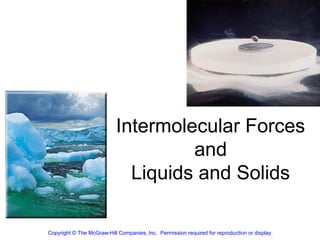
Intermolecular Forces
                                    and
                             Liquids and Solids

Copyright © The McGraw-Hill Companies, Inc. Permission required for reproduction or display.
A phase is a homogeneous part of the system in
contact with other parts of the system but
separated from them by a well-defined boundary.
                                    2 Phases

                                Solid phase - ice

                               Liquid phase - water


                                                      11.1
Intermolecular Forces
Intermolecular forces are attractive forces between molecules.
Intramolecular forces hold atoms together in a molecule.

 Intermolecular vs Intramolecular
 •   41 kJ to vaporize 1 mole of water (inter)
 •   930 kJ to break all O-H bonds in 1 mole of water (intra)

                                “Measure” of intermolecular force
             Generally,
                                           boiling point
             intermolecular
             forces are much               melting point
             weaker than                         ∆Hvap
             intramolecular
                                                 ∆Hfus
             forces.
                                                 ∆Hsub          11.2
Intermolecular Forces

Dipole-Dipole Forces

    Attractive forces between polar molecules

           Orientation of Polar Molecules in a Solid


                                                       11.2
Intermolecular Forces

Ion-Dipole Forces

    Attractive forces between an ion and a polar molecule


                     Ion-Dipole Interaction


                                                            11.2
11.2
Intermolecular Forces
Dispersion Forces

   Attractive forces that arise as a result of temporary
   dipoles induced in atoms or molecules


                                                           11.2
What type(s) of intermolecular forces exist between
       each of the following molecules?


HBr
 HBr is a polar molecule: dipole-dipole forces. There are
 also dispersion forces between HBr molecules.

CH4
 CH4 is nonpolar: dispersion forces.
            S   O
SO2    O
 SO2 is a polar molecule: dipole-dipole forces. There are
 also dispersion forces between SO2 molecules.
                                                             11.2
Intermolecular Forces
Hydrogen Bond
The hydrogen bond is a special dipole-dipole interaction
between they hydrogen atom in a polar N-H, O-H, or F-H bond
and an electronegative O, N, or F atom.
         A    H…B           or        A    H…A
                    A & B are N, O, or F


                                                        11.2
Hydrogen Bond


11.2
Why is the hydrogen bond considered a
“special” dipole-dipole interaction?


               Decreasing molar mass
               Decreasing boiling point


                                          11.2
A crystalline solid possesses rigid and long-range order. In a
crystalline solid, atoms, molecules or ions occupy specific
(predictable) positions.
An amorphous solid does not possess a well-defined
arrangement and long-range molecular order.

A unit cell is the basic repeating structural unit of a crystalline
solid.


        lattice                                    At lattice points:
         point                                     •   Atoms
                                                   •   Molecules
                                                   •   Ions

Unit Cell         Unit cells in 3 dimensions                      11.4
When silver crystallizes, it forms face-centered cubic
       cells. The unit cell edge length is 409 pm. Calculate
       the density of silver.
            m
       d=         V = a3 = (409 pm)3 = 6.83 x 10⁻²³ cm3
            V
       4 atoms/unit cell in a face-centered cubic cell

                 107.9 g     1 mole Ag
m = 4 Ag atoms x         x                  = 7.17 x 10⁻²² g
                 mole Ag 6.022 x 10²³ atoms

          m    7.17 x 10⁻²² g
       d=   =                  = 10.5 g/cm3
          V   6.83 x 10⁻²³ cm3


                                                            11.4
An amorphous solid does not possess a well-defined
arrangement and long-range molecular order.

A glass is an optically transparent fusion product of inorganic
materials that has cooled to a rigid state without crystallizing


               Crystalline         Non-crystalline
              quartz (SiO2)         quartz glass              11.7

Intermolecular Force

  • 1.
    Intermolecular Forces and Liquids and Solids Copyright © The McGraw-Hill Companies, Inc. Permission required for reproduction or display.
  • 2.
    A phase isa homogeneous part of the system in contact with other parts of the system but separated from them by a well-defined boundary. 2 Phases Solid phase - ice Liquid phase - water 11.1
  • 3.
    Intermolecular Forces Intermolecular forcesare attractive forces between molecules. Intramolecular forces hold atoms together in a molecule. Intermolecular vs Intramolecular • 41 kJ to vaporize 1 mole of water (inter) • 930 kJ to break all O-H bonds in 1 mole of water (intra) “Measure” of intermolecular force Generally, boiling point intermolecular forces are much melting point weaker than ∆Hvap intramolecular ∆Hfus forces. ∆Hsub 11.2
  • 4.
    Intermolecular Forces Dipole-Dipole Forces Attractive forces between polar molecules Orientation of Polar Molecules in a Solid 11.2
  • 5.
    Intermolecular Forces Ion-Dipole Forces Attractive forces between an ion and a polar molecule Ion-Dipole Interaction 11.2
  • 6.
  • 7.
    Intermolecular Forces Dispersion Forces Attractive forces that arise as a result of temporary dipoles induced in atoms or molecules 11.2
  • 8.
    What type(s) ofintermolecular forces exist between each of the following molecules? HBr HBr is a polar molecule: dipole-dipole forces. There are also dispersion forces between HBr molecules. CH4 CH4 is nonpolar: dispersion forces. S O SO2 O SO2 is a polar molecule: dipole-dipole forces. There are also dispersion forces between SO2 molecules. 11.2
  • 9.
    Intermolecular Forces Hydrogen Bond Thehydrogen bond is a special dipole-dipole interaction between they hydrogen atom in a polar N-H, O-H, or F-H bond and an electronegative O, N, or F atom. A H…B or A H…A A & B are N, O, or F 11.2
  • 10.
  • 11.
    Why is thehydrogen bond considered a “special” dipole-dipole interaction? Decreasing molar mass Decreasing boiling point 11.2
  • 12.
    A crystalline solidpossesses rigid and long-range order. In a crystalline solid, atoms, molecules or ions occupy specific (predictable) positions. An amorphous solid does not possess a well-defined arrangement and long-range molecular order. A unit cell is the basic repeating structural unit of a crystalline solid. lattice At lattice points: point • Atoms • Molecules • Ions Unit Cell Unit cells in 3 dimensions 11.4
  • 13.
    When silver crystallizes,it forms face-centered cubic cells. The unit cell edge length is 409 pm. Calculate the density of silver. m d= V = a3 = (409 pm)3 = 6.83 x 10⁻²³ cm3 V 4 atoms/unit cell in a face-centered cubic cell 107.9 g 1 mole Ag m = 4 Ag atoms x x = 7.17 x 10⁻²² g mole Ag 6.022 x 10²³ atoms m 7.17 x 10⁻²² g d= = = 10.5 g/cm3 V 6.83 x 10⁻²³ cm3 11.4
  • 14.
    An amorphous soliddoes not possess a well-defined arrangement and long-range molecular order. A glass is an optically transparent fusion product of inorganic materials that has cooled to a rigid state without crystallizing Crystalline Non-crystalline quartz (SiO2) quartz glass 11.7