THE HUMAN
MEMORY
KATE NDERU
SHIKO MWAURA
IRVINE JULIA
BERNARD NYACHIEO
WILLIAM KANGU
ANN MATILDA
MEMORY INTRODUCTION
 Memory is the ability to encode, store and
remember information and past experiences in
the brain.
 Encoding: a process of making mental
representation of information. It can also mean
transferring from short term to long term.
 Storing: Process of placing encoded
information into relatively permanent storage
for later recall.
 Remembering: the process of retrieving what
has been stored in short term or long term
memory.
Intro cont...
 In general terms one can define memory as
the use of past experience to influence or
affect human behaviour.
WHERE MEMORY COMES FROM
 Memory is not located on one particular
part of the brain but instead there is a brain
wide process in which different parts of the
brain work in conjunction with one
another(distributing process).
Intro cont...
 For example: when riding a bicycle,
the whole process is reconstructed by
the brain in different areas.
 The memory of how to operate the
bike comes from one area, the
memory of the street paths comes
from another area, the memory of bike
safety rules in another and the
nervous feeling when almost falling or
being hit comes from another part of
the brain.
DISTRIBUTIVE PROCESS
DIAGRAM
TYPES OF MEMORY
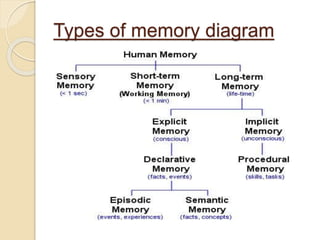
There are three main types of memory.
1) Sensory memory
2) Long term memory
3) Short term memory
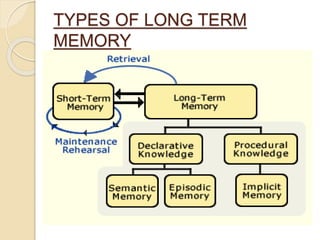
 Unlike the other two types, long type
memory is extensive as it lasts a
lifetime and thus has further sub
divisions as can be seen in the
diagram below:
Types of memory diagram
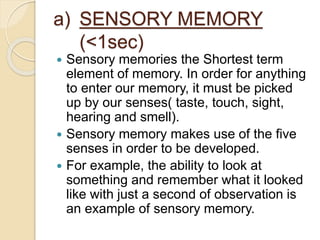
a) SENSORY MEMORY
(<1sec)
 Sensory memories the Shortest term
element of memory. In order for anything
to enter our memory, it must be picked
up by our senses( taste, touch, sight,
hearing and smell).
 Sensory memory makes use of the five
senses in order to be developed.
 For example, the ability to look at
something and remember what it looked
like with just a second of observation is
an example of sensory memory.
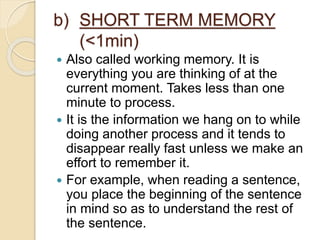
b) SHORT TERM MEMORY
(<1min)
 Also called working memory. It is
everything you are thinking of at the
current moment. Takes less than one
minute to process.
 It is the information we hang on to while
doing another process and it tends to
disappear really fast unless we make an
effort to remember it.
 For example, when reading a sentence,
you place the beginning of the sentence
in mind so as to understand the rest of
the sentence.
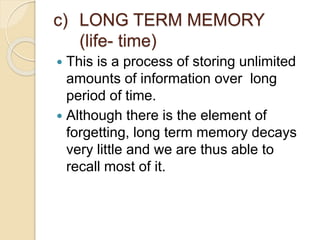
c) LONG TERM MEMORY
(life- time)
 This is a process of storing unlimited
amounts of information over long
period of time.
 Although there is the element of
forgetting, long term memory decays
very little and we are thus able to
recall most of it.
Long term memory cont...
 Short term memories can become
long term memories through the
process of consolidation which
involves rehearsal and meaningful
association.
 Unlike short-term memory (which
relies mostly on an acoustic, and to a
lesser extent a visual, code for storing
information), long-term memory
encodes information for
storage semantically (i.e. based on
meaning and association).
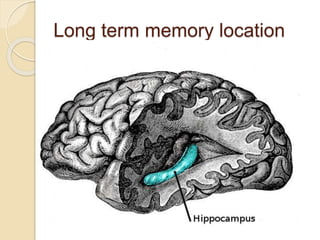
Long term memory location
Characteristics of long term
memory
 It has an unlimited capacity and it is
relatively permanent.
 Chances of retrieval are dependent on
encoding process.
 Its accuracy may be distorted over
time
TYPES OF LONG TERM
MEMORY
a) IMPLICIT
MEMORY(procedural)
 Implicit memory is memory that can be
unconsciously recalled. This is also known as
procedural memory. It is a memory of skills and
how to do things, particularly movement of body
parts and use of objects or machines.
 This is memory acquired through repetition and
practise and is composed of automatic
sensorimeter behaviours that are so deeply
embedded that we are no longer aware of them.
An example is when you teach a child to write
over and over again, eventually it becomes
embedded in him until he is able to do it simply
without thinking so much about it. Other
examples include riding a bike, tying a shoe-lace,
playing the guitar etc.
cont....
 This type of long-term memory allows people
to carry out ordinary motor actions more or
less automatically. This is aided by previous
performances of the task without explicit or
conscious awareness of the previous
experiences, like you do not remember how
you learnt how to hold a spoon or how to tie
your shoe lace, yet now you can do it more
unconsciously.
 Implicit memory is stored and encoded by the
cerebellum, putamen, caudate nucleus
and the motor cortex- all of which are
involved in motor control.
Factors Affecting Implicit Memory
 Stroke
 Depression and stress
 Drug abuse
 Lack of sleep
 Nutritional deficiency
 Head injury
 Medications
b) EXPLICIT(declarative)
 Declarative memory is a type of long
term memory and it is also known as
explicit memory.
 It is in this memory where we store
memories of fact.
 Your ability to recall addresses,
locations of parking garages,
intersection names, phone numbers,
and an experience that you had at a
restaurant are all a part of declarative
memory.
Explicit cont...
 For example: let's say that you know
that your favourite restaurant is only
open until 6 PM on Sundays. The time
that the restaurant closes is stored as
a declarative memory. We can
consciously recall declarative
memory.
Factors Affecting Declarative
Memory.
STRESS
 Through experimentation method,
scholars have been able to detect that
those who are undergoing stress tend
to affect their declarative memory
more than those who are not
undergoing stress.
i. EPISODIC MEMORY
 Episodic memory represents our
memory of experiences and
specific events in time, from which we
can reconstruct the actual events that
took place at any given point in our
lives
 Episodic memory is what enables one
to give an account of an event which
happened and will tend to be different
from someone else's.
EXAMPLES OF EPISODIC
MEMORY
 First day at a new job.
 First movie you watched with your
wife.
 The first time you travelled by plane.
 Your wedding day.
 Your first kiss.
ii. SEMANTIC MEMORY
 Semantic memory includes things that
are common knowledge, such as the
names of colors, the sounds of letters,
the capitals of countries and basic
facts acquired over a life time.
 Semantic memory is the recollection
of facts gathered from the time we are
young
Examples of semantic
memory.
 Knowing that grass is green.
 Knowing how to use scissors.
 Understanding how to put words
together to form a sentence.
 Knowing how to use a phone.
 Recognizing the names of colours.
GENERAL FACTORS
AFFECTING MEMORY.
a. Ability to retain:
 This depends upon good memory traces left
in the brain by past experiences.
b. Good health:
 A person with good health can retain the
learnt material better than a person with poor
health.
c. Age of the learner:
 Youngsters can remember better than the
aged.
d. Maturity:
 Very young children cannot retain and
remember complex material.
Factors cont...
e. Will to remember:
 Willingness to remember helps for better
retention.
f. Intelligence:
 More intelligent person will have better memory
than a dull person,
g. Interest:
 If a person has more interest, he will learn and
retain better.
h. Over learning:
 Experiments have proved that over learning will
lead to better memory.
i. Speed of learning:
 Quicker learning leads to better retention,
Factors cont...
j. Meaningfulness of the material:
 Meaningful materials remain in our
memory for longer period than for
nonsense material,
k. Sleep or rest:
 Sleep or rest immediately after
learning strengthens connections in
the brain and helps for clear memory.
THE END

The human memory

  • 1.
    THE HUMAN MEMORY KATE NDERU SHIKOMWAURA IRVINE JULIA BERNARD NYACHIEO WILLIAM KANGU ANN MATILDA
  • 2.
    MEMORY INTRODUCTION  Memoryis the ability to encode, store and remember information and past experiences in the brain.  Encoding: a process of making mental representation of information. It can also mean transferring from short term to long term.  Storing: Process of placing encoded information into relatively permanent storage for later recall.  Remembering: the process of retrieving what has been stored in short term or long term memory.
  • 3.
    Intro cont...  Ingeneral terms one can define memory as the use of past experience to influence or affect human behaviour. WHERE MEMORY COMES FROM  Memory is not located on one particular part of the brain but instead there is a brain wide process in which different parts of the brain work in conjunction with one another(distributing process).
  • 4.
    Intro cont...  Forexample: when riding a bicycle, the whole process is reconstructed by the brain in different areas.  The memory of how to operate the bike comes from one area, the memory of the street paths comes from another area, the memory of bike safety rules in another and the nervous feeling when almost falling or being hit comes from another part of the brain.
  • 5.
  • 6.
    TYPES OF MEMORY Thereare three main types of memory. 1) Sensory memory 2) Long term memory 3) Short term memory  Unlike the other two types, long type memory is extensive as it lasts a lifetime and thus has further sub divisions as can be seen in the diagram below:
  • 7.
  • 8.
    a) SENSORY MEMORY (<1sec) Sensory memories the Shortest term element of memory. In order for anything to enter our memory, it must be picked up by our senses( taste, touch, sight, hearing and smell).  Sensory memory makes use of the five senses in order to be developed.  For example, the ability to look at something and remember what it looked like with just a second of observation is an example of sensory memory.
  • 9.
    b) SHORT TERMMEMORY (<1min)  Also called working memory. It is everything you are thinking of at the current moment. Takes less than one minute to process.  It is the information we hang on to while doing another process and it tends to disappear really fast unless we make an effort to remember it.  For example, when reading a sentence, you place the beginning of the sentence in mind so as to understand the rest of the sentence.
  • 10.
    c) LONG TERMMEMORY (life- time)  This is a process of storing unlimited amounts of information over long period of time.  Although there is the element of forgetting, long term memory decays very little and we are thus able to recall most of it.
  • 11.
    Long term memorycont...  Short term memories can become long term memories through the process of consolidation which involves rehearsal and meaningful association.  Unlike short-term memory (which relies mostly on an acoustic, and to a lesser extent a visual, code for storing information), long-term memory encodes information for storage semantically (i.e. based on meaning and association).
  • 12.
  • 13.
    Characteristics of longterm memory  It has an unlimited capacity and it is relatively permanent.  Chances of retrieval are dependent on encoding process.  Its accuracy may be distorted over time
  • 14.
    TYPES OF LONGTERM MEMORY
  • 15.
    a) IMPLICIT MEMORY(procedural)  Implicitmemory is memory that can be unconsciously recalled. This is also known as procedural memory. It is a memory of skills and how to do things, particularly movement of body parts and use of objects or machines.  This is memory acquired through repetition and practise and is composed of automatic sensorimeter behaviours that are so deeply embedded that we are no longer aware of them. An example is when you teach a child to write over and over again, eventually it becomes embedded in him until he is able to do it simply without thinking so much about it. Other examples include riding a bike, tying a shoe-lace, playing the guitar etc.
  • 16.
    cont....  This typeof long-term memory allows people to carry out ordinary motor actions more or less automatically. This is aided by previous performances of the task without explicit or conscious awareness of the previous experiences, like you do not remember how you learnt how to hold a spoon or how to tie your shoe lace, yet now you can do it more unconsciously.  Implicit memory is stored and encoded by the cerebellum, putamen, caudate nucleus and the motor cortex- all of which are involved in motor control.
  • 17.
    Factors Affecting ImplicitMemory  Stroke  Depression and stress  Drug abuse  Lack of sleep  Nutritional deficiency  Head injury  Medications
  • 18.
    b) EXPLICIT(declarative)  Declarativememory is a type of long term memory and it is also known as explicit memory.  It is in this memory where we store memories of fact.  Your ability to recall addresses, locations of parking garages, intersection names, phone numbers, and an experience that you had at a restaurant are all a part of declarative memory.
  • 19.
    Explicit cont...  Forexample: let's say that you know that your favourite restaurant is only open until 6 PM on Sundays. The time that the restaurant closes is stored as a declarative memory. We can consciously recall declarative memory.
  • 20.
    Factors Affecting Declarative Memory. STRESS Through experimentation method, scholars have been able to detect that those who are undergoing stress tend to affect their declarative memory more than those who are not undergoing stress.
  • 21.
    i. EPISODIC MEMORY Episodic memory represents our memory of experiences and specific events in time, from which we can reconstruct the actual events that took place at any given point in our lives  Episodic memory is what enables one to give an account of an event which happened and will tend to be different from someone else's.
  • 22.
    EXAMPLES OF EPISODIC MEMORY First day at a new job.  First movie you watched with your wife.  The first time you travelled by plane.  Your wedding day.  Your first kiss.
  • 23.
    ii. SEMANTIC MEMORY Semantic memory includes things that are common knowledge, such as the names of colors, the sounds of letters, the capitals of countries and basic facts acquired over a life time.  Semantic memory is the recollection of facts gathered from the time we are young
  • 24.
    Examples of semantic memory. Knowing that grass is green.  Knowing how to use scissors.  Understanding how to put words together to form a sentence.  Knowing how to use a phone.  Recognizing the names of colours.
  • 25.
    GENERAL FACTORS AFFECTING MEMORY. a.Ability to retain:  This depends upon good memory traces left in the brain by past experiences. b. Good health:  A person with good health can retain the learnt material better than a person with poor health. c. Age of the learner:  Youngsters can remember better than the aged. d. Maturity:  Very young children cannot retain and remember complex material.
  • 26.
    Factors cont... e. Willto remember:  Willingness to remember helps for better retention. f. Intelligence:  More intelligent person will have better memory than a dull person, g. Interest:  If a person has more interest, he will learn and retain better. h. Over learning:  Experiments have proved that over learning will lead to better memory. i. Speed of learning:  Quicker learning leads to better retention,
  • 27.
    Factors cont... j. Meaningfulnessof the material:  Meaningful materials remain in our memory for longer period than for nonsense material, k. Sleep or rest:  Sleep or rest immediately after learning strengthens connections in the brain and helps for clear memory.
  • 28.