Louis
Yasmina Raidan
    Grace
   Jaydeep
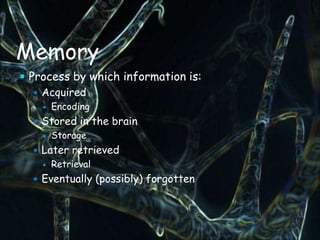
Memory
 Process by which information is:
    Acquired
       Encoding
   Stored in the brain
       Storage
   Later retrieved
       Retrieval
   Eventually (possibly) forgotten
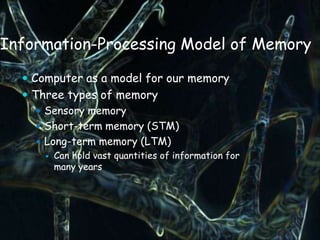
Information-Processing Model of Memory

   Computer as a model for our memory
   Three types of memory
      Sensory memory
      Short-term memory (STM)
      Long-term memory (LTM)
         Can hold vast quantities of information for
          many years
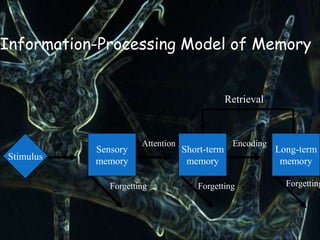
Information-Processing Model of Memory


                                               Retrieval


                      Attention                 Encoding
           Sensory                Short-term               Long-term
Stimulus   memory                  memory                   memory

              Forgetting             Forgetting              Forgetting
Sensory Memory
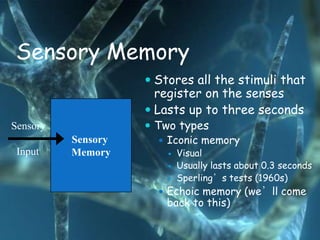
                     Stores all the stimuli that
                      register on the senses
                     Lasts up to three seconds
Sensory              Two types
          Sensory      Iconic memory
 Input    Memory         Visual
                         Usually lasts about 0.3 seconds
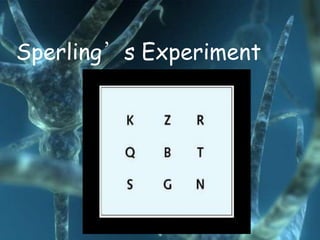
                         Sperling’s tests (1960s)

                       Echoic memory (we’ll come
                        back to this)
Sperling’s Experiment
Sensory Memory
   Echoic memory
      Sensory memory for auditory input that lasts only 2
       to 3 seconds
Why do we need sensory memory?
Short-term Memory
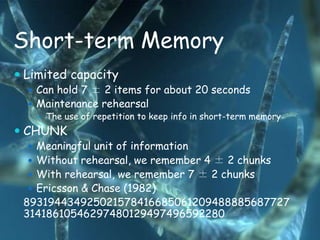
 Limited capacity
   Can hold 7 ± 2 items for about 20 seconds
   Maintenance rehearsal
     The use of repetition to keep info in short-term memory

 CHUNK
   Meaningful unit of information
   Without rehearsal, we remember 4 ± 2 chunks
   With rehearsal, we remember 7 ± 2 chunks
   Ericsson & Chase (1982)
 893194434925021578416685061209488885687727
 31418610546297480129497496592280
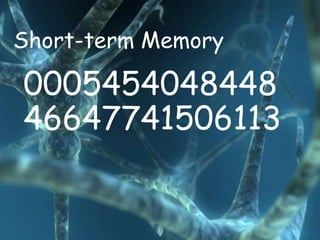
Short-term Memory

0005454048448
46647741506113
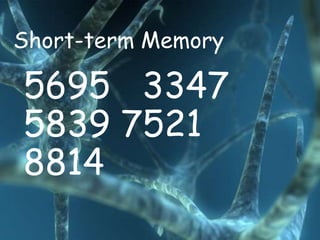
Short-term Memory

5695 3347
5839 7521
8814
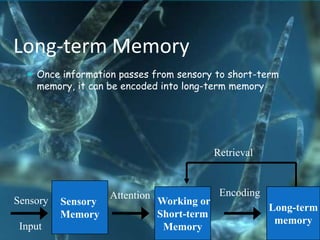
Long-term Memory
   Once information passes from sensory to short-term
    memory, it can be encoded into long-term memory


                                             Retrieval


                    Attention                 Encoding
Sensory   Sensory               Working or
                                                         Long-term
          Memory                Short-term
                                                          memory
 Input                           Memory
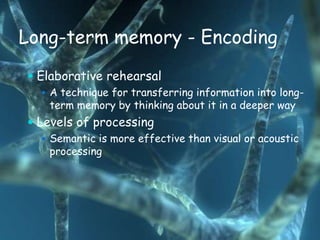
Long-term memory - Encoding
 Elaborative rehearsal
   A technique for transferring information into long-
   term memory by thinking about it in a deeper way
 Levels of processing
   Semantic is more effective than visual or acoustic
   processing
Long-term memory
 Procedural (Implicit)
    Memories of behaviors, skills, etc.
       Demonstrated through behavior
 Declarative (Explicit)
    Memories of facts
       Episodic – personal experiences tied to places & time
       Semantic – general knowledge
Retrieval
  Retrieval
    Process that controls flow of information
      from long-term to working memory store
  Explicit memory
     The types of memory elicited through the
      conscious retrieval of recollections in
      response to direct questions
  Implicit memory
     A nonconscious recollection of a prior
      experience that is revealed indirectly, by its
      effects on performance
Retrieval – Explicit Memory
 Retrieval failure
   Tip-of-the-tongue (Brown & McNeill)
   Retrieval failure is a common experience. Have you
    ever felt as thought a word or name you were trying
    to recall was just out of reach – on the tip of your
    tongue?
Retrieval – Explicit Memory
 Context-Dependent Memory
    We are more successful at retrieving memories if
     we are in the same environment in which we stored
     them

 State-Dependent Memory
    We are more successful at retrieving memories if
     we are in the same mood as when we stored them
Retrieval – Implicit Memory
 Showing knowledge of something without
  recognizing that we know it
 Research with amnesics
 Déjà vu
   The illusion that a new situation is familiar
Forgetting
 Lack of encoding
   Often, we don’t even encode the features
   necessary to ‘remember’ an object/event
 Decay
   Memory traces erode with the passage of time
   No longer a valid theory of forgetting
   Jenkins & Dallenbach (1924)
Forgetting
 Repression
  There are times when we are unable
   to remember painful past events
  While there is no laboratory evidence
   for this, case studies suggest that
   memories
   can be repressed for a
   number of years and
   recovered in therapy
Interference theory
 Forgetting is a result of some
 memories interfering with others
   Proactive interference
     Old memories interfere with ability to
      remember new memories
   Retroactive interference
     New memories interfere with ability to
      remember old memories
   Interference is stronger when material
   is similar
Memory Construction
 Schema theory
 Illusory memories
   People sometimes create memories that are completely false
Improving Memory
 Practice time
    Distribute your studying over time
 Depth of processing
    Spend ‘quality’ time studying
 Verbal mnemonics
    Use rhyming to reduce the amount of info to be stored
Improving Memory
 Interference
   Study right before sleeping & review all the material
    right before the exam
   Allocate an uninterrupted chunk of time to one course
 Context reinstatement
   Try to study in the same environment & mood in which
    you will be taking the exam
Test
Photographic memory
The problem essentially the confusion over
the term and many individuals believe that
a photographic memory is supposed to
present a photographic image in their brain
of the information.
THANK YOU
FOR
LISTENING

Human memory

  • 2.
    Louis Yasmina Raidan Grace Jaydeep
  • 3.
    Memory  Process bywhich information is:  Acquired  Encoding  Stored in the brain  Storage  Later retrieved  Retrieval  Eventually (possibly) forgotten
  • 4.
    Information-Processing Model ofMemory  Computer as a model for our memory  Three types of memory  Sensory memory  Short-term memory (STM)  Long-term memory (LTM)  Can hold vast quantities of information for many years
  • 5.
    Information-Processing Model ofMemory Retrieval Attention Encoding Sensory Short-term Long-term Stimulus memory memory memory Forgetting Forgetting Forgetting
  • 6.
    Sensory Memory  Stores all the stimuli that register on the senses  Lasts up to three seconds Sensory  Two types Sensory  Iconic memory Input Memory  Visual  Usually lasts about 0.3 seconds  Sperling’s tests (1960s)  Echoic memory (we’ll come back to this)
  • 7.
  • 8.
    Sensory Memory  Echoic memory  Sensory memory for auditory input that lasts only 2 to 3 seconds Why do we need sensory memory?
  • 9.
    Short-term Memory  Limitedcapacity  Can hold 7 ± 2 items for about 20 seconds  Maintenance rehearsal  The use of repetition to keep info in short-term memory  CHUNK  Meaningful unit of information  Without rehearsal, we remember 4 ± 2 chunks  With rehearsal, we remember 7 ± 2 chunks  Ericsson & Chase (1982) 893194434925021578416685061209488885687727 31418610546297480129497496592280
  • 10.
  • 11.
  • 12.
    Long-term Memory  Once information passes from sensory to short-term memory, it can be encoded into long-term memory Retrieval Attention Encoding Sensory Sensory Working or Long-term Memory Short-term memory Input Memory
  • 13.
    Long-term memory -Encoding  Elaborative rehearsal  A technique for transferring information into long- term memory by thinking about it in a deeper way  Levels of processing  Semantic is more effective than visual or acoustic processing
  • 14.
    Long-term memory  Procedural(Implicit)  Memories of behaviors, skills, etc.  Demonstrated through behavior  Declarative (Explicit)  Memories of facts  Episodic – personal experiences tied to places & time  Semantic – general knowledge
  • 15.
    Retrieval  Retrieval  Process that controls flow of information from long-term to working memory store  Explicit memory  The types of memory elicited through the conscious retrieval of recollections in response to direct questions  Implicit memory  A nonconscious recollection of a prior experience that is revealed indirectly, by its effects on performance
  • 16.
    Retrieval – ExplicitMemory  Retrieval failure  Tip-of-the-tongue (Brown & McNeill)  Retrieval failure is a common experience. Have you ever felt as thought a word or name you were trying to recall was just out of reach – on the tip of your tongue?
  • 17.
    Retrieval – ExplicitMemory  Context-Dependent Memory  We are more successful at retrieving memories if we are in the same environment in which we stored them  State-Dependent Memory  We are more successful at retrieving memories if we are in the same mood as when we stored them
  • 18.
    Retrieval – ImplicitMemory  Showing knowledge of something without recognizing that we know it  Research with amnesics  Déjà vu  The illusion that a new situation is familiar
  • 19.
    Forgetting  Lack ofencoding  Often, we don’t even encode the features necessary to ‘remember’ an object/event  Decay  Memory traces erode with the passage of time  No longer a valid theory of forgetting  Jenkins & Dallenbach (1924)
  • 20.
    Forgetting  Repression There are times when we are unable to remember painful past events  While there is no laboratory evidence for this, case studies suggest that memories can be repressed for a number of years and recovered in therapy
  • 21.
    Interference theory  Forgettingis a result of some memories interfering with others  Proactive interference  Old memories interfere with ability to remember new memories  Retroactive interference  New memories interfere with ability to remember old memories  Interference is stronger when material is similar
  • 22.
    Memory Construction  Schematheory  Illusory memories  People sometimes create memories that are completely false
  • 23.
    Improving Memory  Practicetime  Distribute your studying over time  Depth of processing  Spend ‘quality’ time studying  Verbal mnemonics  Use rhyming to reduce the amount of info to be stored
  • 24.
    Improving Memory  Interference  Study right before sleeping & review all the material right before the exam  Allocate an uninterrupted chunk of time to one course  Context reinstatement  Try to study in the same environment & mood in which you will be taking the exam
  • 25.
  • 26.
    Photographic memory The problemessentially the confusion over the term and many individuals believe that a photographic memory is supposed to present a photographic image in their brain of the information.
  • 27.