Downloaded 11 times
![Membrane Potentials
Introduction
Without membrane potentials human life would not be possible. All living cells maintain a potential difference across
their membrane. Simply stated, membrane potential is due to disparities in concentration and permeability of
important ions across a membrane. Because of the unequal concentrations of ions across a membrane, the membrane
has an electrical charge. Changes in membrane potential elicit action potentials and give cells the ability to send
messages around the body. More specifically, the action potentials are electrical signals; these signals carry efferent
messages to the central nervous system for processing and afferent messages away from the brain to elicit a specific
reaction or movement. Numerous active transports embedded within the cellular membrane contribute to the creation
of membrane potentials, as well as the universal cellular structure of the lipid bilayer. The chemistry involved in
membrane potentials reaches to many scientific disciplines. Chemically it involves molarity, concentration,
electrochemistry and the Nernst equation. From a physiological standpoint, membrane potential is responsible for
sending messages to and from the central nervous system. It is also very important in cellular biology and shows how
cell biology is fundamentally connected with electrochemistry and physiology. The bottom line is that membrane
potentials are at work in your body right now and always will be as long as you live.
History
The subject of membrane potential stretches across multiple scientific disciplines; Membrane Potential plays a role in
the studies of Chemistry, Physiology and Biology. The culmination of the study of membrane potential came in the
19th and early 20th centuries. Early in the 20th century, a man named professor Bernstein hypothesized that there
were three contributing factors to membrane potential; the permeability of the membrane and the fact that [K+] was
higher inside and lower on the outside of the cell. He was very close to being correct, but his proposal had some
flaws. Walther H. Nernst, notable for the development of the Nernst equation and winner of 1920 Nobel Prize in
chemistry, was a major contributor to the study of membrane potential. He developed the Nernst equation to solve for
the equilibrium potential for a specific ion. Goldman, Hodgkin and Katz furthered the study of membrane potential by
developing the Goldman-Hodgkin-Katz equation to account for any ion that might permeate the membrane and affect
its potential. The study of membrane potential utilizes electrochemistry and physiology to formulate a conclusive idea
of how charges are separated across a membrane.
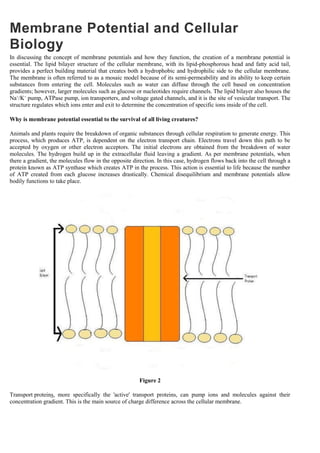
Figure 1. Differences in concentration of ions on opposite sides of a cellular membrane produce a voltage difference
called the membrane potential. The largest contributions usually come from sodium (Na+
) and chloride (Cl–
) ions
which have high concentrations in the extracellular region, and potassium (K+
) ions, which along with large protein
anions have high concentrations in the intracellular region. Calcium ions, which sometimes play an important role, are
not shown.](https://image.slidesharecdn.com/membranepotentials-160613153702/85/Membrane-potentials-1-320.jpg)
![Physiology of Membrane Potential
Understanding Membrane Potential
The following points should help you to understand how membrane potential works
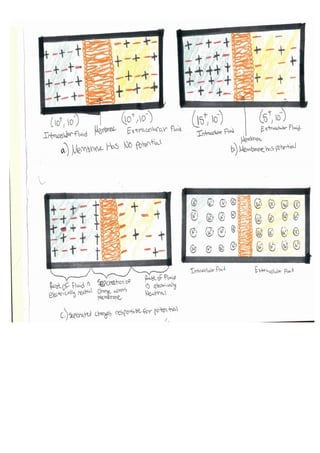
The difference between the electrical and chemical gradient is important.
o Electrical Gradient
Opposes the chemical gradient.
Represents the difference in electrical charge across the membrane
o Chemical Gradient
Opposes the electrical gradient
Represents the difference in the concentration of a specific ion across the membrane.
o A good example is K+
. The membrane is very permeable to K+
and the [K+
] inside the cell is great, therefore a positive
charge is flowing out of the cell along with K+
. The [K+
] inside the cell decreases causing the concentration gradient to
flow towards the outside of the cell. This also causes the inside of the cell to become more electronegative
increasing its electrical gradient.
The Nernst equation can help us relate the numerical values of concentration to the electrical gradient.
Leak Channels
o Channels that are always open
o Permit unregulated flow of ions down an electrochemical gradient.
Na+
/K+
ATPase Pump
o Actively transports Na+
out of the cell and K+
into the cell.
o Helps to maintain the concentration gradient and to counteract the leak channels.
Membrane Potential and Physiology of
Human Nerve Cells
Human nerve cells work mainly on the concept of membrane potentials. They transmit chemicals known as serotonin
or dopamine through gradients. The brain receives these neurotransmitters and uses it to perform functions.
Na+
has a much higher concentration outside of the cell and the cell membrane is very impermeable to Na+
K+
has a high concentration inside the cell due to the fact that the cell membrane is very permeable to K+
A-
is used to refer to large ions that are found completely inside of the cell and cannot penetrate the cell membrane.
Concentration (in Millimoles/ Liter) and permeability of Ions Responsible for Membrane Potential in a
Resting Nerve Cell
ION Extracellular Intracellular Relative Permeability
Na+
150 15 1
K+
5 150 25-30
A-
0 65 0
Check out this YouTube video if you want to know more about how the Na+
/K+
pump and how the membrane
potential works.http://www.youtube.com/watch?v=iA-Gdkje6pg](https://image.slidesharecdn.com/membranepotentials-160613153702/85/Membrane-potentials-3-320.jpg)
![How To Calculate A Membrane Potential
The calculation for the charge of an ion across a membrane, The Nernst Potential, is relatively easy to
calculate. The equation is as follows: (RT/zF) log([X]out/[X]in). RT/F is approximately 61, therefore the
equation can be written as
(61/z) ln([X]out/[X]in)
R is the universal gas constant (8.314 J.K-1
.mol-1
).
T is the temperature in Kelvin (°K = °C + 273.15).
z is the ionic charge for an ion. For example, z is +1 for K+
, +2 for Mg2+
, -1 for F-
, -1 for Cl-
, etc. Remember,
z does not have a unit.
F is the Faraday's constant (96485 C.mol-1
).
[X]out is the concentration of the ion outside of the species. For example the molarity outside of a neuron.
[X]in is the concentration of the ion inside of the species. For example, the molarity inside of a neuron.
The only difference in the Goldman-Hodgkin-Katz equation is that is adds together the concentrations of all
permeable ions as follows
(RT/zF) log([K+
]o+[Na+
]o+[Cl-
]o /[K+
]i+[Na+
]i+[Cl-
]i)](https://image.slidesharecdn.com/membranepotentials-160613153702/85/Membrane-potentials-4-320.jpg)

Membrane potentials are electrical gradients created by differences in ion concentrations across cell membranes. The lipid bilayer structure of cell membranes allows selective permeability of ions like sodium, potassium, and chloride. Active transport of ions against their gradients by proteins like the sodium-potassium pump helps maintain concentration differences and the resulting membrane potential. Membrane potentials allow cells like neurons to transmit electrochemical signals and are essential for processes like cellular respiration that generate energy in living organisms.


