4. Membrane Potential and Action Potential (1).pptx
1.
Action potential andElectrical
Neurotransmission
(Membrane Potential)
Dr. Yousef Sahoury
Pharmacology and
Physiology
2.
Resting Membrane
Potential
• Potassium(K+) is the major cation within cells and sodium (Na+)
dominates the extracellular fluid
• chloride ions (Cl-) mostly remain with Na+ in the extracellular
fluid.
• Phosphate ions and negatively charged proteins are the major
anions of the intracellular fluid.
3.
• The intracellularcompartment contains some anions that do not
have matching cations, giving the cells a net negative charge.
• the extracellular compartment has the cations, giving the ECF a
net positive charge.
• One consequence of this uneven distribution of ions is that the
intracellular and extracellular compartments are not in electrical
equilibrium.
Resting Membrane Potential
4.
• The electricaldisequilibrium that
exists between the extracellular fluid
(ECF) and intracellular fluid (ICF) of
living cells is called the membrane
potential difference (Vm), or
membrane potential
• The membrane potential results from
the uneven distribution of electrical
charge (i.e., ions) between the ECF
and ICF.
Membrane Potential
5.
Creation of aMembrane Potential in an
Artificial System
• To show how a membrane potential difference can arise from ion
concentration gradients and a selectively permeable membrane, we
will use an artificial cell system where we can control the
membrane’s permeability to ions and the composition of the ECF
and ICF.
What creates membrane potential?
1. Ion concentration gradients between the ECF and ICF
2. The selectively permeable cell membrane
6.
1 Creation ofa Membrane Potential in an Artificial
System
• The system is in chemical disequilibrium,
with concentration gradients for all four
ions.
• The cell membrane acts as an insulator to
prevent the free movement of ions between
the ICF and ECF.
7.
2
• The transferof just one K+ from
the cell to the ECF creates an
electrical disequilibrium:
• the ECF has a net positive charge
(+1) while the ICF has a net
negative charge (-1)
• The cell now has a membrane
potential difference, with the
inside of the cell negative relative
to the outside.
Creation of a Membrane Potential in an Artificial
System
Electrochemical Equilibrium
• Forany given concentration gradient
[Ion]out – [Ion]in across a cell
membrane, there is a membrane
potential difference (i.e., electrical
gradient) that exactly opposes ion
movement down the concentration
gradient.
• The cell is at electrochemical
equilibrium: There is no net
movement of ions across the cell
membrane.
10.
Equilibrium Potential
• Forany ion, the membrane potential that exactly opposes a given concentration
gradient is known as the equilibrium potential (Eion).
• To calculate the equilibrium potential for any concentration gradient, we use the
Nernst equation
• The Nernst equation is used for a cell that is freely permeable to only one ion
at a time.
• Living cells have permeability to several ions.
• To calculate the actual membrane potential of cells, we use a multi-ion equation
called the Goldman-Hodgkin-Katz equation
11.
• To measurethis difference, we can place
electrodes in the cell and surrounding fluid
(equivalent to the ECF).
• the ECF would be at +1 and the ICF at −1
• In real life, we cannot measure absolute numbers
of ions, however. Instead, we measure the
difference between the two electrodes. By
convention, the ECF is set at 0 mV (the ground).
This gives the ICF a relative charge of −2.
Measuring Membrane Potential
12.
The Nernst EquationPredicts Membrane Potential for a Single Ion
Two factors influence the membrane potential:
1. The uneven distribution of ions across the cell membrane.
sodium (Na+), chloride (Cl-), and calcium (Ca2+) are more concentrated
in the extracellular fluid than in the cytosol.
Potassium (K+) is more concentrated in the cytosol than in the
extracellular fluid.
2. Differing membrane permeability to those ions.
The resting cell membrane is much more permeable to K+ than to Na+
or Ca2+.
This makes K+ the major ion contributing to the resting membrane
potential.
13.
• For anygiven ion concentration
gradient, this membrane potential is
called the equilibrium potential of the
ion (Eion)=
where:
61 is 2.303 RT/F at 37 °C
z is the electrical charge on
the ion (+1 for K+)
[ion]out and [ion]in are the
ion concentrations outside
and inside the cell.
R is the ideal gas constant
T is absolute temperature,
F is the Faraday constant
The Nernst Equation
14.
The equilibriumpotential for potassium (EK) is (-90 mV)
The equilibrium potential for Sodium (ENa) is (+ 60 mV)
The Nernst Equation
15.
The GHK EquationPredicts Membrane Potential
Using Multiple Ions
• The Goldman-Hodgkin-Katz (GHK) equation calculates the membrane
potential that results from the contribution of all ions that can cross the
membrane.
• The GHK equation includes membrane permeability values
• If the membrane is not permeable to a particular ion, that ion does not
affect the membrane potential.
• For mammalian cells, we assume that Na+, K+, and Cl- are the three ions
that influence membrane potential in resting cells.
16.
P is therelative permeability of the membrane to the ion
The GHK Equation
• The GHK equation for cells that are permeable to Na+, K+,
and Cl-
• Cell has a resting membrane potential of -70 mV.
• Most cells are about 40 times more permeable to K than to
Na.
• As a result, a cell resting membrane potential is closer to the
EK of -90 mV than to the ENa of +60 mV.
• Na+ and K+ are leaked promptly and pumped back by the
Na–K ATPase that helps maintain the electrical gradient.
• If themembrane suddenly increases its Na+
permeability, Na+ enters the cell, moving
down its electrochemical gradient
• The addition of positive Na+ to the
intracellular fluid depolarizes the cell
membrane and creates an electrical signal.
• A return to the resting membrane potential is
termed repolarization
• If the cell membrane suddenly becomes more
permeable to K+, positive charge is lost from
inside the cell, and the cell becomes more
negative (hyperpolarizes)
Membrane potential
The membrane potential (Vm) begins at a
steady resting value of -70 mV
19.
• Graded potentialsin neurons are depolarizations or hyperpolarizations that
occur in the dendrites and cell body
• These changes in membrane potential are called “graded” because of their
size, or amplitude
Directly proportional to the strength of the triggering event:
A large stimulus causes a strong graded potential
small stimulus results in a weak graded potential
Graded Potentials
20.
Graded Potentials
• Gradedpotentials occur when chemical signals from other neurons open
chemically gated ion channels, allowing ions to enter or leave the neuron.
• Graded potentials may also occur when an open channel closes.
For example, if K+ leak channels close, fewer K+ leave the cell. The
retention of K+ depolarizes the cell.
• The positive charge carried in by the Na+ spreads as a wave of
depolarization through the cytoplasm
• The wave of depolarization that moves through the cell is known as local
current flow.
21.
• The strengthof the initial
depolarization in a graded
potential is determined by
how much charge enters the
cell
• If more Na+ channels open,
more Na+ enters, and the
graded potential has a higher
initial amplitude.
Graded Potentials
22.
Why do gradedpotentials lose strength as they move through the
cytoplasm?
1. Current leak:
The membrane of the neuron cell body has open leak channels that allow
positive charge to leak out
into the extracellular fluid.
2. Cytoplasmic resistance:
The cytoplasm provides resistance to the flow of electricity
The combination of the current leak and cytoplasmic resistance means
that the strength of the signal inside the cell decreases over distance.
Graded Potentials
24.
• The triggerzone is the integrating center of the neuron and
contains a high concentration of voltage-gated Na+ channels in
its membrane.
• If graded potentials reach the trigger zone depolarize the
membrane to the threshold voltage, voltage-gated Na+ channels
open, and an action potential begins.
• If the depolarization does not reach the threshold, the graded
potential dies out as it moves into the axon.
Graded Potentials
25.
• Depolarizing gradedpotentials are considered to be
excitatory.
• A hyperpolarizing graded potential moves the membrane
potential farther from the threshold value, making the neuron
less likely to fire an action potential.
• Hyperpolarizing graded potentials are considered to be
inhibitory.
Graded Potentials
27.
Action Potentials(AP)
• (AP)known as spikes, are electrical signals of uniform strength that
travel from a neuron’s trigger zone to the end of its axon.
• In action potentials, voltage-gated ion channels in the axon membrane
open sequentially as electrical current passes down the axon.
• Action potentials are sometimes called all-or-none phenomena:
they either occur as a maximal depolarization (if the stimulus reaches the
threshold) or do not occur at all (if the stimulus is below the threshold).
28.
• The strengthof the graded
potential that initiates an action
potential has no influence on the
amplitude of the action potential.
• In an action potential, a wave of
electrical energy moves down the
axon.
• Action potentials are replenished
along the way so that they maintain
constant amplitude.
Action Potentials
Rising Phase ofthe Action Potential
• The rising phase is due to a sudden temporary increase in the cell’s
permeability to Na+
• An action potential begins when a graded potential reaching the trigger
zone depolarizes the membrane to the threshold (−55 mV).
• As the cell depolarizes, voltage-gated Na+ channels open, making the
membrane much more permeable to Na+.
• Na+ then flows into the cell, down its concentration gradient, and is
attracted by the negative membrane potential inside the cell.
31.
• The cellmembrane potential becomes positive, and the electrical
driving force moving Na+ into the cell disappears.
• The membrane potential moves toward the Na+ equilibrium
potential (ENa) of +60 mV.
• The action potential peaks at +30 mV when Na+ channels in the
axon close and potassium channels open.5
Rising Phase of the Action Potential
32.
Falling Phase ofthe Action Potential
• The falling phase corresponds to an increase in K+ permeability.
• Voltage-gated K+ channels open in response to depolarization.
• the K+ channels open, the membrane potential of the cell has reached +30
mV
• At a positive membrane potential, the concentration and electrical gradients
for K+ favor the movement of K+ out of the cell.
• As K+ moves out of the cell, the membrane potential rapidly becomes more
negative, creating the falling phase of the action potential
33.
Falling Phase ofthe Action Potential
• K+ continues to leave the cell through both voltage-gated and K+ leak
channels, and the membrane hyperpolarizes, approaching the EK of −90
mV. This after-hyperpolarization
• Retention of K+ and leak of Na+ into the axon bring the membrane potential
back to −70 mV
The influx (movement into the cell) of Na+ depolarizes the cell
K+ efflux (movement out of the cell), which restores the cell to the resting
membrane potential.
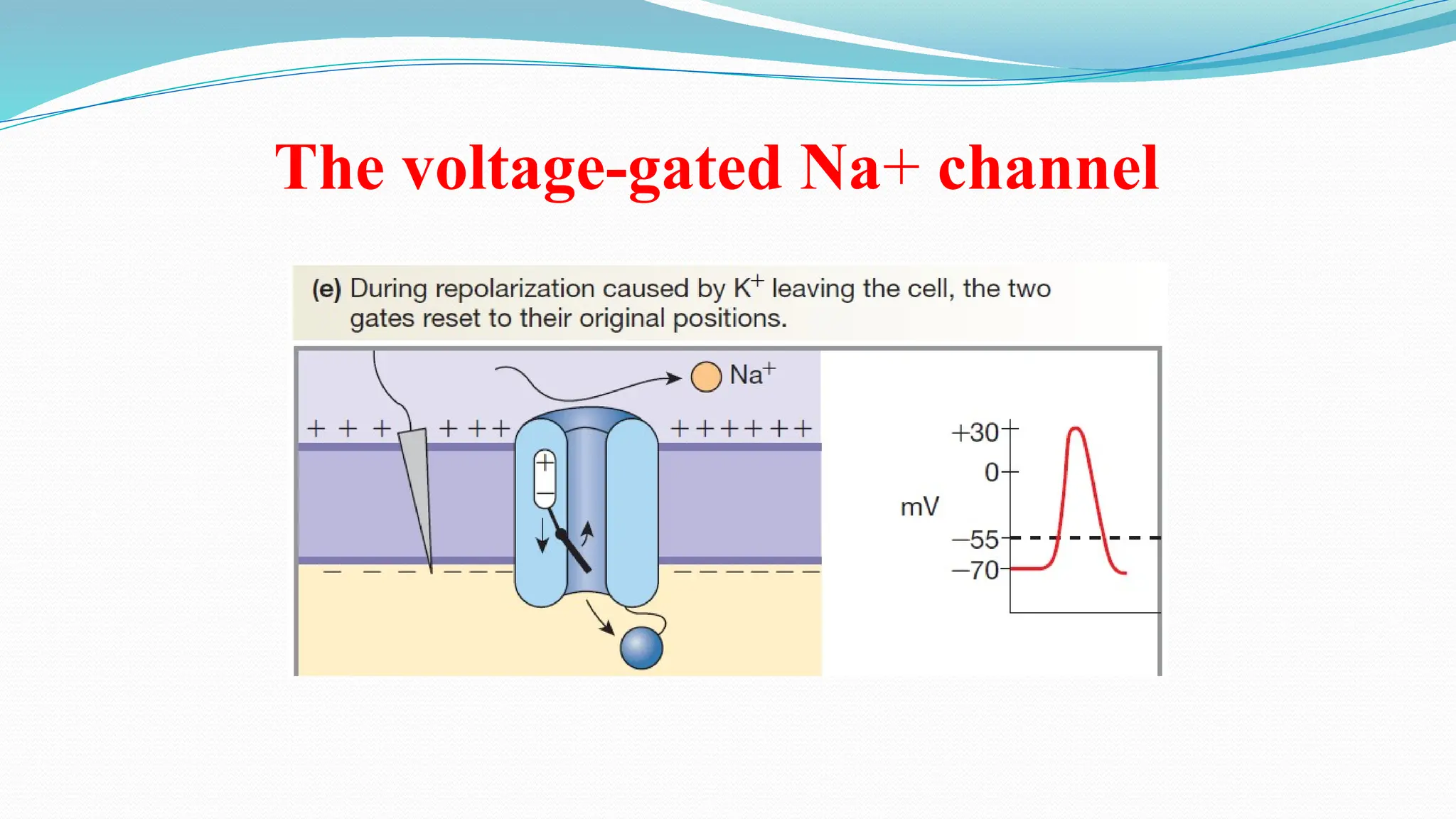
Axonal Na+ ChannelsHave Two Gates
• How the voltage-gated Na+ channels could close at the peak of the
action potential when the cell was depolarized?
• Why should these channels close when depolarization was the
stimulus for Na+ channel opening?
• These voltage-gated Na+ channels have two gates to regulate ion
movement rather than a single gate.
• The two gates, known as activation and inactivation gates
Positive
Feedback
• starts thepositive feedback loop: depolarization opens Na+ channels→ Na+ enters →
causing more depolarization and opening more Na+ channels in the adjacent membrane
39.
• A secondaction potential cannot be triggered for about 1–2 msec, a second
action potential cannot occur before the first has finished.
• This delay, called the absolute refractory period, represents the time
required for the Na+ channel gates to reset to their resting positions
• Action potentials moving from the trigger zone to the axon terminal cannot
overlap and cannot travel backward.
• A relative refractory period follows the absolute refractory period.
Some but not all Na+ channel gates have reset to their original positions.
K+ channels are still open.
Absolute and Relative Refractory Period
Action Potentials AreConducted
• AP can travel over long distances of a meter or more without losing energy, a process
known as conduction.
• The action potential that reaches the end of an axon is identical to the action potential that
started at the trigger zone.
• The depolarization of a section of axon causes positive current to spread through the
cytoplasm in all directions by local current flow
• The local current flow in the cytoplasm diminishes over distance as energy dissipates.
• Forward current flow down the axon would eventually die out were it not for voltage-
gated channels.
• The axon is well supplied with voltage-gated Na+ channels.
42.
Action Potentials Faster
•Two parameters influence the speed of action potential conduction in a mammalian
neuron:
1. the diameter of the axon
2. the resistance of the axon membrane to ion leakage out of the cell.
• The larger the diameter of the axon or the more leak-resistant the membrane, the
faster an action potential will move.
• The unmyelinated axon has low resistance to current leak because the entire axon
membrane is in contact with the extracellular fluid and it has ion channels through
which current can leak.
• Myelinated axons limit the amount of membrane in contact with the extracellular fluid.
• The myelinsheath creates a high-resistance wall preventing ion flow from the
cytoplasm.
• Action potential passes through alternating regions of myelinated axon and nodes of
Ranvier
• Each node has a high concentration of voltage-gated Na+ channels, which open with
depolarization and allow Na+ into the axon.
• Sodium ions entering a node reinforce the depolarization and restore the amplitude of
the action potential
• The apparent jump of the action potential from node to node is called saltatory
conduction
Conduction of action potentials
45.
• In unmyelinatedaxons, channels must open sequentially all the way down the axon
membrane to maintain the amplitude of the action potential.
• In myelinated axons only the nodes need Na+ channels because of the insulating
properties of the myelin membrane.
• As the action potential passes along myelinated segments, conduction is not slowed by
channel opening.
• Saltatory conduction thus is an effective alternative to large-diameter axons and allows
rapid action potentials through small axons.
• A myelinated axon 10 μm in diameter conducts action potentials at the same speed as
an unmyelinated 500-μm axon.
Conduction of action potentials
• In unmyelinatedaxons:
channels must open sequentially all the way down the axon membrane
to maintain the amplitude of the action potential.
• In myelinated axons:
only the nodes need Na+ channels because of the insulating properties of
the myelin membrane.
As the action potential passes along myelinated segments, conduction is
not slowed by channel opening.
What makes conduction more rapid in myelinated
axons?
50.
Chemical Factors AlterElectrical Activity
• The concentration of K+ in the blood and interstitial fluid is the major determinant of the resting
potential of all cells
• At normal K+ levels, subthreshold graded potentials do not trigger action potentials
• An increase in blood K+ concentration hyperkalemia shifts the resting membrane potential of a
neuron closer to the threshold and causes the cells to fire action potentials in response to smaller
graded potentials
• If blood K+ concentration hypokalemia resting membrane potential of the cells hyperpolarizes,
moving farther from the threshold.
• This condition shows up as muscle weakness because the neurons that control skeletal muscles
are not firing normally.
• When people sweat excessively, causing hypokalemia.


![Electrochemical Equilibrium
• For any given concentration gradient
[Ion]out – [Ion]in across a cell
membrane, there is a membrane
potential difference (i.e., electrical
gradient) that exactly opposes ion
movement down the concentration
gradient.
• The cell is at electrochemical
equilibrium: There is no net
movement of ions across the cell
membrane.](https://image.slidesharecdn.com/4-250213174923-bcab354c/75/4-Membrane-Potential-and-Action-Potential-1-pptx-9-2048.jpg)


![• For any given ion concentration
gradient, this membrane potential is
called the equilibrium potential of the
ion (Eion)=
where:
61 is 2.303 RT/F at 37 °C
z is the electrical charge on
the ion (+1 for K+)
[ion]out and [ion]in are the
ion concentrations outside
and inside the cell.
R is the ideal gas constant
T is absolute temperature,
F is the Faraday constant
The Nernst Equation](https://image.slidesharecdn.com/4-250213174923-bcab354c/75/4-Membrane-Potential-and-Action-Potential-1-pptx-13-2048.jpg)