Chromosomal Crossing
Over
Name- Soumili Paul
1st year, M.Sc Marine Biology
Department of Marine and Coastal Studies
Madurai Kamaraj University
Crossing Over
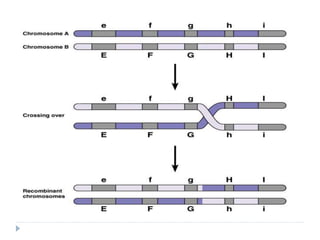
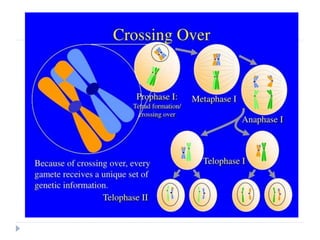
 Crossing over, as related to Genetics refers to the
exchange of DNA between paired homologous
chromosomes ( one from each parent) that occurs
during the development of eggs and sperm cells i.e
Meiosis.
 It produces new combinations (re-combinations) of
genes by inter-chanching and exchanging of
corresponding segments between non-sister
chromatids of homologous chromosomes.
 It occurs between prophase-1 and metaphase-1.
 Frequency of crossing over of a given pair of genes
is not constant.
 Crossing over frequencies are higher in the female
sex than in males.
 Temperature, nutrition, sex, age, etc. influence
crossing over.
 It is a part of meiotic mechanism during
Gametogenesis.
 Brings about variation and leads to evolution through
natural selection.
Mechanism of Crossing Over
 Crossing over, leading to recombination of linked
genes, is due to interchange of sections of
homologous chromosomes.
 At meiosis, the homologous chromosomes come
together and pair, or synapse, during prophase.
 The pairing is remarkably precise and is evidently
brought about by mutual attraction of the parts of the
chromosomes that are similar or homologous
because they contain allellic genes.
Types of Crossing Over
Somatic crossing over Meiotic crossing over
 Pairing of homologous
chromosomes occurs in
meiotic cells but some
times in somatic cells.
 Somatic crossing over
is reported in
Drosophilla by Curt
Stern(1935).
 It occurs rarely.
 This type of crossing
over takes place in
germinal cells during
gametogenesis.
Kinds of Crossing Over
 Single Crossing Over:
 In this type of crossing over only one chiasma is formed
all along the length of a chromosome pair. Gametes
formed by this type of crossing over are called Single
Crossing Over gametes.
 * chiasma- the point where two homologous non-sister
chromatids exchange genetic material during
chromosomal crossover in meiosis.
 Double Crossing Over:
 In this type two chiasmata are formed along the entire
length of the chromosome leading to breakage and rejoin
of chromatids at two point. The gametes produced
produced are Double Crossing Over gametes.
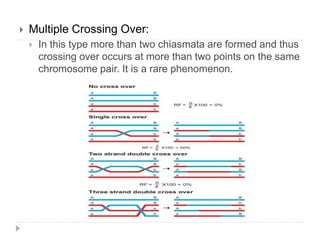
 Multiple Crossing Over:
 In this type more than two chiasmata are formed and thus
crossing over occurs at more than two points on the same
chromosome pair. It is a rare phenomenon.
What is the function of Crossing
Over?
 In species that reproduce sexually, offsprings are
genetically distinct from their parents because they
inherit genetic materials from both.
 Such genetic diversity is the product of meiosis, a
type of cellular division that creates reproductive
cells from the parent cells.
 The paired chromosomes can exchange segments
of DNA via, a mechanism called Crossing over.
Thank you!!

Chromosomal Crossing Over.pptx

  • 1.
    Chromosomal Crossing Over Name- SoumiliPaul 1st year, M.Sc Marine Biology Department of Marine and Coastal Studies Madurai Kamaraj University
  • 2.
    Crossing Over  Crossingover, as related to Genetics refers to the exchange of DNA between paired homologous chromosomes ( one from each parent) that occurs during the development of eggs and sperm cells i.e Meiosis.  It produces new combinations (re-combinations) of genes by inter-chanching and exchanging of corresponding segments between non-sister chromatids of homologous chromosomes.  It occurs between prophase-1 and metaphase-1.
  • 4.
     Frequency ofcrossing over of a given pair of genes is not constant.  Crossing over frequencies are higher in the female sex than in males.  Temperature, nutrition, sex, age, etc. influence crossing over.  It is a part of meiotic mechanism during Gametogenesis.  Brings about variation and leads to evolution through natural selection.
  • 6.
    Mechanism of CrossingOver  Crossing over, leading to recombination of linked genes, is due to interchange of sections of homologous chromosomes.  At meiosis, the homologous chromosomes come together and pair, or synapse, during prophase.  The pairing is remarkably precise and is evidently brought about by mutual attraction of the parts of the chromosomes that are similar or homologous because they contain allellic genes.
  • 7.
    Types of CrossingOver Somatic crossing over Meiotic crossing over  Pairing of homologous chromosomes occurs in meiotic cells but some times in somatic cells.  Somatic crossing over is reported in Drosophilla by Curt Stern(1935).  It occurs rarely.  This type of crossing over takes place in germinal cells during gametogenesis.
  • 8.
    Kinds of CrossingOver  Single Crossing Over:  In this type of crossing over only one chiasma is formed all along the length of a chromosome pair. Gametes formed by this type of crossing over are called Single Crossing Over gametes.  * chiasma- the point where two homologous non-sister chromatids exchange genetic material during chromosomal crossover in meiosis.  Double Crossing Over:  In this type two chiasmata are formed along the entire length of the chromosome leading to breakage and rejoin of chromatids at two point. The gametes produced produced are Double Crossing Over gametes.
  • 9.
     Multiple CrossingOver:  In this type more than two chiasmata are formed and thus crossing over occurs at more than two points on the same chromosome pair. It is a rare phenomenon.
  • 10.
    What is thefunction of Crossing Over?  In species that reproduce sexually, offsprings are genetically distinct from their parents because they inherit genetic materials from both.  Such genetic diversity is the product of meiosis, a type of cellular division that creates reproductive cells from the parent cells.  The paired chromosomes can exchange segments of DNA via, a mechanism called Crossing over.
  • 11.