Developmental BiologyDevelopmental Biology
An IntroductionAn Introduction
Animal DevelopmentAnimal Development
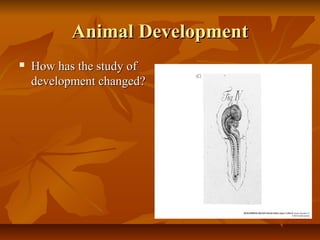
 How has the study ofHow has the study of
development changed?development changed?
Animal DevelopmentAnimal Development
What kinds of questions areWhat kinds of questions are
developmental biologists asking?developmental biologists asking?
Animal DevelopmentAnimal Development
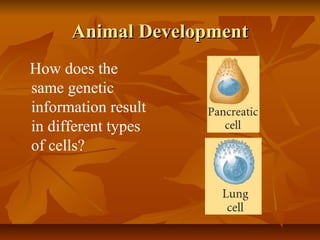
How does the
same genetic
information result
in different types
of cells?
Animal DevelopmentAnimal Development
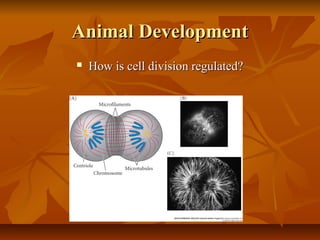
 How is cell division regulated?How is cell division regulated?
Animal DevelopmentAnimal Development
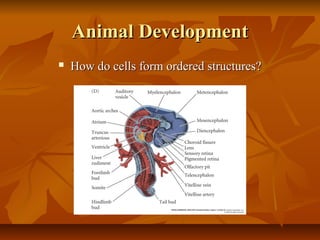
 How do cells form ordered structures?How do cells form ordered structures?
Animal DevelopmentAnimal Development
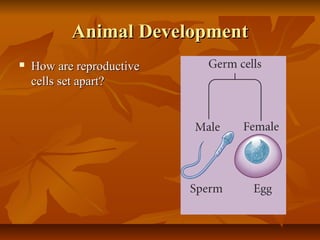
 How are reproductiveHow are reproductive
cells set apart?cells set apart?
Animal DevelopmentAnimal Development
How do changes in
development create new
body forms and what
changes are possible?
Animal DevelopmentAnimal Development
 How do each of these contribute to the studyHow do each of these contribute to the study
of development?of development?
 comparative embryologycomparative embryology
 evolutionary embryologyevolutionary embryology
 teratologyteratology
 mathematical modelingmathematical modeling
Comparative EmbryologyComparative Embryology
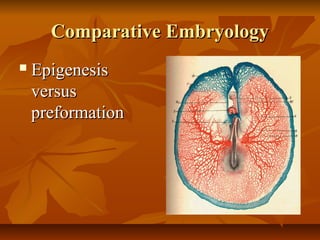
 EpigenesisEpigenesis
versusversus
preformationpreformation
Comparative EmbryologyComparative Embryology
 How does the concept of germ layers support epigenesis?How does the concept of germ layers support epigenesis?
 How does the concept of induction fit in here?How does the concept of induction fit in here?
Comparative EmbryologyComparative Embryology
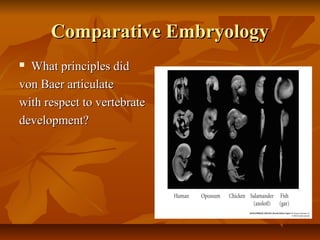
 What principles didWhat principles did
von Baer articulatevon Baer articulate
with respect to vertebratewith respect to vertebrate
development?development?
Comparative EmbryologyComparative Embryology
 General features of large group of animalsGeneral features of large group of animals
appear earlier than specialized features ofappear earlier than specialized features of
smaller groupsmaller group
 Less general characteristics develop from moreLess general characteristics develop from more
generalgeneral
Comparative EmbryologyComparative Embryology
 A particular type of embryo, instead of passingA particular type of embryo, instead of passing
through adult stages of a lower form, departsthrough adult stages of a lower form, departs
more and more from it.more and more from it.
 Embryo of higher animal is only like earlyEmbryo of higher animal is only like early
embryo of lower animal.embryo of lower animal.
Comparative EmbryologyComparative Embryology
 How have fate mapsHow have fate maps
contributed to ourcontributed to our
understanding ofunderstanding of
development?development?
Evolutionary EmbryologyEvolutionary Embryology
 How have observations of embryos contributed to ourHow have observations of embryos contributed to our
understanding of evolutionary relationships?understanding of evolutionary relationships?
Evolutionary EmbryologyEvolutionary Embryology
 Why is the distinction between analogous andWhy is the distinction between analogous and
homologous structures important?homologous structures important?
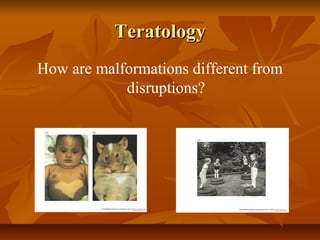
TeratologyTeratology
How are malformations different from
disruptions?
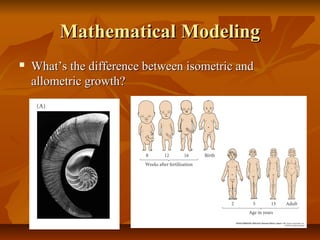
Mathematical ModelingMathematical Modeling
 What’s the difference between isometric andWhat’s the difference between isometric and
allometric growth?allometric growth?
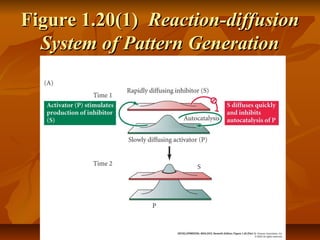
Figure 1.20(1)Figure 1.20(1) Reaction-diffusionReaction-diffusion
System of Pattern GenerationSystem of Pattern Generation
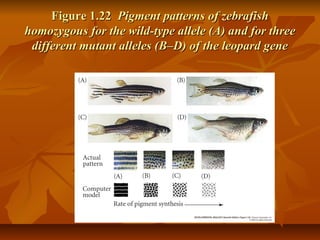
Figure 1.22Figure 1.22 Pigment patterns of zebrafishPigment patterns of zebrafish
homozygous for the wild-type allele (A) and for threehomozygous for the wild-type allele (A) and for three
different mutant alleles (B–D) of the leopard genedifferent mutant alleles (B–D) of the leopard gene

Developmental biology

Editor's Notes

  • #3 purely descriptive focus only on embryo to experimental to integrative with respect to genetics, biochemistry, and at different levels of biology. considers more than just embryo, entire life cycle
  • #4 How does one cell generate many different cell types? How do cells form ordered structures – morphogenesis? How is cell division tightly regulated? How are sperm and egg set apart to form next generation? How do changes in development create new body forms and which heritable changes are possible? How is development of organism integrated into context of its habitat and how do chemicals alter development?
  • #11 epigenesis – Aristotle & Harvey organs are formed from scratch in embryonic chick parts develop from tissues that have counterpart in adult weakness – hard to explain how this happens preformation – Malpighi growth of preformed structures going back to sperm or egg; is there a lower limit to size?
  • #12 germ layers show progression of development shows how each layer gives rise to different types of cells tissue formation requires cooperation among different types of cells
  • #14 All vertebrate embryos have similar structures: gill arches, notocords, spinal cords which develop early Feathers and scales both develop from skin
  • #15 in fish visceral clefts develop into gills, in mammals they develop into eustacian tubes
  • #16 Can trace the movement and positioning of cells dyes, fluorescent tags, radioactive labels used formation of chimeric embryos picture is zebrafish embryo with fluorescent label showing formation of neural tube, especial forebrain and midbrain
  • #17 See similarities in larval stages that don’t exist later on
  • #18 analogous – have similar function and therefore similar structure but not necessarily related homologous – have similar structure because of common ancestry
  • #19 malformations – genetic anomalies seen on left disruptions – come from environmental influences like use of thalidomide
  • #20 isometric – proportional growth – follows a predictable formula as in equiangular spiral growth allometric – different rates of growth of different parts at different stages
  • #21 Turing Model – two different solutions interact to produce stable patterns during morphogenesis alternating areas of high and low concentrations of solutions evidence to support model comes from mutations in leopard gene in zebrafish can generate models via computer to predict patterns Figures\Chapter01\DevBio7e01201.jpg
  • #22 Leopard gene codes for an enzyme catalyzing one of the reactions of reaction-diffusion system. Mutations change kinetics of synthesis or degradation leading to change in patterns. Figures\Chapter01\DevBio7e01220.jpg