MEDICAL EDUCATION:
Emerging Perspectives
Dr. Syed Amin Tabish
FRCP, FAP, FAMS, MD HA (AIIMS), Postdoc Fellow, Bristol University
(England);
Lecture
Strengths:
 Lectures are efficient ways of
delivering information. Good
lectures can introduce new
material or synthesize concepts
students have through text-, web-,
or field-based activities.
Lecture
 Weaknesses:
 Lectures are not as effective as small group
sessions when it comes to stimulating
thinking, inspiring interest in a subject,
teaching behavioural skills, or changing
attitudes. Most often, lectures will only
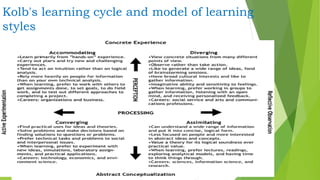
address part of the learning cycle and
appeal most to students who are primarily
auditory learners or have an assimilating
learning style, while others may disengage
from the presentation of the material.
Students will need other opportunities to
apply and reflect on the content for deep
learning to occur.
Lecture
Applications: Most educators agree
that lectures are necessary, but that
they should be limited in number and
well delivered. It is important to give
students opportunities to apply and
reflect on lecture material during
course time. Buzz groups can be
incorporated into lectures in order to
promote more active learning
Kolb's learning cycle and model of learning
styles
SMALL GROUP LEARNING
 Traditionally small groups consist
of 8-12 participants. Small groups
can take on a variety of different
tasks, including problem solving,
role play, discussion, brainstorming,
debate, workshops and
presentations. Generally students
prefer small group learning to other
instructional methods.
Lecture
 Strengths: The main advantages of small group learning
are that it encourages active learningb and develops
communication and teamwork skills. Among the
educational objectives that can be best achieved through
the use of small group teaching methods are the
development of higher-level intellectual skills such as
reasoning and problem-solving, the development of
attitudes and the acquisition of interpersonal skills such
as listening, speaking, arguing, and group leadership.
Small groups encourage deeper level of learning
compared with lectures, as students are encouraged to
discuss and interpret meaning.
 Weaknesses: Small group teaching can be resource
intensive.
PBL/ CASE-BASED LEARNING/TUTORIAL/CASE STUDY/CASE
SCENARIO
 The definition of PBL is not always clear. One
common definition is “problem first learning via
work in small groups and independent study”.
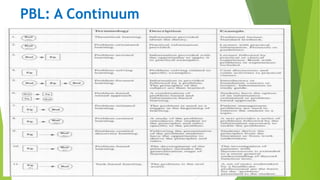
Harden describes a continuum of PBL from
problem-oriented learning, involving a lecture with
practical examples, to PBL itself, where from the
study of a problem students develop principles and
rules and generalize their applicability to a variety
of situations (see table). Davies points out that PBL
usually requires an element of self-directed
learning (see below) on behalf of the learner. In the
writer's experience, people will use the term PBL to
refer to all of the teaching methods listed in the
title of this section.
PBL
 Strengths:
 PBL is said to develop problem solving skills and an integrated
body of knowledge.
 It is a student-centered approach to learning, in which students
determine what and how they learn. Case studies help learners
identify problems and solutions, compare options and decide how
to handle a real situation. A recent review by Koh et al of physician
competencies following medical education through a PBL
curriculum in several countries including Canada, found a positive
effect on social and cognitive competencies, particularly teamwork
skills, appreciation of social and emotional aspects of health care,
appreciation of legal and ethical aspects of health care,
appropriate attitudes toward personal health and wellbeing, coping
with uncertainty, use of computers and information technology, and
understanding of evidence based medicine.
PBL
 In active learning, students are much more
engaged in their own learning while
educators take a more guiding role. Active
learning techniques include buzz groups,
case studies, role play, group projects and
seminars. This approach is thought to
promote processing of skills/knowledge to a
much deeper level than passive learning, in
which material to be learned is often
transmitted to students by teachers.
PBL
 Weaknesses: In Koh’s review, PBL was not found to
have a positive effect on technical, managerial or
teaching skills, including patient education,
prescribing and procedural skills. This may be
expected, given that these skills are more
effectively learned through practice. When using
cases, problems that may arise include lack of
learner motivation, unequal participation of learners
and inadequate accommodation of various learning
styles. Effective cases must be well developed and
well administered, needing significant
administrative and faculty commitment.
 Difficulties may also arise in the evaluation of
student participation and teaching effectiveness.
PBL
 Applicability: The use of cases and case examples is
already widespread in public health teaching and can
help make public health principles real.
 It has been shown that learners learn best when
given the opportunity to integrate their education and
experience with opportunities to apply what they
have learned.
 Cases should be made as relevant as possible to
students, either emphasizing the role of the clinician
or clearly elucidating the practice of public health
physicians
PBL: A Continuum
E-LEARNING/WEB-BASED MEDICAL
EDUCATION/COMPUTER-ASSISTED INSTRUCTION
 Computer technologies, including the Internet, can
support a wide range of learning activities from
dissemination of lectures and materials, access to live or
recorded presentations, real-time discussions, self-
instruction modules and virtual patient simulations.
 Most teaching methods, including lectures, small group
discussion and excercises can be translated into an
electronic format.
 Generally, all computer-based methods must follow the
same educational principles as traditionally-based
educational methods in order to maximize effectiveness.
 Some instructional methods are unique to computer
technology, including virtual patient simulation,
interactive models or games and the use of multimedia.
Computer-based Learning
 Strengths: Assuming that a computer-
based learning intervention is well
designed, it can have a number of
advantages, including distance-
independence, flexible scheduling, the
creation of reusable learning
materials that are easily shared and
updated, the ability to individualize
instruction through adaptive
instruction technologies and
automated record keeping for
assessment purposes.
Computer-based Learning
 Weaknesses: There are concerns that
computer-based learning can detract
from building team-based working
skills, that on-line facilitators are not
able to respond as quickly or
adequately to student needs and that
instructional design may often be
compromised in order to use
educational technology for
technology’s sake.
Computer-based Learning
 Applicability: Reviews of the literature have generally
concluded that computer-based education is not superior
to traditional methods and its effectiveness depends on
the quality of the educational program's design rather
than the computer-based tools being used.
 The move to increased education being offered on-line
has been described as "inevitable".
 Exciting opportunities for public health education exist
using instructional methods unique to computer
technology, such as interactive models or games that
allow students to apply public health principles and
experience public health practice in real life simulations.
 Computer technology can also assist in sharing materials
and improving student access to public health
information.
SELF-INSTRUCTION MODULES/EXERCISES
 Self-instruction can include reading,
workbooks, videos or computer-based
modules, designed to teach a particular
concept or skill through an individual's
independent completion of a series of
readings, tasks or exercises. Increasingly
self-instruction is being delivered using
computer technology, which allows for
multimedia presentation and some
adaptation of the educational experience
to the individual learner.
SELF-INSTRUCTION MODULES
 Strengths: Self-instruction is an efficient and
flexible way to increase cognitive knowledge.
 Students are able to progress through self-
instruction modules at their own pace and at their
own convenience.
 Many students find the multimedia interaction of
computerized self-instruction modules attractive.
 Studies have found that computerized self-
instruction modules are equally effective when
compared with conventional teaching in terms of
knowledge gain and retention.
SELF-INSTRUCTION MODULES
Weaknesses: Self-instruction is less
effective than other methods for
teaching skills and attitudes.
Specific self-instruction modules
may vary widely in design and
educational effectiveness and those
included in a curriculum should be
chosen with care.
SELF-INSTRUCTION MODULES
 Applicability: Self-instruction can
be an effective way to teach basic
public health knowledge.
 Discussion and application of this
knowledge in small group
excercises could allow students to
further integrate their learning
SITE VISIT, COMMUNITY PLACEMENT/ROTATION,
PUBLIC HEALTH ROTATION/ELECTIVE
 Experiential learning is the keystone in adult education. Most
theorists agree that having experiences and reflecting on these
experiences is the way in which most learning is generated.
 In the undergraduate medical education context, experiences
can be classified in two categories: observational experiences,
such as site visits and community placements, and active
experiences, such as rotations and electives.
 Schon describes three levels of professional practicum
experiences, including "technical training", in which students
learn facts and rules and apply them non-problematically,
"thinking like a...", in which students learn the forms of inquiry
by which competent practitioners reason their way, and
"reflection–in–action" in which students are able to construct
and test new categories of understanding, strategies of action
and ways of framing problems.
Site Visit
 Strengths: Site visits and community placements
can allow students to observe different aspects of
public health and help them to contextualize their
theoretical learning.
 This can help engage students actively and will
appeal most to kinesthetic learners and the
accommodating learning style.
 Rotations and electives in public health can help
students develop skills, apply their knowledge,
and actively experiment with PH concepts
Site Visits
 Weaknesses: Available experiences may differ
widely in quality and content. Regardless, the
experience students may get from a site visit,
community placement or rotation addresses
only one part of the learning cycle.
 Educational opportunities must also exist for
students to reflect on their experience and
experiment with or alter their behaviour for
deep learning to occur.
Site Visits
 Applicability: The more opportunity students
have to experience and reflect on public health,
the deeper their learning will be.
 It is unrealistic to expect more then "technical
training" to occur at an undergraduate medical
education level.
 Administrative and public health human
resource issues must be considered in order to
plan good experiential learning opportunities.
PERSONAL REFLECTION
 Reflection is one of the most important adult
educational tools available.
 Many theorists have argued that without reflection,
knowledge translation and thus genuine “deep”
learning cannot occur.
 Individual reflection tools include: learning journals,
learning portfolios, pre-course needs assessments,
post-course commitment to change statements and
time-out periods or reflective moments built into
course time.
 Small group or team-based reflection can include:
cases based on participants past experiences, team
debriefing, critical incident analysis and practice
review or audit.
Personal Reflection
Strengths: Reflection allows students to
take inventory of their current
knowledge skills and attitudes, to
integrate concepts from various
experiences, to transform current ideas
and experiences into new knowledge
and actions and to complete the
experiential learning cycle.
Personal Reflection
Weaknesses: For some individuals,
reflection is an uncomfortable
process that is actively resisted.
Ideally, reflection should be built into
course time to allow for guidance by
facilitators and to help overcome
resistance.
Personal Reflection
 Applicability: All curricula should allow time
for students to reflect on their public health
experiences and on how these experiences
relate to their medical training.
 Easily incorporated reflection methods
include some journaling after small group
discussions, the opportunity for debrief or
reflective discussions and reflective course
assignments.
SELF-DIRECTED LEARNING
 In self-directed learning students have primary
responsibility for planning, implementing, and evaluating
their effort.
 It is an adult learning technique that assumes that the
learner knows best what their educational needs are.
 The facilitators role in self-directed learning is to support
learners in identifying their needs and goals for the
program, to contribute to clarifying the learners'
directions and objectives and to provide timely feedback.
 Within the context of self-directed learning, adults can
seek out and participate in a variety of teaching methods.
Self-directed learning is not the same as self-instruction
SDL
Strengths: Self-directed learning can
be highly motivating, especially if
the learner is focusing on problems
of the immediate present, a potential
positive outcome is anticipated and
obtained and they are not threatened
by taking responsibility for their own
learning
SDL
Weaknesses: The process of
clarifying learning needs can
require extensive facilitation,
especially if the adult learner is
feeling threatened, dissatisfied
or anxious, or if their learning
needs are ambiguous.
SDL
Applications: Self-directed
learning projects can give
students the opportunity to
explore areas of specific interest
to them that otherwise may not
be covered in the curriculum.
New Methods
• E-learning and blended learning. ...
• Simulation-based teaching. ...
• Reflective feedback. ...
• Problem-based discussions. ...
• Mentorship. ...
• Objective Structured Clinical
Examination. ...
• Direct Observation of Procedural Skills
• Mini-Clinical Evaluation Exercise.
Clinical Education
 Clinical education is one of the most important
parts of the training of physicians, which forms a
major and vital part of educating skilled and
professional people; the value of an ideal clinical
education is in the role played by personal and
professional development as well as clinical skills
of students.
 The promotion of clinical education is one of
the main concerns of medical education science.
 clinical education is an essential part of education in medical sciences,
without which it would be difficult or impossible to educate competent
people. The main concern of medical education’s authorities, both in Iran and
outside of it, is to provide all medical students with theoretical knowledge as
well as the field of work experience
Simulation based medical education
 Simulation-based learning has the potential to engage in behaviors in
areas similar to actual performance. In simulation, real-world elements
are simplified and applied in the classroom; in other words, it attempts
to approach elements in a manner that they are more similar to real
situations so that the learned concepts and solutions can be transferred
to the real world
 Simulation based education focuses on improving apprenticeship skills
and evaluating them in clinical skills and techniques, knowledge,
communication, teamwork, and the practice of resuscitation code
performance.
 Types of educational applications to achieve these goals include
surgical training sessions or practical training methods.
 The development of simulators, such as mechanical mannequins with
the ability to analyze anatomy and human physiology, is an essential tool
in medical education today. Learning, thus, plays an effective role in
reducing costs, improving learning, the experience, the comfort of
education, and patient safety
Simulation…………
 Clinical simulation is a learning strategy that influences
professional abilities and skills.
 It is a strategy that has the potential to be improved and
advanced in comparison to other methods.
 This method is an interactive orientation towards the
actual medical education being a modern self-study
teaching method and group work.
 Through a realistic scenario, it has a huge effect on
increasing in therapeutic experience without any risk
regarding the health and well-being of actual patients.
 Clinical simulations help provide better medical education.
 Simulation is not a technique; it is a learning strategy that
simulates the transition from theory to practice and, as a
result, leads to the actual practice of medicine.
Clinical Education
 In medical education, courses are divided into two
parts: Basic Sciences and Clinical Sciences.
 One of the important issues of medical education
in the country is the effective communication
between basic and clinical education.
 Among the continuous stages of medical
education, internship or clinical education is the
most important stage in which students enter the
practical stage leaving the theoretical stage
behind and feel as future physicians; the more is
the practical and scientific point of view of
medical students, the better they are prepared to
enter this stage and the better they will be able to
carry out their duties regarding the treatment of
patients.
Evidence Based Medicine
 Medicine and clinical decision making need to be able
to recognize, analyze, refine, and deduce the correct
medical knowledge from the mass of generated
information.
 Today's doctors treat patients in a situation where the
amount of evidence is doubled in a few months.
 A committed physician who wants to keep up with the
up to date knowledge must choose among medical
evidence from thousands of articles published each
year in hundreds of reputable medical journals; such
an important decision is not feasible without
knowledge and skills in identifying and grading the
evidence in terms of credibility and validity
The Way Forward
 Medical education, the art and science behind
medical learning and teaching, has progressed
remarkably.
 Teaching and learning have become more
scientific and rigorous, curricula are based on
sound pedagogical principles, and Problem Based
and other forms of active and self directed
learning have become the mainstream.
 Teachers have progressed from the role of
problem-identifier to that of the solution-provider.
SUMMARY
 The method of discussion in small groups is more
influential than the traditional method of lecturing in
terms of the level of learning, interest and satisfaction
of students, encouragement for participation in
discussions and dialogues;
 With the tremendous advances that have taken place
in the information systems of today's world; this issue
is exposed to changes day by day or every hour.
 Educational methods that are solely teacher-centered
and based on prior knowledge of instructors do not
meet the needs of today's students and instructors
should use new methods of teaching

MEDICAL EDUCATION: TEACHING & LEARNING METHODS

  • 1.
    MEDICAL EDUCATION: Emerging Perspectives Dr.Syed Amin Tabish FRCP, FAP, FAMS, MD HA (AIIMS), Postdoc Fellow, Bristol University (England);
  • 2.
    Lecture Strengths:  Lectures areefficient ways of delivering information. Good lectures can introduce new material or synthesize concepts students have through text-, web-, or field-based activities.
  • 3.
    Lecture  Weaknesses:  Lecturesare not as effective as small group sessions when it comes to stimulating thinking, inspiring interest in a subject, teaching behavioural skills, or changing attitudes. Most often, lectures will only address part of the learning cycle and appeal most to students who are primarily auditory learners or have an assimilating learning style, while others may disengage from the presentation of the material. Students will need other opportunities to apply and reflect on the content for deep learning to occur.
  • 4.
    Lecture Applications: Most educatorsagree that lectures are necessary, but that they should be limited in number and well delivered. It is important to give students opportunities to apply and reflect on lecture material during course time. Buzz groups can be incorporated into lectures in order to promote more active learning
  • 5.
    Kolb's learning cycleand model of learning styles
  • 6.
    SMALL GROUP LEARNING Traditionally small groups consist of 8-12 participants. Small groups can take on a variety of different tasks, including problem solving, role play, discussion, brainstorming, debate, workshops and presentations. Generally students prefer small group learning to other instructional methods.
  • 7.
    Lecture  Strengths: Themain advantages of small group learning are that it encourages active learningb and develops communication and teamwork skills. Among the educational objectives that can be best achieved through the use of small group teaching methods are the development of higher-level intellectual skills such as reasoning and problem-solving, the development of attitudes and the acquisition of interpersonal skills such as listening, speaking, arguing, and group leadership. Small groups encourage deeper level of learning compared with lectures, as students are encouraged to discuss and interpret meaning.  Weaknesses: Small group teaching can be resource intensive.
  • 8.
    PBL/ CASE-BASED LEARNING/TUTORIAL/CASESTUDY/CASE SCENARIO  The definition of PBL is not always clear. One common definition is “problem first learning via work in small groups and independent study”. Harden describes a continuum of PBL from problem-oriented learning, involving a lecture with practical examples, to PBL itself, where from the study of a problem students develop principles and rules and generalize their applicability to a variety of situations (see table). Davies points out that PBL usually requires an element of self-directed learning (see below) on behalf of the learner. In the writer's experience, people will use the term PBL to refer to all of the teaching methods listed in the title of this section.
  • 9.
    PBL  Strengths:  PBLis said to develop problem solving skills and an integrated body of knowledge.  It is a student-centered approach to learning, in which students determine what and how they learn. Case studies help learners identify problems and solutions, compare options and decide how to handle a real situation. A recent review by Koh et al of physician competencies following medical education through a PBL curriculum in several countries including Canada, found a positive effect on social and cognitive competencies, particularly teamwork skills, appreciation of social and emotional aspects of health care, appreciation of legal and ethical aspects of health care, appropriate attitudes toward personal health and wellbeing, coping with uncertainty, use of computers and information technology, and understanding of evidence based medicine.
  • 10.
    PBL  In activelearning, students are much more engaged in their own learning while educators take a more guiding role. Active learning techniques include buzz groups, case studies, role play, group projects and seminars. This approach is thought to promote processing of skills/knowledge to a much deeper level than passive learning, in which material to be learned is often transmitted to students by teachers.
  • 11.
    PBL  Weaknesses: InKoh’s review, PBL was not found to have a positive effect on technical, managerial or teaching skills, including patient education, prescribing and procedural skills. This may be expected, given that these skills are more effectively learned through practice. When using cases, problems that may arise include lack of learner motivation, unequal participation of learners and inadequate accommodation of various learning styles. Effective cases must be well developed and well administered, needing significant administrative and faculty commitment.  Difficulties may also arise in the evaluation of student participation and teaching effectiveness.
  • 12.
    PBL  Applicability: Theuse of cases and case examples is already widespread in public health teaching and can help make public health principles real.  It has been shown that learners learn best when given the opportunity to integrate their education and experience with opportunities to apply what they have learned.  Cases should be made as relevant as possible to students, either emphasizing the role of the clinician or clearly elucidating the practice of public health physicians
  • 13.
  • 14.
    E-LEARNING/WEB-BASED MEDICAL EDUCATION/COMPUTER-ASSISTED INSTRUCTION Computer technologies, including the Internet, can support a wide range of learning activities from dissemination of lectures and materials, access to live or recorded presentations, real-time discussions, self- instruction modules and virtual patient simulations.  Most teaching methods, including lectures, small group discussion and excercises can be translated into an electronic format.  Generally, all computer-based methods must follow the same educational principles as traditionally-based educational methods in order to maximize effectiveness.  Some instructional methods are unique to computer technology, including virtual patient simulation, interactive models or games and the use of multimedia.
  • 15.
    Computer-based Learning  Strengths:Assuming that a computer- based learning intervention is well designed, it can have a number of advantages, including distance- independence, flexible scheduling, the creation of reusable learning materials that are easily shared and updated, the ability to individualize instruction through adaptive instruction technologies and automated record keeping for assessment purposes.
  • 16.
    Computer-based Learning  Weaknesses:There are concerns that computer-based learning can detract from building team-based working skills, that on-line facilitators are not able to respond as quickly or adequately to student needs and that instructional design may often be compromised in order to use educational technology for technology’s sake.
  • 17.
    Computer-based Learning  Applicability:Reviews of the literature have generally concluded that computer-based education is not superior to traditional methods and its effectiveness depends on the quality of the educational program's design rather than the computer-based tools being used.  The move to increased education being offered on-line has been described as "inevitable".  Exciting opportunities for public health education exist using instructional methods unique to computer technology, such as interactive models or games that allow students to apply public health principles and experience public health practice in real life simulations.  Computer technology can also assist in sharing materials and improving student access to public health information.
  • 18.
    SELF-INSTRUCTION MODULES/EXERCISES  Self-instructioncan include reading, workbooks, videos or computer-based modules, designed to teach a particular concept or skill through an individual's independent completion of a series of readings, tasks or exercises. Increasingly self-instruction is being delivered using computer technology, which allows for multimedia presentation and some adaptation of the educational experience to the individual learner.
  • 19.
    SELF-INSTRUCTION MODULES  Strengths:Self-instruction is an efficient and flexible way to increase cognitive knowledge.  Students are able to progress through self- instruction modules at their own pace and at their own convenience.  Many students find the multimedia interaction of computerized self-instruction modules attractive.  Studies have found that computerized self- instruction modules are equally effective when compared with conventional teaching in terms of knowledge gain and retention.
  • 20.
    SELF-INSTRUCTION MODULES Weaknesses: Self-instructionis less effective than other methods for teaching skills and attitudes. Specific self-instruction modules may vary widely in design and educational effectiveness and those included in a curriculum should be chosen with care.
  • 21.
    SELF-INSTRUCTION MODULES  Applicability:Self-instruction can be an effective way to teach basic public health knowledge.  Discussion and application of this knowledge in small group excercises could allow students to further integrate their learning
  • 22.
    SITE VISIT, COMMUNITYPLACEMENT/ROTATION, PUBLIC HEALTH ROTATION/ELECTIVE  Experiential learning is the keystone in adult education. Most theorists agree that having experiences and reflecting on these experiences is the way in which most learning is generated.  In the undergraduate medical education context, experiences can be classified in two categories: observational experiences, such as site visits and community placements, and active experiences, such as rotations and electives.  Schon describes three levels of professional practicum experiences, including "technical training", in which students learn facts and rules and apply them non-problematically, "thinking like a...", in which students learn the forms of inquiry by which competent practitioners reason their way, and "reflection–in–action" in which students are able to construct and test new categories of understanding, strategies of action and ways of framing problems.
  • 23.
    Site Visit  Strengths:Site visits and community placements can allow students to observe different aspects of public health and help them to contextualize their theoretical learning.  This can help engage students actively and will appeal most to kinesthetic learners and the accommodating learning style.  Rotations and electives in public health can help students develop skills, apply their knowledge, and actively experiment with PH concepts
  • 24.
    Site Visits  Weaknesses:Available experiences may differ widely in quality and content. Regardless, the experience students may get from a site visit, community placement or rotation addresses only one part of the learning cycle.  Educational opportunities must also exist for students to reflect on their experience and experiment with or alter their behaviour for deep learning to occur.
  • 25.
    Site Visits  Applicability:The more opportunity students have to experience and reflect on public health, the deeper their learning will be.  It is unrealistic to expect more then "technical training" to occur at an undergraduate medical education level.  Administrative and public health human resource issues must be considered in order to plan good experiential learning opportunities.
  • 26.
    PERSONAL REFLECTION  Reflectionis one of the most important adult educational tools available.  Many theorists have argued that without reflection, knowledge translation and thus genuine “deep” learning cannot occur.  Individual reflection tools include: learning journals, learning portfolios, pre-course needs assessments, post-course commitment to change statements and time-out periods or reflective moments built into course time.  Small group or team-based reflection can include: cases based on participants past experiences, team debriefing, critical incident analysis and practice review or audit.
  • 27.
    Personal Reflection Strengths: Reflectionallows students to take inventory of their current knowledge skills and attitudes, to integrate concepts from various experiences, to transform current ideas and experiences into new knowledge and actions and to complete the experiential learning cycle.
  • 28.
    Personal Reflection Weaknesses: Forsome individuals, reflection is an uncomfortable process that is actively resisted. Ideally, reflection should be built into course time to allow for guidance by facilitators and to help overcome resistance.
  • 29.
    Personal Reflection  Applicability:All curricula should allow time for students to reflect on their public health experiences and on how these experiences relate to their medical training.  Easily incorporated reflection methods include some journaling after small group discussions, the opportunity for debrief or reflective discussions and reflective course assignments.
  • 30.
    SELF-DIRECTED LEARNING  Inself-directed learning students have primary responsibility for planning, implementing, and evaluating their effort.  It is an adult learning technique that assumes that the learner knows best what their educational needs are.  The facilitators role in self-directed learning is to support learners in identifying their needs and goals for the program, to contribute to clarifying the learners' directions and objectives and to provide timely feedback.  Within the context of self-directed learning, adults can seek out and participate in a variety of teaching methods. Self-directed learning is not the same as self-instruction
  • 31.
    SDL Strengths: Self-directed learningcan be highly motivating, especially if the learner is focusing on problems of the immediate present, a potential positive outcome is anticipated and obtained and they are not threatened by taking responsibility for their own learning
  • 32.
    SDL Weaknesses: The processof clarifying learning needs can require extensive facilitation, especially if the adult learner is feeling threatened, dissatisfied or anxious, or if their learning needs are ambiguous.
  • 33.
    SDL Applications: Self-directed learning projectscan give students the opportunity to explore areas of specific interest to them that otherwise may not be covered in the curriculum.
  • 34.
    New Methods • E-learningand blended learning. ... • Simulation-based teaching. ... • Reflective feedback. ... • Problem-based discussions. ... • Mentorship. ... • Objective Structured Clinical Examination. ... • Direct Observation of Procedural Skills • Mini-Clinical Evaluation Exercise.
  • 35.
    Clinical Education  Clinicaleducation is one of the most important parts of the training of physicians, which forms a major and vital part of educating skilled and professional people; the value of an ideal clinical education is in the role played by personal and professional development as well as clinical skills of students.  The promotion of clinical education is one of the main concerns of medical education science.
  • 36.
     clinical educationis an essential part of education in medical sciences, without which it would be difficult or impossible to educate competent people. The main concern of medical education’s authorities, both in Iran and outside of it, is to provide all medical students with theoretical knowledge as well as the field of work experience
  • 37.
    Simulation based medicaleducation  Simulation-based learning has the potential to engage in behaviors in areas similar to actual performance. In simulation, real-world elements are simplified and applied in the classroom; in other words, it attempts to approach elements in a manner that they are more similar to real situations so that the learned concepts and solutions can be transferred to the real world  Simulation based education focuses on improving apprenticeship skills and evaluating them in clinical skills and techniques, knowledge, communication, teamwork, and the practice of resuscitation code performance.  Types of educational applications to achieve these goals include surgical training sessions or practical training methods.  The development of simulators, such as mechanical mannequins with the ability to analyze anatomy and human physiology, is an essential tool in medical education today. Learning, thus, plays an effective role in reducing costs, improving learning, the experience, the comfort of education, and patient safety
  • 38.
    Simulation…………  Clinical simulationis a learning strategy that influences professional abilities and skills.  It is a strategy that has the potential to be improved and advanced in comparison to other methods.  This method is an interactive orientation towards the actual medical education being a modern self-study teaching method and group work.  Through a realistic scenario, it has a huge effect on increasing in therapeutic experience without any risk regarding the health and well-being of actual patients.  Clinical simulations help provide better medical education.  Simulation is not a technique; it is a learning strategy that simulates the transition from theory to practice and, as a result, leads to the actual practice of medicine.
  • 39.
    Clinical Education  Inmedical education, courses are divided into two parts: Basic Sciences and Clinical Sciences.  One of the important issues of medical education in the country is the effective communication between basic and clinical education.  Among the continuous stages of medical education, internship or clinical education is the most important stage in which students enter the practical stage leaving the theoretical stage behind and feel as future physicians; the more is the practical and scientific point of view of medical students, the better they are prepared to enter this stage and the better they will be able to carry out their duties regarding the treatment of patients.
  • 40.
    Evidence Based Medicine Medicine and clinical decision making need to be able to recognize, analyze, refine, and deduce the correct medical knowledge from the mass of generated information.  Today's doctors treat patients in a situation where the amount of evidence is doubled in a few months.  A committed physician who wants to keep up with the up to date knowledge must choose among medical evidence from thousands of articles published each year in hundreds of reputable medical journals; such an important decision is not feasible without knowledge and skills in identifying and grading the evidence in terms of credibility and validity
  • 41.
    The Way Forward Medical education, the art and science behind medical learning and teaching, has progressed remarkably.  Teaching and learning have become more scientific and rigorous, curricula are based on sound pedagogical principles, and Problem Based and other forms of active and self directed learning have become the mainstream.  Teachers have progressed from the role of problem-identifier to that of the solution-provider.
  • 42.
    SUMMARY  The methodof discussion in small groups is more influential than the traditional method of lecturing in terms of the level of learning, interest and satisfaction of students, encouragement for participation in discussions and dialogues;  With the tremendous advances that have taken place in the information systems of today's world; this issue is exposed to changes day by day or every hour.  Educational methods that are solely teacher-centered and based on prior knowledge of instructors do not meet the needs of today's students and instructors should use new methods of teaching