CLINICAL
AUDIT
Professor Syed Amin Tabish
FRCP (London), FRCP (Edin), FAMS, MHA (AIIMS)
Clinical Audit
‘Clinical audit is the systematic
critical analysis of the quality of
healthcare , including the procedures
used for diagnosis , treatment and
care, the use of resources and the
resulting outcome and quality of life
for the patient’.
Why Audit?
Audit allows one to see how near
one gets to the standards.
It shows how our systems and
every day PRACTICE let us down.
it gives us opportunity to change to
allow our efforts to be optimized.
Audit puts the control of the quality
of our work into our own hands.
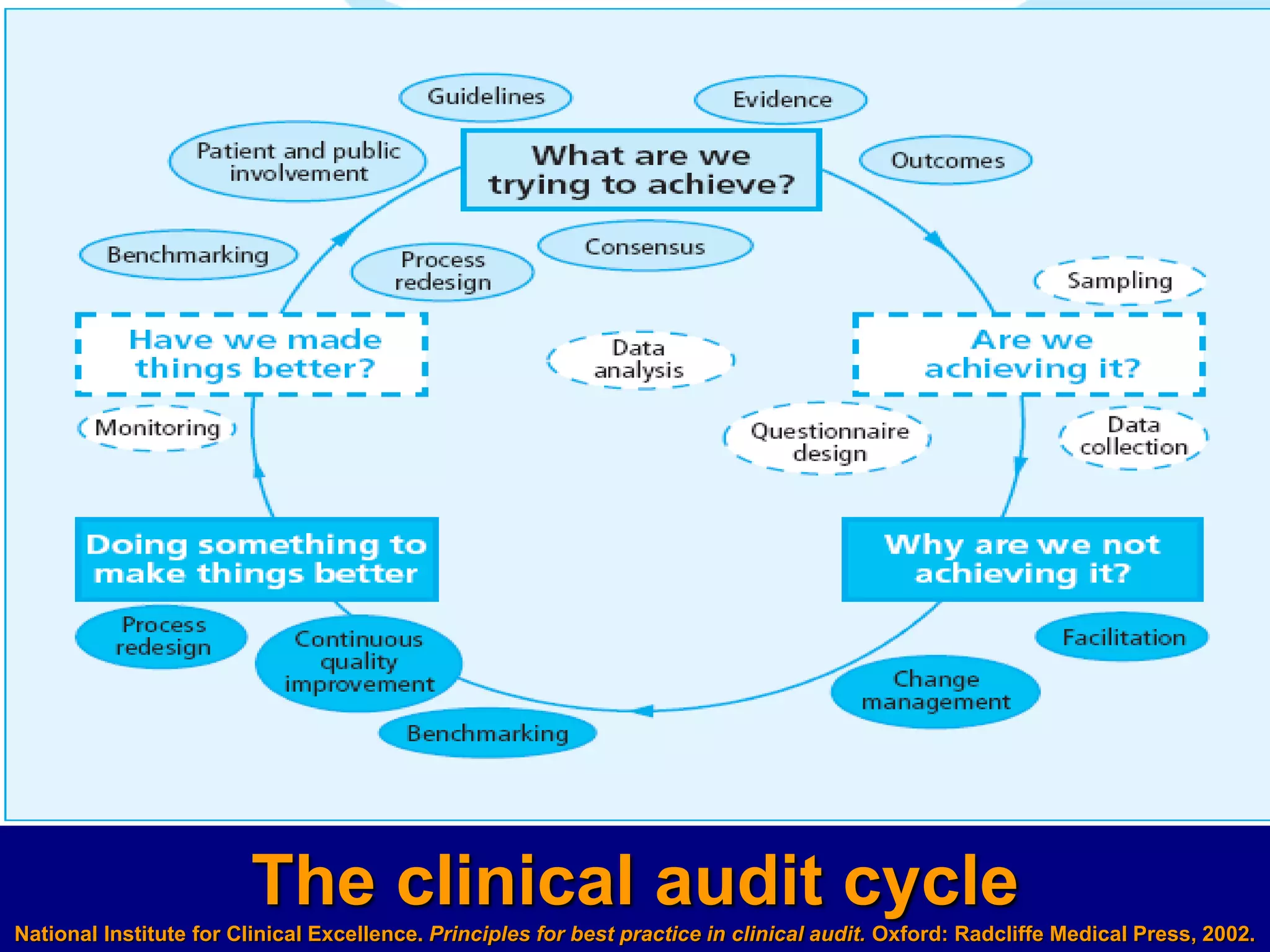
The clinical audit cycle
National Institute for Clinical Excellence. Principles for best practice in clinical audit. Oxford: Radcliffe Medical Press, 2002.
Audit Cycle
What we are doing ?
Collect (data or performance)
Comparison [Assess performance against criteria & standard]
Identify Needs for change
Implementing change
Define Criteria & Standards
Select the issue
Audit Cycle
Goals of Quality assurance
Increasing the capacity &
effectiveness of health services
Increasing efficiency of HS
Maintaining good standards for HS
Improving the outcome on
interventions
Increasing consumer satisfaction
Increasing effectiveness of
community participation
Elements, Criteria, Standards
Elements: represent the component
parts of an activity
Criteria: selected elements that are
precise, clear, effective, measurable, &
able to reflect the quality of that
activity
Standards: when the criterion has
been defined at a descriptive or
numerical level
The Consumer
Quality means from consumer
point of view:
A service that is available at all
time
Easily accessible
Feeling of comfort
Politeness of health providers
Disappearance of symptoms
Framework of Quality
Structure: Manpower,
drugs, equipment,
buildings, records, etc
Process: content,
configuration
Outcome: the results, the
impact
Quality Assessment
Collection of data
Analysis of trends
Interpretation of results
Corrective actions
Follow-up
Doing AUDIT
Audit is concerned with
monitoring performance against
established stadards, and
implementing appropriate change,
as necessary, to meet those
standards
Audit Cycle/Spiral:
Setting standards
Monitoring performance
Effecting change
Types of Standards
Protocols
Options
Guidelines: how the doctor
should behave in most instances
Standards: have a ring of
absoluteness among them
Criterion: standards with
flexibility (all diabetics should
have their feet inspected once a
year)
Monitoring Performance
Collection of data
Retrospective data
collection (death &
disaster type of case
reviews)
Prospective data
collection: collecting data
‘on the run’
Effecting change
Audit is all about change
Comparing present
behaviour against
standards and being willing
to change that behaviour in
order to bring yourself or
your practice up towards
those standards
Approaching Change
Education
Feedback
Financial reward
Financial penalties
Participation
Administrative change (terms
& conditions put in service
contract)
Achieving Change
Be involved
Choose a meaningful topic
Set suitable standards
Set an appropriate time scale
for change
Reward success
Change for the better in a
purposeful manner
CLINICAL AUDIT
It is primarily for accountability,
for management control, for
professional development
It is multidisciplinary: concerns
not only the clinical practice
within individual professions but
also demonstrates the
contributions made by each &
the organizational links between
them
Frame For Assessing Care
Structure Process Outcome
In which description , measurement,
comparison and evaluation of quality of
health care can be made.
QUALITY OF:
Building )
Equipments ) STRUCTURE
Systems )
Structure
Health care is likely to be more effective if it
carried out in comfortable surrounding with
right equipment and by most appropriate
people.
The presence of structure attribute increase
the chance of good quality of care but does
not assure it.
Quality assessed primarily on basis of
doctors performance, So the performance of
health professionals embodies the other two
constituents of quality (process& outcome).
Audit of Structure - assess quality of environment in which care is provided.
Audit of process
Process describe the care given by
practitioner i.e. what the practitioner
does , the sum of actions and decisions
that describe a persons professional
practice.
Treatments
Diagnosis / Intervention
Dr. / Patient Communication
Audit of process : describe quality of work done by health professionals.
Patient current and future health
status.
Definite indicators of health, and
describe effectiveness of care.
Success in outcome
Preventing Suffering of Illness
Audit of Outcome - assess the benefit achieved by patient.
Outcome
The benefits of audit to a practice
Bringing about change.
Reducing organizational and clinical
error.
Improving effectiveness.
Demonstrating good care.
Meeting patients’ needs and
expectations.
Stimulating education.
Promoting higher standards of hospital
and community care for patients.
Securing effective medical defense
through risk avoidance.
Methods of Clinical Audit
Peer Review
Audit should involve the Objective
Peer Review of patterns of care, be
sensitive to the expectations of
patients, & be used on scientific
evidence of good medical practice
Case for review can be selected
randomly or by pre-agreed criteria
Patterns of practice can be compared
with Guidelines
Methods of Clinical Audit
Adverse Patient Reaction involves
systematic identification and analysis of
events during a patient’s treatment which
may indicate some lapse in the quality of
care
Screening criteria are defined by the
participating clinicians:
Peri-operative deaths
Admission to ICU
Unplanned second operations
Unplanned readmissions
Methods of Clinical Audit
Criteria for whole hospital includes:
Admission because of complications of
out-patient management
Readmission for complications or
incomplete management of problems on
previous admission
Unplanned removal, injury or repair of
organ or structure during surgery/invasive
procedure
Unplanned return to theatre
Nosocomial infection
Methods of Clinical Audit-II
Pathology report varies significantly
from pre-operative diagnosis
Cardiac or respiratory arrest
Cardiac arrest within 48 hours of
surgery
Neurological deficit on discharge not
present at the time of admission
Unexpected transfer to a High
Dependency Unit
Unexpected death
Methods of Clinical Audit-III
Clinical Indicators:
monitoring of routinely generated
data within a specialty, in order to
identify exceptions or trends which
may merit detailed adhoc review
Includes Workload, Access
(waiting times), Appropriateness,
Outcome, Information. Efficiency
(Theatre sessions cancelled)
Methods of Clinical Audit
Topic Review
Analysis of an agreed topic may be carried
out by prospective study or by
retrospective analysis
A systematic review of a large enough
sample of similar cases in order to
identify, quantify & compare patterns of
practice
Indicators: colonic resection,
cholecytectomy, CABG, TURP,
prolapsed disc, orchidopexy,
hysterectomy, cataract, radical neck
dissection
Methods of Clinical Audit
Medical Records
Clinical guidelines for minimum
standards of records are required
Auditing the records of every
patient who had general
anesthesia or adverse reaction or
death
Clinical Audit Methods
Therapeutics
Audit of drug usage
Appropriateness
Route of administration
Serum monitoring
On what criteria are patients
selected/refused (diagnosis, disability,
disease, age)
How should treatment be conducted
(machine, safety, staff)
When should treatment cease
Methods of Clinical Audit
Other Methods
Diagnostic investigations (Radiology)
Autopsy
Random case Review
Patient Satisfaction
Comparative Audit (confidential
pooling of aggregated data, standard
definitions & formats of individual
doctors compared with their peers)
Audit of Outcome
Assessment of outcome is much
more difficult
Indicator: post-operative mortality
(account of severity of illness &
fitness of patient for operation be
taken)
Death certificates are unreliable
Random control trials for evaluating
outcome of surgical interventions is
universally accepted
Audit of quality of life after surgery
What matters
Patients are likely to be satisfied with
their treatment if medical and
nursing staff observe the rules of
communication, courtesy, concern,
competence & comfort
Prevention by control of their origin
is cheaper, more humane and more
effective than intervention by
treatment after they occur.
PLAN AN AUDIT
1. Define the nature of perceived problem.
2. Produce a clear written statements of
aims.
3. Select the most appropriate method.
4. Decide upon the other basic design
features.
5. Identify the main analysis to be made.
6. State who the audit will involve.
7. Start small.
8. Have a short time - scale.
9. Proceed step by step.
10. Indicate how the possible need for
changes to be handled.
Data Collection
1.Routine practice data.
2. Medical Records.
3. Practice activity analysis.
4. Prospective recording of specific
data.
5. Surveys.
6. Interviews.
7. Direct Observations.
How To Do It ?
1.Routine performance
monitoring.
2. Practice activity analysis.
3. Surveys and Interviews.
4.Direct observation.
5. Confidential enquiries.
6. Use of tracer.
7.Pracice visiting.
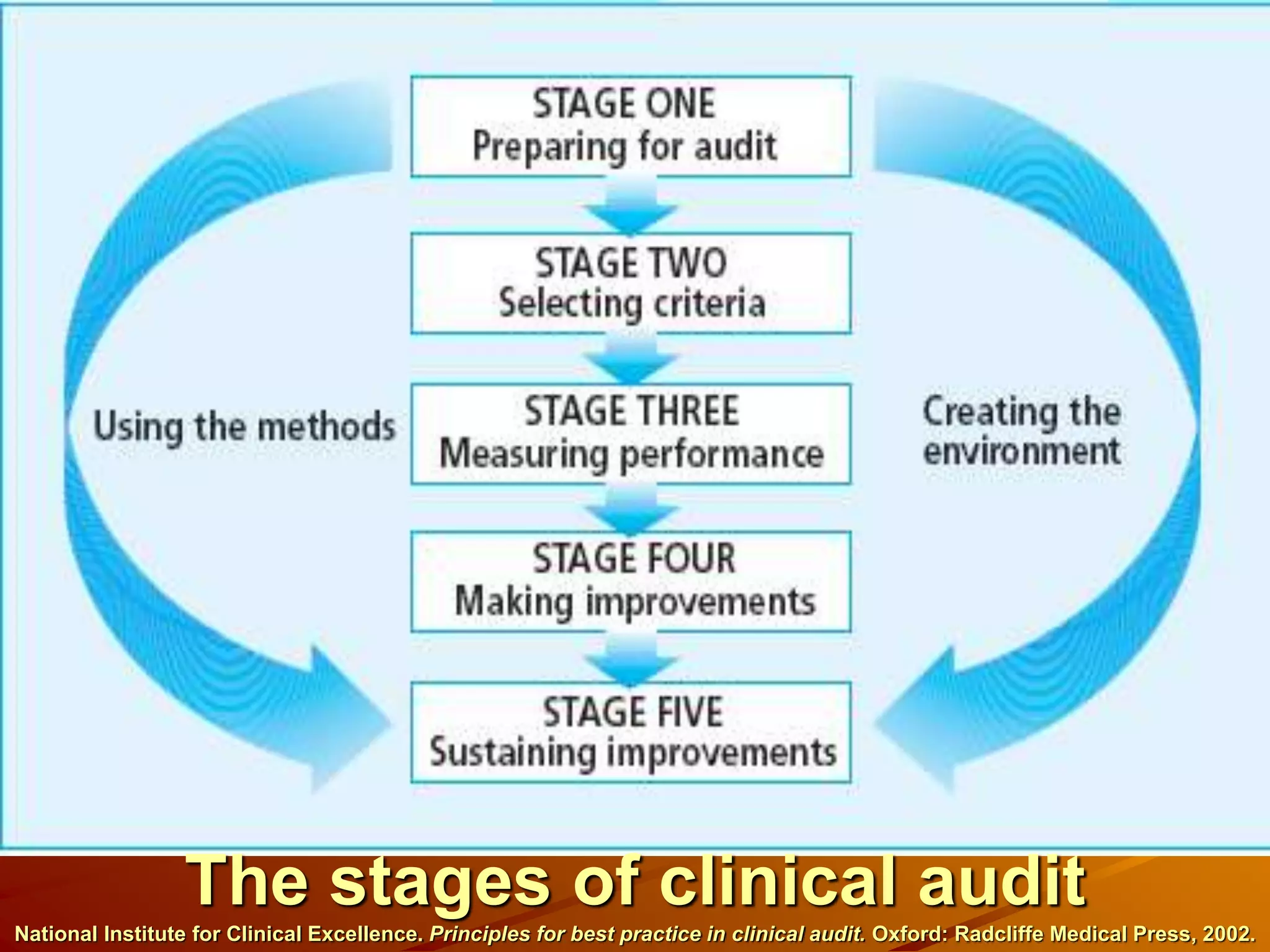
The stages of clinical audit
National Institute for Clinical Excellence. Principles for best practice in clinical audit. Oxford: Radcliffe Medical Press, 2002.
Analysis
Analysis must reflect the audit aim.
Analysis should always be focused.
First step: examine the frequency of
occurrence of each item or event [example 8
out of 40 may be widowed , 15 out of 40 may
be taken more than one drugs…etc] each of
these could be expressed as percentage.
Next step construct the tables that shows
range of each item of data collected this will
highlight unusual event occurrence &analysis
can be focused
As the result production one or more tables
containing only data required.
Analysis - Presentation of
Data
ANALYSIS OF DATA PRODUCE
RESULTS THAT’S NEEDS TO BE
CONVERTED INTO INFORMATIONS
WHICH THE PRACTICE TEAMS CAN
UNDERSTAND AN TO WHICH THEY
CAN RELATED .
PRESENTED IN VISUAL WAY THAT
COMMUNICTE INFORMATIONS EFFECTIVELY.
PROBLEMS OF AUDIT IN PRIMARY CARE:
1. Difficulty in setting standards for many aspects
of primary care.
Why ??
a) lack of scientific evidence.!!
b) audit is relatively new activity – few area have
been examined and few audit validated.
c) process measure is not necessary correlate
well with outcome measures.
e.g a practice may have recorded B.P for all its patients
(100%)- but if
non of the patients with high BP are treated the
quality of care is low.
" remember –measuring activity dose not
necessary mean measuring quality"
e.g. referrals
DR A- High referral rate.
DR B – Low referral rate.
PROBLEMS OF AUDIT
2. Good quality care means improved outcome,
Outcome rather difficult to measure in G.P.
“AIM OF TREATMENT HYPERTENSION IS TO REDUCE
STROKES”
ABSOLUTE OUTCOME MEASURES , STROKES
NUMBERS
To justify improved care of
hypertensives, one has to look for
intermediate outcome measures.
e.g. Level of B.P. control – in treated
hypertensives. Good control usually results in
less strokes
HbA1c intermediate outcome measure in
diabetic care.
PROBLEMS OF AUDIT IN PRIMARY CARE
3. Good care should take into account
the patients’ views. This is usually
difficult in practice based audit.
However, patients’ views are vital
when auditing appointments or
availability AND satisfaction
4. The idea of Audit causes anxiety for
some doctors.
Expose – poor care and therefore
problems with PHC Administration or
problems within PHC Team.
Thank you
very much

CLINICAL AUDIT

  • 1.
    CLINICAL AUDIT Professor Syed AminTabish FRCP (London), FRCP (Edin), FAMS, MHA (AIIMS)
  • 2.
    Clinical Audit ‘Clinical auditis the systematic critical analysis of the quality of healthcare , including the procedures used for diagnosis , treatment and care, the use of resources and the resulting outcome and quality of life for the patient’.
  • 3.
    Why Audit? Audit allowsone to see how near one gets to the standards. It shows how our systems and every day PRACTICE let us down. it gives us opportunity to change to allow our efforts to be optimized. Audit puts the control of the quality of our work into our own hands.
  • 4.
    The clinical auditcycle National Institute for Clinical Excellence. Principles for best practice in clinical audit. Oxford: Radcliffe Medical Press, 2002.
  • 5.
    Audit Cycle What weare doing ? Collect (data or performance) Comparison [Assess performance against criteria & standard] Identify Needs for change Implementing change Define Criteria & Standards Select the issue Audit Cycle
  • 6.
    Goals of Qualityassurance Increasing the capacity & effectiveness of health services Increasing efficiency of HS Maintaining good standards for HS Improving the outcome on interventions Increasing consumer satisfaction Increasing effectiveness of community participation
  • 7.
    Elements, Criteria, Standards Elements:represent the component parts of an activity Criteria: selected elements that are precise, clear, effective, measurable, & able to reflect the quality of that activity Standards: when the criterion has been defined at a descriptive or numerical level
  • 8.
    The Consumer Quality meansfrom consumer point of view: A service that is available at all time Easily accessible Feeling of comfort Politeness of health providers Disappearance of symptoms
  • 9.
    Framework of Quality Structure:Manpower, drugs, equipment, buildings, records, etc Process: content, configuration Outcome: the results, the impact
  • 10.
    Quality Assessment Collection ofdata Analysis of trends Interpretation of results Corrective actions Follow-up
  • 11.
    Doing AUDIT Audit isconcerned with monitoring performance against established stadards, and implementing appropriate change, as necessary, to meet those standards Audit Cycle/Spiral: Setting standards Monitoring performance Effecting change
  • 12.
    Types of Standards Protocols Options Guidelines:how the doctor should behave in most instances Standards: have a ring of absoluteness among them Criterion: standards with flexibility (all diabetics should have their feet inspected once a year)
  • 13.
    Monitoring Performance Collection ofdata Retrospective data collection (death & disaster type of case reviews) Prospective data collection: collecting data ‘on the run’
  • 14.
    Effecting change Audit isall about change Comparing present behaviour against standards and being willing to change that behaviour in order to bring yourself or your practice up towards those standards
  • 15.
    Approaching Change Education Feedback Financial reward Financialpenalties Participation Administrative change (terms & conditions put in service contract)
  • 16.
    Achieving Change Be involved Choosea meaningful topic Set suitable standards Set an appropriate time scale for change Reward success Change for the better in a purposeful manner
  • 17.
    CLINICAL AUDIT It isprimarily for accountability, for management control, for professional development It is multidisciplinary: concerns not only the clinical practice within individual professions but also demonstrates the contributions made by each & the organizational links between them
  • 18.
    Frame For AssessingCare Structure Process Outcome In which description , measurement, comparison and evaluation of quality of health care can be made. QUALITY OF: Building ) Equipments ) STRUCTURE Systems )
  • 19.
    Structure Health care islikely to be more effective if it carried out in comfortable surrounding with right equipment and by most appropriate people. The presence of structure attribute increase the chance of good quality of care but does not assure it. Quality assessed primarily on basis of doctors performance, So the performance of health professionals embodies the other two constituents of quality (process& outcome). Audit of Structure - assess quality of environment in which care is provided.
  • 20.
    Audit of process Processdescribe the care given by practitioner i.e. what the practitioner does , the sum of actions and decisions that describe a persons professional practice. Treatments Diagnosis / Intervention Dr. / Patient Communication Audit of process : describe quality of work done by health professionals.
  • 21.
    Patient current andfuture health status. Definite indicators of health, and describe effectiveness of care. Success in outcome Preventing Suffering of Illness Audit of Outcome - assess the benefit achieved by patient. Outcome
  • 22.
    The benefits ofaudit to a practice Bringing about change. Reducing organizational and clinical error. Improving effectiveness. Demonstrating good care. Meeting patients’ needs and expectations. Stimulating education. Promoting higher standards of hospital and community care for patients. Securing effective medical defense through risk avoidance.
  • 23.
    Methods of ClinicalAudit Peer Review Audit should involve the Objective Peer Review of patterns of care, be sensitive to the expectations of patients, & be used on scientific evidence of good medical practice Case for review can be selected randomly or by pre-agreed criteria Patterns of practice can be compared with Guidelines
  • 24.
    Methods of ClinicalAudit Adverse Patient Reaction involves systematic identification and analysis of events during a patient’s treatment which may indicate some lapse in the quality of care Screening criteria are defined by the participating clinicians: Peri-operative deaths Admission to ICU Unplanned second operations Unplanned readmissions
  • 25.
    Methods of ClinicalAudit Criteria for whole hospital includes: Admission because of complications of out-patient management Readmission for complications or incomplete management of problems on previous admission Unplanned removal, injury or repair of organ or structure during surgery/invasive procedure Unplanned return to theatre Nosocomial infection
  • 26.
    Methods of ClinicalAudit-II Pathology report varies significantly from pre-operative diagnosis Cardiac or respiratory arrest Cardiac arrest within 48 hours of surgery Neurological deficit on discharge not present at the time of admission Unexpected transfer to a High Dependency Unit Unexpected death
  • 27.
    Methods of ClinicalAudit-III Clinical Indicators: monitoring of routinely generated data within a specialty, in order to identify exceptions or trends which may merit detailed adhoc review Includes Workload, Access (waiting times), Appropriateness, Outcome, Information. Efficiency (Theatre sessions cancelled)
  • 28.
    Methods of ClinicalAudit Topic Review Analysis of an agreed topic may be carried out by prospective study or by retrospective analysis A systematic review of a large enough sample of similar cases in order to identify, quantify & compare patterns of practice Indicators: colonic resection, cholecytectomy, CABG, TURP, prolapsed disc, orchidopexy, hysterectomy, cataract, radical neck dissection
  • 29.
    Methods of ClinicalAudit Medical Records Clinical guidelines for minimum standards of records are required Auditing the records of every patient who had general anesthesia or adverse reaction or death
  • 30.
    Clinical Audit Methods Therapeutics Auditof drug usage Appropriateness Route of administration Serum monitoring On what criteria are patients selected/refused (diagnosis, disability, disease, age) How should treatment be conducted (machine, safety, staff) When should treatment cease
  • 31.
    Methods of ClinicalAudit Other Methods Diagnostic investigations (Radiology) Autopsy Random case Review Patient Satisfaction Comparative Audit (confidential pooling of aggregated data, standard definitions & formats of individual doctors compared with their peers)
  • 32.
    Audit of Outcome Assessmentof outcome is much more difficult Indicator: post-operative mortality (account of severity of illness & fitness of patient for operation be taken) Death certificates are unreliable Random control trials for evaluating outcome of surgical interventions is universally accepted Audit of quality of life after surgery
  • 33.
    What matters Patients arelikely to be satisfied with their treatment if medical and nursing staff observe the rules of communication, courtesy, concern, competence & comfort Prevention by control of their origin is cheaper, more humane and more effective than intervention by treatment after they occur.
  • 34.
    PLAN AN AUDIT 1.Define the nature of perceived problem. 2. Produce a clear written statements of aims. 3. Select the most appropriate method. 4. Decide upon the other basic design features. 5. Identify the main analysis to be made. 6. State who the audit will involve. 7. Start small. 8. Have a short time - scale. 9. Proceed step by step. 10. Indicate how the possible need for changes to be handled.
  • 35.
    Data Collection 1.Routine practicedata. 2. Medical Records. 3. Practice activity analysis. 4. Prospective recording of specific data. 5. Surveys. 6. Interviews. 7. Direct Observations.
  • 36.
    How To DoIt ? 1.Routine performance monitoring. 2. Practice activity analysis. 3. Surveys and Interviews. 4.Direct observation. 5. Confidential enquiries. 6. Use of tracer. 7.Pracice visiting.
  • 37.
    The stages ofclinical audit National Institute for Clinical Excellence. Principles for best practice in clinical audit. Oxford: Radcliffe Medical Press, 2002.
  • 38.
    Analysis Analysis must reflectthe audit aim. Analysis should always be focused. First step: examine the frequency of occurrence of each item or event [example 8 out of 40 may be widowed , 15 out of 40 may be taken more than one drugs…etc] each of these could be expressed as percentage. Next step construct the tables that shows range of each item of data collected this will highlight unusual event occurrence &analysis can be focused As the result production one or more tables containing only data required.
  • 39.
    Analysis - Presentationof Data ANALYSIS OF DATA PRODUCE RESULTS THAT’S NEEDS TO BE CONVERTED INTO INFORMATIONS WHICH THE PRACTICE TEAMS CAN UNDERSTAND AN TO WHICH THEY CAN RELATED . PRESENTED IN VISUAL WAY THAT COMMUNICTE INFORMATIONS EFFECTIVELY.
  • 40.
    PROBLEMS OF AUDITIN PRIMARY CARE: 1. Difficulty in setting standards for many aspects of primary care. Why ?? a) lack of scientific evidence.!! b) audit is relatively new activity – few area have been examined and few audit validated. c) process measure is not necessary correlate well with outcome measures. e.g a practice may have recorded B.P for all its patients (100%)- but if non of the patients with high BP are treated the quality of care is low. " remember –measuring activity dose not necessary mean measuring quality" e.g. referrals DR A- High referral rate. DR B – Low referral rate.
  • 41.
    PROBLEMS OF AUDIT 2.Good quality care means improved outcome, Outcome rather difficult to measure in G.P. “AIM OF TREATMENT HYPERTENSION IS TO REDUCE STROKES” ABSOLUTE OUTCOME MEASURES , STROKES NUMBERS To justify improved care of hypertensives, one has to look for intermediate outcome measures. e.g. Level of B.P. control – in treated hypertensives. Good control usually results in less strokes HbA1c intermediate outcome measure in diabetic care.
  • 42.
    PROBLEMS OF AUDITIN PRIMARY CARE 3. Good care should take into account the patients’ views. This is usually difficult in practice based audit. However, patients’ views are vital when auditing appointments or availability AND satisfaction 4. The idea of Audit causes anxiety for some doctors. Expose – poor care and therefore problems with PHC Administration or problems within PHC Team.
  • 43.