Professor Shyama Prasad Mitra
Professor, CM, IH&FW
Choosing a teaching method for
objectives and competencies
“When one teaches , two learn.”
Robert Half
“Every teacher needs to improve not because they are
not good enough , but because they can be even better”.
- Dylan William
Learning objectives
At the end of the session the participants will be able to:
 Define teaching and learning
 Classify & describe various Teaching Learning Methods
(TLMs)
 Discuss Efficiency & Effectiveness of various TLM in
different situations
 Mention the advantages / limitations of each
 Choose the right TLM for objectives
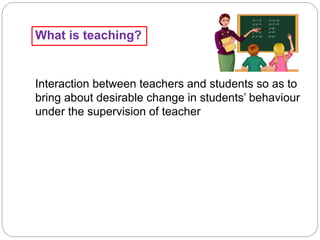
What is teaching?
Interaction between teachers and students so as to
bring about desirable change in students’ behaviour
under the supervision of teacher
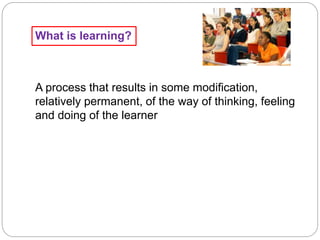
What is learning?
A process that results in some modification,
relatively permanent, of the way of thinking, feeling
and doing of the learner
 Objectives: Expected outcome of learning
 Competency: A measurable set of knowledge , skill &
attitudes that a person needs to perform effectively
Selection of teaching learning methods
 Learning objectives
 Target audiences
 Size of the group
 Ability of the instructor
 Time available for instruction
 Budget allocation
TLM
Irrespective of which method is used, one
needs:
Expertise in subject
Communication skills
 Command on language
 Voice modulation
 Body Language
Teaching learning methods: Why so many?
TLM for large groups
Lecture
Panel discussion
Symposium
Seminar
Conference
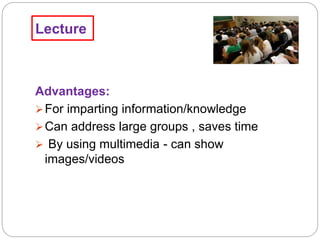
Lecture
Advantages:
For imparting information/knowledge
Can address large groups , saves time
 By using multimedia - can show
images/videos
Disadvantages of lecture:
Can’t teach all competencies
Passive learning
Minimum student involvement
If not interactive, students may lose interest
Often Lecture becomes -
“A process by which information is transferred
from the notes of the lecturer to the notes of
students without going through the minds of
either”.
SIR JOSEPH BANCROFT
How to make lectures effective?
Structuring the Content - Logical flow
In the Beginning
 Get attention: shock, humor, question, story,
facts
 Promote Active Listening
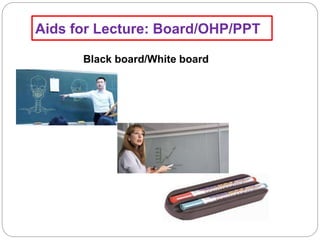
Aids for Lecture: Board/OHP/PPT
Black board/White board
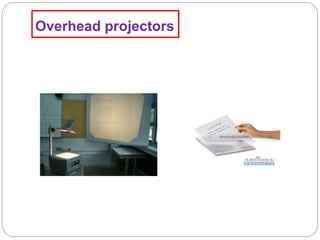
Overhead projectors
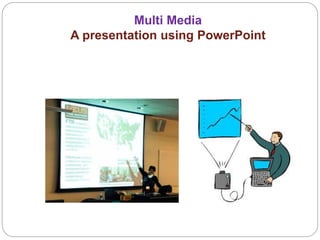
Multi Media
A presentation using PowerPoint
Chalk board/White board
Advantages
 Simple, Cheap
 Speed allows students to take notes
Limitations
 Time consuming
 Difficult to display complex table/chart/diagram
 Difficult to face audience while writing on board
 Irritation due to chalk dust
Chalk board/White board
Suggestions for Effective use
Good illumination
Ensure clarity in writing
Don’t overcrowd the board: only key points
Position of teacher
Overhead projector
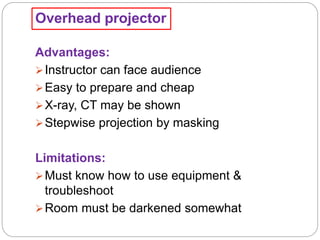
Advantages:
Instructor can face audience
Easy to prepare and cheap
X-ray, CT may be shown
Stepwise projection by masking
Limitations:
Must know how to use equipment &
troubleshoot
Room must be darkened somewhat
Overhead projector
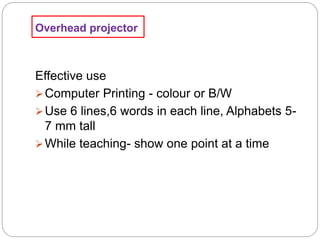
Effective use
Computer Printing - colour or B/W
Use 6 lines,6 words in each line, Alphabets 5-
7 mm tall
While teaching- show one point at a time
Power point presentation
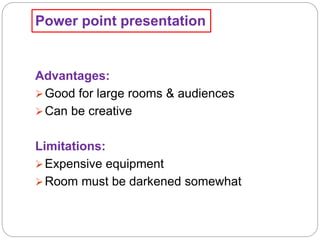
Advantages:
Good for large rooms & audiences
Can be creative
Limitations:
Expensive equipment
Room must be darkened somewhat
Power point presentation
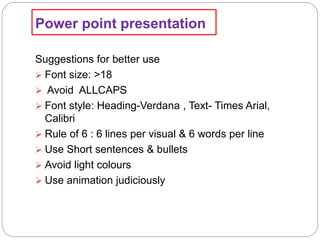
Suggestions for better use
 Font size: >18
 Avoid ALLCAPS
 Font style: Heading-Verdana , Text- Times Arial,
Calibri
 Rule of 6 : 6 lines per visual & 6 words per line
 Use Short sentences & bullets
 Avoid light colours
 Use animation judiciously
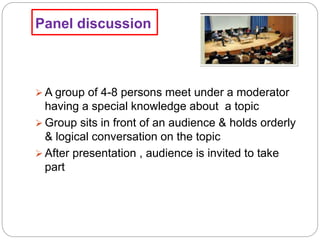
Panel discussion
 A group of 4-8 persons meet under a moderator
having a special knowledge about a topic
 Group sits in front of an audience & holds orderly
& logical conversation on the topic
 After presentation , audience is invited to take
part
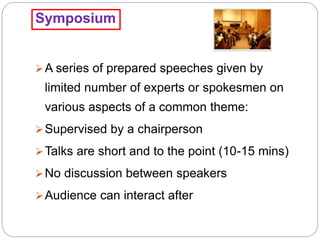
Symposium
A series of prepared speeches given by
limited number of experts or spokesmen on
various aspects of a common theme:
Supervised by a chairperson
Talks are short and to the point (10-15 mins)
No discussion between speakers
Audience can interact after
Seminar
 An activity in which a group of persons engaged in
research / advanced study of a subject matter meet
 under the general direction of an expert staff
member
 for a discussion leading to an in-depth
consideration of the subject/problem
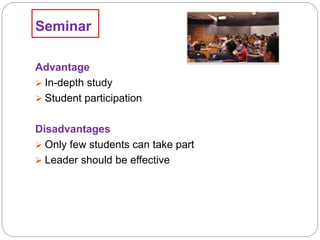
Seminar
Advantage
 In-depth study
 Student participation
Disadvantages
 Only few students can take part
 Leader should be effective
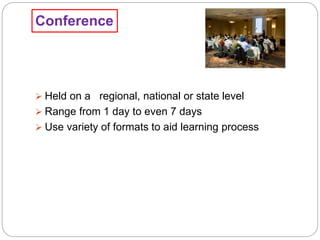
Conference
 Held on a regional, national or state level
 Range from 1 day to even 7 days
 Use variety of formats to aid learning process
TLM for small groups
Tutorial
Group discussion
Demonstration
Workshop
Role play
Others
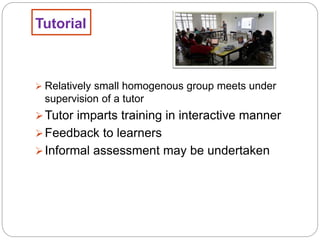
Tutorial
 Relatively small homogenous group meets under
supervision of a tutor
Tutor imparts training in interactive manner
Feedback to learners
Informal assessment may be undertaken
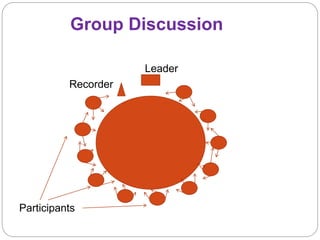
Group discussion
A face-to-face mutual interchange of ideas & opinions
 between 5-20 members
 Structured
 can still be democratic regarding information , problem
solving & taking decision
 a group leader initiates subject, help discussion ,
encourage everyone & sums up at end
 a recorder prepares report on issues discussed &
agreement reached
Group Discussion
Leader
Recorder
Participants
Group discussion
Advantage:
 Interactive
 Learners discover own strength & weakness
Disadvantage:
 Good for selected topics
 Time consuming
 Some students may dominate
Demonstration
 Carefully prepared presentation to show how to
perform a skill or procedure
 Dramatize arousing interest
 Upholds the principles of learning by doing,
 Example: Lumber puncture, demonstration of oral
rehydration technique to mothers
 have high educational & motivational value
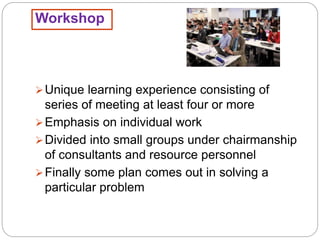
Workshop
Unique learning experience consisting of
series of meeting at least four or more
Emphasis on individual work
Divided into small groups under chairmanship
of consultants and resource personnel
Finally some plan comes out in solving a
particular problem
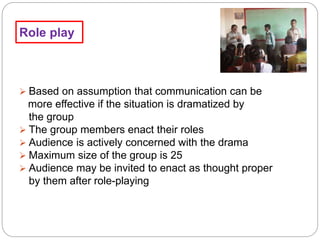
Role play
 Based on assumption that communication can be
more effective if the situation is dramatized by
the group
 The group members enact their roles
 Audience is actively concerned with the drama
 Maximum size of the group is 25
 Audience may be invited to enact as thought proper
by them after role-playing
Role play
Advantage:
 Stimulates interest
 Present vividly
 Creates long lasting impression
Disadvantage:
 More recreational than educational
 Time consuming
 Depends on students’ power of imagination
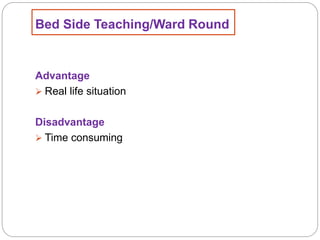
Bed Side Teaching/Ward Round
Advantage
 Real life situation
Disadvantage
 Time consuming
Effective bedside teaching
Suggestions:
 Provide good teaching environment
 Involve students / Observe students
 Patient oriented & Not disease oriented
 Role Modeling
Self Directed Learning
Advantage
 Better learner
 Confidence building
Disadvantage
 Can loose track
 Lack of validation of content
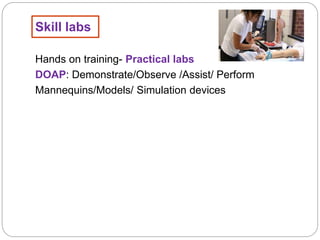
Skill labs
Hands on training- Practical labs
DOAP: Demonstrate/Observe /Assist/ Perform
Mannequins/Models/ Simulation devices
Aids for small group teaching: Flip Charts
Advantage
 Provide a written record of points
Disadvantage
 Limited writing space / changes are messy
For Effective use
 Good illumination
 Position of teacher
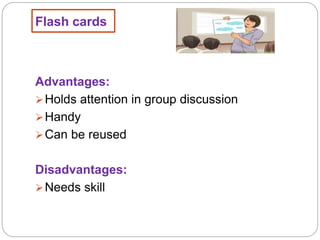
Flash cards
Advantages:
Holds attention in group discussion
Handy
Can be reused
Disadvantages:
Needs skill
Flanellograph
Flannel board and cutouts/ pictures/ text/
drawing
Useful flexible aid –used stepwise
Immediate use/repetition
Inexpensive
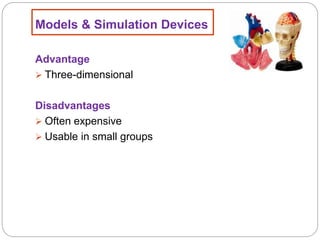
Models & Simulation Devices
Advantage
 Three-dimensional
Disadvantages
 Often expensive
 Usable in small groups
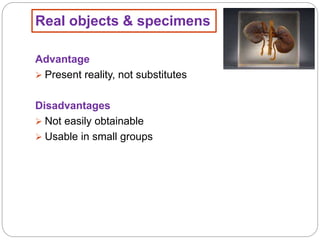
Real objects & specimens
Advantage
 Present reality, not substitutes
Disadvantages
 Not easily obtainable
 Usable in small groups
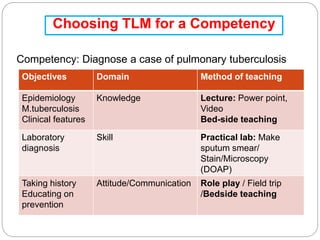
Choosing TLM for a Competency
Competency: Diagnose a case of pulmonary tuberculosis
Objectives Domain Method of teaching
Epidemiology
M.tuberculosis
Clinical features
Knowledge Lecture: Power point,
Video
Bed-side teaching
Laboratory
diagnosis
Skill Practical lab: Make
sputum smear/
Stain/Microscopy
(DOAP)
Taking history
Educating on
prevention
Attitude/Communication Role play / Field trip
/Bedside teaching
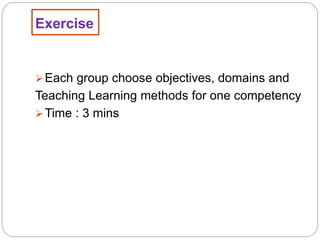
Exercise
Each group choose objectives, domains and
Teaching Learning methods for one competency
Time : 3 mins
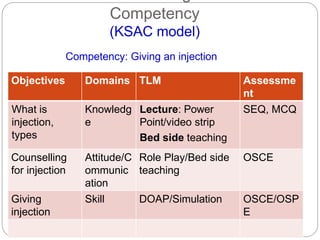
Competency
(KSAC model)
Objectives Domains TLM Assessme
nt
What is
injection,
types
Knowledg
e
Lecture: Power
Point/video strip
Bed side teaching
SEQ, MCQ
Counselling
for injection
Attitude/C
ommunic
ation
Role Play/Bed side
teaching
OSCE
Giving
injection
Skill DOAP/Simulation OSCE/OSP
E
Competency: Giving an injection
Thank you

Choosing teaching methods in nursing dean.pptx

  • 1.
    Professor Shyama PrasadMitra Professor, CM, IH&FW Choosing a teaching method for objectives and competencies
  • 2.
    “When one teaches, two learn.” Robert Half
  • 3.
    “Every teacher needsto improve not because they are not good enough , but because they can be even better”. - Dylan William
  • 4.
    Learning objectives At theend of the session the participants will be able to:  Define teaching and learning  Classify & describe various Teaching Learning Methods (TLMs)  Discuss Efficiency & Effectiveness of various TLM in different situations  Mention the advantages / limitations of each  Choose the right TLM for objectives
  • 5.
    What is teaching? Interactionbetween teachers and students so as to bring about desirable change in students’ behaviour under the supervision of teacher
  • 6.
    What is learning? Aprocess that results in some modification, relatively permanent, of the way of thinking, feeling and doing of the learner
  • 7.
     Objectives: Expectedoutcome of learning  Competency: A measurable set of knowledge , skill & attitudes that a person needs to perform effectively
  • 8.
    Selection of teachinglearning methods  Learning objectives  Target audiences  Size of the group  Ability of the instructor  Time available for instruction  Budget allocation
  • 9.
    TLM Irrespective of whichmethod is used, one needs: Expertise in subject Communication skills  Command on language  Voice modulation  Body Language
  • 10.
  • 11.
    TLM for largegroups Lecture Panel discussion Symposium Seminar Conference
  • 12.
    Lecture Advantages: For imparting information/knowledge Canaddress large groups , saves time  By using multimedia - can show images/videos
  • 13.
    Disadvantages of lecture: Can’tteach all competencies Passive learning Minimum student involvement If not interactive, students may lose interest
  • 14.
    Often Lecture becomes- “A process by which information is transferred from the notes of the lecturer to the notes of students without going through the minds of either”. SIR JOSEPH BANCROFT
  • 15.
    How to makelectures effective? Structuring the Content - Logical flow In the Beginning  Get attention: shock, humor, question, story, facts  Promote Active Listening
  • 16.
    Aids for Lecture:Board/OHP/PPT Black board/White board
  • 17.
  • 18.
  • 19.
    Chalk board/White board Advantages Simple, Cheap  Speed allows students to take notes Limitations  Time consuming  Difficult to display complex table/chart/diagram  Difficult to face audience while writing on board  Irritation due to chalk dust
  • 20.
    Chalk board/White board Suggestionsfor Effective use Good illumination Ensure clarity in writing Don’t overcrowd the board: only key points Position of teacher
  • 21.
    Overhead projector Advantages: Instructor canface audience Easy to prepare and cheap X-ray, CT may be shown Stepwise projection by masking Limitations: Must know how to use equipment & troubleshoot Room must be darkened somewhat
  • 22.
    Overhead projector Effective use ComputerPrinting - colour or B/W Use 6 lines,6 words in each line, Alphabets 5- 7 mm tall While teaching- show one point at a time
  • 23.
    Power point presentation Advantages: Goodfor large rooms & audiences Can be creative Limitations: Expensive equipment Room must be darkened somewhat
  • 24.
    Power point presentation Suggestionsfor better use  Font size: >18  Avoid ALLCAPS  Font style: Heading-Verdana , Text- Times Arial, Calibri  Rule of 6 : 6 lines per visual & 6 words per line  Use Short sentences & bullets  Avoid light colours  Use animation judiciously
  • 25.
    Panel discussion  Agroup of 4-8 persons meet under a moderator having a special knowledge about a topic  Group sits in front of an audience & holds orderly & logical conversation on the topic  After presentation , audience is invited to take part
  • 26.
    Symposium A series ofprepared speeches given by limited number of experts or spokesmen on various aspects of a common theme: Supervised by a chairperson Talks are short and to the point (10-15 mins) No discussion between speakers Audience can interact after
  • 27.
    Seminar  An activityin which a group of persons engaged in research / advanced study of a subject matter meet  under the general direction of an expert staff member  for a discussion leading to an in-depth consideration of the subject/problem
  • 28.
    Seminar Advantage  In-depth study Student participation Disadvantages  Only few students can take part  Leader should be effective
  • 29.
    Conference  Held ona regional, national or state level  Range from 1 day to even 7 days  Use variety of formats to aid learning process
  • 30.
    TLM for smallgroups Tutorial Group discussion Demonstration Workshop Role play Others
  • 31.
    Tutorial  Relatively smallhomogenous group meets under supervision of a tutor Tutor imparts training in interactive manner Feedback to learners Informal assessment may be undertaken
  • 32.
    Group discussion A face-to-facemutual interchange of ideas & opinions  between 5-20 members  Structured  can still be democratic regarding information , problem solving & taking decision  a group leader initiates subject, help discussion , encourage everyone & sums up at end  a recorder prepares report on issues discussed & agreement reached
  • 33.
  • 34.
    Group discussion Advantage:  Interactive Learners discover own strength & weakness Disadvantage:  Good for selected topics  Time consuming  Some students may dominate
  • 35.
    Demonstration  Carefully preparedpresentation to show how to perform a skill or procedure  Dramatize arousing interest  Upholds the principles of learning by doing,  Example: Lumber puncture, demonstration of oral rehydration technique to mothers  have high educational & motivational value
  • 36.
    Workshop Unique learning experienceconsisting of series of meeting at least four or more Emphasis on individual work Divided into small groups under chairmanship of consultants and resource personnel Finally some plan comes out in solving a particular problem
  • 37.
    Role play  Basedon assumption that communication can be more effective if the situation is dramatized by the group  The group members enact their roles  Audience is actively concerned with the drama  Maximum size of the group is 25  Audience may be invited to enact as thought proper by them after role-playing
  • 38.
    Role play Advantage:  Stimulatesinterest  Present vividly  Creates long lasting impression Disadvantage:  More recreational than educational  Time consuming  Depends on students’ power of imagination
  • 39.
    Bed Side Teaching/WardRound Advantage  Real life situation Disadvantage  Time consuming
  • 40.
    Effective bedside teaching Suggestions: Provide good teaching environment  Involve students / Observe students  Patient oriented & Not disease oriented  Role Modeling
  • 41.
    Self Directed Learning Advantage Better learner  Confidence building Disadvantage  Can loose track  Lack of validation of content
  • 42.
    Skill labs Hands ontraining- Practical labs DOAP: Demonstrate/Observe /Assist/ Perform Mannequins/Models/ Simulation devices
  • 43.
    Aids for smallgroup teaching: Flip Charts Advantage  Provide a written record of points Disadvantage  Limited writing space / changes are messy For Effective use  Good illumination  Position of teacher
  • 44.
    Flash cards Advantages: Holds attentionin group discussion Handy Can be reused Disadvantages: Needs skill
  • 45.
    Flanellograph Flannel board andcutouts/ pictures/ text/ drawing Useful flexible aid –used stepwise Immediate use/repetition Inexpensive
  • 46.
    Models & SimulationDevices Advantage  Three-dimensional Disadvantages  Often expensive  Usable in small groups
  • 47.
    Real objects &specimens Advantage  Present reality, not substitutes Disadvantages  Not easily obtainable  Usable in small groups
  • 48.
    Choosing TLM fora Competency Competency: Diagnose a case of pulmonary tuberculosis Objectives Domain Method of teaching Epidemiology M.tuberculosis Clinical features Knowledge Lecture: Power point, Video Bed-side teaching Laboratory diagnosis Skill Practical lab: Make sputum smear/ Stain/Microscopy (DOAP) Taking history Educating on prevention Attitude/Communication Role play / Field trip /Bedside teaching
  • 49.
    Exercise Each group chooseobjectives, domains and Teaching Learning methods for one competency Time : 3 mins
  • 50.
    Competency (KSAC model) Objectives DomainsTLM Assessme nt What is injection, types Knowledg e Lecture: Power Point/video strip Bed side teaching SEQ, MCQ Counselling for injection Attitude/C ommunic ation Role Play/Bed side teaching OSCE Giving injection Skill DOAP/Simulation OSCE/OSP E Competency: Giving an injection
  • 51.