MEU-VIMS, Pawapuri
Dr. G.P.Singh
Associate Professor of Medicine
VIMS, Pawapuri, Nalanda, Bihar
MIU, VIMS Pawapuri, Nalanda, Bihar
Writing Objectives, Developing
Objectives from Competencies,
linking learning and assessment
with competencies .
----------------------------------------------
Dr. Ganesh Prasad Singh
Associate Professor of Medicine
VIMS, Pawapuri, Nalanda, Bihar
Objective
• At the end of this session the participants will be
able to:-
a)- Define competency & L. Objective
b)-Differentiate between Competency & L.
Objective
c)-Frame L. Objective from given
Competency
Contd--
-
d)-Chose T-L method for given L. Objective
e)- Choose method of Assessment for
given L. Objective & T.L. method
-
In Medical Education, we have-
A GOAL---- To produce Indian
Medical Graduate (IMG)
-
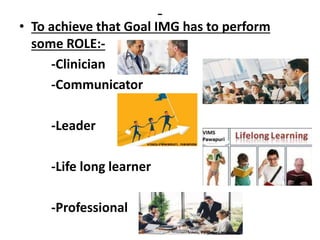
• To achieve that Goal IMG has to perform
some ROLE:-
-Clinician
-Communicator
-Leader
-Life long learner
-Professional
-
• To perform these roles
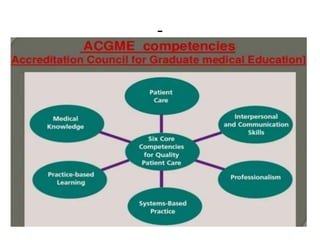
IMC needs certain competencies.
*-The competencies expected in the IMG
are listed in Graduate Medical Education
Regulation(GMER) 2019
*-The IMG has to acquire all
the listed competencies
*-To acquire these competencies the IMG
has to learn
-
*-To learn these competencies, learning
Objectives have to be developed
*-Learning Objectives are, what a learner
should be able to do at the end of a
particular learning session
*-Dividing Competencies in to learning
objectives makes learning easier
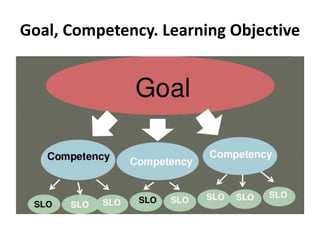
Goal, Competency. Learning Objective
-
• Role to be Played by IMC:-
- Clinician who provides
Preventive,
Promotive,
Curative,
Palliative and Holistic care
with compassion
-
• For this role, the IMG will
need to acquire some competencies
like:-
-Understand normal and
abnormal structure and function of
human body
-Be capable of clinical problem
solving
-
-Understand medico legal,
Ethical and Humanitarian principal of
health care
-Know when to refer the patient
to other
-Understand National &
Regional health care policies
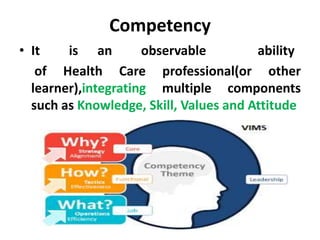
Competency
• It is an observable ability
of Health Care professional(or other
learner),integrating multiple components
such as Knowledge, Skill, Values and Attitude
-
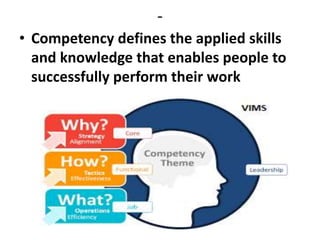
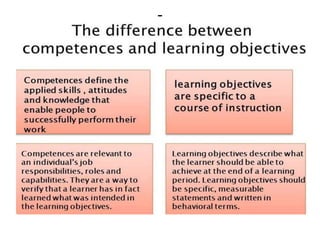
• Competency defines the applied skills
and knowledge that enables people to
successfully perform their work
-
• Example:- The IMG should be able
to demonstrate knowledge of
normal human structure, function
and development from molecular,
clinical, behavioral and social
prospective
-
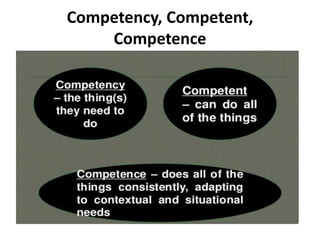
Competency, Competent,
Competence
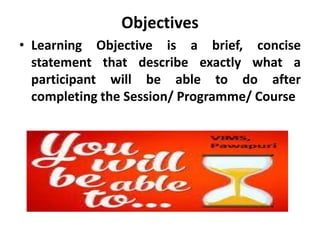
Objectives
• Learning Objective is a brief, concise
statement that describe exactly what a
participant will be able to do after
completing the Session/ Programme/ Course
-
• Education Objective may be of 3 types
at 3 levels
- Institutional Objective
-Departmental Objective
-Specific Learning Objective
-
• Institutional Objective :-
“-At the end of M.B;B.S course the
students will be able to provide
independently Preventive and Curative
care to Individual and Community in
health and in disease”
-
• Departmental Objective:-
“ At the end of final M.B;B.S.
year the students will be able to Diagnose
and Treat common infectious diseases in
adults under supervision”
“ At the end of final M.B;B.S. year
students will be able to diagnose and treat
common Cardio vascular Diseases in adults
under supervision”
-
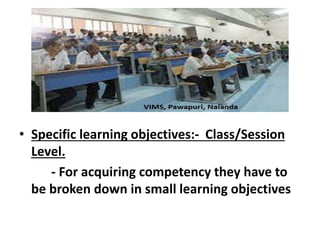
• Specific learning objectives:- Class/Session
Level.
- For acquiring competency they have to
be broken down in small learning objectives
-
- SLOs are brief, concise and specific
statements that describe what a
participant will be able to do after
completing the session
-SLOs are specific and measurable
whether the participant has met that
learning objective or not
-
• Example of SLO:-
“At the end of this Lecture/
Tutorial/Small group teaching session
the students of Final M.B;B.S.
will be able to define CPR”
-
• “ At the end of this clinical session the
student of final M.B;B.S will be able to record
Blood Pressure of an adult by
sphygmomanometer in supine position with
an accuracy of +/- 5mm. Hg.”
Competencies/Objectives
• Competency
- defines the applied skill and
knowledge that enables people successfully
do their work
-Are relevant to an individuals job
responsibility, Role & capability. They are a
way to verify that a learner has in fact learned
what was intended in the learning objective
-
Objectives-
-Are specific to a course of interaction
-Describe what the learner should be able
to do at the end of the learning period.
-Are measurable statements and written in
behavioral form
In short- Objective says what we want the
learner to know / Competency says how we
can be certain they know it.
-
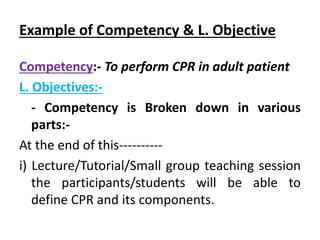
Example of Competency & L. Objective
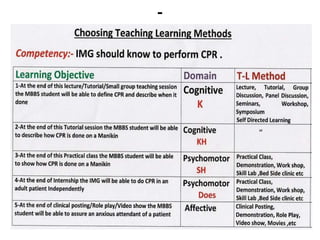
Competency:- To perform CPR in adult patient
L. Objectives:-
- Competency is Broken down in various
parts:-
At the end of this----------
i) Lecture/Tutorial/Small group teaching session
the participants/students will be able to
define CPR and its components.
-
Ii- this demonstration session the
participant/ student will be able to
describe how CPR is done on a Manikin
Iii- this practical class the participant/
student will be able to do CPR on an
adult manikin without an error
-
Iv- this clinical posting in emergency
department the Medical Intern will be
able to show CPR in adult patient under
supervision
V - internship the Doctor will be able to do
CPR in an adult patient independently
Developing Learning objectives from
competencies
Competency of this session:- “Developing
Learning Objective from competencies”
SLO of this session:- At the end of this session
the participants will be able to:-
i- Define specific Learning Objective (SLO)
ii-Describe the elements and qualities of SLO
iii-Develop SLO from given competency
-
• Definition of SLO:- Brief, Concise and specific
statement of what the learner will be able to
do at the end of a Teaching-Learning activity
(Beginning from the end in mind)
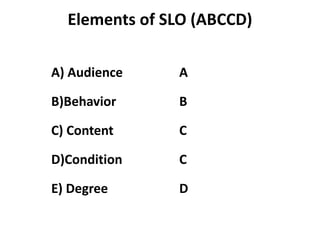
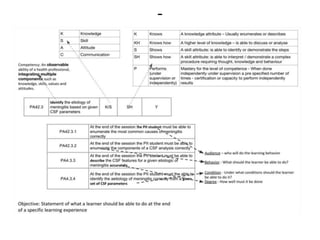
Elements of SLO (ABCCD)
A) Audience A
B)Behavior B
C) Content C
D)Condition C
E) Degree D
-
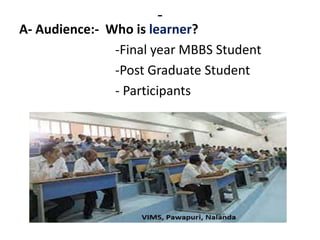
A- Audience:- Who is learner?
-Final year MBBS Student
-Post Graduate Student
- Participants
-
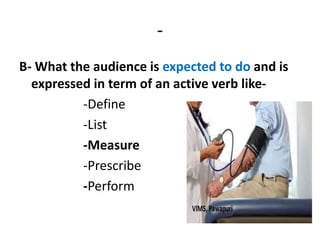
B- What the audience is expected to do and is
expressed in term of an active verb like-
-Define
-List
-Measure
-Prescribe
-Perform
-
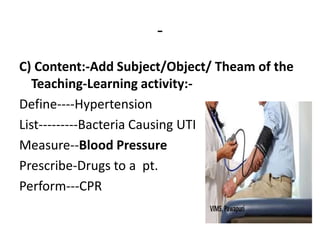
C) Content:-Add Subject/Object/ Theam of the
Teaching-Learning activity:-
Define----Hypertension
List---------Bacteria Causing UTI
Measure--Blood Pressure
Prescribe-Drugs to a pt.
Perform---CPR
-
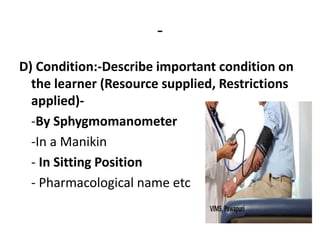
D) Condition:-Describe important condition on
the learner (Resource supplied, Restrictions
applied)-
-By Sphygmomanometer
-In a Manikin
- In Sitting Position
- Pharmacological name etc
-
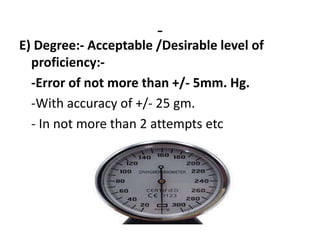
E) Degree:- Acceptable /Desirable level of
proficiency:-
-Error of not more than +/- 5mm. Hg.
-With accuracy of +/- 25 gm.
- In not more than 2 attempts etc
Qualities of SLO (SMART)
• Specific
• Measurable
• Achievable
• Realistic
• Time bound
Specific
• To help set specific objectives ask the following:
a. What exactly are we going to do, with or for whom?
b. What strategies will be used?
c. Is the objective described with action verbs?
d. Is it clear who is involved?
e. Is it clear where this will happen?
f. Is it clear what will happen?
g. Is the outcome clear?
h. Will this objective lead to the desired results?
Measurable
• All activities should be measurable at some level. To
determine if your objective is measurable, ask
questions such as:
a. How much? How many?
b. How will I know when it is accomplished?
c. How will I know that the change has occurred?
d. Can these measurements be obtained?
Achievable
• With a reasonable amount of effort and
application can the objective be achieved??
a. Can we get it done in the proposed
timeframe?
b. Do I understand the limitations and
constraints?
c. Has anyone else done this successfully?
d. Is this possible?
Relevant
a. Can you realistically achieve the
objectives with the resources you
have?
b. Do we need to revisit priorities to make
this happen?
Time-framed
• When will this objective be
accomplished? This means stating clearly
when the objective will be achieved.
Deadlines create the all- important sense
of urgency.
a. When will this objective be
accomplished? Is there a stated
deadline?
-
• Example of SLO which fulfils Qualities of
SLO:-
At the end of this practical class II MBBS
students will be able to measure the Blood
pressure of a patient with
sphygmomanometer in supine position with
an error of not more than +/-5mm. Of Hg.
Some SLO which do not fulfill above
qualities
SLO- At the end of this lecture the III MBBS
student will be able to describe in detail the
steps of Liver Transplantation
- No achievable for III MBBS student
and irrelevant to him/her
SLO-At the end of this demonstration the Junior
Resident will be able to perform Hip
replacement surgery independently
-Unrealistic/not achievable
Steps in framing SLO
• Competency- Students should know measuring
Blood pressure in Adults
Frame SLOs for above competency:-
Step-1-Create a stem--- It begins like
“At the end of this---------------
add T-L activity
“At the end of this clinical session--------
-
Step-2- Identify an add Audience(Learner)for
this T-L session
UG student/ PG student/
Participants etc
“At the end of this clinical session
the final MBBS student-----------------
-
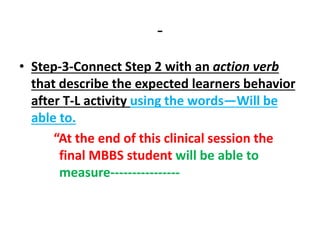
• Step-3-Connect Step 2 with an action verb
that describe the expected learners behavior
after T-L activity using the words—Will be
able to.
“At the end of this clinical session the
final MBBS student will be able to
measure----------------
-
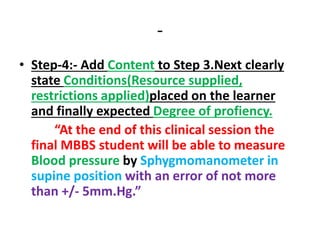
• Step-4:- Add Content to Step 3.Next clearly
state Conditions(Resource supplied,
restrictions applied)placed on the learner
and finally expected Degree of profiency.
“At the end of this clinical session the
final MBBS student will be able to measure
Blood pressure by Sphygmomanometer in
supine position with an error of not more
than +/- 5mm.Hg.”
-
Step-5 Use Check list to review SLO whether it
is effectively formed (Specific, Measurable,
Achievable.Realastic, Time bond)
“At the end of this clinical session the final
MBBS student will be able to measure Blood
pressure by Sphygmomanometer in supine
position with an error of not more than +/-
5mm.Hg.”
-
-
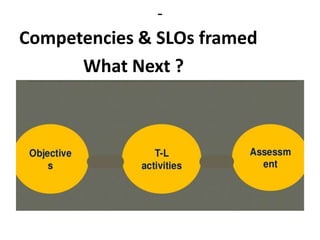
Competencies & SLOs framed
What Next ?
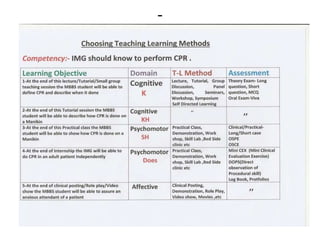
Teaching- Learning
-
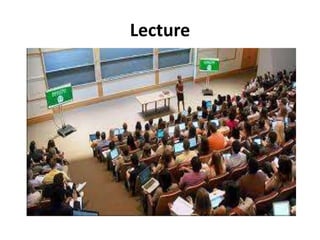
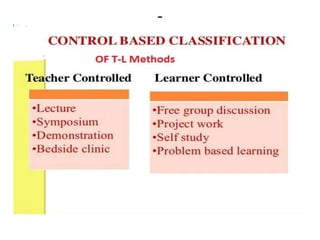
Lecture
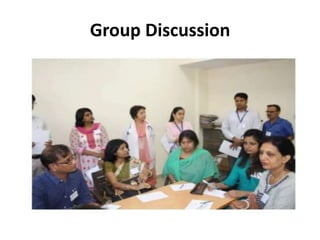
Group Discussion
-
-
-
-
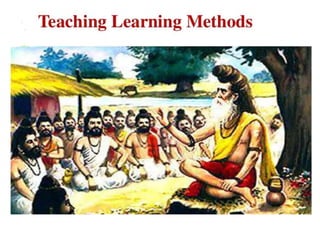
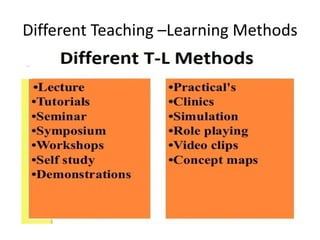
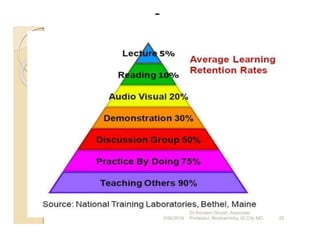
Different Teaching –Learning Methods
-
-
-
-
-
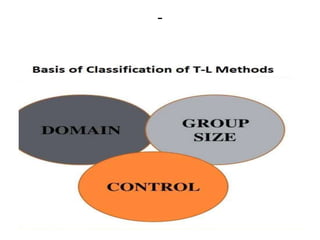
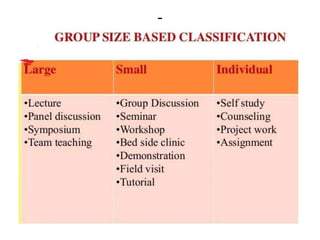
Choosing T-L Method
• There is no such thing as best teaching
method. The best method is the one
that works, that yields in given
circumstance.
-
• Choosing T-L methods depends on many
factors including-
- Competencies & Learning objectives
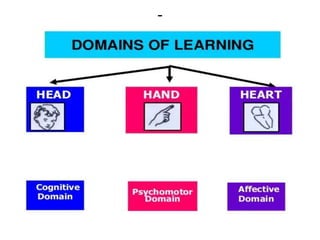
-Domain of learning in given L. Objective
-Available Time
-Availability of Faculty
- Space, Equipment , Other facilities
-
-
-
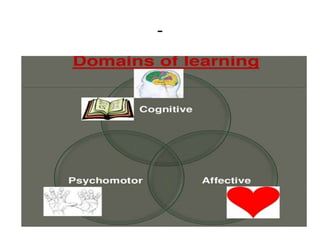
Cognitive Domain
• It is domain of cognitive function only---Brain
• Does not require muscular co-ordination-
(Psychomotor Domain)
• Does not require Ethics, Attitude &
Communication ( Affective Domain)
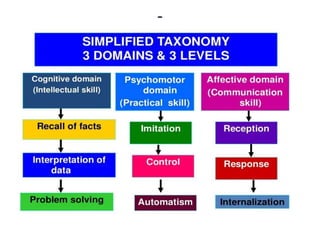
Cognitive Domain
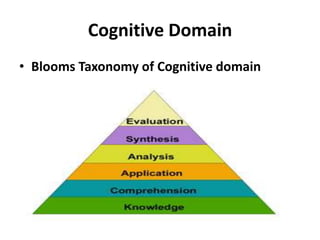
• Blooms Taxonomy of Cognitive domain
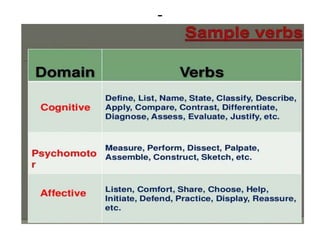
Action Verbs of Cognitive Domain
• Define
• Discuss
• Explain
• Express
• innumerate
• Report
• Recognize
• Review etc
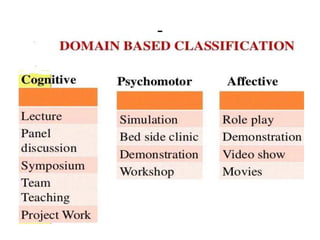
Teaching-Learning Methods for
Cognitive Domain
• Lecture
• Tutorial
• Group Discussion
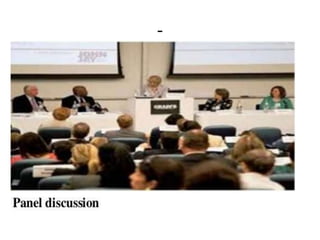
• Panel Discussion
• Seminars
• Workshop
• Symposium
• Self Directed Learning
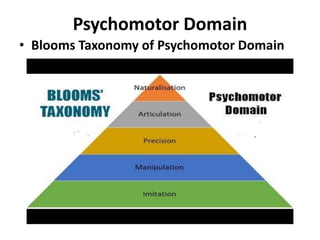
Psychomotor Domain
• Blooms Taxonomy of Psychomotor Domain
Psychomotor Domain
• Domain of Practical skill
• Requires neuro muscular co ordination
• Cognitive domain is prerequisite (Body does
only what the brain knows)
• Action Verbs:-Measure, Count, Palpate, Per
cuss, Auscultate, Inject, Insert etc
T-L method for Psychomotor domain
• Practical Class
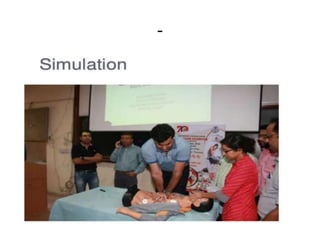
• Demonstration
• Work shop
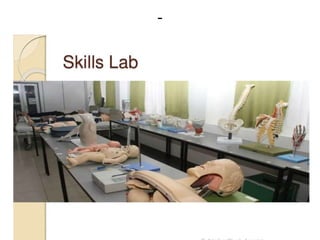
• Skill Lab
• Bed Side clinic etc
Affective Domain
• Domain of Communication Skill
• Deals with interpersonal relationship
• Relates to Ethics, Attitude & Communication
• Action Verbs Used:-Receive, Respond, Display,
Interact, Co-operate, motivate, Assure,
Contribute etc
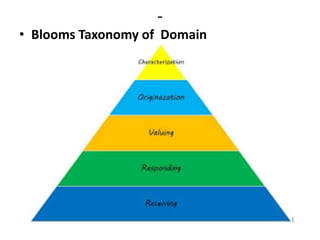
-
• Blooms Taxonomy of Domain
T-L method for Affective Domain
• Clinical Posting
• Demonstration
• Role Play
• Video show
• Movies etc
-
-
-
-
-
-
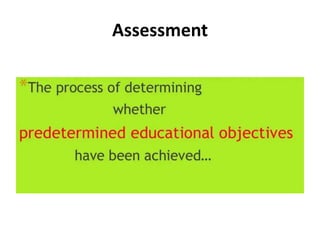
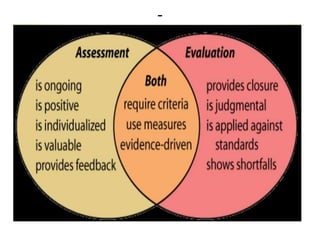
Assessment
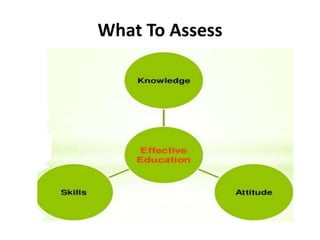
What To Assess
-
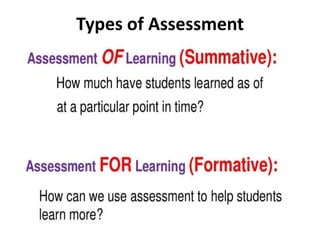
Types of Assessment
-
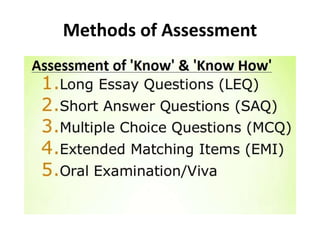
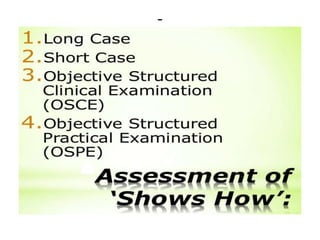
Methods of Assessment
-
-
-
-
-
Thank You
Write the Objective
Teach based on the Objective
Assess Over the Objective

MEU Workshop, writing objectives, Developing objectives from competencies, linking learning and assessment with competency

  • 1.
    MEU-VIMS, Pawapuri Dr. G.P.Singh AssociateProfessor of Medicine VIMS, Pawapuri, Nalanda, Bihar
  • 2.
    MIU, VIMS Pawapuri,Nalanda, Bihar Writing Objectives, Developing Objectives from Competencies, linking learning and assessment with competencies . ---------------------------------------------- Dr. Ganesh Prasad Singh Associate Professor of Medicine VIMS, Pawapuri, Nalanda, Bihar
  • 3.
    Objective • At theend of this session the participants will be able to:- a)- Define competency & L. Objective b)-Differentiate between Competency & L. Objective c)-Frame L. Objective from given Competency Contd--
  • 4.
    - d)-Chose T-L methodfor given L. Objective e)- Choose method of Assessment for given L. Objective & T.L. method
  • 5.
    - In Medical Education,we have- A GOAL---- To produce Indian Medical Graduate (IMG)
  • 6.
    - • To achievethat Goal IMG has to perform some ROLE:- -Clinician -Communicator -Leader -Life long learner -Professional
  • 7.
    - • To performthese roles IMC needs certain competencies. *-The competencies expected in the IMG are listed in Graduate Medical Education Regulation(GMER) 2019 *-The IMG has to acquire all the listed competencies *-To acquire these competencies the IMG has to learn
  • 8.
    - *-To learn thesecompetencies, learning Objectives have to be developed *-Learning Objectives are, what a learner should be able to do at the end of a particular learning session *-Dividing Competencies in to learning objectives makes learning easier
  • 9.
  • 10.
    - • Role tobe Played by IMC:- - Clinician who provides Preventive, Promotive, Curative, Palliative and Holistic care with compassion
  • 11.
    - • For thisrole, the IMG will need to acquire some competencies like:- -Understand normal and abnormal structure and function of human body -Be capable of clinical problem solving
  • 12.
    - -Understand medico legal, Ethicaland Humanitarian principal of health care -Know when to refer the patient to other -Understand National & Regional health care policies
  • 13.
    Competency • It isan observable ability of Health Care professional(or other learner),integrating multiple components such as Knowledge, Skill, Values and Attitude
  • 14.
    - • Competency definesthe applied skills and knowledge that enables people to successfully perform their work
  • 15.
    - • Example:- TheIMG should be able to demonstrate knowledge of normal human structure, function and development from molecular, clinical, behavioral and social prospective
  • 16.
  • 17.
  • 18.
    Objectives • Learning Objectiveis a brief, concise statement that describe exactly what a participant will be able to do after completing the Session/ Programme/ Course
  • 19.
    - • Education Objectivemay be of 3 types at 3 levels - Institutional Objective -Departmental Objective -Specific Learning Objective
  • 20.
    - • Institutional Objective:- “-At the end of M.B;B.S course the students will be able to provide independently Preventive and Curative care to Individual and Community in health and in disease”
  • 21.
    - • Departmental Objective:- “At the end of final M.B;B.S. year the students will be able to Diagnose and Treat common infectious diseases in adults under supervision” “ At the end of final M.B;B.S. year students will be able to diagnose and treat common Cardio vascular Diseases in adults under supervision”
  • 22.
    - • Specific learningobjectives:- Class/Session Level. - For acquiring competency they have to be broken down in small learning objectives
  • 23.
    - - SLOs arebrief, concise and specific statements that describe what a participant will be able to do after completing the session -SLOs are specific and measurable whether the participant has met that learning objective or not
  • 24.
    - • Example ofSLO:- “At the end of this Lecture/ Tutorial/Small group teaching session the students of Final M.B;B.S. will be able to define CPR”
  • 25.
    - • “ Atthe end of this clinical session the student of final M.B;B.S will be able to record Blood Pressure of an adult by sphygmomanometer in supine position with an accuracy of +/- 5mm. Hg.”
  • 26.
    Competencies/Objectives • Competency - definesthe applied skill and knowledge that enables people successfully do their work -Are relevant to an individuals job responsibility, Role & capability. They are a way to verify that a learner has in fact learned what was intended in the learning objective
  • 27.
    - Objectives- -Are specific toa course of interaction -Describe what the learner should be able to do at the end of the learning period. -Are measurable statements and written in behavioral form In short- Objective says what we want the learner to know / Competency says how we can be certain they know it.
  • 28.
  • 29.
    Example of Competency& L. Objective Competency:- To perform CPR in adult patient L. Objectives:- - Competency is Broken down in various parts:- At the end of this---------- i) Lecture/Tutorial/Small group teaching session the participants/students will be able to define CPR and its components.
  • 30.
    - Ii- this demonstrationsession the participant/ student will be able to describe how CPR is done on a Manikin Iii- this practical class the participant/ student will be able to do CPR on an adult manikin without an error
  • 31.
    - Iv- this clinicalposting in emergency department the Medical Intern will be able to show CPR in adult patient under supervision V - internship the Doctor will be able to do CPR in an adult patient independently
  • 32.
    Developing Learning objectivesfrom competencies Competency of this session:- “Developing Learning Objective from competencies” SLO of this session:- At the end of this session the participants will be able to:- i- Define specific Learning Objective (SLO) ii-Describe the elements and qualities of SLO iii-Develop SLO from given competency
  • 33.
    - • Definition ofSLO:- Brief, Concise and specific statement of what the learner will be able to do at the end of a Teaching-Learning activity (Beginning from the end in mind)
  • 34.
    Elements of SLO(ABCCD) A) Audience A B)Behavior B C) Content C D)Condition C E) Degree D
  • 35.
    - A- Audience:- Whois learner? -Final year MBBS Student -Post Graduate Student - Participants
  • 36.
    - B- What theaudience is expected to do and is expressed in term of an active verb like- -Define -List -Measure -Prescribe -Perform
  • 37.
    - C) Content:-Add Subject/Object/Theam of the Teaching-Learning activity:- Define----Hypertension List---------Bacteria Causing UTI Measure--Blood Pressure Prescribe-Drugs to a pt. Perform---CPR
  • 38.
    - D) Condition:-Describe importantcondition on the learner (Resource supplied, Restrictions applied)- -By Sphygmomanometer -In a Manikin - In Sitting Position - Pharmacological name etc
  • 39.
    - E) Degree:- Acceptable/Desirable level of proficiency:- -Error of not more than +/- 5mm. Hg. -With accuracy of +/- 25 gm. - In not more than 2 attempts etc
  • 40.
    Qualities of SLO(SMART) • Specific • Measurable • Achievable • Realistic • Time bound
  • 41.
    Specific • To helpset specific objectives ask the following: a. What exactly are we going to do, with or for whom? b. What strategies will be used? c. Is the objective described with action verbs? d. Is it clear who is involved? e. Is it clear where this will happen? f. Is it clear what will happen? g. Is the outcome clear? h. Will this objective lead to the desired results?
  • 42.
    Measurable • All activitiesshould be measurable at some level. To determine if your objective is measurable, ask questions such as: a. How much? How many? b. How will I know when it is accomplished? c. How will I know that the change has occurred? d. Can these measurements be obtained?
  • 43.
    Achievable • With areasonable amount of effort and application can the objective be achieved?? a. Can we get it done in the proposed timeframe? b. Do I understand the limitations and constraints? c. Has anyone else done this successfully? d. Is this possible?
  • 44.
    Relevant a. Can yourealistically achieve the objectives with the resources you have? b. Do we need to revisit priorities to make this happen?
  • 45.
    Time-framed • When willthis objective be accomplished? This means stating clearly when the objective will be achieved. Deadlines create the all- important sense of urgency. a. When will this objective be accomplished? Is there a stated deadline?
  • 46.
    - • Example ofSLO which fulfils Qualities of SLO:- At the end of this practical class II MBBS students will be able to measure the Blood pressure of a patient with sphygmomanometer in supine position with an error of not more than +/-5mm. Of Hg.
  • 47.
    Some SLO whichdo not fulfill above qualities SLO- At the end of this lecture the III MBBS student will be able to describe in detail the steps of Liver Transplantation - No achievable for III MBBS student and irrelevant to him/her SLO-At the end of this demonstration the Junior Resident will be able to perform Hip replacement surgery independently -Unrealistic/not achievable
  • 48.
    Steps in framingSLO • Competency- Students should know measuring Blood pressure in Adults Frame SLOs for above competency:- Step-1-Create a stem--- It begins like “At the end of this--------------- add T-L activity “At the end of this clinical session--------
  • 49.
    - Step-2- Identify anadd Audience(Learner)for this T-L session UG student/ PG student/ Participants etc “At the end of this clinical session the final MBBS student-----------------
  • 50.
    - • Step-3-Connect Step2 with an action verb that describe the expected learners behavior after T-L activity using the words—Will be able to. “At the end of this clinical session the final MBBS student will be able to measure----------------
  • 51.
    - • Step-4:- AddContent to Step 3.Next clearly state Conditions(Resource supplied, restrictions applied)placed on the learner and finally expected Degree of profiency. “At the end of this clinical session the final MBBS student will be able to measure Blood pressure by Sphygmomanometer in supine position with an error of not more than +/- 5mm.Hg.”
  • 52.
    - Step-5 Use Checklist to review SLO whether it is effectively formed (Specific, Measurable, Achievable.Realastic, Time bond) “At the end of this clinical session the final MBBS student will be able to measure Blood pressure by Sphygmomanometer in supine position with an error of not more than +/- 5mm.Hg.”
  • 53.
  • 54.
    - Competencies & SLOsframed What Next ?
  • 55.
  • 56.
  • 57.
  • 58.
  • 59.
  • 60.
  • 61.
  • 62.
  • 63.
  • 64.
  • 65.
  • 66.
  • 67.
  • 68.
  • 69.
    Choosing T-L Method •There is no such thing as best teaching method. The best method is the one that works, that yields in given circumstance.
  • 70.
    - • Choosing T-Lmethods depends on many factors including- - Competencies & Learning objectives -Domain of learning in given L. Objective -Available Time -Availability of Faculty - Space, Equipment , Other facilities
  • 71.
  • 72.
  • 73.
  • 74.
    Cognitive Domain • Itis domain of cognitive function only---Brain • Does not require muscular co-ordination- (Psychomotor Domain) • Does not require Ethics, Attitude & Communication ( Affective Domain)
  • 75.
    Cognitive Domain • BloomsTaxonomy of Cognitive domain
  • 76.
    Action Verbs ofCognitive Domain • Define • Discuss • Explain • Express • innumerate • Report • Recognize • Review etc
  • 77.
    Teaching-Learning Methods for CognitiveDomain • Lecture • Tutorial • Group Discussion • Panel Discussion • Seminars • Workshop • Symposium • Self Directed Learning
  • 78.
    Psychomotor Domain • BloomsTaxonomy of Psychomotor Domain
  • 79.
    Psychomotor Domain • Domainof Practical skill • Requires neuro muscular co ordination • Cognitive domain is prerequisite (Body does only what the brain knows) • Action Verbs:-Measure, Count, Palpate, Per cuss, Auscultate, Inject, Insert etc
  • 80.
    T-L method forPsychomotor domain • Practical Class • Demonstration • Work shop • Skill Lab • Bed Side clinic etc
  • 81.
    Affective Domain • Domainof Communication Skill • Deals with interpersonal relationship • Relates to Ethics, Attitude & Communication • Action Verbs Used:-Receive, Respond, Display, Interact, Co-operate, motivate, Assure, Contribute etc
  • 82.
  • 83.
    T-L method forAffective Domain • Clinical Posting • Demonstration • Role Play • Video show • Movies etc
  • 84.
  • 85.
  • 86.
  • 87.
  • 88.
  • 89.
  • 90.
  • 91.
  • 92.
  • 93.
  • 94.
  • 95.
  • 96.
  • 97.
  • 98.
  • 99.
  • 100.
  • 101.
    Thank You Write theObjective Teach based on the Objective Assess Over the Objective