
Problem based learning
Principles and Practice
An overview
Grace Lindsay BSc(Hons)RN MN PhD
Nursing Faculty
Umm Al Qura University
Makkah
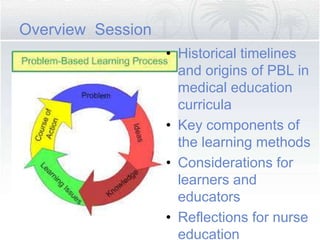
Overview Session
• Historical timelines
and origins of PBL in
medical education
curricula
• Key components of
the learning methods
• Considerations for
learners and
educators
• Reflections for nurse
education
Central learning forum: planning,
exchange shaping, thinking, concluding
+++ ………
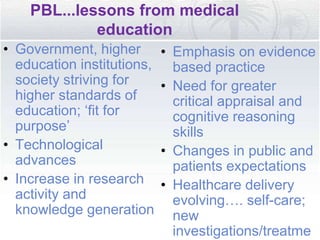
PBL...lessons from medical
education
• Government, higher
education institutions,
society striving for
higher standards of
education; ‘fit for
purpose’
• Technological
advances
• Increase in research
activity and
knowledge generation
• Emphasis on evidence
based practice
• Need for greater
critical appraisal and
cognitive reasoning
skills
• Changes in public and
patients expectations
• Healthcare delivery
evolving…. self-care;
new
investigations/treatme
New Horizons in Medical Education
• Patient’s expectations
• HC delivery (style of doctors)
• Medical knowledge exponential
growth
• Traditionally curriculum structured as a
progression from basic sciences to clinical
sciences; little integration
• Failing to prepare students adequately for
diversity of problems they will encounter as
professionals.
What was the response to these
challenges?
• The development of new curricula
incorporating new themes & different
educational strategies
• The introduction of new learning situations
& the use of new tools & aids to learning
• New methods of assessment [OSCE - tests
performance & competence in a wide
diversity of clinical settings; Formative
Assessment; Portfolio assessment; Work-
based assess]
Problem based Learning (PBL)
• Helps learners build a bridge between what
already known ……to…. what need to know
to find answers to problem
• Active learning, which has been shown to
be more satisfying than passive teacher-to-
student learning; enhances retention and
recall
• Emphasizing student-centered learning in
which students are actively involved in
setting their own broader learning goals in
line with learning outcomes of curriculum
unit
PBL: What is it?
• Problem-based learning (PBL)- learners first
encounter a problem followed by a
systematic, learner-centered inquiry and
reflection process.
• PBL designed to support learning sciences
basic to medicine….. at same time as they
develop reasoning processes used by
physicians and other health professionals in
clinical practice.
􀂄 The problem presented first without
advance readings, lectures, or preparation.
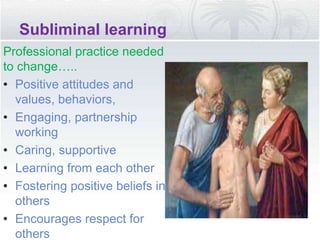
Subliminal learning
Professional practice needed
to change…..
• Positive attitudes and
values, behaviors,
• Engaging, partnership
working
• Caring, supportive
• Learning from each other
• Fostering positive beliefs in
others
• Encourages respect for
others
Supported with Tools & Aids
• Use of Study Guides
• Use of Computer Assisted Programs &
Internet
• Use of Videos to teach Clinical
Skills/consultation techniques
• Role of Simulators embraced
• Simulations in aspects of physical exam &
practical procedures
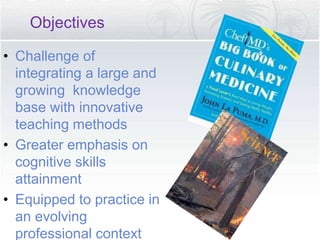
• Challenge of
integrating a large and
growing knowledge
base with innovative
teaching methods
• Greater emphasis on
cognitive skills
attainment
• Equipped to practice in
an evolving
professional context
Objectives
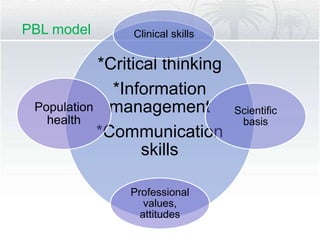
*Critical thinking
*Information
management
*Communication
skills
Clinical skills
Scientific
basis
Professional
values,
attitudes
Population
health
PBL model
PBL Group in action (1)
• No need for prior
knowledge to
generate ideas for
further collective &
personal learning
• Each member brings
experience and
distinctive contribution
• Tutor focus to manage
interactions
• Students nominate a
scribe and chair
• Safe environment for
sharing and testing new
knowledge & ideas
• Brainstorming
• Group evaluates
contributions; feedback
from peers and tutor
• When accompanied by
clinical exposure-
intellectual & practical
skills develop in parallel
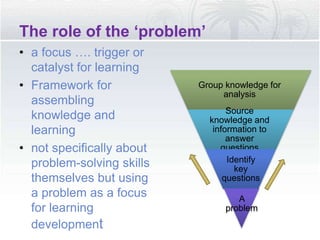
The role of the ‘problem’
• a focus …. trigger or
catalyst for learning
• Framework for
assembling
knowledge and
learning
• not specifically about
problem-solving skills
themselves but using
a problem as a focus
for learning
development
Group knowledge for
analysis
Source
knowledge and
information to
answer
questions
Identify
key
questions
A
problem
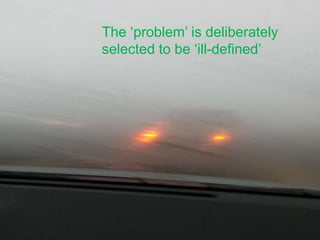
The ‘problem’ is deliberately
selected to be ‘ill-defined’
PBL Group in action (2)
• Broad thinking leads to array of ideas and
mechanisms
• Evidence base utilization encouraged
• Reasoning and hypothesis generation
• Need for additional information identified
• Summary of process/sources/dates
• Actions/Tasks to be undertaken (by whom)
before next meeting
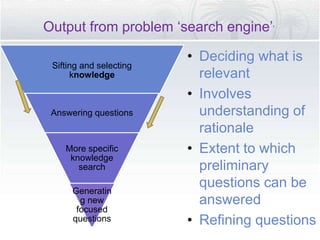
Sifting and selecting
knowledge
Answering questions
More specific
knowledge
search
Generatin
g new
focused
questions
• Deciding what is
relevant
• Involves
understanding of
rationale
• Extent to which
preliminary
questions can be
answered
• Refining questions
Output from problem ‘search engine’’
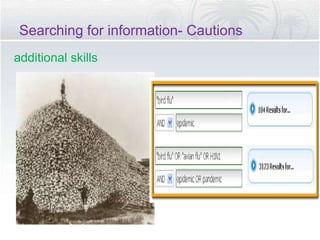
Searching for information- Cautions
additional skills
Tutor guidance: Sensitive balancing
act
X
Evaluation of learning outcomes
• Formative/summative
• Scenario designed
according to pre-set
learning objectives
• Fit with overall
curriculum goals
• In line with learning
style
• Breadth of learning
captured?
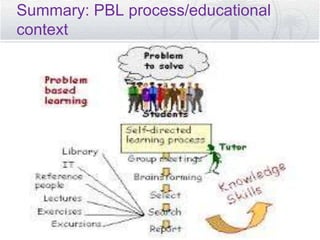
Summary: PBL process/educational
context
Advantages
• Encourages independence as students identify
& meet individual learning needs
• Stimulates reflection & self-direction for life-long
learning
• Supports ongoing self-assessment
• Introduces clinical reasoning
• Enhances critical thinking & evidence-based
decision making
• Lateral thinking
• Ensures that knowledge is transferred, applied
& retained by providing a relevant, integrated
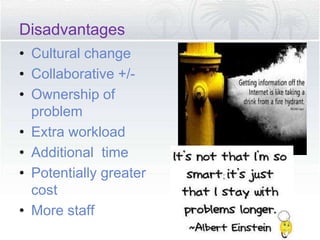
Disadvantages
• Cultural change
• Collaborative +/-
• Ownership of
problem
• Extra workload
• Additional time
• Potentially greater
cost
• More staff
Strategies for re-direction?
Some differences compared to general group
work
• More formal process
with agreed rules of
operating
• Identifying learning
needs
• Ongoing
• Iterative
• Prioritizing importance
of learning areas
• Student-led
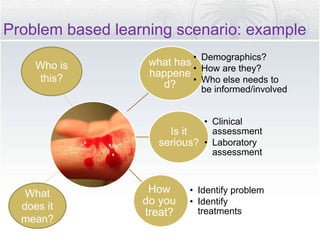
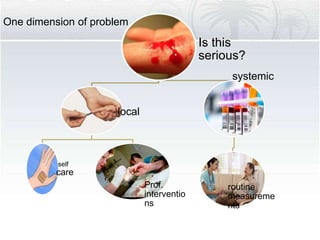
Problem based learning scenario: example
what has
happene
d?
• Demographics?
• How are they?
• Who else needs to
be informed/involved
Is it
serious?
• Clinical
assessment
• Laboratory
assessment
How
do you
treat?
• Identify problem
• Identify
treatments
Who is
this?
What
does it
mean?
Is this
serious?
local
self
care
Prof.
interventio
ns
systemic
routine
measureme
nts
One dimension of problem
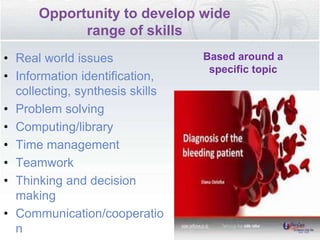
Opportunity to develop wide
range of skills
• Real world issues
• Information identification,
collecting, synthesis skills
• Problem solving
• Computing/library
• Time management
• Teamwork
• Thinking and decision
making
• Communication/cooperatio
n
Based around a
specific topic
Staff development
• Enhanced skills in
facilitation of team-
working;
• Interpersonal skills
management
• Managing group
dynamics
• Assessment of learning
outcomes;
• Time management;
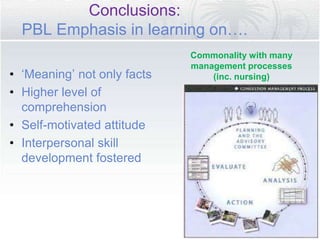
Conclusions:
PBL Emphasis in learning on….
• ‘Meaning’ not only facts
• Higher level of
comprehension
• Self-motivated attitude
• Interpersonal skill
development fostered
Commonality with many
management processes
(inc. nursing)
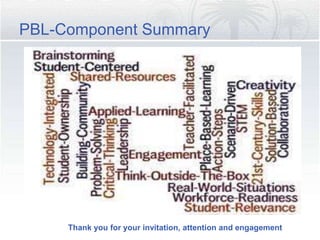
PBL-Component Summary
Thank you for your invitation, attention and engagement
Questions & Answers

Problem based learning: Principles and Practice for Healthcare practitioners

  • 1.
    Problem based learning Principlesand Practice An overview Grace Lindsay BSc(Hons)RN MN PhD Nursing Faculty Umm Al Qura University Makkah
  • 2.
    Overview Session • Historicaltimelines and origins of PBL in medical education curricula • Key components of the learning methods • Considerations for learners and educators • Reflections for nurse education
  • 4.
    Central learning forum:planning, exchange shaping, thinking, concluding +++ ………
  • 5.
    PBL...lessons from medical education •Government, higher education institutions, society striving for higher standards of education; ‘fit for purpose’ • Technological advances • Increase in research activity and knowledge generation • Emphasis on evidence based practice • Need for greater critical appraisal and cognitive reasoning skills • Changes in public and patients expectations • Healthcare delivery evolving…. self-care; new investigations/treatme
  • 6.
    New Horizons inMedical Education • Patient’s expectations • HC delivery (style of doctors) • Medical knowledge exponential growth • Traditionally curriculum structured as a progression from basic sciences to clinical sciences; little integration • Failing to prepare students adequately for diversity of problems they will encounter as professionals.
  • 7.
    What was theresponse to these challenges? • The development of new curricula incorporating new themes & different educational strategies • The introduction of new learning situations & the use of new tools & aids to learning • New methods of assessment [OSCE - tests performance & competence in a wide diversity of clinical settings; Formative Assessment; Portfolio assessment; Work- based assess]
  • 8.
    Problem based Learning(PBL) • Helps learners build a bridge between what already known ……to…. what need to know to find answers to problem • Active learning, which has been shown to be more satisfying than passive teacher-to- student learning; enhances retention and recall • Emphasizing student-centered learning in which students are actively involved in setting their own broader learning goals in line with learning outcomes of curriculum unit
  • 9.
    PBL: What isit? • Problem-based learning (PBL)- learners first encounter a problem followed by a systematic, learner-centered inquiry and reflection process. • PBL designed to support learning sciences basic to medicine….. at same time as they develop reasoning processes used by physicians and other health professionals in clinical practice. 􀂄 The problem presented first without advance readings, lectures, or preparation.
  • 10.
    Subliminal learning Professional practiceneeded to change….. • Positive attitudes and values, behaviors, • Engaging, partnership working • Caring, supportive • Learning from each other • Fostering positive beliefs in others • Encourages respect for others
  • 11.
    Supported with Tools& Aids • Use of Study Guides • Use of Computer Assisted Programs & Internet • Use of Videos to teach Clinical Skills/consultation techniques • Role of Simulators embraced • Simulations in aspects of physical exam & practical procedures
  • 12.
    • Challenge of integratinga large and growing knowledge base with innovative teaching methods • Greater emphasis on cognitive skills attainment • Equipped to practice in an evolving professional context Objectives
  • 13.
  • 14.
    PBL Group inaction (1) • No need for prior knowledge to generate ideas for further collective & personal learning • Each member brings experience and distinctive contribution • Tutor focus to manage interactions • Students nominate a scribe and chair • Safe environment for sharing and testing new knowledge & ideas • Brainstorming • Group evaluates contributions; feedback from peers and tutor • When accompanied by clinical exposure- intellectual & practical skills develop in parallel
  • 15.
    The role ofthe ‘problem’ • a focus …. trigger or catalyst for learning • Framework for assembling knowledge and learning • not specifically about problem-solving skills themselves but using a problem as a focus for learning development Group knowledge for analysis Source knowledge and information to answer questions Identify key questions A problem
  • 16.
    The ‘problem’ isdeliberately selected to be ‘ill-defined’
  • 17.
    PBL Group inaction (2) • Broad thinking leads to array of ideas and mechanisms • Evidence base utilization encouraged • Reasoning and hypothesis generation • Need for additional information identified • Summary of process/sources/dates • Actions/Tasks to be undertaken (by whom) before next meeting
  • 18.
    Sifting and selecting knowledge Answeringquestions More specific knowledge search Generatin g new focused questions • Deciding what is relevant • Involves understanding of rationale • Extent to which preliminary questions can be answered • Refining questions Output from problem ‘search engine’’
  • 19.
    Searching for information-Cautions additional skills
  • 20.
  • 21.
    Evaluation of learningoutcomes • Formative/summative • Scenario designed according to pre-set learning objectives • Fit with overall curriculum goals • In line with learning style • Breadth of learning captured?
  • 22.
  • 23.
    Advantages • Encourages independenceas students identify & meet individual learning needs • Stimulates reflection & self-direction for life-long learning • Supports ongoing self-assessment • Introduces clinical reasoning • Enhances critical thinking & evidence-based decision making • Lateral thinking • Ensures that knowledge is transferred, applied & retained by providing a relevant, integrated
  • 25.
    Disadvantages • Cultural change •Collaborative +/- • Ownership of problem • Extra workload • Additional time • Potentially greater cost • More staff
  • 26.
  • 27.
    Some differences comparedto general group work • More formal process with agreed rules of operating • Identifying learning needs • Ongoing • Iterative • Prioritizing importance of learning areas • Student-led
  • 28.
    Problem based learningscenario: example what has happene d? • Demographics? • How are they? • Who else needs to be informed/involved Is it serious? • Clinical assessment • Laboratory assessment How do you treat? • Identify problem • Identify treatments Who is this? What does it mean?
  • 29.
  • 30.
    Opportunity to developwide range of skills • Real world issues • Information identification, collecting, synthesis skills • Problem solving • Computing/library • Time management • Teamwork • Thinking and decision making • Communication/cooperatio n Based around a specific topic
  • 31.
    Staff development • Enhancedskills in facilitation of team- working; • Interpersonal skills management • Managing group dynamics • Assessment of learning outcomes; • Time management;
  • 32.
    Conclusions: PBL Emphasis inlearning on…. • ‘Meaning’ not only facts • Higher level of comprehension • Self-motivated attitude • Interpersonal skill development fostered Commonality with many management processes (inc. nursing)
  • 33.
    PBL-Component Summary Thank youfor your invitation, attention and engagement
  • 34.