
Prof G.S.Patnaik
 Deteriorating undergraduate medical
education
 Less stress on didactic lectures
 Assessment systems like MEQs, OSCE.,MCQs
 PBL as a learning Tool
 Manipal Experience
 Problem-Based Learning (PBL)
begun in 1950’s as a movement to
restructure medical school education unlike
traditional instruction that culminates in a
problem after basic instruction on facts and
skills, PBL begins with a problem, teaching
facts and skills in a relevant context.
 These are all difficult concepts for traditional
medical teachers
 Problem-based learning is an innovative and
challenging approach to medical education
 …innovative because it is a new way of using
clinical material to help students learn, and
 ...challenging because it requires the medical
teacher to use facilitating and supporting
skills rather than didactic, directive ones.
‘’A learning method based on the
principle of using problems as a
starting point for the acquisition
and integration of new
knowledge.”
H. S. Barrows 1982
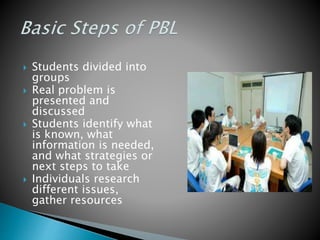
 Students divided into
groups
 Real problem is
presented and
discussed
 Students identify what
is known, what
information is needed,
and what strategies or
next steps to take
 Individuals research
different issues,
gather resources
 Resources evaluated in group
 Cycle repeats until students feel the problem
has been framed adequately and all issues
have been addressed
 Possible actions, recommendations,
solutions, or hypotheses are generated
 Tutor groups conduct peer/self-assessments
 Learning in context of a problem
 Student-driven
 Student – generates issues, finds
answers, shares answers
 Active learning
 Group process
 Facilitated > taught
 Problem-based learning (PBL) is a student-
centered pedagogy in which students learn
about a subject in the context of complex,
multifaceted, and realistic problems
 Not to be confused with project-based
learning.
 The goals of PBL are to help the students
develop flexible knowledge, effective problem
solving skills, self-directed learning, effective
collaboration skills and intrinsic motivation
 A facilitator is key to these learning
environments
 Models higher-order process skills
 Probes for student understanding
 Never identifies issues or states an opinion
while students frame problems
 For the student, problem-based learning
emphasizes the application of knowledge and
skills to the solution of problems rather than
the recall of facts.
 It is an approach much favored by curriculum
planners in new and more progressive
medical schools.
 Very well operates in undergraduate medical
education.
 PBL is a learner-centered educational method
In PBL, learners are progressively given more
and more responsibility for their own
education.
 PBL produces independent learners who can
continue to learn on their own in life and in
their chosen careers.
 The responsibility of the teacher in PBL is to
provide the educational materials and
guidance that facilitate learning.
 PBL is based on real world problems
PBL is based on the messy, complex problems
encountered in the real world as a stimulus
for learning, integrating, and organizing
learned information in ways that will ensure
its recall and application to future problems.
The problems in PBL are also designed to
challenge learners to develop effective
problem-solving and critical thinking skills.
 The series of problems encountered by
learners with this process make up the
curriculum.
 The problems are put together as a group to
stimulate learning of content appropriate to
the course.
 In the PBL process learners characteristically
learn far more in areas relevant to their
personal needs.
 The principle role of the teacher in PBL is that
of a facilitator or educational coach guiding
the learners in the PBL process.
 As learners become more proficient in the
PBL learning process the tutor becomes less
active.
 This is a new skill for many teachers and
specific training is required
PBL is a motivating way to learn as learners
are involved in active learning, working with
real problems and what they have to learn in
their study is seen as important and relevant
to their own lives.
“40 year old man with jaundice. Sustained
fracture of femur shaft . History of
asthma ,went to a local quack , Doesn’t
want any treatment.”
How will you deal with the issues that he
presents?
 Talk through scenario, understand it,
decide on the problems
 Define/analyse the problems
 Brainstorming
 Prioritise the problems, restructure
 Decide on learning objectives
 Every member has a task – private study
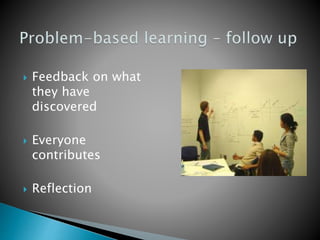
 Feedback on what
they have
discovered
 Everyone
contributes
 Reflection
 Realistic, common, important
 Sufficiently open
 Complexity – a number of components
 Maybe a problem that actually happened and
that was poorly managed
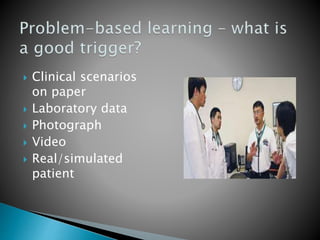
 Clinical scenarios
on paper
 Laboratory data
 Photograph
 Video
 Real/simulated
patient
 Greater recall of knowledge, retention
 interdisciplinary, can require accessing and
using information from a variety of subject
domains; better integration of knowledge
 Development of life-long learning skills: how
to research, how to communicate in groups,
how to handle problems
 Increased motivation, interest in subject areas
 increased student-student interaction, and
student-instructor interaction
 Real- life cases
 Not with a specific discipline
 Student- centered
 Close, more equal student-faculty
relationship
 Enjoyable
 Presentational skills
 Cost
 Time
 Workload
 Tutor quality
 Unscheduled time
 Students with no supervision ……….. The tutor
takes over
 One faculty member for each group of students!
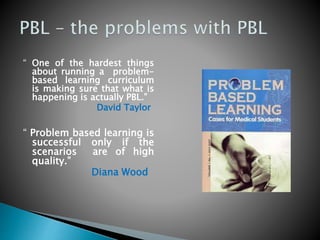
“ One of the hardest things
about running a problem-
based learning curriculum
is making sure that what is
happening is actually PBL.”
David Taylor
“ Problem based learning is
successful only if the
scenarios are of high
quality.”
Diana Wood
 Simulation/simulated patients
 Interprofessional education – should the
group include nurses/AHPs?
 E-learning
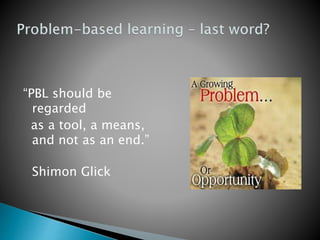
“PBL should be
regarded
as a tool, a means,
and not as an end.”
Shimon Glick
Donner RS, Bickley H. Problem-based learning in American medical education: an
overview. Bull Med Libr Assoc. 1993 Jul;81(3):294-8.
Wood DF. Problem based learning. BMJ. 2003 Feb 8;326(7384):328-30.
Kilroy DA. Problem based learning. Emerg Med J. 2004 Jul;21(4):411-3.
Walton HJ, Matthews MB. Essentials of problem-based learning. Med Educ. 1989
Nov;23(6):542-58.
Mellon AF, Mellon J. Logical debate on problem based learning. BMJ. 2006 Mar
4;332(7540):550-1.
Wood DF. Problem based learning. BMJ. 2008 May 3;336(7651):971.
Problem based learning in orthopedics

Problem based learning in orthopedics

  • 1.
  • 2.
     Deteriorating undergraduatemedical education  Less stress on didactic lectures  Assessment systems like MEQs, OSCE.,MCQs  PBL as a learning Tool  Manipal Experience
  • 3.
     Problem-Based Learning(PBL) begun in 1950’s as a movement to restructure medical school education unlike traditional instruction that culminates in a problem after basic instruction on facts and skills, PBL begins with a problem, teaching facts and skills in a relevant context.  These are all difficult concepts for traditional medical teachers
  • 4.
     Problem-based learningis an innovative and challenging approach to medical education  …innovative because it is a new way of using clinical material to help students learn, and  ...challenging because it requires the medical teacher to use facilitating and supporting skills rather than didactic, directive ones.
  • 5.
    ‘’A learning methodbased on the principle of using problems as a starting point for the acquisition and integration of new knowledge.” H. S. Barrows 1982
  • 6.
     Students dividedinto groups  Real problem is presented and discussed  Students identify what is known, what information is needed, and what strategies or next steps to take  Individuals research different issues, gather resources
  • 7.
     Resources evaluatedin group  Cycle repeats until students feel the problem has been framed adequately and all issues have been addressed  Possible actions, recommendations, solutions, or hypotheses are generated  Tutor groups conduct peer/self-assessments
  • 8.
     Learning incontext of a problem  Student-driven  Student – generates issues, finds answers, shares answers  Active learning  Group process  Facilitated > taught
  • 9.
     Problem-based learning(PBL) is a student- centered pedagogy in which students learn about a subject in the context of complex, multifaceted, and realistic problems  Not to be confused with project-based learning.  The goals of PBL are to help the students develop flexible knowledge, effective problem solving skills, self-directed learning, effective collaboration skills and intrinsic motivation
  • 10.
     A facilitatoris key to these learning environments  Models higher-order process skills  Probes for student understanding  Never identifies issues or states an opinion while students frame problems
  • 11.
     For thestudent, problem-based learning emphasizes the application of knowledge and skills to the solution of problems rather than the recall of facts.  It is an approach much favored by curriculum planners in new and more progressive medical schools.  Very well operates in undergraduate medical education.
  • 12.
     PBL isa learner-centered educational method In PBL, learners are progressively given more and more responsibility for their own education.  PBL produces independent learners who can continue to learn on their own in life and in their chosen careers.  The responsibility of the teacher in PBL is to provide the educational materials and guidance that facilitate learning.
  • 13.
     PBL isbased on real world problems PBL is based on the messy, complex problems encountered in the real world as a stimulus for learning, integrating, and organizing learned information in ways that will ensure its recall and application to future problems. The problems in PBL are also designed to challenge learners to develop effective problem-solving and critical thinking skills.
  • 14.
     The seriesof problems encountered by learners with this process make up the curriculum.  The problems are put together as a group to stimulate learning of content appropriate to the course.  In the PBL process learners characteristically learn far more in areas relevant to their personal needs.
  • 15.
     The principlerole of the teacher in PBL is that of a facilitator or educational coach guiding the learners in the PBL process.  As learners become more proficient in the PBL learning process the tutor becomes less active.  This is a new skill for many teachers and specific training is required
  • 16.
    PBL is amotivating way to learn as learners are involved in active learning, working with real problems and what they have to learn in their study is seen as important and relevant to their own lives.
  • 17.
    “40 year oldman with jaundice. Sustained fracture of femur shaft . History of asthma ,went to a local quack , Doesn’t want any treatment.” How will you deal with the issues that he presents?
  • 18.
     Talk throughscenario, understand it, decide on the problems  Define/analyse the problems  Brainstorming  Prioritise the problems, restructure  Decide on learning objectives  Every member has a task – private study
  • 19.
     Feedback onwhat they have discovered  Everyone contributes  Reflection
  • 20.
     Realistic, common,important  Sufficiently open  Complexity – a number of components  Maybe a problem that actually happened and that was poorly managed
  • 21.
     Clinical scenarios onpaper  Laboratory data  Photograph  Video  Real/simulated patient
  • 22.
     Greater recallof knowledge, retention  interdisciplinary, can require accessing and using information from a variety of subject domains; better integration of knowledge  Development of life-long learning skills: how to research, how to communicate in groups, how to handle problems
  • 23.
     Increased motivation,interest in subject areas  increased student-student interaction, and student-instructor interaction  Real- life cases  Not with a specific discipline  Student- centered  Close, more equal student-faculty relationship  Enjoyable  Presentational skills
  • 24.
     Cost  Time Workload  Tutor quality  Unscheduled time  Students with no supervision ……….. The tutor takes over  One faculty member for each group of students!
  • 25.
    “ One ofthe hardest things about running a problem- based learning curriculum is making sure that what is happening is actually PBL.” David Taylor “ Problem based learning is successful only if the scenarios are of high quality.” Diana Wood
  • 26.
     Simulation/simulated patients Interprofessional education – should the group include nurses/AHPs?  E-learning
  • 27.
    “PBL should be regarded asa tool, a means, and not as an end.” Shimon Glick
  • 28.
    Donner RS, BickleyH. Problem-based learning in American medical education: an overview. Bull Med Libr Assoc. 1993 Jul;81(3):294-8. Wood DF. Problem based learning. BMJ. 2003 Feb 8;326(7384):328-30. Kilroy DA. Problem based learning. Emerg Med J. 2004 Jul;21(4):411-3. Walton HJ, Matthews MB. Essentials of problem-based learning. Med Educ. 1989 Nov;23(6):542-58. Mellon AF, Mellon J. Logical debate on problem based learning. BMJ. 2006 Mar 4;332(7540):550-1. Wood DF. Problem based learning. BMJ. 2008 May 3;336(7651):971.