PGCAP
LTHE module
    @pgcap

              1
 Explain   the basics of PBL

 Discuss   how PBL could be used in own
 practice


                                           3
 Discuss common characteristics and
 differences in pairs


                                       4
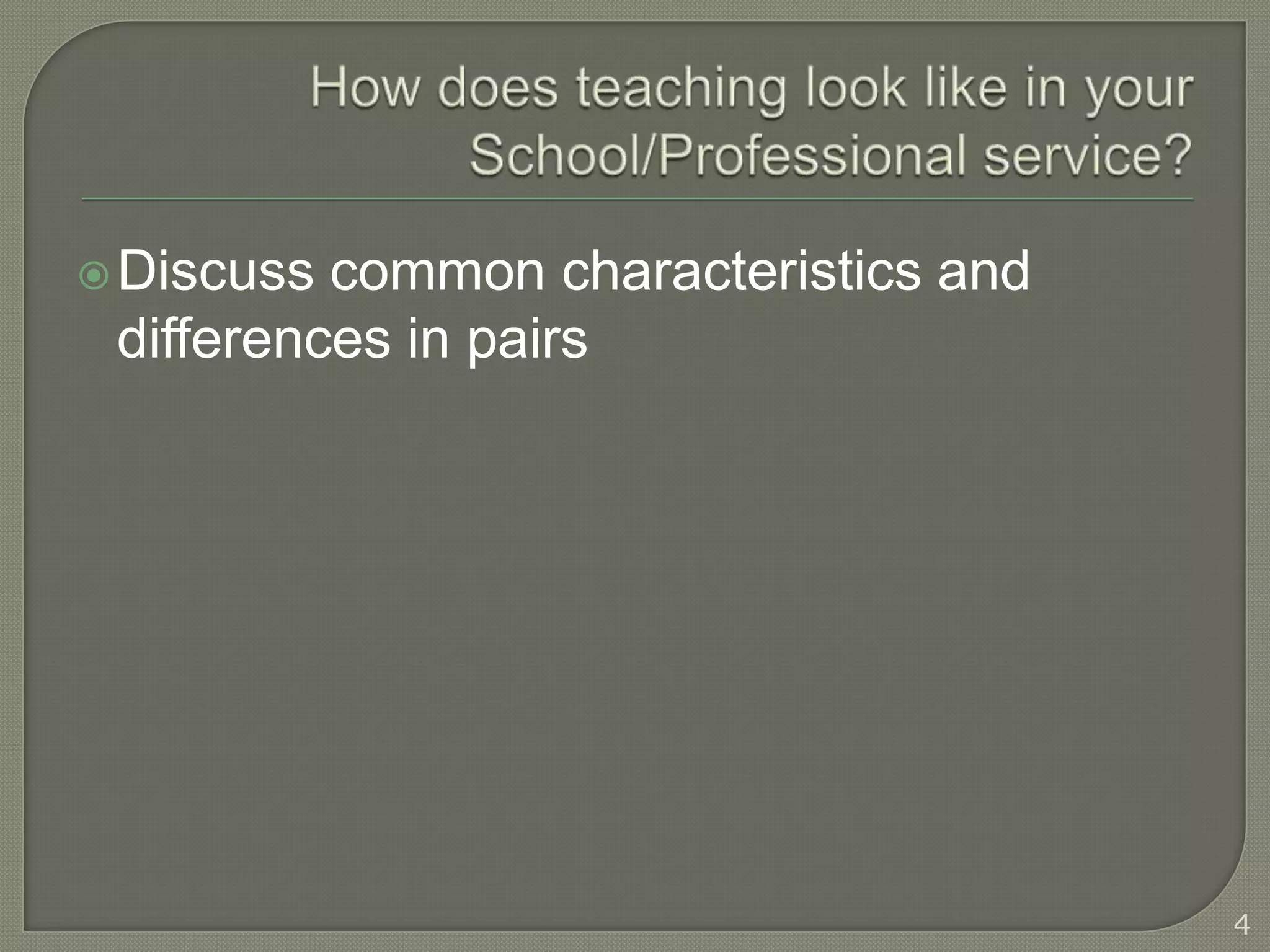
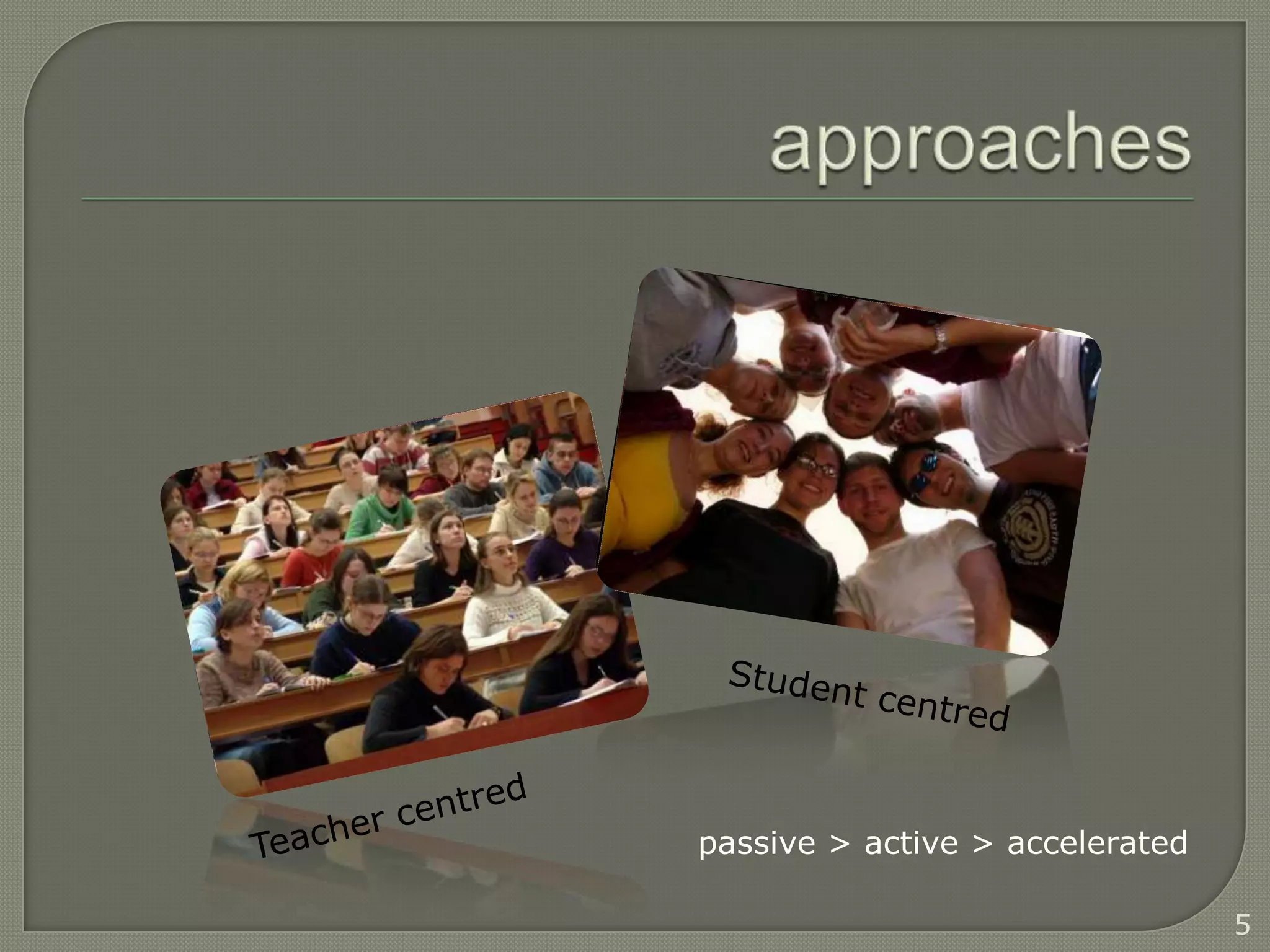
passive > active > accelerated

                                 5
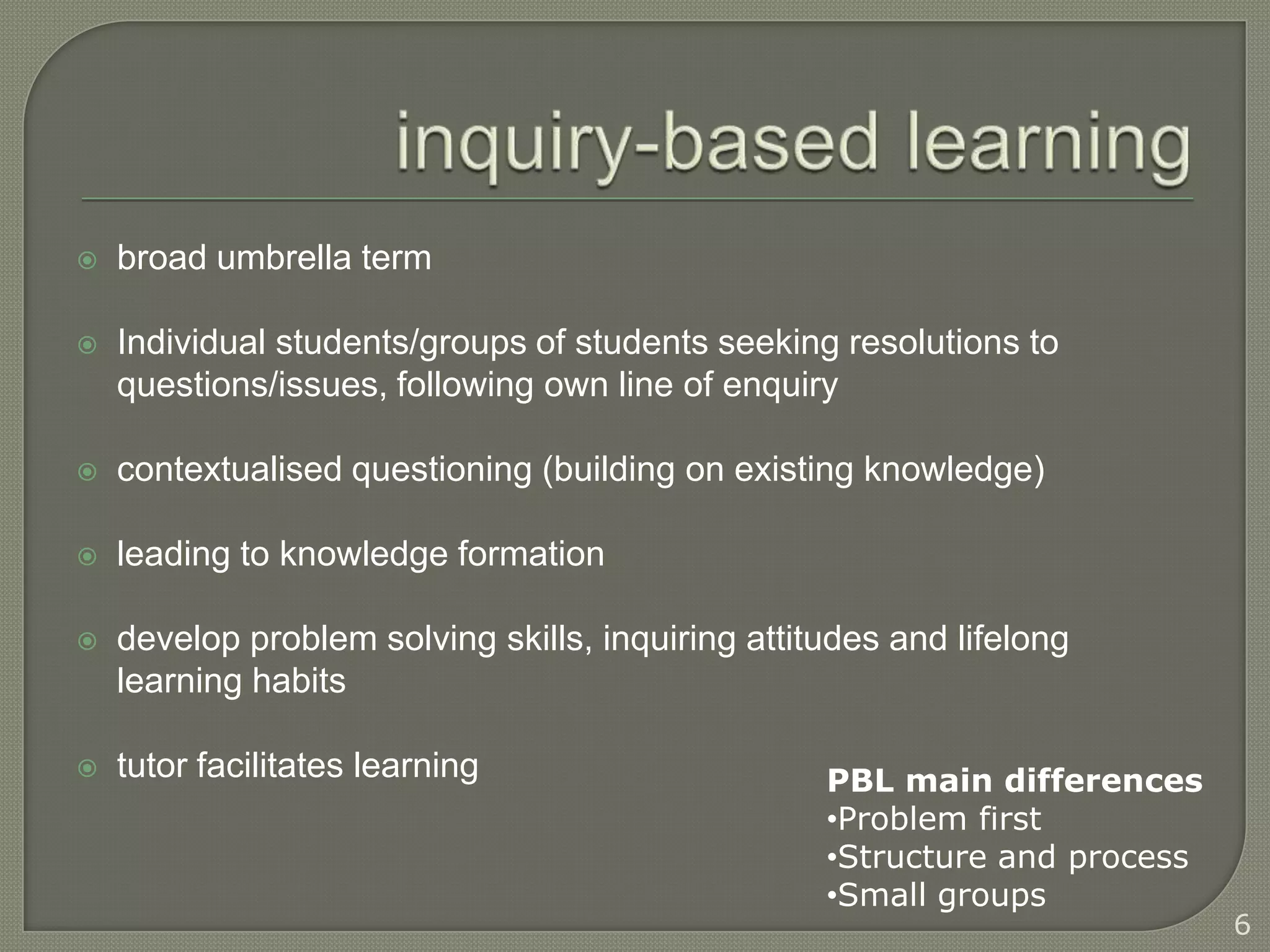
   broad umbrella term

   Individual students/groups of students seeking resolutions to
    questions/issues, following own line of enquiry

   contextualised questioning (building on existing knowledge)

   leading to knowledge formation

   develop problem solving skills, inquiring attitudes and lifelong
    learning habits

   tutor facilitates learning                     PBL main differences
                                                   •Problem first
                                                   •Structure and process
                                                   •Small groups
                                                                            6
Grown since 1960s pioneered at McMaster
University
http://www.mcmaster.ca/home.cfm

with medical students (Howard Barrows)

Strong evidence that it works well!!!

Whole university approach: Maastricht University
http://www.maastrichtuniversity.nl/web/Main/AboutUM.htm
http://www.maastrichtuniversity.nl/web/Main/Education/EducationalProfile/Pr
oblemBasedLearning.htm


                                                                              7
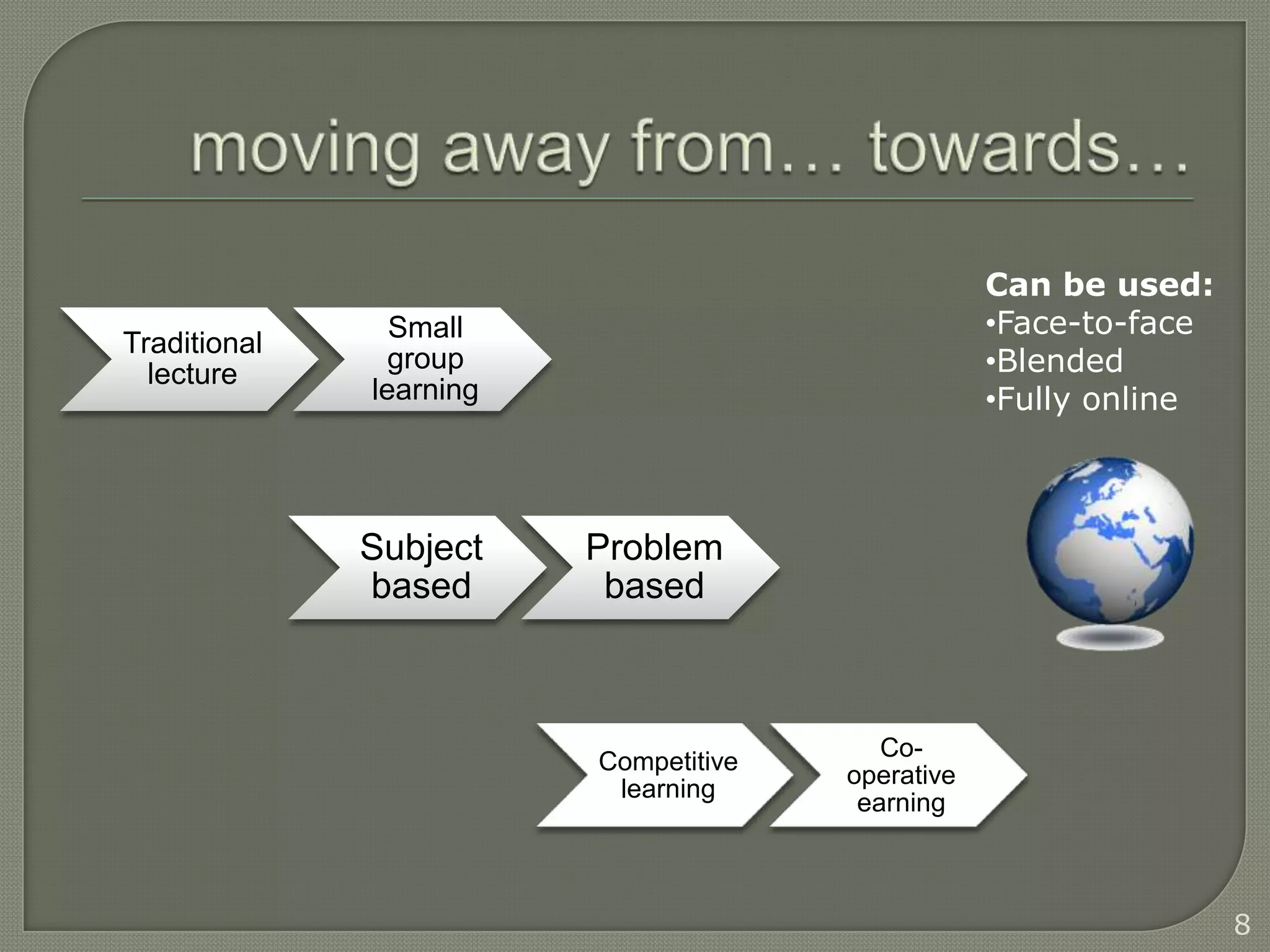
Can be used:
                Small                              •Face-to-face
Traditional
  lecture
                group                              •Blended
              learning                             •Fully online


              Subject    Problem
              based       based


                                          Co-
                         Competitive
                                       operative
                          learning
                                        earning


                                                                   8
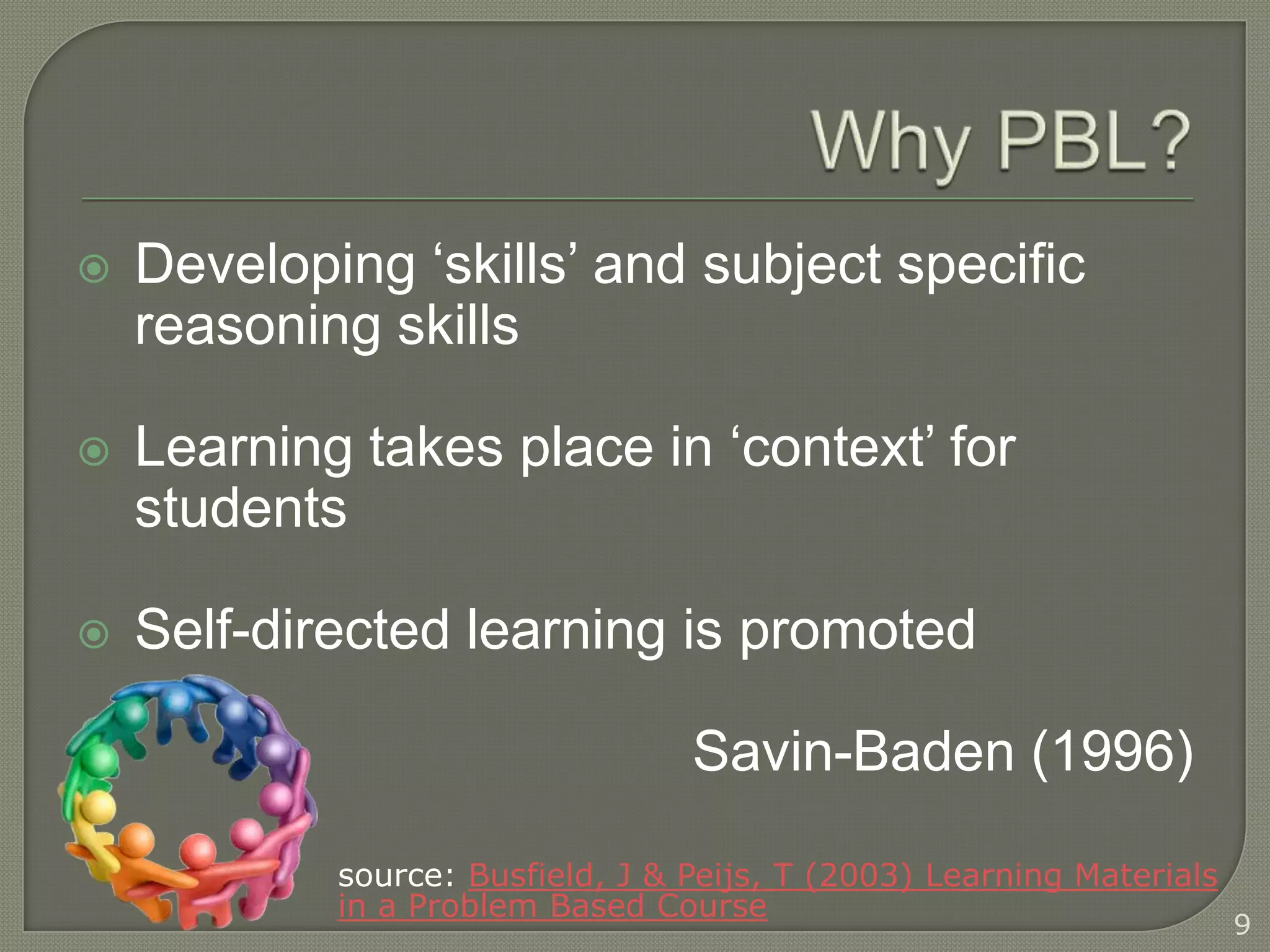
   Developing ‘skills’ and subject specific
    reasoning skills

   Learning takes place in ‘context’ for
    students

   Self-directed learning is promoted

                                  Savin-Baden (1996)

            source: Busfield, J & Peijs, T (2003) Learning Materials
            in a Problem Based Course
                                                                       9
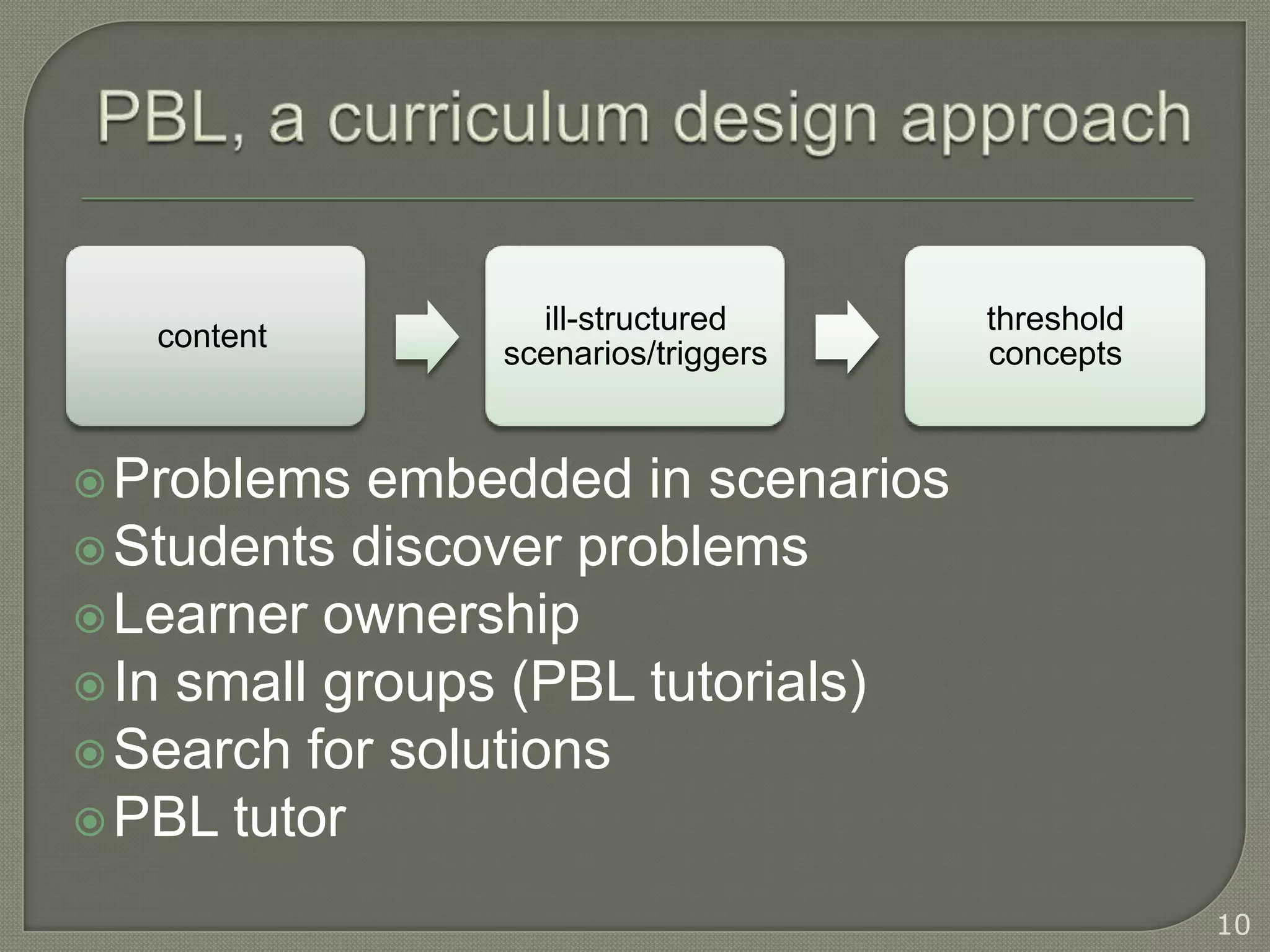
ill-structured     threshold
   content
                scenarios/triggers   concepts


 Problems   embedded in scenarios
 Students discover problems
 Learner ownership
 In small groups (PBL tutorials)
 Search for solutions
 PBL tutor

                                                 10
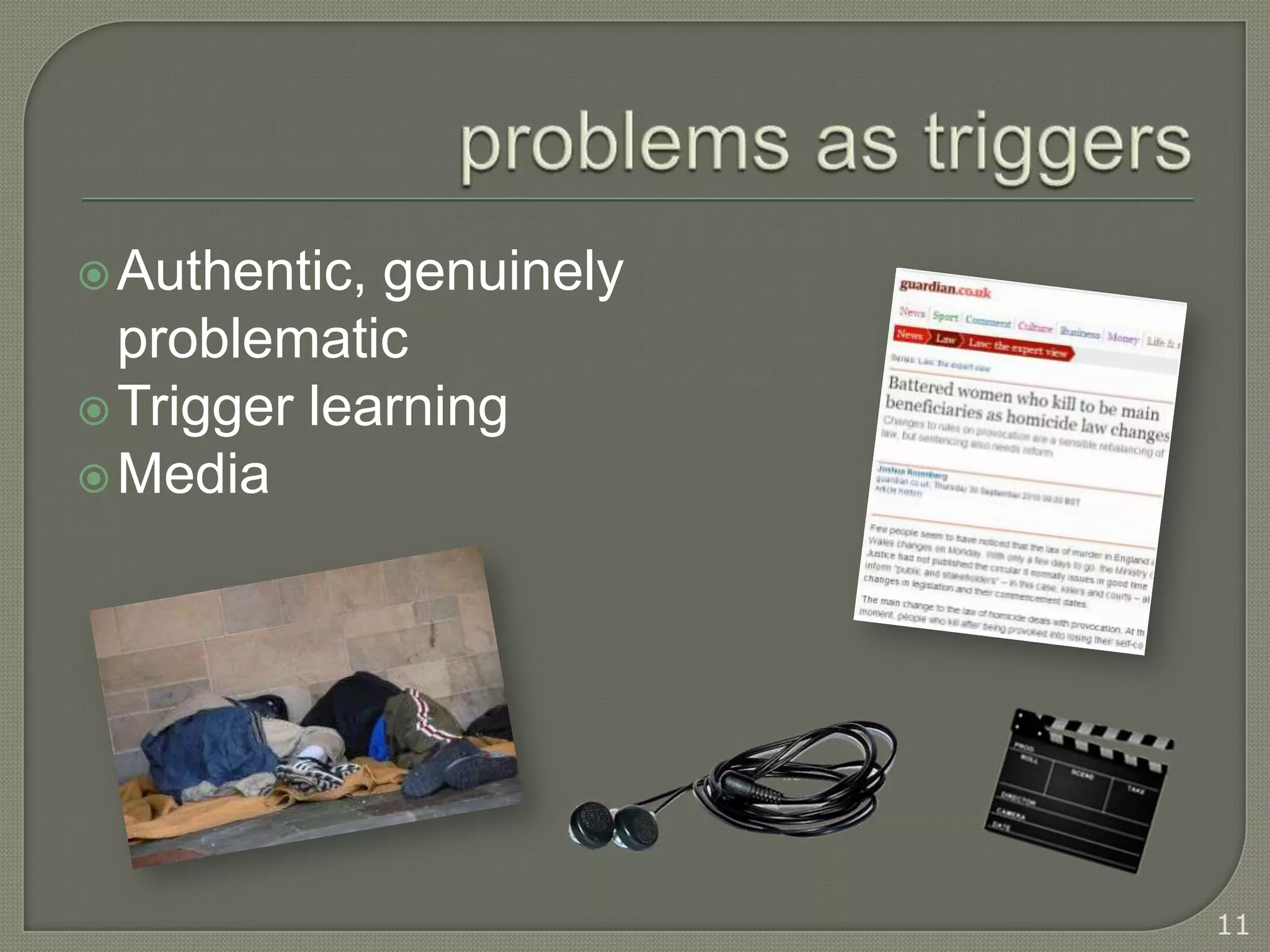
 Authentic, genuinely
  problematic
 Trigger learning
 Media


                         11
stage 1: explore the problem

   stage 2: discover known and unknown,
   plan

       stage 3 : research and share


          stage 4: apply


              stage 5: present
                                    based on Mills, D (2006) Problem-based learning: An overview, available at
                  http://www.c-sap.bham.ac.uk/resources/project_reports/ShowOverview.asp?id=4 [accessed 5
                                                                                                March 2010]

                                                                                                                 12
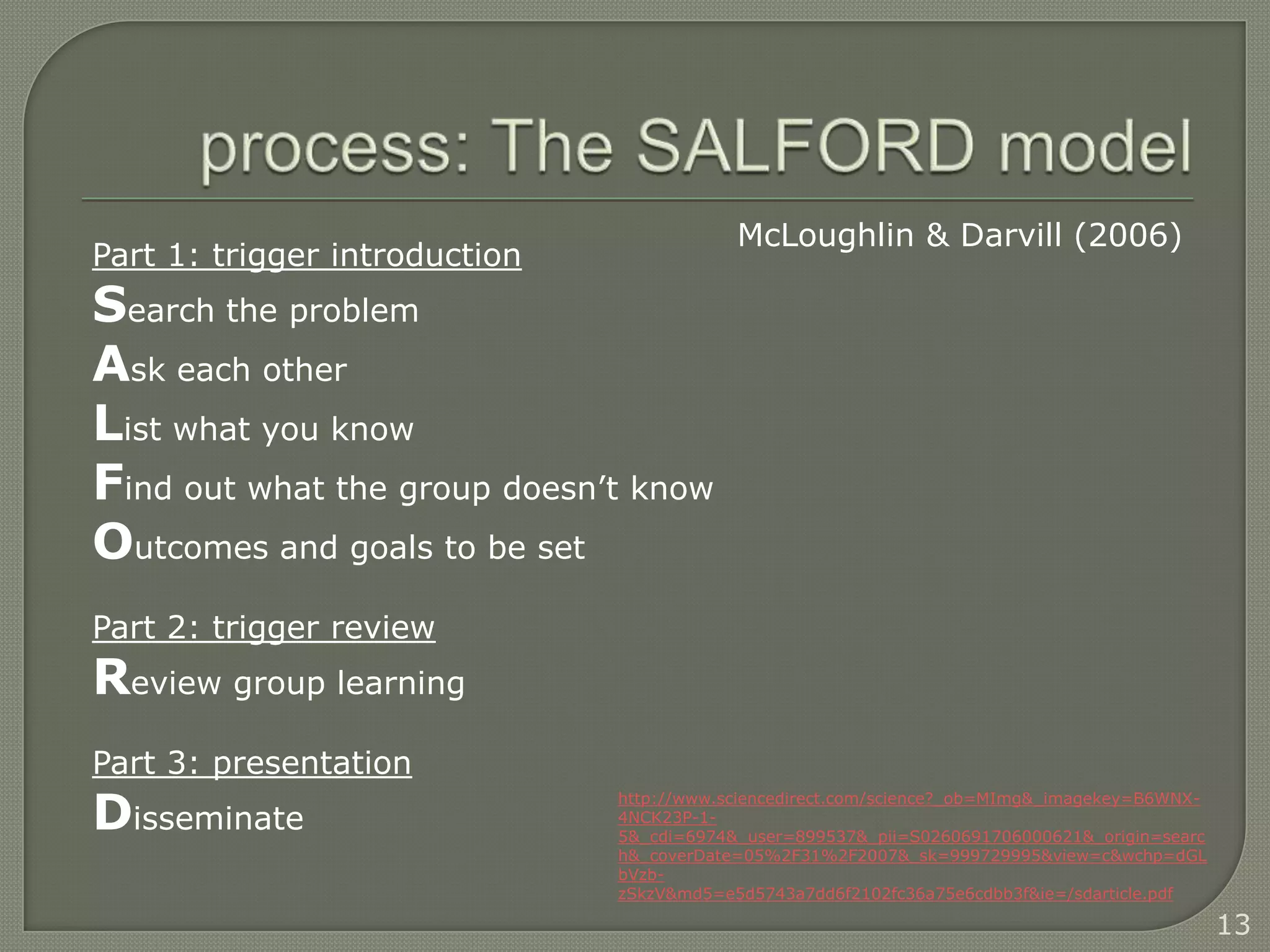
McLoughlin & Darvill (2006)
Part 1: trigger introduction
Search the problem
Ask each other
List what you know
Find out what the group doesn’t know
Outcomes and goals to be set
Part 2: trigger review
Review group learning
Part 3: presentation
Disseminate
                               http://www.sciencedirect.com/science?_ob=MImg&_imagekey=B6WNX-
                               4NCK23P-1-
                               5&_cdi=6974&_user=899537&_pii=S0260691706000621&_origin=searc
                               h&_coverDate=05%2F31%2F2007&_sk=999729995&view=c&wchp=dGL
                               bVzb-
                               zSkzV&md5=e5d5743a7dd6f2102fc36a75e6cdbb3f&ie=/sdarticle.pdf

                                                                                                13
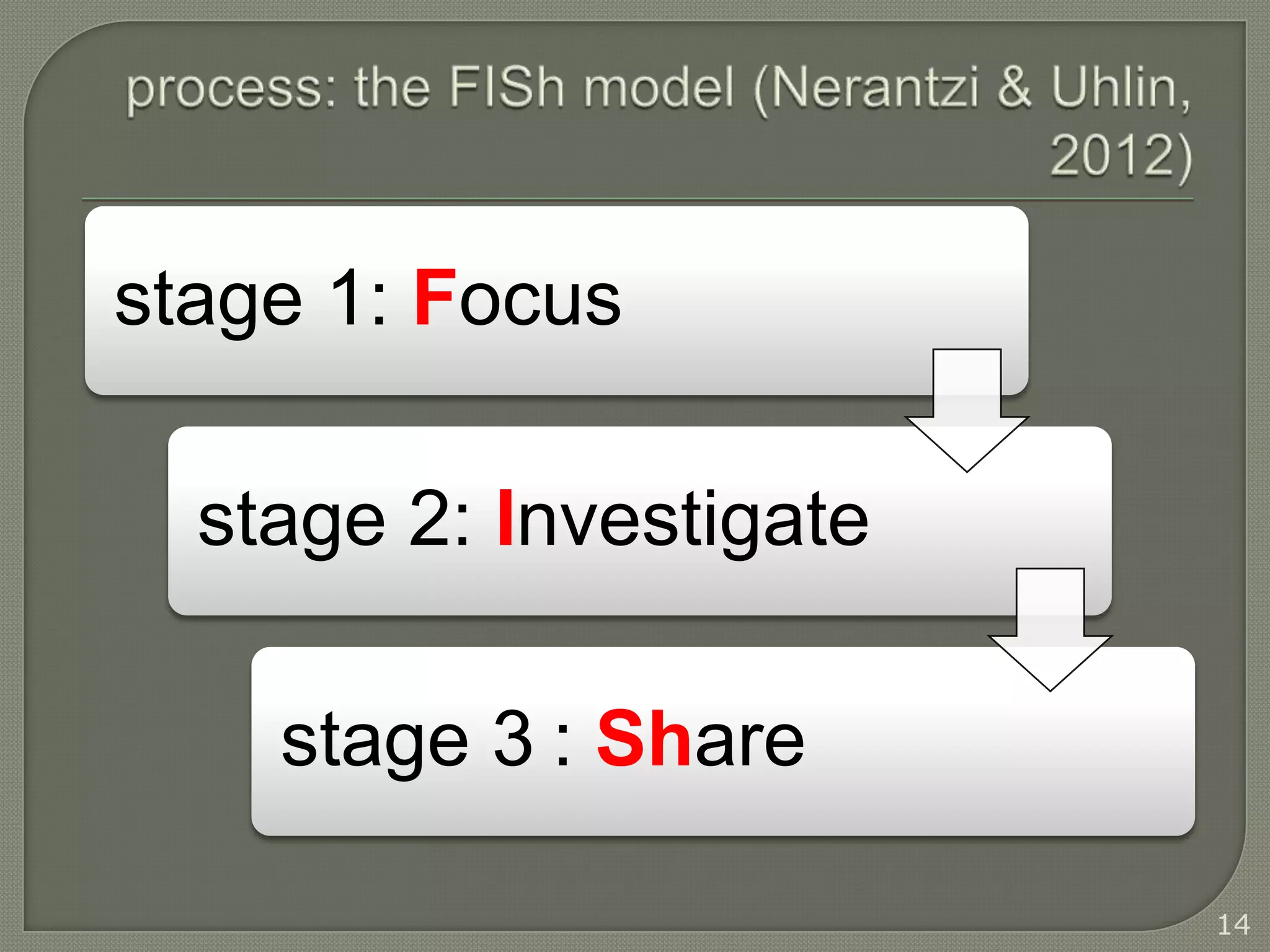
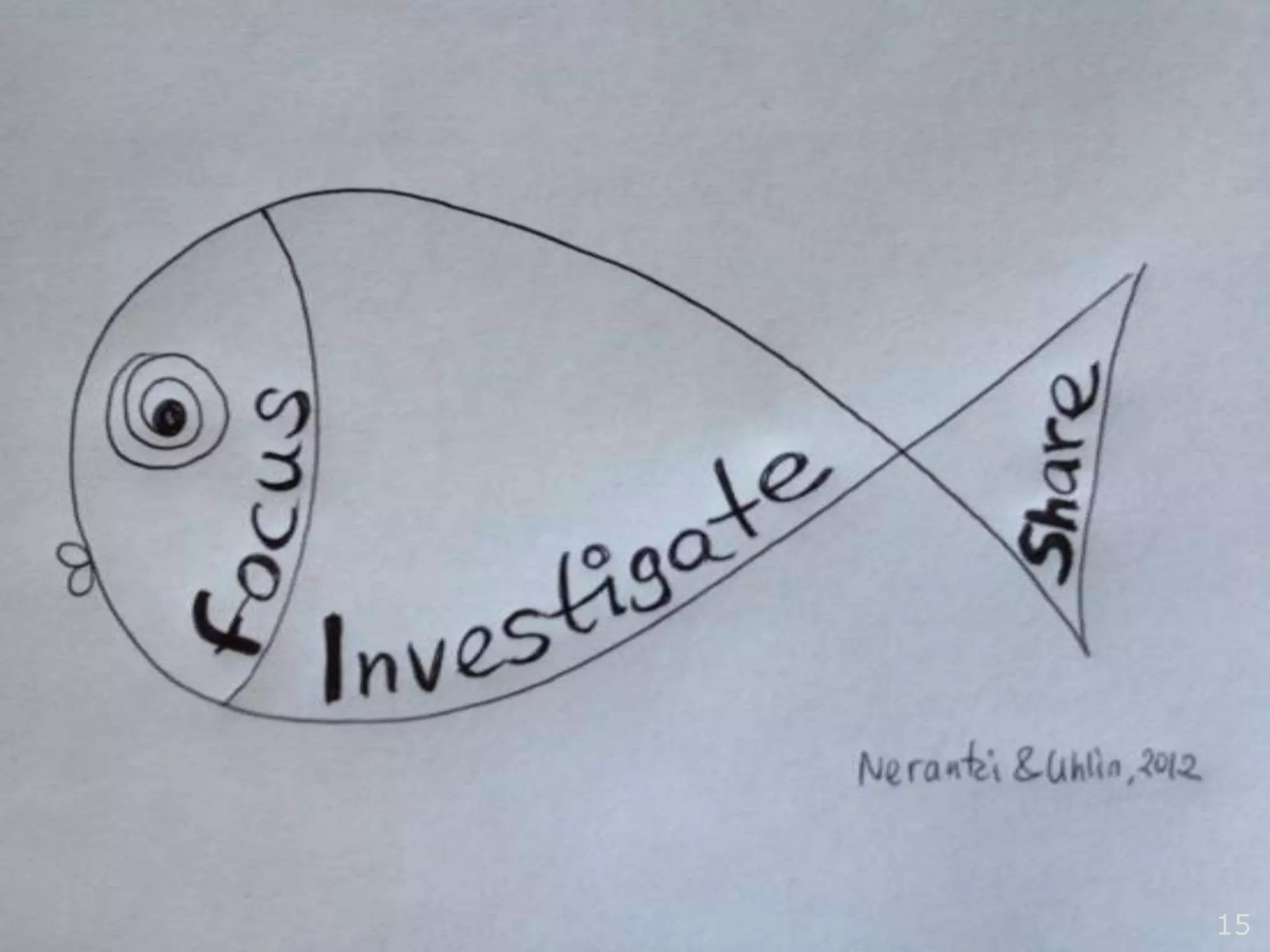
stage 1: Focus

  stage 2: Investigate

    stage 3 : Share

                         14
15
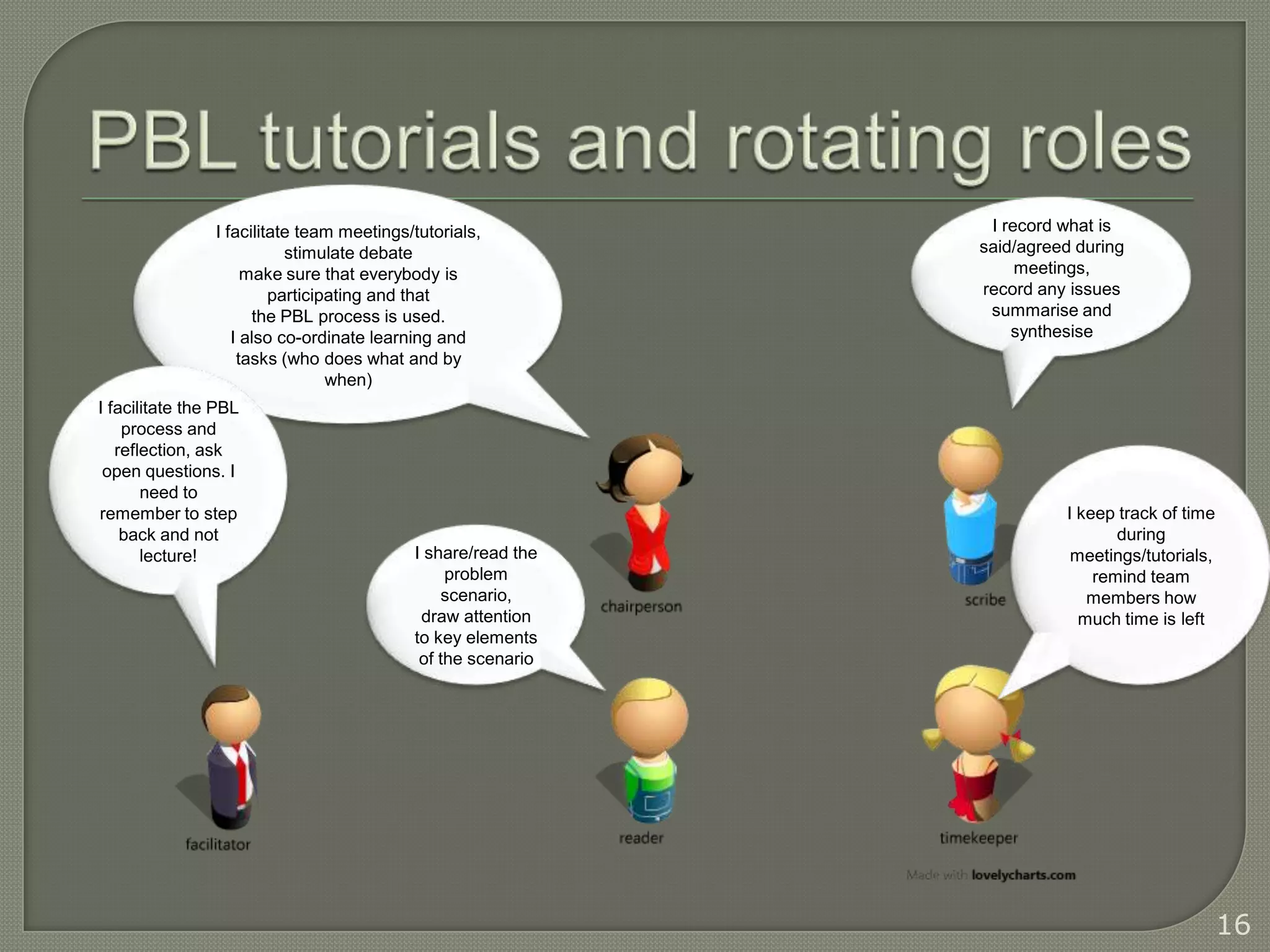
I facilitate team meetings/tutorials,          I record what is
                           stimulate debate                   said/agreed during
                     make sure that everybody is                   meetings,
                         participating and that               record any issues
                      the PBL process is used.                 summarise and
                   I also co-ordinate learning and                synthesise
                    tasks (who does what and by
                                 when)
I facilitate the PBL
    process and
   reflection, ask
 open questions. I
       need to
remember to step                                                        I keep track of time
    back and not                                                               during
       lecture!                            I share/read the              meetings/tutorials,
                                                problem                     remind team
                                               scenario,                   members how
                                            draw attention                much time is left
                                           to key elements
                                            of the scenario


                                                                                               16
 Resource   intensive
 Stressful for staff and students
 Time intensive (Des Marchais, 1993)
 Covering less curriculum content 80%
  (Albanese and Mitchell, 1993)
 Scenarios too ill-structured: students
  disorientated (McLoughlin & Oliver, online)


                                                17
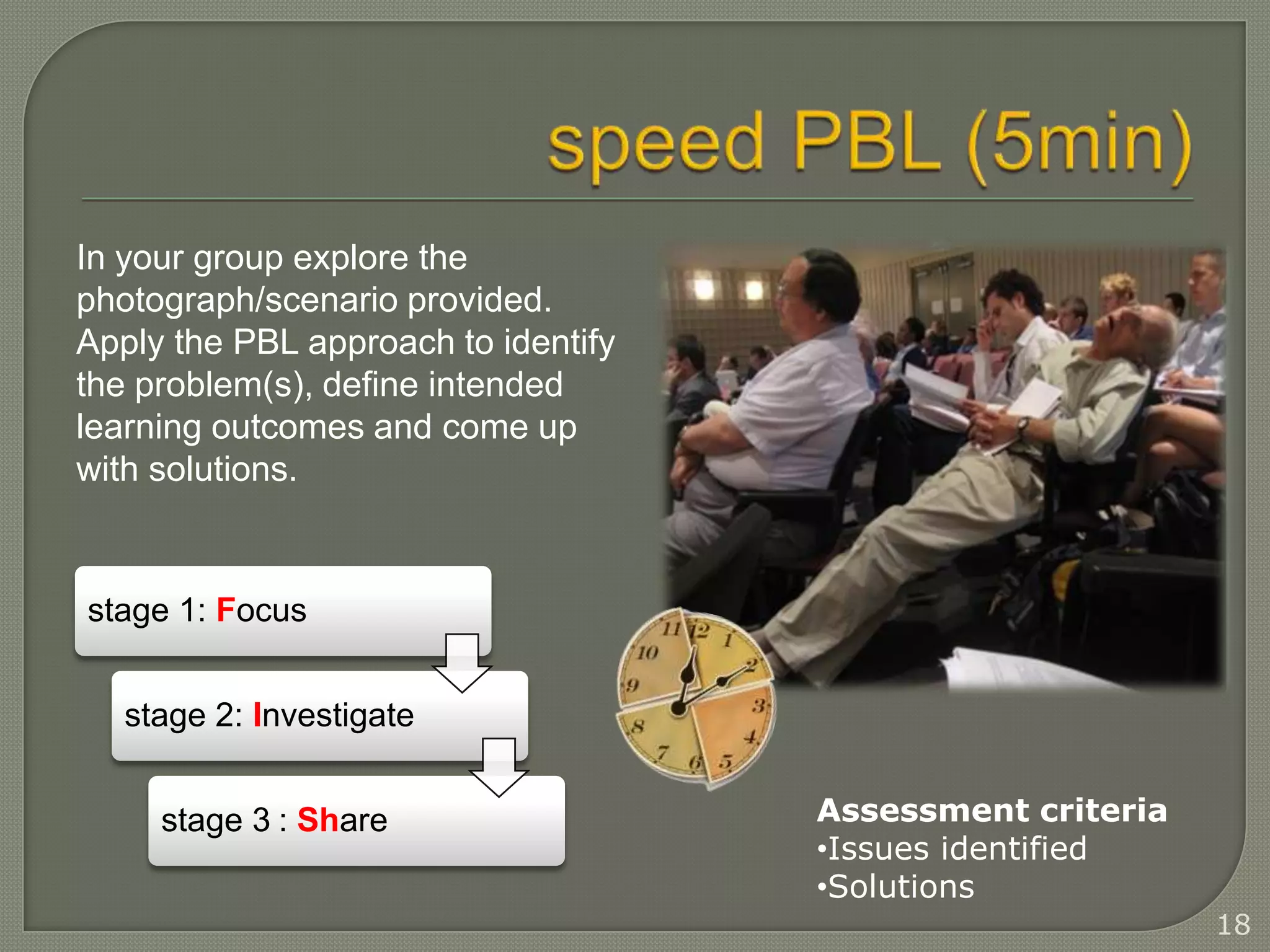
In your group explore the
photograph/scenario provided.
Apply the PBL approach to identify
the problem(s), define intended
learning outcomes and come up
with solutions.


stage 1: Focus


   stage 2: Investigate


     stage 3 : Share                 Assessment criteria
                                     •Issues identified
                                     •Solutions
                                                           18
Think about the following:

•Could PBL features be used within your sessions?

•Could PBL be used for large-group teaching?

•Could you use it as a curriculum design approach and/or for
assessment?


                                                               19
 Students
         and facilitators to familiarise with
 PBL before using it!


                                                20
UK Centre for Legal Education
http://www.ukcle.ac.uk/resources/teaching-
  and-learning-practices/pbl/

PBL collection
http://delicious.com/chrissinerantzi/pbl


                                             21
Albanese M A & Mitchell S (1993) Problem-based learning: a review of literature on its outcomes and implementation
issues. Acad Med, pp. 68: 52-81.

Barrows, H S (2000) Problem-based learning applied to medical education, Southern Illinois School of Medicine: Illinois

Des Marchais, J E (1993) A student-centred, problem-based curriculum: 5 years' experience. Can Med Assoc J, pp.
1567-1572.

McLoughlin, M & Darvill, A (2007) Peeling back the layers of learning: A classroom model for problem-based learning,
in: Nurse Education Today , 27, pp. 271-277.

McLoughlin, C & Oliver, R (online) Problem-based learning (PBL):Developing learning capability through the WWW,
available at http://elrond.scam.ecu.edu.au/oliver/docs/99/ODLAA.pdf [accessed 11 February 2011]

Mills, D (2006) Problem-based learning: An overview, available at
http://www.c-sap.bham.ac.uk/resources/project_reports/ShowOverview.asp?id=4 [accessed 5 March 2010]

Savin-Baden, M, (1996) Problem-based learning: a catalyst for enabling and disablling disjunction prompting transitions
in learner stances? Ph D thesis University of London. Institute of Education

Woods, D R (1994) How to Gain the Most from PBL, Hamilton: McMaster University


                                                                                                                          22
The LTHE Module Team
University of Salford, Academic Development Unit
                                  Twitter @pgcap

                                                   23

LTHE about PBL

  • 1.
  • 2.
     Explain the basics of PBL  Discuss how PBL could be used in own practice 3
  • 3.
     Discuss commoncharacteristics and differences in pairs 4
  • 4.
    passive > active> accelerated 5
  • 5.
    broad umbrella term  Individual students/groups of students seeking resolutions to questions/issues, following own line of enquiry  contextualised questioning (building on existing knowledge)  leading to knowledge formation  develop problem solving skills, inquiring attitudes and lifelong learning habits  tutor facilitates learning PBL main differences •Problem first •Structure and process •Small groups 6
  • 6.
    Grown since 1960spioneered at McMaster University http://www.mcmaster.ca/home.cfm with medical students (Howard Barrows) Strong evidence that it works well!!! Whole university approach: Maastricht University http://www.maastrichtuniversity.nl/web/Main/AboutUM.htm http://www.maastrichtuniversity.nl/web/Main/Education/EducationalProfile/Pr oblemBasedLearning.htm 7
  • 7.
    Can be used: Small •Face-to-face Traditional lecture group •Blended learning •Fully online Subject Problem based based Co- Competitive operative learning earning 8
  • 8.
    Developing ‘skills’ and subject specific reasoning skills  Learning takes place in ‘context’ for students  Self-directed learning is promoted Savin-Baden (1996) source: Busfield, J & Peijs, T (2003) Learning Materials in a Problem Based Course 9
  • 9.
    ill-structured threshold content scenarios/triggers concepts  Problems embedded in scenarios  Students discover problems  Learner ownership  In small groups (PBL tutorials)  Search for solutions  PBL tutor 10
  • 10.
     Authentic, genuinely problematic  Trigger learning  Media 11
  • 11.
    stage 1: explorethe problem stage 2: discover known and unknown, plan stage 3 : research and share stage 4: apply stage 5: present based on Mills, D (2006) Problem-based learning: An overview, available at http://www.c-sap.bham.ac.uk/resources/project_reports/ShowOverview.asp?id=4 [accessed 5 March 2010] 12
  • 12.
    McLoughlin & Darvill(2006) Part 1: trigger introduction Search the problem Ask each other List what you know Find out what the group doesn’t know Outcomes and goals to be set Part 2: trigger review Review group learning Part 3: presentation Disseminate http://www.sciencedirect.com/science?_ob=MImg&_imagekey=B6WNX- 4NCK23P-1- 5&_cdi=6974&_user=899537&_pii=S0260691706000621&_origin=searc h&_coverDate=05%2F31%2F2007&_sk=999729995&view=c&wchp=dGL bVzb- zSkzV&md5=e5d5743a7dd6f2102fc36a75e6cdbb3f&ie=/sdarticle.pdf 13
  • 13.
    stage 1: Focus stage 2: Investigate stage 3 : Share 14
  • 14.
  • 15.
    I facilitate teammeetings/tutorials, I record what is stimulate debate said/agreed during make sure that everybody is meetings, participating and that record any issues the PBL process is used. summarise and I also co-ordinate learning and synthesise tasks (who does what and by when) I facilitate the PBL process and reflection, ask open questions. I need to remember to step I keep track of time back and not during lecture! I share/read the meetings/tutorials, problem remind team scenario, members how draw attention much time is left to key elements of the scenario 16
  • 16.
     Resource intensive  Stressful for staff and students  Time intensive (Des Marchais, 1993)  Covering less curriculum content 80% (Albanese and Mitchell, 1993)  Scenarios too ill-structured: students disorientated (McLoughlin & Oliver, online) 17
  • 17.
    In your groupexplore the photograph/scenario provided. Apply the PBL approach to identify the problem(s), define intended learning outcomes and come up with solutions. stage 1: Focus stage 2: Investigate stage 3 : Share Assessment criteria •Issues identified •Solutions 18
  • 18.
    Think about thefollowing: •Could PBL features be used within your sessions? •Could PBL be used for large-group teaching? •Could you use it as a curriculum design approach and/or for assessment? 19
  • 19.
     Students and facilitators to familiarise with PBL before using it! 20
  • 20.
    UK Centre forLegal Education http://www.ukcle.ac.uk/resources/teaching- and-learning-practices/pbl/ PBL collection http://delicious.com/chrissinerantzi/pbl 21
  • 21.
    Albanese M A& Mitchell S (1993) Problem-based learning: a review of literature on its outcomes and implementation issues. Acad Med, pp. 68: 52-81. Barrows, H S (2000) Problem-based learning applied to medical education, Southern Illinois School of Medicine: Illinois Des Marchais, J E (1993) A student-centred, problem-based curriculum: 5 years' experience. Can Med Assoc J, pp. 1567-1572. McLoughlin, M & Darvill, A (2007) Peeling back the layers of learning: A classroom model for problem-based learning, in: Nurse Education Today , 27, pp. 271-277. McLoughlin, C & Oliver, R (online) Problem-based learning (PBL):Developing learning capability through the WWW, available at http://elrond.scam.ecu.edu.au/oliver/docs/99/ODLAA.pdf [accessed 11 February 2011] Mills, D (2006) Problem-based learning: An overview, available at http://www.c-sap.bham.ac.uk/resources/project_reports/ShowOverview.asp?id=4 [accessed 5 March 2010] Savin-Baden, M, (1996) Problem-based learning: a catalyst for enabling and disablling disjunction prompting transitions in learner stances? Ph D thesis University of London. Institute of Education Woods, D R (1994) How to Gain the Most from PBL, Hamilton: McMaster University 22
  • 22.
    The LTHE ModuleTeam University of Salford, Academic Development Unit Twitter @pgcap 23

Editor's Notes

  • #2 Prepare activity envelopesPete: feedback sheetChrissi: PBL quiz, will do crossword
  • #5 2min
  • #6 Accelerated using all senses, props etc, immersing
  • #7 Unfortunately, our traditional educational system has worked in a way that discourages the natural process of inquiry. Students become less prone to ask questions as they move through the grade levels. In traditional schools, students learn not to ask too many questions, instead to listen and repeat the expected answers.Some of the discouragement of our natural inquiry process may come from a lack of understanding about the deeper nature of inquiry-based learning. There is even a tendency to view it as "fluff" learning. Effective inquiry is more than just asking questions. A complex process is involved when individuals attempt to convert information and data into useful knowledge. Useful application of inquiry learning involves several factors: a context for questions, a framework for questions, a focus for questions, and different levels of questions. Well-designed inquiry learning produces knowledge formation that can be widely applied.Inquiry is not so much seeking the right answer -- because often there is none -- but rather seeking appropriate resolutions to questions and issues. For educators, inquiry implies emphasis on the development of inquiry skills and the nurturing of inquiring attitudes or habits of mind that will enable individuals to continue the quest for knowledge throughout life.Content of disciplines is very important, but as a means to an end, not as an end in itself. The knowledge base for disciplines is constantly expanding and changing. No one can ever learn everything, but everyone can better develop their skills and nurture the inquiring attitudes necessary to continue the generation and examination of knowledge throughout their lives. For modern education, the skills and the ability to continue learning should be the most important outcomes.
  • #9 Problem presented first (at the start of the learning process)Students define issuesResponsible for their learning Mainly applied in small groups
  • #19 Additional criteria: Quality of knowledgeQuality of presentationScenarios in envelopes: blendedto print – apply peer assessment! feedback sheet
  • #24 Prepare activity envelopesPete: feedback sheetChrissi: PBL quiz, will do crossword