




Electronic
Medical
Records
Dr. S. A. Tabish
What is EHR?
• An electronic health record (EHR) is a
digital version of a patient’s paper chart.
EHRs are real-time, patient-centered
records that make information available
instantly and securely to authorized users.
While an EHR does contain the medical
and treatment histories of patients, an
EHR system is built to go beyond standard
clinical data collected in a provider’s office
and can be inclusive of a broader view of a
patient’s care.
EHR
• ISO TC 215 defines an EHR as “a
healthcare record in computer
processable format.”
EHRs are a vital part of health IT and can:
• Contain a patient’s medical history, diagnoses,
medications, treatment plans, immunization dates,
allergies, radiology images, and laboratory and
test results
• Allow access to evidence-based tools that
providers can use to make decisions about a
patient’s care
• Automate and streamline provider workflow
Electronic Health Record (EHR):
• An electronic version of a patients medical
history, that is maintained by the provider
over time,and may include all of the key
administrative clinical data relevant to that
persons care under a particular provider,
includingdemographics, progress notes,
problems, medications, vital signs, past
medical history, immunizations, laboratory
data and radiologyreports.
Electronic medical record
• Should document history,
examination, diagnoses intuitively,
rapidly, efficiently
• Should automate tests, medication,
submission of diagnostic /
procedure codes
• Should include error checking rules
to avert allergies / cross reactions
Electronic Medical Record
• An EMR contains the results of clinical and
administrative encounters between a provider
(physician, nurse, telephone triage nurse, and others)
and a patient that occur during episodes of patient
care. Consequently, the EMR reflects the practice
style, job function, knowledge and skill of the
providers who create it. It necessarily includes data
structures and data elements that reflect those
providers' systems.
• The Institute of Medicine defined the basic functions of
an EMR, then known as the computer-based patient
record (CPR). The Institute of Medicine's definition
remains the gold standard
Electronic medical record
• Evaluation and Management (E
& M) electronic guidelines
should be built into the code
system
• Should be compliant with
HIPAA policies
EHR
• One of the key features of an EHR is that health
information can be created and managed by
authorized providers in a digital format capable
of being shared with other providers across
more than one health care organization.
• EHRs are built to share information with other
health care providers and organizations – such
as laboratories, specialists, medical imaging
facilities, pharmacies, emergency facilities, and
school and workplace clinics – so they contain
information from all clinicians involved in a
patient’s care.
EHR Scope
• EHR contain patient-level data collected during
and for clinical care. Data within the electronic
health record include diagnostic billing codes,
procedure codes, vital signs, laboratory test
results, clinical imaging, and physician notes. With
repeated clinic visits, these data are longitudinal,
providing valuable information on disease
development, progression, and response to
treatment or intervention strategies. The nearly
universal adoption of EHRs nationally has the
potential to provide population-scale real-world
clinical data accessible for biomedical research,
including genetic association studies
EHR System Functions
• Identify and maintain a patient record
• manage patient demographics
• manage problem lists
• manage medication lists
• manage patient history
• manage clinical documents and notes
• capture external clinical documents
• present care plans, guidelines, and protocols
• manage guidelines, protocols and patient-specific
care plans
• generate and record patient-specific instructions
Requirements of EHR
• EHRs must include the following assumptions:
• The relevant information of general interest should
always be present, easy to access and extract from
the general information. This is the case for both family
and personal histories that are kept and increase/are
added to over time so they can be used to inform
clinical decisions, regardless of where they take place.
• The limited temporal information generated in isolated
events may be well supported in closed electronic
documents. These documents may contain the
particularities of each specialty or service provided, in
terms of design and functionality, as part of each care
episode.
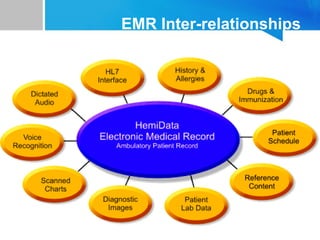
EMR Inter-relationships
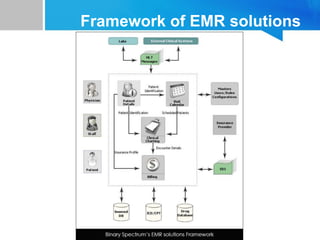
Framework of EMR solutions
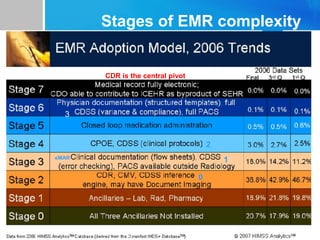
Stages of EMR complexity
1
2
3
0
eMAR
CDR is the central pivot
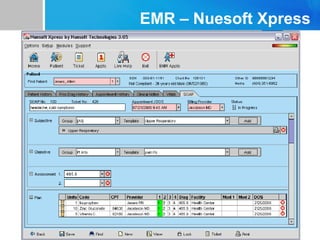
EMR – Nuesoft Xpress
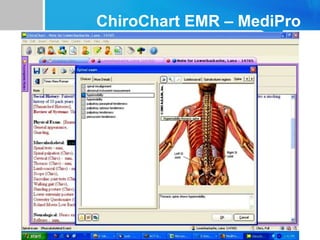
ChiroChart EMR – MediPro
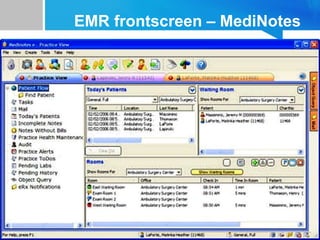
EMR frontscreen – MediNotes
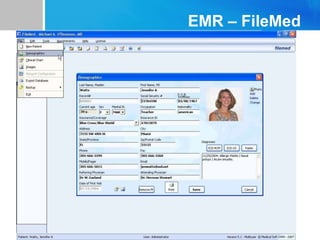
EMR – FileMed
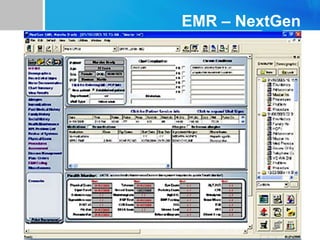
EMR – NextGen
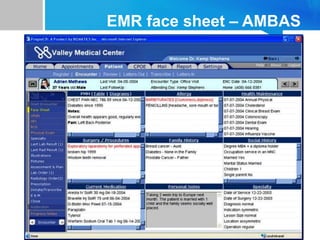
EMR face sheet – AMBAS
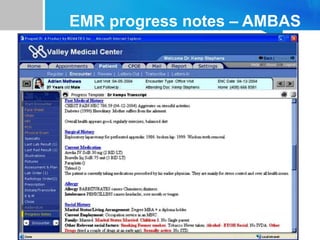
EMR progress notes – AMBAS
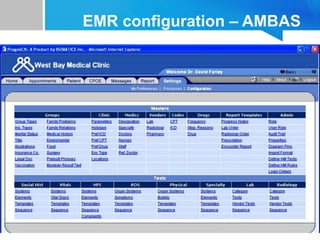
EMR configuration – AMBAS
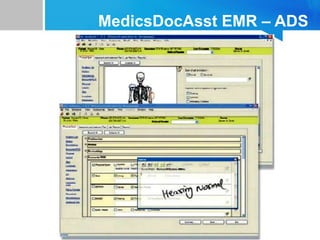
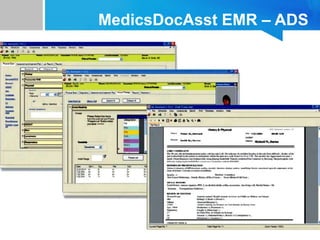
MedicsDocAsst EMR – ADS
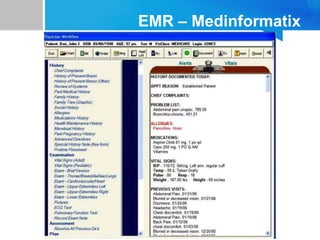
EMR – Medinformatix
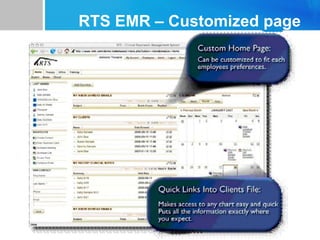
RTS EMR – Customized page
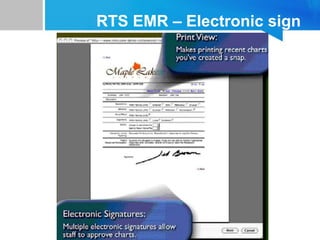
RTS EMR – Electronic sign
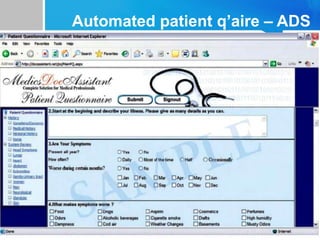
Automated patient q’aire – ADS
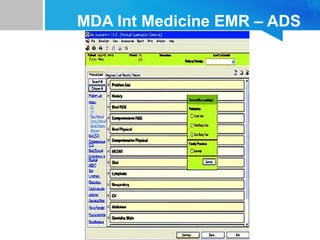
MDA Int Medicine EMR – ADS
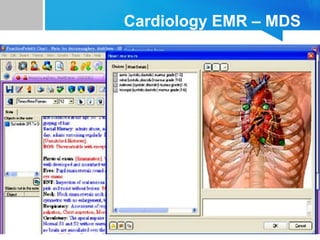
Cardiology EMR – MDS
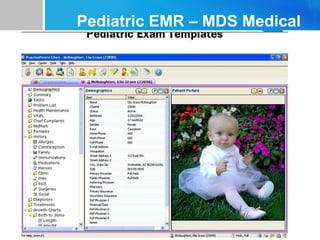
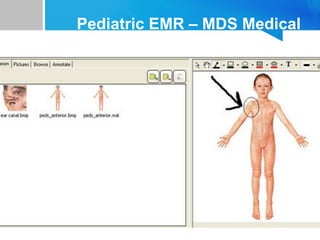
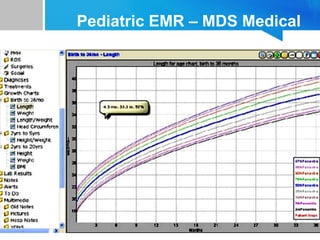
Pediatric EMR – MDS Medical
Oncology EMR – Synergy
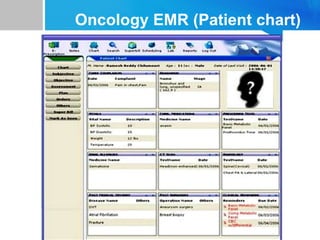
Oncology EMR (Patient chart)
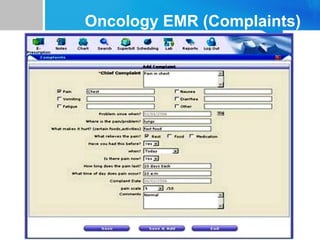
Oncology EMR (Complaints)
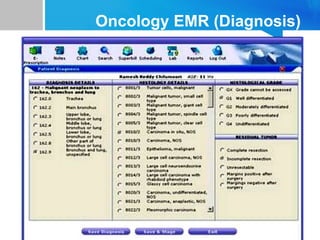
Oncology EMR (Diagnosis)
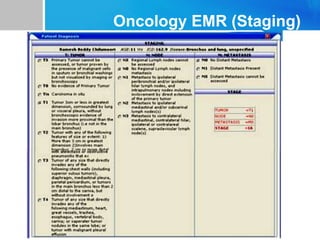
Oncology EMR (Staging)
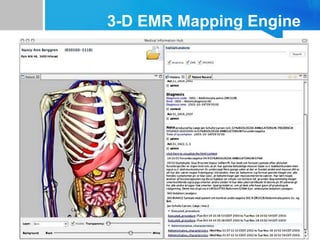
3-D EMR Mapping Engine
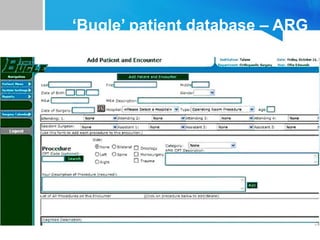
‘Bugle’ patient database – ARG
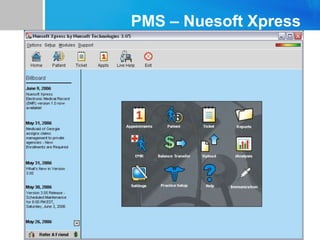
PMS – Nuesoft Xpress
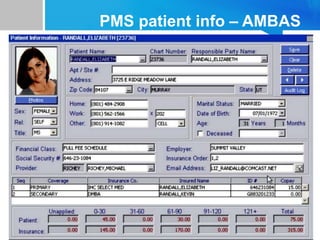
PMS patient info – AMBAS
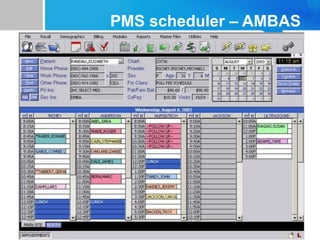
PMS scheduler – AMBAS
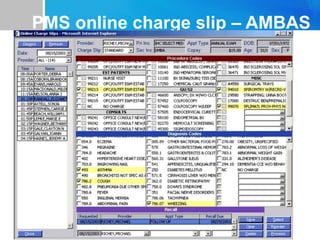
PMS online charge slip – AMBAS
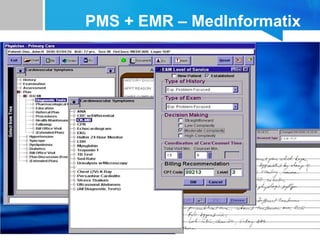
PMS + EMR – MedInformatix
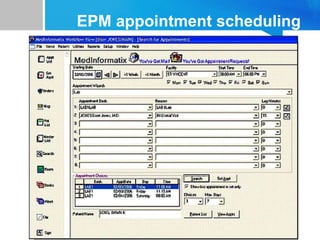
EPM appointment scheduling
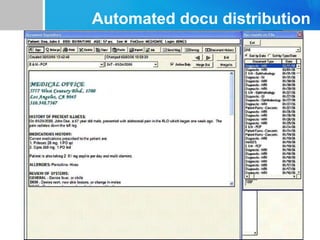
Automated docu distribution
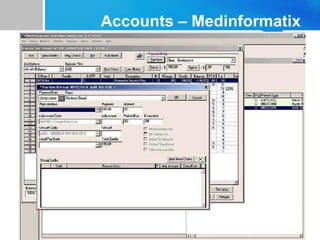
Accounts – Medinformatix
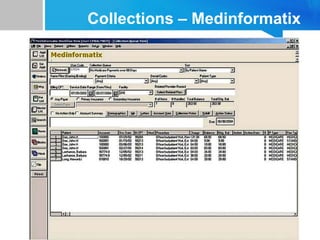
Collections – Medinformatix
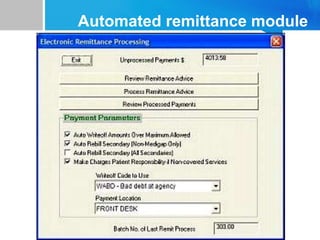
Automated remittance module
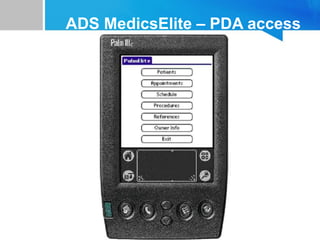
ADS MedicsElite – PDA access
EMR data entry in PDA
Conclusion
• EMR is not about just installing
a few computers and storing
patient data
• EMR has to be integrated with
PMS / EPM
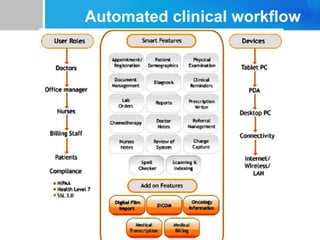
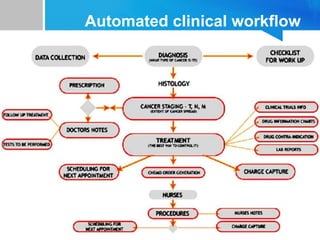
• EMR is all about automating
WORKFLOW process
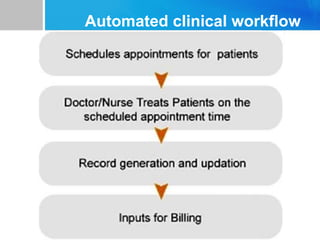
Automated clinical workflow
Nature of big data in healthcare
• Electronic health record (EHR)
can empower progressed
appraisal and offer assistance
to clinical fundamental
organization by giving colossal
information
Conclusion
•EMR is ultimately geared
towards reducing errors,
improving safety and
care and cutting costs of
healthcare

Electronic Medical Records

  • 1.
  • 2.
    What is EHR? •An electronic health record (EHR) is a digital version of a patient’s paper chart. EHRs are real-time, patient-centered records that make information available instantly and securely to authorized users. While an EHR does contain the medical and treatment histories of patients, an EHR system is built to go beyond standard clinical data collected in a provider’s office and can be inclusive of a broader view of a patient’s care.
  • 3.
    EHR • ISO TC215 defines an EHR as “a healthcare record in computer processable format.” EHRs are a vital part of health IT and can: • Contain a patient’s medical history, diagnoses, medications, treatment plans, immunization dates, allergies, radiology images, and laboratory and test results • Allow access to evidence-based tools that providers can use to make decisions about a patient’s care • Automate and streamline provider workflow
  • 4.
    Electronic Health Record(EHR): • An electronic version of a patients medical history, that is maintained by the provider over time,and may include all of the key administrative clinical data relevant to that persons care under a particular provider, includingdemographics, progress notes, problems, medications, vital signs, past medical history, immunizations, laboratory data and radiologyreports.
  • 5.
    Electronic medical record •Should document history, examination, diagnoses intuitively, rapidly, efficiently • Should automate tests, medication, submission of diagnostic / procedure codes • Should include error checking rules to avert allergies / cross reactions
  • 6.
    Electronic Medical Record •An EMR contains the results of clinical and administrative encounters between a provider (physician, nurse, telephone triage nurse, and others) and a patient that occur during episodes of patient care. Consequently, the EMR reflects the practice style, job function, knowledge and skill of the providers who create it. It necessarily includes data structures and data elements that reflect those providers' systems. • The Institute of Medicine defined the basic functions of an EMR, then known as the computer-based patient record (CPR). The Institute of Medicine's definition remains the gold standard
  • 7.
    Electronic medical record •Evaluation and Management (E & M) electronic guidelines should be built into the code system • Should be compliant with HIPAA policies
  • 8.
    EHR • One ofthe key features of an EHR is that health information can be created and managed by authorized providers in a digital format capable of being shared with other providers across more than one health care organization. • EHRs are built to share information with other health care providers and organizations – such as laboratories, specialists, medical imaging facilities, pharmacies, emergency facilities, and school and workplace clinics – so they contain information from all clinicians involved in a patient’s care.
  • 9.
    EHR Scope • EHRcontain patient-level data collected during and for clinical care. Data within the electronic health record include diagnostic billing codes, procedure codes, vital signs, laboratory test results, clinical imaging, and physician notes. With repeated clinic visits, these data are longitudinal, providing valuable information on disease development, progression, and response to treatment or intervention strategies. The nearly universal adoption of EHRs nationally has the potential to provide population-scale real-world clinical data accessible for biomedical research, including genetic association studies
  • 10.
    EHR System Functions •Identify and maintain a patient record • manage patient demographics • manage problem lists • manage medication lists • manage patient history • manage clinical documents and notes • capture external clinical documents • present care plans, guidelines, and protocols • manage guidelines, protocols and patient-specific care plans • generate and record patient-specific instructions
  • 11.
    Requirements of EHR •EHRs must include the following assumptions: • The relevant information of general interest should always be present, easy to access and extract from the general information. This is the case for both family and personal histories that are kept and increase/are added to over time so they can be used to inform clinical decisions, regardless of where they take place. • The limited temporal information generated in isolated events may be well supported in closed electronic documents. These documents may contain the particularities of each specialty or service provided, in terms of design and functionality, as part of each care episode.
  • 12.
  • 13.
  • 14.
    Stages of EMRcomplexity 1 2 3 0 eMAR CDR is the central pivot
  • 16.
  • 17.
  • 18.
  • 19.
  • 20.
  • 21.
    EMR face sheet– AMBAS
  • 22.
  • 23.
  • 24.
  • 25.
  • 26.
  • 27.
    RTS EMR –Customized page
  • 28.
    RTS EMR –Electronic sign
  • 29.
  • 30.
    MDA Int MedicineEMR – ADS
  • 31.
  • 32.
    Pediatric EMR –MDS Medical
  • 33.
    Pediatric EMR –MDS Medical
  • 34.
    Pediatric EMR –MDS Medical
  • 35.
  • 36.
  • 37.
  • 38.
  • 39.
  • 40.
  • 42.
  • 43.
  • 44.
  • 45.
  • 46.
    PMS online chargeslip – AMBAS
  • 47.
    PMS + EMR– MedInformatix
  • 48.
  • 49.
  • 50.
  • 51.
  • 52.
  • 53.
  • 54.
  • 55.
    Conclusion • EMR isnot about just installing a few computers and storing patient data • EMR has to be integrated with PMS / EPM • EMR is all about automating WORKFLOW process
  • 56.
  • 57.
  • 58.
  • 59.
    Nature of bigdata in healthcare • Electronic health record (EHR) can empower progressed appraisal and offer assistance to clinical fundamental organization by giving colossal information
  • 60.
    Conclusion •EMR is ultimatelygeared towards reducing errors, improving safety and care and cutting costs of healthcare