Mechanics of structuresMechanics of structures
Stresses in beamsStresses in beams,
Inelastic bending,
Deflections
Dr. Rajesh K. N.
Assistant Professor in Civil EngineeringAssistant Professor in Civil Engineering
Govt. College of Engineering, Kannur
1
Module III
Bending stresses in beams - shear flow - shearing stress formulae for
Module III
Bending stresses in beams shear flow shearing stress formulae for
beams –
Inelastic bending of beams –Inelastic bending of beams –
Deflection of beams - direct integration method - singularity
f ti iti t h i t th dfunctions - superposition techniques - moment area method -
conjugate beam ideas –
Elementary treatment of statically indeterminate beams - fixed and
continuous beams
Dept. of CE, GCE Kannur Dr.RajeshKN
2
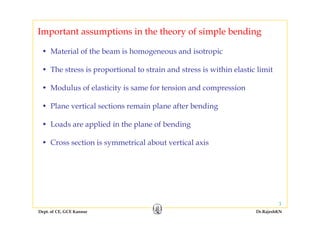
Important assumptions in the theory of simple bending
• Material of the beam is homogeneous and isotropic
p p y p g
• The stress is proportional to strain and stress is within elastic limit
• Modulus of elasticity is same for tension and compression• Modulus of elasticity is same for tension and compression
• Plane vertical sections remain plane after bending
• Loads are applied in the plane of bending
• Cross section is symmetrical about vertical axis
Dept. of CE, GCE Kannur Dr.RajeshKN
3
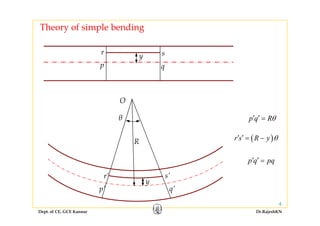
Theory of simple bending
r sy
p q
O
θ p q Rθ′ ′ =
( )r s R y θ′ ′ = −R ( )r s R y θ= −
p q pq′ ′ =
r’ s’
p’ q’
y
p q pq
Dept. of CE, GCE Kannur Dr.RajeshKN
4
p q
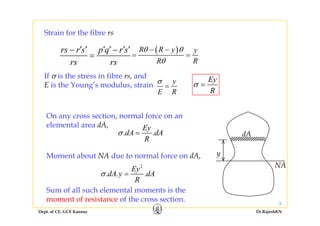
Strain for the fibre rs
rs r s p q r s
rs rs
′ ′ ′ ′ ′ ′− −
=
( )R R y y
R R
θ θ
θ
− −
= =
rs rs R Rθ
yσ
=
Ey
σ =
If σ is the stress in fibre rs, and
E is the Young’s modulus, strain
E R R
E is the Young s modulus, strain
O l f
. .
Ey
dA dA
R
σ =
On any cross section, normal force on an
elemental area dA,
dA
R
Moment about NA due to normal force on dA, y
NA2
. . .
Ey
dA y dA
R
σ =
Sum of all such elemental moments is the
NA
Dept. of CE, GCE Kannur Dr.RajeshKN
5
Sum of all such elemental moments is the
moment of resistance of the cross section.
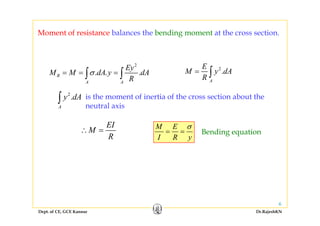
Moment of resistance balances the bending moment at the cross section.g
2
. . .R
A A
Ey
M M dA y dA
R
σ= = =∫ ∫
2
.
A
E
M y dA
R
= ∫
2
.
A
y dA∫ is the moment of inertia of the cross section about the
neutral axis
EI
M
R
∴ = M E
I R y
σ
= = Bending equation
R I R y
Dept. of CE, GCE Kannur Dr.RajeshKN
6
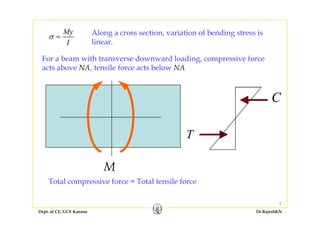
My
σ Along a cross section, variation of bending stress is
I
σ =
For a beam with transverse downward loading, compressive force
g , g
linear.
g, p
acts above NA, tensile force acts below NA
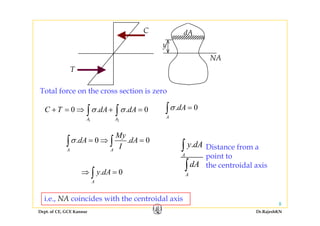
C
T
MM
Total compressive force = Total tensile force
Dept. of CE, GCE Kannur Dr.RajeshKN
7
C dA
NA
y
T
0 . . 0C T dA dAσ σ+ = ⇒ + =∫ ∫
Total force on the cross section is zero
. 0dAσ =∫
1 2A A
∫ ∫
0 0
My
dA dA∫ ∫ ∫
A
∫
. 0 . 0
A A
y
dA dA
I
σ = ⇒ =∫ ∫ .
A
y dA
dA
∫
∫
Distance from a
point to
the centroidal axis
. 0
A
y dA⇒ =∫ A
dA∫ the centroidal axis
Dept. of CE, GCE Kannur Dr.RajeshKN
8
i.e., NA coincides with the centroidal axis
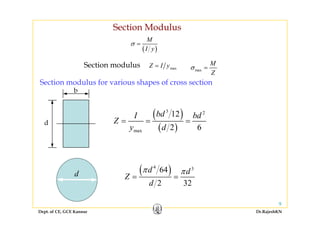
Section Modulus
( )
M
I y
σ =
M
maxZ I y=
Section modulus for various shapes of cross section
max
M
Z
σ =Section modulus
b
( )3 212bdI bd
d
( )
( )
2
max
12
2 6
bdI bd
Z
y d
= = =
d ( )4 364
2 32
d d
Z
d
π π
= =
Dept. of CE, GCE Kannur Dr.RajeshKN
9
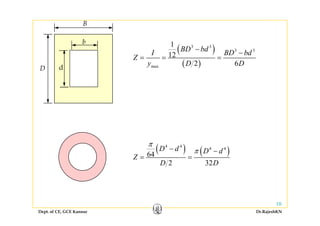
B
( )
( )
3 3
3 3
1
12
2 6
BD bdI BD bd
Z
D D
− −
= = =
b
( )max 2 6y D D
D d
( ) ( )
4 4
4 4
64
2 32
D d D d
Z
D D
π
π− −
= =
2 32D D
Dept. of CE, GCE Kannur Dr.RajeshKN
10
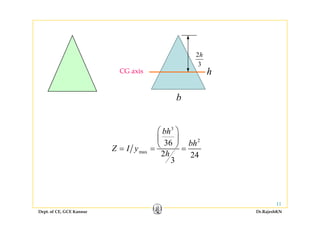
2h
3
CG axis h
b
3
bh⎛ ⎞
⎜ ⎟ 2
max
36
2 24
3
bh
Z I y
h
⎜ ⎟
⎝ ⎠= = =
Dept. of CE, GCE Kannur Dr.RajeshKN
11
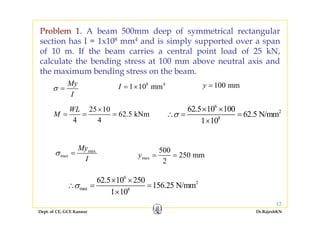
Problem 1. A beam 500mm deep of symmetrical rectangulary g
section has I = 1x108 mm4 and is simply supported over a span
of 10 m. If the beam carries a central point load of 25 kN,
calculate the bending stress at 100 mm above neutral axis andcalculate the bending stress at 100 mm above neutral axis and
the maximum bending stress on the beam.
My
σ
8 4
1 10 mmI = × 100 mmy =y
I
σ =
25 10
62 5 kN
WL
M
×
1 10 mmI = × 100 mmy
6
262.5 10 100
62 5 N/
× ×
∴62.5 kNm
4 4
M = = = 2
8
62.5 N/mm
1 10
σ∴ = =
×
max
max
My
I
σ =
max
500
250 mm
2
y = =
6
2
max 8
62.5 10 250
156.25 N/mm
1 10
σ
× ×
∴ = =
Dept. of CE, GCE Kannur Dr.RajeshKN
12
max 8
1 10×
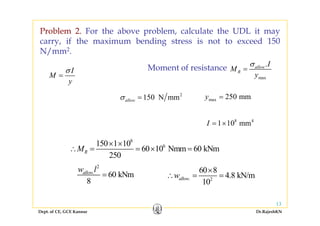
Problem 2. For the above problem, calculate the UDL it mayy
carry, if the maximum bending stress is not to exceed 150
N/mm2.
I
I
M
y
σ
= max
.allow
R
I
M
y
σ
=Moment of resistance
2
150 N mmallowσ = max 250 mmy =
8 4
1 10 mmI = ×
8
6150 1 10
60 10 Nmm 60 kNm
250
RM
× ×
∴ = = × =
2
.
60 kNm
8
alloww l
= . 2
60 8
4.8 kN/m
10
alloww
×
∴ = =
Dept. of CE, GCE Kannur Dr.RajeshKN
13
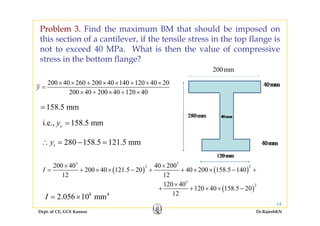
Problem 3. Find the maximum BM that should be imposed on
hi i f il if h il i h fl ithis section of a cantilever, if the tensile stress in the top flange is
not to exceed 40 MPa. What is then the value of compressive
stress in the bottom flange?stress in the bottom flange?
200 40 260 200 40 140 120 40 20
y
× × + × × + × ×
=
200mm
200 40 200 40 120 40
y =
× + × + ×
158.5 mm=
i.e., 158.5 mmcy =
3 3
200 40 40 200
280 158.5 121.5 mmty∴ = − =
( ) ( )
( )
3 3
2 2
3
2
200 40 40 200
200 40 121.5 20 40 200 158.5 140
12 12
120 40
120 40 158.5 20
I
× ×
= + × × − + + × × − +
×
+ + × × −
Dept. of CE, GCE Kannur Dr.RajeshKN
14
( )120 40 158.5 20
12
+ + × ×
8 4
2.056 10 mmI = ×
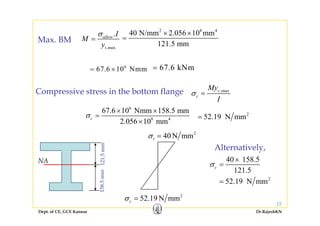
.ll Iσ
2 8 4
40 N/mm 2.056 10 mm× ×
,max
.allow
t
I
M
y
σ
=Max. BM 121.5 mm
=
6
67.6 10 Nmm= × 67.6 kNm=
My
Compressive stress in the bottom flange ,maxc
c
My
I
σ =
6
67.6 10 Nmm 158.5 mm× × 2
8 4
67.6 10 Nmm 158.5 mm
2.056 10 mm
cσ =
×
2
52.19 N mm=
2
40 N mmtσ =t
40 158.5
σ
×
=
Alternatively,
121.5mm
NA
121.5
cσ =
2
52.19 N mm=
158.5mm
Dept. of CE, GCE Kannur Dr.RajeshKN
15
2
52.19 N mmcσ =
1
Theory of simple bending is applicable to pure bending.y g g
But since the effect of shear on bending stress is negligible, the
theory can be applied generally
The effect of shear on bending stress is not of practical
theory can be applied generally.
The effect of shear on bending stress is not of practical
importance, but shearing stresses must be considered for their
own importance.
Dept. of CE, GCE Kannur Dr.RajeshKN
16
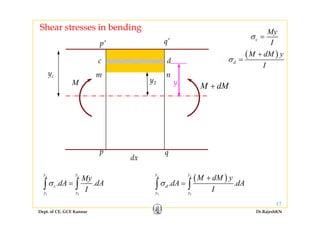
Shear stresses in bending My
σc
I
σ =
( )
d
M dM y
σ
+
=
p’ q’p’ q’
c d d
I
σ
m n
y1M M dM+
yc m n
y1 y
c d
M dM+
p q
dx
p q
. .
c cy y
c
My
dA dA
I
σ =∫ ∫
( ). .
c cy y
d
M dM y
dA dA
I
σ
+
=∫ ∫
Dept. of CE, GCE Kannur Dr.RajeshKN
17
1 1y y
I 1 1y y
I
c cy y
dA dAσ σ−∫ ∫
( )c cy y
M dM y My
dA dA
+
∫ ∫
cy
dM
y dA= ∫
1 1
. .d c
y y
dA dAσ σ∫ ∫
( )
1 1
. .
y y
dA dA
I I
= −∫ ∫ 1
.
y
y dA
I∫
.
cy
dAσ∫
A
cy
dAσ∫1
.c
y
dAσ∫
b
d
1
.d
y
dAσ∫
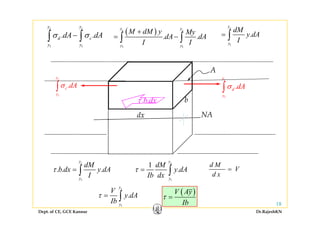
. .b dxτ
NAdx NA
cy
dM 1 cy
dM d M
1
. . .
y
dM
b dx y dA
I
τ = ∫
1
1
.
y
dM
y dA
Ib dx
τ = ∫
cy
V
d M
V
d x
=
( )V A
Dept. of CE, GCE Kannur Dr.RajeshKN
181
.
y
V
y dA
Ib
τ = ∫
( )V Ay
Ib
τ =
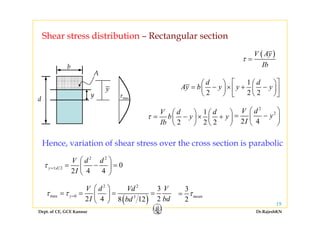
Shear stress distribution Rectangular sectionShear stress distribution – Rectangular section
( )V Ay
τ =
b Ib
A
1d d
Ay b y y y
⎡ ⎤⎛ ⎞ ⎛ ⎞
= − × + −⎜ ⎟ ⎜ ⎟⎢ ⎥
d
y
y
2 2 2
Ay b y y y= − × + −⎜ ⎟ ⎜ ⎟⎢ ⎥
⎝ ⎠ ⎝ ⎠⎣ ⎦
1V d d⎛ ⎞ ⎛ ⎞
2
2V d⎛ ⎞
maxτ
1
2 2 2
V d d
b y y
Ib
τ ⎛ ⎞ ⎛ ⎞
= − × +⎜ ⎟ ⎜ ⎟
⎝ ⎠ ⎝ ⎠
2
2 4
V d
y
I
⎛ ⎞
= −⎜ ⎟
⎝ ⎠
Hence, variation of shear stress over the cross section is parabolic
2 2
0
V d d
τ
⎛ ⎞
⎜ ⎟2 0
2 4 4
y d
I
τ =± = − =⎜ ⎟
⎝ ⎠
2 2
3V d Vd V⎛ ⎞ 3
Dept. of CE, GCE Kannur Dr.RajeshKN
19
( )max 0 3
3
2 4 28 12
y
V d Vd V
I bdbd
τ τ =
⎛ ⎞
= = = =⎜ ⎟
⎝ ⎠
3
2
meanτ=
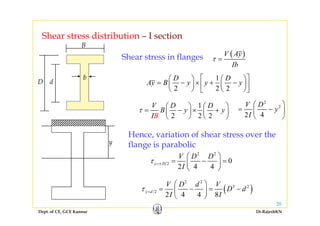
Shear stress distribution I sectionShear stress distribution – I section
( )V Ay
τ =
B
Shear stress in flanges
Ib
1
2 2 2
D D
Ay B y y y
⎡ ⎤⎛ ⎞ ⎛ ⎞
= − × + −⎜ ⎟ ⎜ ⎟⎢ ⎥
⎝ ⎠ ⎝ ⎠⎣ ⎦
D d
b
g
2 2 2
⎜ ⎟ ⎜ ⎟⎢ ⎥
⎝ ⎠ ⎝ ⎠⎣ ⎦
1V D D
B y yτ
⎛ ⎞ ⎛ ⎞
= − × +⎜ ⎟ ⎜ ⎟
⎝ ⎠ ⎝ ⎠
2
2
2 4
V D
y
I
⎛ ⎞
= −⎜ ⎟
⎝ ⎠2 2 2
y
B
y
I
⎜ ⎟ ⎜ ⎟
⎝ ⎠ ⎝ ⎠ 2 4
y
I
⎜ ⎟
⎝ ⎠
Hence, variation of shear stress over the
flange is parabolic
2 2
2 0
2 4 4
y D
V D D
I
τ =±
⎛ ⎞
= − =⎜ ⎟
⎝ ⎠
y
2
2 4 4
y D
I
=± ⎜ ⎟
⎝ ⎠
( )
2 2
2 2V D d V
D dτ
⎛ ⎞
= − = −⎜ ⎟
Dept. of CE, GCE Kannur Dr.RajeshKN
20
( )/2
2 4 4 8
y d D d
I I
τ = = =⎜ ⎟
⎝ ⎠
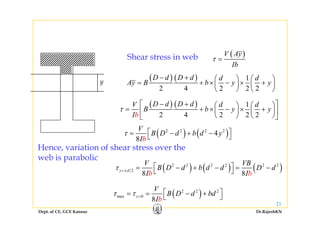
( )V Ay
τ =Shear stress in web
Ib
( ) ( ) 1
2 4 2 2 2
D d D d d d
Ay B b y y
− + ⎛ ⎞ ⎛ ⎞
= + × − × +⎜ ⎟ ⎜ ⎟
⎝ ⎠ ⎝ ⎠
y
2 4 2 2 2
⎜ ⎟ ⎜ ⎟
⎝ ⎠ ⎝ ⎠
( ) ( ) 1
2 4 2 2 2
D d D dV d d
b y y
Ib
Bτ
− +⎡ ⎤⎛ ⎞ ⎛ ⎞
= + × − × +⎜ ⎟ ⎜ ⎟⎢ ⎥
⎝ ⎠ ⎝ ⎠⎣ ⎦2 4 2 2 2
y y
Ib
⎜ ⎟ ⎜ ⎟⎢ ⎥
⎝ ⎠ ⎝ ⎠⎣ ⎦
( ) ( )2 2 2 2
4
8
V
B D d
b
b d y
I
τ ⎡ ⎤= − + −⎣ ⎦
Hence, variation of shear stress over the
web is parabolic
( ) ( ) ( )2 2 2 2 2 2V VB
⎡ ⎤
( ) ( )8 bI ⎣ ⎦
( ) ( ) ( )2 2 2 2 2 2
2
8 8
y d
V VB
B D d b d
b
d D d
I bI
τ =±
⎡ ⎤= − + − = −⎣ ⎦
( )2 2 2V
⎡ ⎤
Dept. of CE, GCE Kannur Dr.RajeshKN
21
( )2 2 2
max 0
8
y
V
B d
Ib
D bdτ τ =
⎡ ⎤= = − +⎣ ⎦
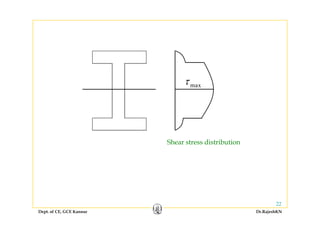
maxτ
Shear stress distribution
Dept. of CE, GCE Kannur Dr.RajeshKN
22
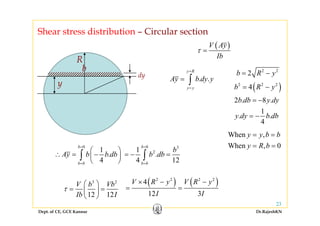
Shear stress distribution – Circular section
( )V Ay
Ib
τ =
R
y
R
b
dy
2 2
2b R y= −
( )2 2 2
4b R y= −
. .
y R
Ay b dy y
=
= ∫y ( )4b R y= −
2 . 8 .b db y dy= −
1
y y=
1
. .
4
y dy b db= −
When ,y y b b= =
When , 0y R b= =0
1
.
4
b
b b
Ay b b db
=
=
⎛ ⎞
∴ = −⎜ ⎟
⎝ ⎠
∫
0 3
21
.
4 12
b
b b
b
b db
=
=
= − =∫
3 2
V b Vb
τ
⎛ ⎞
= =⎜ ⎟
( ) ( )2 2 2 2
4V R y V R y× − −
= =
b b b b
Dept. of CE, GCE Kannur Dr.RajeshKN
23
12 12Ib I
τ = =⎜ ⎟
⎝ ⎠ 12 3I I
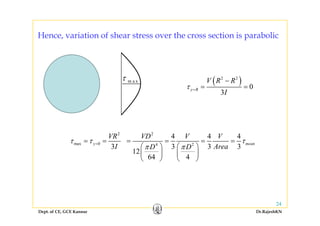
Hence variation of shear stress over the cross section is parabolicHence, variation of shear stress over the cross section is parabolic
( )2 2
0
V R R
τ
−
= =
m a xτ
0
3
y R
I
τ = = =
2
VR 2
4 4 4VD V V
max 0
3
y
V
I
τ τ == = 4 2
3 3 3
12
64 4
mean
V V V
AreaD D
τ
π π
= = = =
⎛ ⎞ ⎛ ⎞
⎜ ⎟ ⎜ ⎟
⎝ ⎠ ⎝ ⎠
Dept. of CE, GCE Kannur Dr.RajeshKN
24
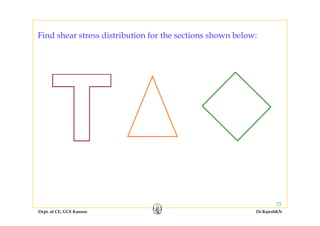
Find shear stress distribution for the sections shown below:Find shear stress distribution for the sections shown below:
Dept. of CE, GCE Kannur Dr.RajeshKN
25
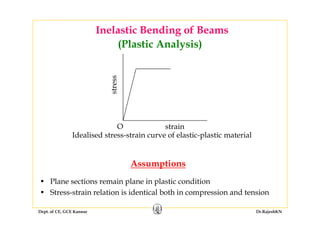
Inelastic Bending of Beams
(Plastic Analysis)
g
ressstr
strainO
Idealised stress-strain curve of elastic-plastic materialp
AssumptionsAssumptions
• Plane sections remain plane in plastic condition
S i l i i id i l b h i i d i
Dept. of CE, GCE Kannur Dr.RajeshKN
• Stress-strain relation is identical both in compression and tension
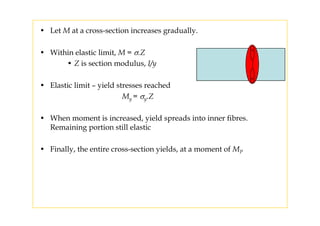
• Let M at a cross-section increases gradually.
• Within elastic limit, M = σ.Z
Z i ti d l I/• Z is section modulus, I/y
• Elastic limit – yield stresses reachedElastic limit yield stresses reached
My = σy.Z
• When moment is increased, yield spreads into inner fibres.
Remaining portion still elastic
• Finally, the entire cross-section yields, at a moment of MP
yσ
σ
σ
yσ
yσ yσ yσσ
σ
Dept. of CE, GCE Kannur Dr.RajeshKN
yσ yσ yσσ
σy σy
σy σyσy σy y y
σy
σy
Dept. of CE, GCE Kannur Dr.RajeshKN
Plastic moment
• M – Moment corresponding to working load
• My – Moment at which the section yieldsMy Moment at which the section yields
• MP – Moment at which entire section is under yield stress – plastic moment
yσ
CC
T
yσ
MP
Dept. of CE, GCE Kannur Dr.RajeshKN
• At plastic moment the entire section is under yield stressAt plastic moment, the entire section is under yield stress
C T
A Aσ σ
=
=
A
A A⇒ = =
•NA divides cross-section into 2 equal parts
c y t yA Aσ σ=
2
c tA A⇒ = =
A
C T σ= =•NA divides cross-section into 2 equal parts
2
yC T σ= =
yσ
y
2
y
A
C = σ
yt
yc
A
T σ=
yσ
2
yT σ
Dept. of CE, GCE Kannur Dr.RajeshKN
31
Zσ
Similar to
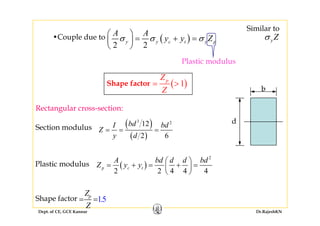
•Couple due to ( )
A A
Z
⎛ ⎞
⎜ ⎟
Plastic modulus
yZσ•Couple due to ( )
2 2
y y c t y py y Zσ σ σ⎛ ⎞
= + =⎜ ⎟
⎝ ⎠
Plastic modulus
Shape factor ( )1pZ
Z
= >
b
Rectangular cross-section:
p ( )
Z b
Section modulus ( )
( )
3 212
2 6
bdI bd
Z
y d
= = =
d
( )y
( )
2
A bd d d bd
Z y y
⎛ ⎞
+ +⎜ ⎟Plastic modulus ( )
2 2 4 4 4
p c tZ y y= + = + =⎜ ⎟
⎝ ⎠
Plastic modulus
Dept. of CE, GCE Kannur Dr.RajeshKN
Shape factor 1.5pZ
Z
= =
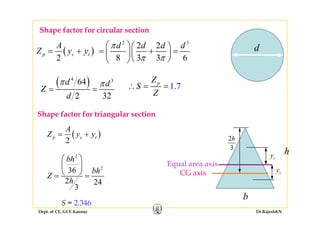
Shape factor for circular section
d( )
2
p c t
A
Z y y= +
2 3
2 2
8 3 3 6
d d d d⎛ ⎞⎛ ⎞
= + =⎜ ⎟⎜ ⎟
⎝ ⎠⎝ ⎠
π
π π
1 7pZ
S∴ = =( )4 364d d
Z
π π
⎝ ⎠⎝ ⎠
1.7S
Z
∴ = =( )
2 32
Z
d
= =
Sh f t f t i ul ti
2h
Shape factor for triangular section
( )
2
p c t
A
Z y y= +
h
Equal area axis
cy
2
3
h
3
bh⎛ ⎞
⎜ ⎟
( )
2
p c t
Equal area axis
tyCG axis
2
36
2 24
3
bh
Z
h
⎜ ⎟
⎝ ⎠= =
Dept. of CE, GCE Kannur Dr.RajeshKN
b
S = 2.346
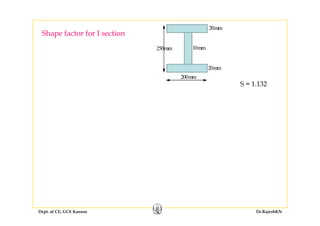
20mm
Shape factor for I section
10mm250mm
p
20mm
200mm
S = 1.132
Dept. of CE, GCE Kannur Dr.RajeshKN
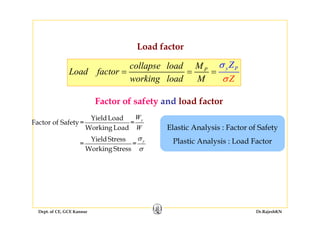
Z
Load factor
P y Pcollapse load M
Load factor
working load M Z
Zσ
σ
= = =
Factor of safety and load factor
YieldLoad
Factor of Safety= =
Working Load
YieldStress
yW
W
σ
Elastic Analysis : Factor of Safety
Pl i A l i L d FYieldStress
= =
Working Stress
yσ
σ
Plastic Analysis : Load Factor
Dept. of CE, GCE Kannur Dr.RajeshKN
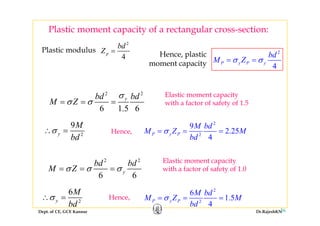
Plastic moment capacity of a rectangular cross-section:
2
P P
bd
M Zσ σ= =
2
4
p
bd
Z =Plastic modulus
Hence, plastic
t it 4
P y P yM Zσ σmoment capacity
2 2
6 1.5 6
ybd bd
M Z
σ
σ σ= = =
Elastic moment capacity
with a factor of safety of 1.5
2
2
9
2.25
4
P y P
M bd
M Z M
bd
σ= = =2
9
y
M
bd
σ∴ = Hence,
4bdbd
2 2
bd bd Elastic moment capacity
6 6
y
bd bd
M Zσ σ σ= = =
p y
with a factor of safety of 1.0
2
6 bd6M
Dept. of CE, GCE Kannur Dr.RajeshKN36
2
2
6
1.5
4
P y P
M bd
M Z M
bd
σ= = =2
6
y
M
bd
σ∴ = Hence,
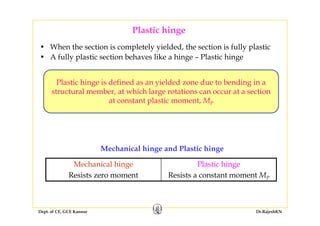
Plastic hinge
• When the section is completely yielded, the section is fully plastic
• A fully plastic section behaves like a hinge – Plastic hinge
Plastic hinge is defined as an yielded zone due to bending in a
structural member, at which large rotations can occur at a section
at constant plastic moment, MP
Mechanical hinge Plastic hinge
Mechanical hinge and Plastic hinge
Mechanical hinge
Resists zero moment
Plastic hinge
Resists a constant moment MP
Dept. of CE, GCE Kannur Dr.RajeshKN
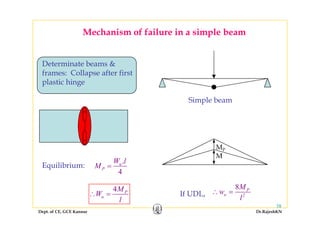
Mechanism of failure in a simple beamp
D t i t b &Determinate beams &
frames: Collapse after first
plastic hinge
Simple beam
MP
M
.uW l
MEquilibrium
4
u
PM =
4M
Equilibrium:
8 PM
Dept. of CE, GCE Kannur Dr.RajeshKN
38
4 P
u
M
W
l
∴ = 2
P
uw
l
∴ =If UDL,
fl i f bDeflection of beams
• Differential equation of the elastic curve
• Slope and deflection of beams by method of
successive integration
• Macaulay’s method
• Moment area method
• Conjugate beam method
Dept. of CE, GCE Kannur Dr.RajeshKN
39
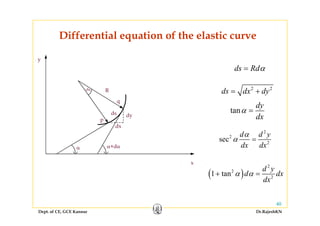
Differential equation of the elastic curveDifferential equation of the elastic curve
yy
ds Rdα=
2 2
q
Rdα
ds
2 2
ds dx dy= +
tan
dy
α =
p
dy
dx
ds a
dx
α
2
2
sec
d d yα
α
α α+dα
x
2
sec
dx dx
α =
x
( )
2
2
2
1 tan
d y
d dx
dx
α α+ =
Dept. of CE, GCE Kannur Dr.RajeshKN
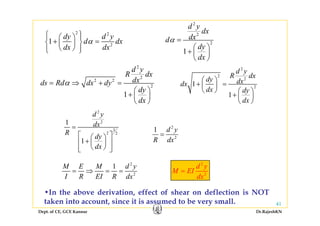
40
2 2
dy d y⎧ ⎫⎪ ⎪⎛ ⎞
2
2
d y
dx
dx
2
1
dy d y
d dx
dx dx
α
⎧ ⎫⎪ ⎪⎛ ⎞
+ =⎨ ⎬⎜ ⎟
⎝ ⎠⎪ ⎪⎩ ⎭
2
1
dxd
dy
dx
α =
⎛ ⎞
+ ⎜ ⎟
⎝ ⎠
2
2
2 2
2
d y
R dx
dxds Rd dx dy
d
α= ⇒ + =
⎛ ⎞
2
2
2
2
1
d y
R dx
dy dxdx
d
⎛ ⎞
+ =⎜ ⎟
⎝ ⎠ ⎛ ⎞
2
1
dy
dx
⎛ ⎞
+ ⎜ ⎟
⎝ ⎠
2
1
dx dy
dx
⎜ ⎟
⎝ ⎠ ⎛ ⎞
+ ⎜ ⎟
⎝ ⎠
2
d2
2
3
2 2
1
1
d y
dx
R
dy
=
⎡ ⎤⎛ ⎞
⎢ ⎥⎜ ⎟
2
2
1 d y
R d
=
1
dy
dx
⎛ ⎞
+⎢ ⎥⎜ ⎟
⎝ ⎠⎢ ⎥⎣ ⎦
2
R dx
2
1M E M d 2
d2
2
1M E M d y
I R EI R dx
= ⇒ = =
2
2
d y
M EI
dx
=
I th b d i ti ff t f h d fl ti i NOT
Dept. of CE, GCE Kannur Dr.RajeshKN
41
•In the above derivation, effect of shear on deflection is NOT
taken into account, since it is assumed to be very small.
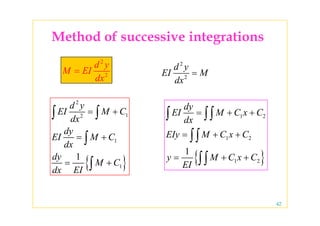
Method of successive integrationsMethod of successive integrations
2
d2
2
d y
M EI
dx
=
2
2
d y
EI M
dx
=
2
d y
EI M C= +∫ ∫
dy
EI M C x C= + +∫ ∫∫12
EI M C
dx
dy
EI M C
= +
= +
∫ ∫
∫
1 2
1 2
EI M C x C
dx
EIy M C x C
= + +
= + +
∫ ∫∫
∫∫
{ }
1
1
EI M C
dx
dy
M C
= +
= +
∫
∫ { }
1 2
1 2
1
y
y M C x C
EI
= + +
∫∫
∫∫{ }1M C
dx EI
= +∫ { }EI ∫∫
42
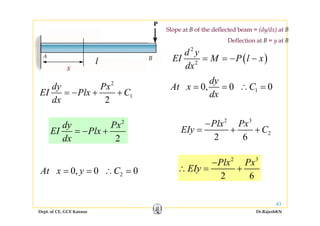
Slope at B of the deflected beam = (dy/dx) at B
( )
2
2
d y
EI M P l x= = − −l B
Deflection at B = y at B
0 0 0
dy
At x C= = ∴ =
( )2
dx
2
dy Px
l
x
10, 0 0At x C
dx
= = ∴ =
1
2
dy Px
EI Plx C
dx
= − + +
2 3
2
2 6
Plx Px
EIy C
−
= + +
2
2
dy Px
EI Plx
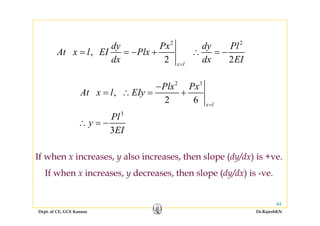
dx
= − +
2 62dx
2 3
Plx Px−
20, 0 0At x y C= = ∴ =
2 6
Plx Px
EIy∴ = +
Dept. of CE, GCE Kannur Dr.RajeshKN
43
2 2
,
2 2
dy Px dy Pl
At x l EI Plx
dx dx EI
= = − + ∴ = −
2 2x l
dx dx EI=
2 3
Plx Px−
3
,
2 6 x l
Plx Px
At x l EIy
=
= ∴ = +
3
3
Pl
y
EI
∴ = −
If when x increases, y also increases, then slope (dy/dx) is +ve.
If when x increases, y decreases, then slope (dy/dx) is -ve.
Dept. of CE, GCE Kannur Dr.RajeshKN
44
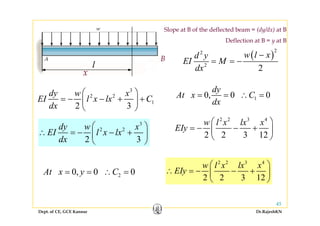
Slope at B of the deflected beam = (dy/dx) at B
Deflection at B = y at B
( )
22
w l xd y
EI M
−
= = −l
B
d
2
2
EI M
dx
= = −l
x
10, 0 0
dy
At x C
dx
= = ∴ =
3
2 2
1
2 3
dy w x
EI l x lx C
dx
⎛ ⎞
= − − + +⎜ ⎟
⎝ ⎠
3
2 2
2 3
dy w x
EI l x lx
dx
⎛ ⎞
∴ = − − +⎜ ⎟
⎝ ⎠
2 2 3 4
2 2 3 12
w l x lx x
EIy
⎛ ⎞
= − − +⎜ ⎟
⎝ ⎠2 3dx ⎝ ⎠
⎝ ⎠
2 2 3 4
w l x lx x⎛ ⎞
20, 0 0At x y C= = ∴ =
2 2 3 12
w l x lx x
EIy
⎛ ⎞
∴ = − − +⎜ ⎟
⎝ ⎠
Dept. of CE, GCE Kannur Dr.RajeshKN
45
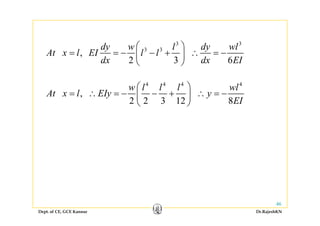
3 3
3 3
,
2 3 6
dy w l dy wl
At x l EI l l
dx dx EI
⎛ ⎞
= = − − + ∴ = −⎜ ⎟
⎝ ⎠2 3 6dx dx EI⎝ ⎠
4 4 4 4
w l l l wl⎛ ⎞
,
2 2 3 12 8
w l l l wl
At x l EIy y
EI
⎛ ⎞
= ∴ = − − + ∴ = −⎜ ⎟
⎝ ⎠
Dept. of CE, GCE Kannur Dr.RajeshKN
46
Moment area methodMoment area method
Charles E. Greene
•For deflections of beams especially cantilever beams•For deflections of beams, especially cantilever beams
•Suitable when slopes and deflections at particular points are
required not the complete equation of the deflection curverequired, not the complete equation of the deflection curve
Dept. of CE, GCE Kannur Dr.RajeshKN
47
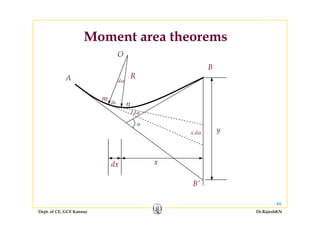
Moment area theoremsMoment area theorems
O
R
dαA
B
dα
ds
m
n
α
dα
x.dα y
xdx xdx
B’
Dept. of CE, GCE Kannur Dr.RajeshKN
48
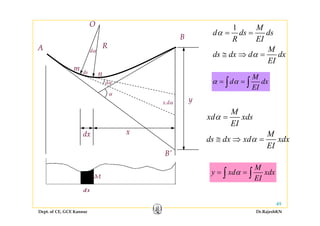
B
O 1 M
d ds dsα = =
R
dαA
B R EI
M
ds dx d dx
EI
α≅ ⇒ =
dα
ds
m
n
EI
M
d dx
EI
α α= =∫ ∫
α
x.dα y
EI∫ ∫
M
xdx
M
xd xds
EI
M
ds dx xd xdx
α
α
=
≅ ⇒
B’
ds dx xd xdx
EI
α≅ ⇒ =
M
y xd xdx
EI
α= =∫ ∫
Dept. of CE, GCE Kannur Dr.RajeshKN
49
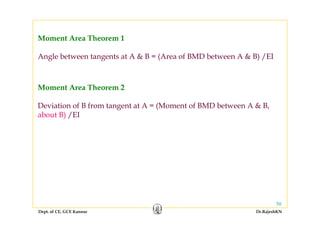
M t A Th 1Moment Area Theorem 1
Angle between tangents at A & B = (Area of BMD between A & B) /EI
Moment Area Theorem 2Moment Area Theorem 2
Deviation of B from tangent at A = (Moment of BMD between A & B,
b t B) /EIabout B) /EI
Dept. of CE, GCE Kannur Dr.RajeshKN
50
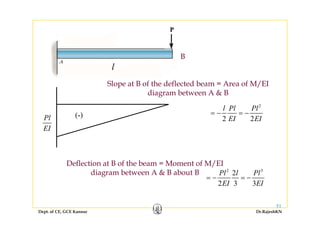
B
l
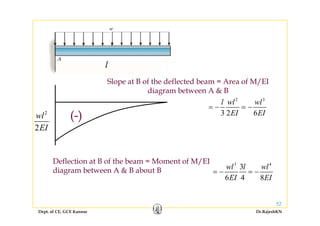
Slope at B of the deflected beam = Area of M/EI
( )
p /
diagram between A & B
2
l Pl Pl
= =(-)Pl
EI
2 2EI EI
= − = −
Deflection at B of the beam = Moment of M/EIDeflection at B of the beam Moment of M/EI
diagram between A & B about B 2 3
2
2 3 3
Pl l Pl
EI EI
= − = −
Dept. of CE, GCE Kannur Dr.RajeshKN
51
l
Slope at B of the deflected beam = Area of M/EI
l
diagram between A & B
2 3
3 2 6
l wl wl
EI EI
= − = −
2
l ( ) 3 2 6EI EI2
2
wl
EI
(-)
Deflection at B of the beam = Moment of M/EI 3 4
3l l l
/
diagram between A & B about B
3 4
3
6 4 8
wl l wl
EI EI
= − = −
Dept. of CE, GCE Kannur Dr.RajeshKN
52
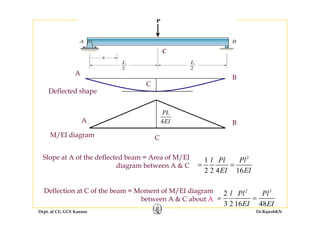
C
C
A
B
Deflected shape
PL
4
PL
EI
M/EI diagram C
A B
g C
Slope at A of the deflected beam = Area of M/EI
di b t A & C
2
1 l Pl Pl
= =diagram between A & C
2 2 4 16EI EI
= =
Deflection at C of the beam = Moment of M/EI diagram 2 3
Dept. of CE, GCE Kannur Dr.RajeshKN
Deflection at C of the beam = Moment of M/EI diagram
between A & C about A
2 3
2
3 2 16 48
l Pl Pl
EI EI
= =
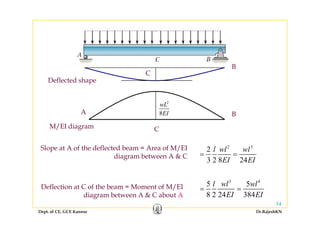
Deflected shape
C
B
2
8
wL
EIA B8EI
M/EI diagram C
A B
Slope at A of the deflected beam = Area of M/EI
diagram between A & C
2 3
2
3 2 8 24
l wl wl
EI EI
= =
Deflection at C of the beam = Moment of M/EI
3 4
5 5l wl wl
= =
Dept. of CE, GCE Kannur Dr.RajeshKN
54
/
diagram between A & C about A 8 2 24 384EI EI
= =
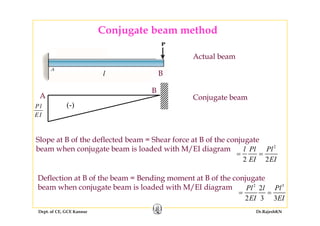
Conjugate beam method
Actual beam
j g
l B
Conjugate beam
(-)Pl
EI
B
A
EI
Slope at B of the deflected beam Shear force at B of the conjugateSlope at B of the deflected beam = Shear force at B of the conjugate
beam when conjugate beam is loaded with M/EI diagram 2
2 2
l Pl Pl
EI EI
= =
Deflection at B of the beam = Bending moment at B of the conjugate
beam when conjugate beam is loaded with M/EI diagram 2 3
2Pl l Pl
Dept. of CE, GCE Kannur Dr.RajeshKN
j g / g 2
2 3 3
Pl l Pl
EI EI
= =
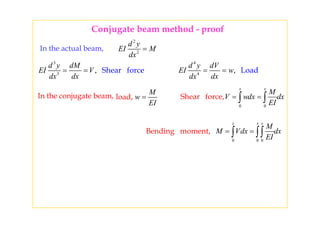
Conjugate beam method - proof
2
2
d y
EI M
dx
=
3 4
In the actual beam,
3
3
, Shear force
d y dM
EI V
dx dx
= =
4
4
, Load
d y dV
EI w
dx dx
= =
load,
M
w
EI
=
0 0
Shear force,
x x
M
V wdx dx
EI
= =∫ ∫In the conjugate beam,
Bending moment,
x x x
M
M Vdx dx
EI
= =∫ ∫∫0 0 0
EI
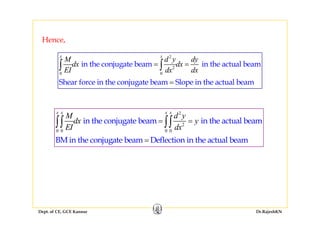
2
i h j b i h l b
x x
M d y dy
d d∫ ∫
Hence,
2
0 0
in the conjugate beam in the actual beam
Shear force in the conjugate beam Slope in the actual b ame
M d y dy
dx dx
EI dx dx
= =
=
∫ ∫
2x x x x
M d2
2
0 0 0 0
in the conjugate beam in the actual beam
BM i th j t b D fl ti i th t l b
x x x x
M d y
dx y
EI dx
= =∫∫ ∫∫
BM in the conjugate beam Deflection in the actual e mb a=
Dept. of CE, GCE Kannur Dr.RajeshKN
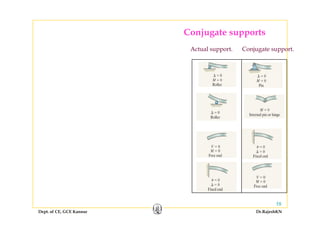
Conjugate supportsj g pp
Actual support. Conjugate support.
Dept. of CE, GCE Kannur Dr.RajeshKN
58
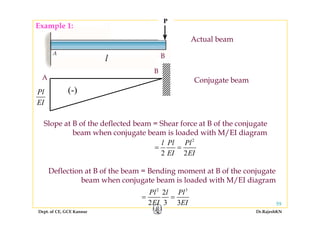
Example 1:
l
Actual beam
B
( )
Conjugate beam
B
A
(-)Pl
EI
Slope at B of the deflected beam = Shear force at B of the conjugate
beam when conjugate beam is loaded with M/EI diagram
2
2 2
l Pl Pl
EI EI
= =
Deflection at B of the beam = Bending moment at B of the conjugate
beam when conjugate beam is loaded with M/EI diagram
2 3
2Pl l Pl
Dept. of CE, GCE Kannur Dr.RajeshKN
59
2 3
2
2 3 3
Pl l Pl
EI EI
= =
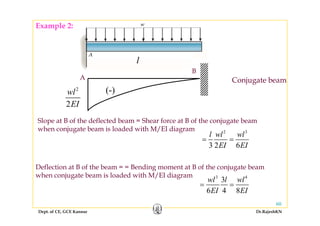
Example 2:
ll
( )
Conjugate beam
B
A
2
2
wl
EI
(-)
Slope at B of the deflected beam = Shear force at B of the conjugate beam
when conjugate beam is loaded with M/EI diagram 2 3
l wl wl
3 2 6EI EI
= =
Deflection at B of the beam = = Bending moment at B of the conjugate beam
when conjugate beam is loaded with M/EI diagram 3 4
3
6 4 8
wl l wl
EI EI
= =
Dept. of CE, GCE Kannur Dr.RajeshKN
60
6 4 8EI EI
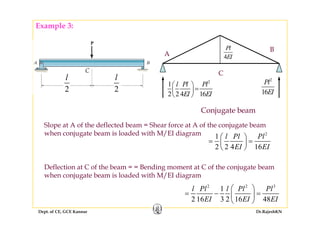
Example 3:
4
Pl
EIA
B
C
2
1 l Pl Pl⎛ ⎞
⎜ ⎟
2
Pl
2
l
2
l
C
Conjugate beam
2 2 4 16EI EI
⎛ ⎞
=⎜ ⎟
⎝ ⎠ 16EI22
j g
Slope at A of the deflected beam = Shear force at A of the conjugate beam
when conjugate beam is loaded with M/EI diagram 2
1 l Pl Pl⎛ ⎞
⎜ ⎟
1
2 2 4 16
l Pl Pl
EI EI
⎛ ⎞
= =⎜ ⎟
⎝ ⎠
Deflection at C of the beam = = Bending moment at C of the conjugate beam
when conjugate beam is loaded with M/EI diagram
2 2 3
1l Pl l Pl Pl⎛ ⎞
Dept. of CE, GCE Kannur Dr.RajeshKN
1
2 16 3 2 16 48
l Pl l Pl Pl
EI EI EI
⎛ ⎞
= − =⎜ ⎟
⎝ ⎠
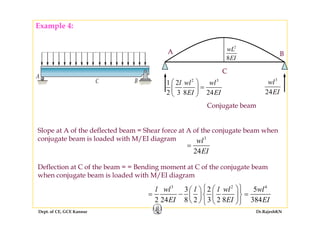
Example 4:
2
8
wL
EI
A B
CC
2 3
1 2l wl wl⎛ ⎞
=⎜ ⎟
3
wl
Conjugate beam
2 3 8 24EI EI
=⎜ ⎟
⎝ ⎠ 24EI
Slope at A of the deflected beam = Shear force at A of the conjugate beam when
conjugate beam is loaded with M/EI diagram 3
lconjugate beam is loaded with M/EI diagram
fl f h b d f h b
3
24
wl
EI
=
Deflection at C of the beam = = Bending moment at C of the conjugate beam
when conjugate beam is loaded with M/EI diagram
3 2 4
3 2 5l wl l l wl wl⎧ ⎫⎛ ⎞⎛ ⎞
Dept. of CE, GCE Kannur Dr.RajeshKN
3 2 5
2 24 8 2 3 2 8 384
l wl l l wl wl
EI EI EI
⎧ ⎫⎛ ⎞⎛ ⎞
= − =⎨ ⎬⎜ ⎟ ⎜ ⎟
⎝ ⎠ ⎝ ⎠⎩ ⎭
Principle of SuperpositionPrinciple of Superposition
Statement: Deflection at a given point in a structure produced by
several loads acting simultaneously on the structure can beseveral loads acting simultaneously on the structure can be
found by superposing deflections at the same point produced
by loads acting individually.
Applicable when there exists a linear relationship between
external forces and corresponding structural displacements.p g p
Dept. of CE, GCE Kannur Dr.RajeshKN
63
SummarySummary
Bending stresses in beams - shear flow - shearing stress formulae forBending stresses in beams shear flow shearing stress formulae for
beams –
Inelastic bending of beams –Inelastic bending of beams –
Deflection of beams - direct integration method - singularity functions
iti t h i t th d j t b- superposition techniques - moment area method - conjugate beam
ideas –
l f ll d b f d dElementary treatment of statically indeterminate beams - fixed and
continuous beams
Dept. of CE, GCE Kannur Dr.RajeshKN
64

Mechanics of structures - module3

  • 1.
    Mechanics of structuresMechanicsof structures Stresses in beamsStresses in beams, Inelastic bending, Deflections Dr. Rajesh K. N. Assistant Professor in Civil EngineeringAssistant Professor in Civil Engineering Govt. College of Engineering, Kannur 1
  • 2.
    Module III Bending stressesin beams - shear flow - shearing stress formulae for Module III Bending stresses in beams shear flow shearing stress formulae for beams – Inelastic bending of beams –Inelastic bending of beams – Deflection of beams - direct integration method - singularity f ti iti t h i t th dfunctions - superposition techniques - moment area method - conjugate beam ideas – Elementary treatment of statically indeterminate beams - fixed and continuous beams Dept. of CE, GCE Kannur Dr.RajeshKN 2
  • 3.
    Important assumptions inthe theory of simple bending • Material of the beam is homogeneous and isotropic p p y p g • The stress is proportional to strain and stress is within elastic limit • Modulus of elasticity is same for tension and compression• Modulus of elasticity is same for tension and compression • Plane vertical sections remain plane after bending • Loads are applied in the plane of bending • Cross section is symmetrical about vertical axis Dept. of CE, GCE Kannur Dr.RajeshKN 3
  • 4.
    Theory of simplebending r sy p q O θ p q Rθ′ ′ = ( )r s R y θ′ ′ = −R ( )r s R y θ= − p q pq′ ′ = r’ s’ p’ q’ y p q pq Dept. of CE, GCE Kannur Dr.RajeshKN 4 p q
  • 5.
    Strain for thefibre rs rs r s p q r s rs rs ′ ′ ′ ′ ′ ′− − = ( )R R y y R R θ θ θ − − = = rs rs R Rθ yσ = Ey σ = If σ is the stress in fibre rs, and E is the Young’s modulus, strain E R R E is the Young s modulus, strain O l f . . Ey dA dA R σ = On any cross section, normal force on an elemental area dA, dA R Moment about NA due to normal force on dA, y NA2 . . . Ey dA y dA R σ = Sum of all such elemental moments is the NA Dept. of CE, GCE Kannur Dr.RajeshKN 5 Sum of all such elemental moments is the moment of resistance of the cross section.
  • 6.
    Moment of resistancebalances the bending moment at the cross section.g 2 . . .R A A Ey M M dA y dA R σ= = =∫ ∫ 2 . A E M y dA R = ∫ 2 . A y dA∫ is the moment of inertia of the cross section about the neutral axis EI M R ∴ = M E I R y σ = = Bending equation R I R y Dept. of CE, GCE Kannur Dr.RajeshKN 6
  • 7.
    My σ Along across section, variation of bending stress is I σ = For a beam with transverse downward loading, compressive force g , g linear. g, p acts above NA, tensile force acts below NA C T MM Total compressive force = Total tensile force Dept. of CE, GCE Kannur Dr.RajeshKN 7
  • 8.
    C dA NA y T 0 .. 0C T dA dAσ σ+ = ⇒ + =∫ ∫ Total force on the cross section is zero . 0dAσ =∫ 1 2A A ∫ ∫ 0 0 My dA dA∫ ∫ ∫ A ∫ . 0 . 0 A A y dA dA I σ = ⇒ =∫ ∫ . A y dA dA ∫ ∫ Distance from a point to the centroidal axis . 0 A y dA⇒ =∫ A dA∫ the centroidal axis Dept. of CE, GCE Kannur Dr.RajeshKN 8 i.e., NA coincides with the centroidal axis
  • 9.
    Section Modulus ( ) M Iy σ = M maxZ I y= Section modulus for various shapes of cross section max M Z σ =Section modulus b ( )3 212bdI bd d ( ) ( ) 2 max 12 2 6 bdI bd Z y d = = = d ( )4 364 2 32 d d Z d π π = = Dept. of CE, GCE Kannur Dr.RajeshKN 9
  • 10.
    B ( ) ( ) 33 3 3 1 12 2 6 BD bdI BD bd Z D D − − = = = b ( )max 2 6y D D D d ( ) ( ) 4 4 4 4 64 2 32 D d D d Z D D π π− − = = 2 32D D Dept. of CE, GCE Kannur Dr.RajeshKN 10
  • 11.
    2h 3 CG axis h b 3 bh⎛⎞ ⎜ ⎟ 2 max 36 2 24 3 bh Z I y h ⎜ ⎟ ⎝ ⎠= = = Dept. of CE, GCE Kannur Dr.RajeshKN 11
  • 12.
    Problem 1. Abeam 500mm deep of symmetrical rectangulary g section has I = 1x108 mm4 and is simply supported over a span of 10 m. If the beam carries a central point load of 25 kN, calculate the bending stress at 100 mm above neutral axis andcalculate the bending stress at 100 mm above neutral axis and the maximum bending stress on the beam. My σ 8 4 1 10 mmI = × 100 mmy =y I σ = 25 10 62 5 kN WL M × 1 10 mmI = × 100 mmy 6 262.5 10 100 62 5 N/ × × ∴62.5 kNm 4 4 M = = = 2 8 62.5 N/mm 1 10 σ∴ = = × max max My I σ = max 500 250 mm 2 y = = 6 2 max 8 62.5 10 250 156.25 N/mm 1 10 σ × × ∴ = = Dept. of CE, GCE Kannur Dr.RajeshKN 12 max 8 1 10×
  • 13.
    Problem 2. Forthe above problem, calculate the UDL it mayy carry, if the maximum bending stress is not to exceed 150 N/mm2. I I M y σ = max .allow R I M y σ =Moment of resistance 2 150 N mmallowσ = max 250 mmy = 8 4 1 10 mmI = × 8 6150 1 10 60 10 Nmm 60 kNm 250 RM × × ∴ = = × = 2 . 60 kNm 8 alloww l = . 2 60 8 4.8 kN/m 10 alloww × ∴ = = Dept. of CE, GCE Kannur Dr.RajeshKN 13
  • 14.
    Problem 3. Findthe maximum BM that should be imposed on hi i f il if h il i h fl ithis section of a cantilever, if the tensile stress in the top flange is not to exceed 40 MPa. What is then the value of compressive stress in the bottom flange?stress in the bottom flange? 200 40 260 200 40 140 120 40 20 y × × + × × + × × = 200mm 200 40 200 40 120 40 y = × + × + × 158.5 mm= i.e., 158.5 mmcy = 3 3 200 40 40 200 280 158.5 121.5 mmty∴ = − = ( ) ( ) ( ) 3 3 2 2 3 2 200 40 40 200 200 40 121.5 20 40 200 158.5 140 12 12 120 40 120 40 158.5 20 I × × = + × × − + + × × − + × + + × × − Dept. of CE, GCE Kannur Dr.RajeshKN 14 ( )120 40 158.5 20 12 + + × × 8 4 2.056 10 mmI = ×
  • 15.
    .ll Iσ 2 84 40 N/mm 2.056 10 mm× × ,max .allow t I M y σ =Max. BM 121.5 mm = 6 67.6 10 Nmm= × 67.6 kNm= My Compressive stress in the bottom flange ,maxc c My I σ = 6 67.6 10 Nmm 158.5 mm× × 2 8 4 67.6 10 Nmm 158.5 mm 2.056 10 mm cσ = × 2 52.19 N mm= 2 40 N mmtσ =t 40 158.5 σ × = Alternatively, 121.5mm NA 121.5 cσ = 2 52.19 N mm= 158.5mm Dept. of CE, GCE Kannur Dr.RajeshKN 15 2 52.19 N mmcσ = 1
  • 16.
    Theory of simplebending is applicable to pure bending.y g g But since the effect of shear on bending stress is negligible, the theory can be applied generally The effect of shear on bending stress is not of practical theory can be applied generally. The effect of shear on bending stress is not of practical importance, but shearing stresses must be considered for their own importance. Dept. of CE, GCE Kannur Dr.RajeshKN 16
  • 17.
    Shear stresses inbending My σc I σ = ( ) d M dM y σ + = p’ q’p’ q’ c d d I σ m n y1M M dM+ yc m n y1 y c d M dM+ p q dx p q . . c cy y c My dA dA I σ =∫ ∫ ( ). . c cy y d M dM y dA dA I σ + =∫ ∫ Dept. of CE, GCE Kannur Dr.RajeshKN 17 1 1y y I 1 1y y I
  • 18.
    c cy y dAdAσ σ−∫ ∫ ( )c cy y M dM y My dA dA + ∫ ∫ cy dM y dA= ∫ 1 1 . .d c y y dA dAσ σ∫ ∫ ( ) 1 1 . . y y dA dA I I = −∫ ∫ 1 . y y dA I∫ . cy dAσ∫ A cy dAσ∫1 .c y dAσ∫ b d 1 .d y dAσ∫ . .b dxτ NAdx NA cy dM 1 cy dM d M 1 . . . y dM b dx y dA I τ = ∫ 1 1 . y dM y dA Ib dx τ = ∫ cy V d M V d x = ( )V A Dept. of CE, GCE Kannur Dr.RajeshKN 181 . y V y dA Ib τ = ∫ ( )V Ay Ib τ =
  • 19.
    Shear stress distributionRectangular sectionShear stress distribution – Rectangular section ( )V Ay τ = b Ib A 1d d Ay b y y y ⎡ ⎤⎛ ⎞ ⎛ ⎞ = − × + −⎜ ⎟ ⎜ ⎟⎢ ⎥ d y y 2 2 2 Ay b y y y= − × + −⎜ ⎟ ⎜ ⎟⎢ ⎥ ⎝ ⎠ ⎝ ⎠⎣ ⎦ 1V d d⎛ ⎞ ⎛ ⎞ 2 2V d⎛ ⎞ maxτ 1 2 2 2 V d d b y y Ib τ ⎛ ⎞ ⎛ ⎞ = − × +⎜ ⎟ ⎜ ⎟ ⎝ ⎠ ⎝ ⎠ 2 2 4 V d y I ⎛ ⎞ = −⎜ ⎟ ⎝ ⎠ Hence, variation of shear stress over the cross section is parabolic 2 2 0 V d d τ ⎛ ⎞ ⎜ ⎟2 0 2 4 4 y d I τ =± = − =⎜ ⎟ ⎝ ⎠ 2 2 3V d Vd V⎛ ⎞ 3 Dept. of CE, GCE Kannur Dr.RajeshKN 19 ( )max 0 3 3 2 4 28 12 y V d Vd V I bdbd τ τ = ⎛ ⎞ = = = =⎜ ⎟ ⎝ ⎠ 3 2 meanτ=
  • 20.
    Shear stress distributionI sectionShear stress distribution – I section ( )V Ay τ = B Shear stress in flanges Ib 1 2 2 2 D D Ay B y y y ⎡ ⎤⎛ ⎞ ⎛ ⎞ = − × + −⎜ ⎟ ⎜ ⎟⎢ ⎥ ⎝ ⎠ ⎝ ⎠⎣ ⎦ D d b g 2 2 2 ⎜ ⎟ ⎜ ⎟⎢ ⎥ ⎝ ⎠ ⎝ ⎠⎣ ⎦ 1V D D B y yτ ⎛ ⎞ ⎛ ⎞ = − × +⎜ ⎟ ⎜ ⎟ ⎝ ⎠ ⎝ ⎠ 2 2 2 4 V D y I ⎛ ⎞ = −⎜ ⎟ ⎝ ⎠2 2 2 y B y I ⎜ ⎟ ⎜ ⎟ ⎝ ⎠ ⎝ ⎠ 2 4 y I ⎜ ⎟ ⎝ ⎠ Hence, variation of shear stress over the flange is parabolic 2 2 2 0 2 4 4 y D V D D I τ =± ⎛ ⎞ = − =⎜ ⎟ ⎝ ⎠ y 2 2 4 4 y D I =± ⎜ ⎟ ⎝ ⎠ ( ) 2 2 2 2V D d V D dτ ⎛ ⎞ = − = −⎜ ⎟ Dept. of CE, GCE Kannur Dr.RajeshKN 20 ( )/2 2 4 4 8 y d D d I I τ = = =⎜ ⎟ ⎝ ⎠
  • 21.
    ( )V Ay τ=Shear stress in web Ib ( ) ( ) 1 2 4 2 2 2 D d D d d d Ay B b y y − + ⎛ ⎞ ⎛ ⎞ = + × − × +⎜ ⎟ ⎜ ⎟ ⎝ ⎠ ⎝ ⎠ y 2 4 2 2 2 ⎜ ⎟ ⎜ ⎟ ⎝ ⎠ ⎝ ⎠ ( ) ( ) 1 2 4 2 2 2 D d D dV d d b y y Ib Bτ − +⎡ ⎤⎛ ⎞ ⎛ ⎞ = + × − × +⎜ ⎟ ⎜ ⎟⎢ ⎥ ⎝ ⎠ ⎝ ⎠⎣ ⎦2 4 2 2 2 y y Ib ⎜ ⎟ ⎜ ⎟⎢ ⎥ ⎝ ⎠ ⎝ ⎠⎣ ⎦ ( ) ( )2 2 2 2 4 8 V B D d b b d y I τ ⎡ ⎤= − + −⎣ ⎦ Hence, variation of shear stress over the web is parabolic ( ) ( ) ( )2 2 2 2 2 2V VB ⎡ ⎤ ( ) ( )8 bI ⎣ ⎦ ( ) ( ) ( )2 2 2 2 2 2 2 8 8 y d V VB B D d b d b d D d I bI τ =± ⎡ ⎤= − + − = −⎣ ⎦ ( )2 2 2V ⎡ ⎤ Dept. of CE, GCE Kannur Dr.RajeshKN 21 ( )2 2 2 max 0 8 y V B d Ib D bdτ τ = ⎡ ⎤= = − +⎣ ⎦
  • 22.
    maxτ Shear stress distribution Dept.of CE, GCE Kannur Dr.RajeshKN 22
  • 23.
    Shear stress distribution– Circular section ( )V Ay Ib τ = R y R b dy 2 2 2b R y= − ( )2 2 2 4b R y= − . . y R Ay b dy y = = ∫y ( )4b R y= − 2 . 8 .b db y dy= − 1 y y= 1 . . 4 y dy b db= − When ,y y b b= = When , 0y R b= =0 1 . 4 b b b Ay b b db = = ⎛ ⎞ ∴ = −⎜ ⎟ ⎝ ⎠ ∫ 0 3 21 . 4 12 b b b b b db = = = − =∫ 3 2 V b Vb τ ⎛ ⎞ = =⎜ ⎟ ( ) ( )2 2 2 2 4V R y V R y× − − = = b b b b Dept. of CE, GCE Kannur Dr.RajeshKN 23 12 12Ib I τ = =⎜ ⎟ ⎝ ⎠ 12 3I I
  • 24.
    Hence variation ofshear stress over the cross section is parabolicHence, variation of shear stress over the cross section is parabolic ( )2 2 0 V R R τ − = = m a xτ 0 3 y R I τ = = = 2 VR 2 4 4 4VD V V max 0 3 y V I τ τ == = 4 2 3 3 3 12 64 4 mean V V V AreaD D τ π π = = = = ⎛ ⎞ ⎛ ⎞ ⎜ ⎟ ⎜ ⎟ ⎝ ⎠ ⎝ ⎠ Dept. of CE, GCE Kannur Dr.RajeshKN 24
  • 25.
    Find shear stressdistribution for the sections shown below:Find shear stress distribution for the sections shown below: Dept. of CE, GCE Kannur Dr.RajeshKN 25
  • 26.
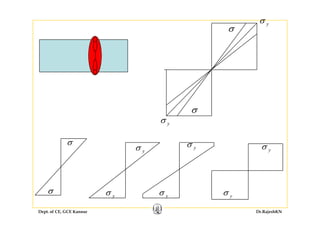
    Inelastic Bending ofBeams (Plastic Analysis) g ressstr strainO Idealised stress-strain curve of elastic-plastic materialp AssumptionsAssumptions • Plane sections remain plane in plastic condition S i l i i id i l b h i i d i Dept. of CE, GCE Kannur Dr.RajeshKN • Stress-strain relation is identical both in compression and tension
  • 27.
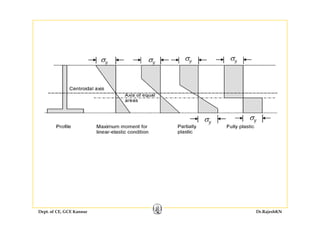
    • Let Mat a cross-section increases gradually. • Within elastic limit, M = σ.Z Z i ti d l I/• Z is section modulus, I/y • Elastic limit – yield stresses reachedElastic limit yield stresses reached My = σy.Z • When moment is increased, yield spreads into inner fibres. Remaining portion still elastic • Finally, the entire cross-section yields, at a moment of MP
  • 28.
    yσ σ σ yσ yσ yσ yσσ σ Dept.of CE, GCE Kannur Dr.RajeshKN yσ yσ yσσ
  • 29.
    σy σy σy σyσyσy y y σy σy Dept. of CE, GCE Kannur Dr.RajeshKN
  • 30.
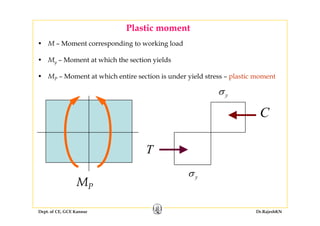
    Plastic moment • M– Moment corresponding to working load • My – Moment at which the section yieldsMy Moment at which the section yields • MP – Moment at which entire section is under yield stress – plastic moment yσ CC T yσ MP Dept. of CE, GCE Kannur Dr.RajeshKN
  • 31.
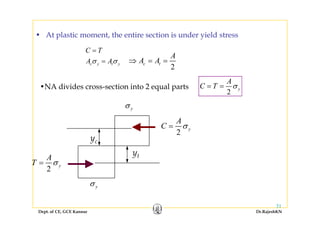
    • At plasticmoment the entire section is under yield stressAt plastic moment, the entire section is under yield stress C T A Aσ σ = = A A A⇒ = = •NA divides cross-section into 2 equal parts c y t yA Aσ σ= 2 c tA A⇒ = = A C T σ= =•NA divides cross-section into 2 equal parts 2 yC T σ= = yσ y 2 y A C = σ yt yc A T σ= yσ 2 yT σ Dept. of CE, GCE Kannur Dr.RajeshKN 31
  • 32.
    Zσ Similar to •Couple dueto ( ) A A Z ⎛ ⎞ ⎜ ⎟ Plastic modulus yZσ•Couple due to ( ) 2 2 y y c t y py y Zσ σ σ⎛ ⎞ = + =⎜ ⎟ ⎝ ⎠ Plastic modulus Shape factor ( )1pZ Z = > b Rectangular cross-section: p ( ) Z b Section modulus ( ) ( ) 3 212 2 6 bdI bd Z y d = = = d ( )y ( ) 2 A bd d d bd Z y y ⎛ ⎞ + +⎜ ⎟Plastic modulus ( ) 2 2 4 4 4 p c tZ y y= + = + =⎜ ⎟ ⎝ ⎠ Plastic modulus Dept. of CE, GCE Kannur Dr.RajeshKN Shape factor 1.5pZ Z = =
  • 33.
    Shape factor forcircular section d( ) 2 p c t A Z y y= + 2 3 2 2 8 3 3 6 d d d d⎛ ⎞⎛ ⎞ = + =⎜ ⎟⎜ ⎟ ⎝ ⎠⎝ ⎠ π π π 1 7pZ S∴ = =( )4 364d d Z π π ⎝ ⎠⎝ ⎠ 1.7S Z ∴ = =( ) 2 32 Z d = = Sh f t f t i ul ti 2h Shape factor for triangular section ( ) 2 p c t A Z y y= + h Equal area axis cy 2 3 h 3 bh⎛ ⎞ ⎜ ⎟ ( ) 2 p c t Equal area axis tyCG axis 2 36 2 24 3 bh Z h ⎜ ⎟ ⎝ ⎠= = Dept. of CE, GCE Kannur Dr.RajeshKN b S = 2.346
  • 34.
    20mm Shape factor forI section 10mm250mm p 20mm 200mm S = 1.132 Dept. of CE, GCE Kannur Dr.RajeshKN
  • 35.
    Z Load factor P yPcollapse load M Load factor working load M Z Zσ σ = = = Factor of safety and load factor YieldLoad Factor of Safety= = Working Load YieldStress yW W σ Elastic Analysis : Factor of Safety Pl i A l i L d FYieldStress = = Working Stress yσ σ Plastic Analysis : Load Factor Dept. of CE, GCE Kannur Dr.RajeshKN
  • 36.
    Plastic moment capacityof a rectangular cross-section: 2 P P bd M Zσ σ= = 2 4 p bd Z =Plastic modulus Hence, plastic t it 4 P y P yM Zσ σmoment capacity 2 2 6 1.5 6 ybd bd M Z σ σ σ= = = Elastic moment capacity with a factor of safety of 1.5 2 2 9 2.25 4 P y P M bd M Z M bd σ= = =2 9 y M bd σ∴ = Hence, 4bdbd 2 2 bd bd Elastic moment capacity 6 6 y bd bd M Zσ σ σ= = = p y with a factor of safety of 1.0 2 6 bd6M Dept. of CE, GCE Kannur Dr.RajeshKN36 2 2 6 1.5 4 P y P M bd M Z M bd σ= = =2 6 y M bd σ∴ = Hence,
  • 37.
    Plastic hinge • Whenthe section is completely yielded, the section is fully plastic • A fully plastic section behaves like a hinge – Plastic hinge Plastic hinge is defined as an yielded zone due to bending in a structural member, at which large rotations can occur at a section at constant plastic moment, MP Mechanical hinge Plastic hinge Mechanical hinge and Plastic hinge Mechanical hinge Resists zero moment Plastic hinge Resists a constant moment MP Dept. of CE, GCE Kannur Dr.RajeshKN
  • 38.
    Mechanism of failurein a simple beamp D t i t b &Determinate beams & frames: Collapse after first plastic hinge Simple beam MP M .uW l MEquilibrium 4 u PM = 4M Equilibrium: 8 PM Dept. of CE, GCE Kannur Dr.RajeshKN 38 4 P u M W l ∴ = 2 P uw l ∴ =If UDL,
  • 39.
    fl i fbDeflection of beams • Differential equation of the elastic curve • Slope and deflection of beams by method of successive integration • Macaulay’s method • Moment area method • Conjugate beam method Dept. of CE, GCE Kannur Dr.RajeshKN 39
  • 40.
    Differential equation ofthe elastic curveDifferential equation of the elastic curve yy ds Rdα= 2 2 q Rdα ds 2 2 ds dx dy= + tan dy α = p dy dx ds a dx α 2 2 sec d d yα α α α+dα x 2 sec dx dx α = x ( ) 2 2 2 1 tan d y d dx dx α α+ = Dept. of CE, GCE Kannur Dr.RajeshKN 40
  • 41.
    2 2 dy dy⎧ ⎫⎪ ⎪⎛ ⎞ 2 2 d y dx dx 2 1 dy d y d dx dx dx α ⎧ ⎫⎪ ⎪⎛ ⎞ + =⎨ ⎬⎜ ⎟ ⎝ ⎠⎪ ⎪⎩ ⎭ 2 1 dxd dy dx α = ⎛ ⎞ + ⎜ ⎟ ⎝ ⎠ 2 2 2 2 2 d y R dx dxds Rd dx dy d α= ⇒ + = ⎛ ⎞ 2 2 2 2 1 d y R dx dy dxdx d ⎛ ⎞ + =⎜ ⎟ ⎝ ⎠ ⎛ ⎞ 2 1 dy dx ⎛ ⎞ + ⎜ ⎟ ⎝ ⎠ 2 1 dx dy dx ⎜ ⎟ ⎝ ⎠ ⎛ ⎞ + ⎜ ⎟ ⎝ ⎠ 2 d2 2 3 2 2 1 1 d y dx R dy = ⎡ ⎤⎛ ⎞ ⎢ ⎥⎜ ⎟ 2 2 1 d y R d = 1 dy dx ⎛ ⎞ +⎢ ⎥⎜ ⎟ ⎝ ⎠⎢ ⎥⎣ ⎦ 2 R dx 2 1M E M d 2 d2 2 1M E M d y I R EI R dx = ⇒ = = 2 2 d y M EI dx = I th b d i ti ff t f h d fl ti i NOT Dept. of CE, GCE Kannur Dr.RajeshKN 41 •In the above derivation, effect of shear on deflection is NOT taken into account, since it is assumed to be very small.
  • 42.
    Method of successiveintegrationsMethod of successive integrations 2 d2 2 d y M EI dx = 2 2 d y EI M dx = 2 d y EI M C= +∫ ∫ dy EI M C x C= + +∫ ∫∫12 EI M C dx dy EI M C = + = + ∫ ∫ ∫ 1 2 1 2 EI M C x C dx EIy M C x C = + + = + + ∫ ∫∫ ∫∫ { } 1 1 EI M C dx dy M C = + = + ∫ ∫ { } 1 2 1 2 1 y y M C x C EI = + + ∫∫ ∫∫{ }1M C dx EI = +∫ { }EI ∫∫ 42
  • 43.
    Slope at Bof the deflected beam = (dy/dx) at B ( ) 2 2 d y EI M P l x= = − −l B Deflection at B = y at B 0 0 0 dy At x C= = ∴ = ( )2 dx 2 dy Px l x 10, 0 0At x C dx = = ∴ = 1 2 dy Px EI Plx C dx = − + + 2 3 2 2 6 Plx Px EIy C − = + + 2 2 dy Px EI Plx dx = − + 2 62dx 2 3 Plx Px− 20, 0 0At x y C= = ∴ = 2 6 Plx Px EIy∴ = + Dept. of CE, GCE Kannur Dr.RajeshKN 43
  • 44.
    2 2 , 2 2 dyPx dy Pl At x l EI Plx dx dx EI = = − + ∴ = − 2 2x l dx dx EI= 2 3 Plx Px− 3 , 2 6 x l Plx Px At x l EIy = = ∴ = + 3 3 Pl y EI ∴ = − If when x increases, y also increases, then slope (dy/dx) is +ve. If when x increases, y decreases, then slope (dy/dx) is -ve. Dept. of CE, GCE Kannur Dr.RajeshKN 44
  • 45.
    Slope at Bof the deflected beam = (dy/dx) at B Deflection at B = y at B ( ) 22 w l xd y EI M − = = −l B d 2 2 EI M dx = = −l x 10, 0 0 dy At x C dx = = ∴ = 3 2 2 1 2 3 dy w x EI l x lx C dx ⎛ ⎞ = − − + +⎜ ⎟ ⎝ ⎠ 3 2 2 2 3 dy w x EI l x lx dx ⎛ ⎞ ∴ = − − +⎜ ⎟ ⎝ ⎠ 2 2 3 4 2 2 3 12 w l x lx x EIy ⎛ ⎞ = − − +⎜ ⎟ ⎝ ⎠2 3dx ⎝ ⎠ ⎝ ⎠ 2 2 3 4 w l x lx x⎛ ⎞ 20, 0 0At x y C= = ∴ = 2 2 3 12 w l x lx x EIy ⎛ ⎞ ∴ = − − +⎜ ⎟ ⎝ ⎠ Dept. of CE, GCE Kannur Dr.RajeshKN 45
  • 46.
    3 3 3 3 , 23 6 dy w l dy wl At x l EI l l dx dx EI ⎛ ⎞ = = − − + ∴ = −⎜ ⎟ ⎝ ⎠2 3 6dx dx EI⎝ ⎠ 4 4 4 4 w l l l wl⎛ ⎞ , 2 2 3 12 8 w l l l wl At x l EIy y EI ⎛ ⎞ = ∴ = − − + ∴ = −⎜ ⎟ ⎝ ⎠ Dept. of CE, GCE Kannur Dr.RajeshKN 46
  • 47.
    Moment area methodMomentarea method Charles E. Greene •For deflections of beams especially cantilever beams•For deflections of beams, especially cantilever beams •Suitable when slopes and deflections at particular points are required not the complete equation of the deflection curverequired, not the complete equation of the deflection curve Dept. of CE, GCE Kannur Dr.RajeshKN 47
  • 48.
    Moment area theoremsMomentarea theorems O R dαA B dα ds m n α dα x.dα y xdx xdx B’ Dept. of CE, GCE Kannur Dr.RajeshKN 48
  • 49.
    B O 1 M dds dsα = = R dαA B R EI M ds dx d dx EI α≅ ⇒ = dα ds m n EI M d dx EI α α= =∫ ∫ α x.dα y EI∫ ∫ M xdx M xd xds EI M ds dx xd xdx α α = ≅ ⇒ B’ ds dx xd xdx EI α≅ ⇒ = M y xd xdx EI α= =∫ ∫ Dept. of CE, GCE Kannur Dr.RajeshKN 49
  • 50.
    M t ATh 1Moment Area Theorem 1 Angle between tangents at A & B = (Area of BMD between A & B) /EI Moment Area Theorem 2Moment Area Theorem 2 Deviation of B from tangent at A = (Moment of BMD between A & B, b t B) /EIabout B) /EI Dept. of CE, GCE Kannur Dr.RajeshKN 50
  • 51.
    B l Slope at Bof the deflected beam = Area of M/EI ( ) p / diagram between A & B 2 l Pl Pl = =(-)Pl EI 2 2EI EI = − = − Deflection at B of the beam = Moment of M/EIDeflection at B of the beam Moment of M/EI diagram between A & B about B 2 3 2 2 3 3 Pl l Pl EI EI = − = − Dept. of CE, GCE Kannur Dr.RajeshKN 51
  • 52.
    l Slope at Bof the deflected beam = Area of M/EI l diagram between A & B 2 3 3 2 6 l wl wl EI EI = − = − 2 l ( ) 3 2 6EI EI2 2 wl EI (-) Deflection at B of the beam = Moment of M/EI 3 4 3l l l / diagram between A & B about B 3 4 3 6 4 8 wl l wl EI EI = − = − Dept. of CE, GCE Kannur Dr.RajeshKN 52
  • 53.
    C C A B Deflected shape PL 4 PL EI M/EI diagramC A B g C Slope at A of the deflected beam = Area of M/EI di b t A & C 2 1 l Pl Pl = =diagram between A & C 2 2 4 16EI EI = = Deflection at C of the beam = Moment of M/EI diagram 2 3 Dept. of CE, GCE Kannur Dr.RajeshKN Deflection at C of the beam = Moment of M/EI diagram between A & C about A 2 3 2 3 2 16 48 l Pl Pl EI EI = =
  • 54.
    Deflected shape C B 2 8 wL EIA B8EI M/EIdiagram C A B Slope at A of the deflected beam = Area of M/EI diagram between A & C 2 3 2 3 2 8 24 l wl wl EI EI = = Deflection at C of the beam = Moment of M/EI 3 4 5 5l wl wl = = Dept. of CE, GCE Kannur Dr.RajeshKN 54 / diagram between A & C about A 8 2 24 384EI EI = =
  • 55.
    Conjugate beam method Actualbeam j g l B Conjugate beam (-)Pl EI B A EI Slope at B of the deflected beam Shear force at B of the conjugateSlope at B of the deflected beam = Shear force at B of the conjugate beam when conjugate beam is loaded with M/EI diagram 2 2 2 l Pl Pl EI EI = = Deflection at B of the beam = Bending moment at B of the conjugate beam when conjugate beam is loaded with M/EI diagram 2 3 2Pl l Pl Dept. of CE, GCE Kannur Dr.RajeshKN j g / g 2 2 3 3 Pl l Pl EI EI = =
  • 56.
    Conjugate beam method- proof 2 2 d y EI M dx = 3 4 In the actual beam, 3 3 , Shear force d y dM EI V dx dx = = 4 4 , Load d y dV EI w dx dx = = load, M w EI = 0 0 Shear force, x x M V wdx dx EI = =∫ ∫In the conjugate beam, Bending moment, x x x M M Vdx dx EI = =∫ ∫∫0 0 0 EI
  • 57.
    2 i h jb i h l b x x M d y dy d d∫ ∫ Hence, 2 0 0 in the conjugate beam in the actual beam Shear force in the conjugate beam Slope in the actual b ame M d y dy dx dx EI dx dx = = = ∫ ∫ 2x x x x M d2 2 0 0 0 0 in the conjugate beam in the actual beam BM i th j t b D fl ti i th t l b x x x x M d y dx y EI dx = =∫∫ ∫∫ BM in the conjugate beam Deflection in the actual e mb a= Dept. of CE, GCE Kannur Dr.RajeshKN
  • 58.
    Conjugate supportsj gpp Actual support. Conjugate support. Dept. of CE, GCE Kannur Dr.RajeshKN 58
  • 59.
    Example 1: l Actual beam B () Conjugate beam B A (-)Pl EI Slope at B of the deflected beam = Shear force at B of the conjugate beam when conjugate beam is loaded with M/EI diagram 2 2 2 l Pl Pl EI EI = = Deflection at B of the beam = Bending moment at B of the conjugate beam when conjugate beam is loaded with M/EI diagram 2 3 2Pl l Pl Dept. of CE, GCE Kannur Dr.RajeshKN 59 2 3 2 2 3 3 Pl l Pl EI EI = =
  • 60.
    Example 2: ll ( ) Conjugatebeam B A 2 2 wl EI (-) Slope at B of the deflected beam = Shear force at B of the conjugate beam when conjugate beam is loaded with M/EI diagram 2 3 l wl wl 3 2 6EI EI = = Deflection at B of the beam = = Bending moment at B of the conjugate beam when conjugate beam is loaded with M/EI diagram 3 4 3 6 4 8 wl l wl EI EI = = Dept. of CE, GCE Kannur Dr.RajeshKN 60 6 4 8EI EI
  • 61.
    Example 3: 4 Pl EIA B C 2 1 lPl Pl⎛ ⎞ ⎜ ⎟ 2 Pl 2 l 2 l C Conjugate beam 2 2 4 16EI EI ⎛ ⎞ =⎜ ⎟ ⎝ ⎠ 16EI22 j g Slope at A of the deflected beam = Shear force at A of the conjugate beam when conjugate beam is loaded with M/EI diagram 2 1 l Pl Pl⎛ ⎞ ⎜ ⎟ 1 2 2 4 16 l Pl Pl EI EI ⎛ ⎞ = =⎜ ⎟ ⎝ ⎠ Deflection at C of the beam = = Bending moment at C of the conjugate beam when conjugate beam is loaded with M/EI diagram 2 2 3 1l Pl l Pl Pl⎛ ⎞ Dept. of CE, GCE Kannur Dr.RajeshKN 1 2 16 3 2 16 48 l Pl l Pl Pl EI EI EI ⎛ ⎞ = − =⎜ ⎟ ⎝ ⎠
  • 62.
    Example 4: 2 8 wL EI A B CC 23 1 2l wl wl⎛ ⎞ =⎜ ⎟ 3 wl Conjugate beam 2 3 8 24EI EI =⎜ ⎟ ⎝ ⎠ 24EI Slope at A of the deflected beam = Shear force at A of the conjugate beam when conjugate beam is loaded with M/EI diagram 3 lconjugate beam is loaded with M/EI diagram fl f h b d f h b 3 24 wl EI = Deflection at C of the beam = = Bending moment at C of the conjugate beam when conjugate beam is loaded with M/EI diagram 3 2 4 3 2 5l wl l l wl wl⎧ ⎫⎛ ⎞⎛ ⎞ Dept. of CE, GCE Kannur Dr.RajeshKN 3 2 5 2 24 8 2 3 2 8 384 l wl l l wl wl EI EI EI ⎧ ⎫⎛ ⎞⎛ ⎞ = − =⎨ ⎬⎜ ⎟ ⎜ ⎟ ⎝ ⎠ ⎝ ⎠⎩ ⎭
  • 63.
    Principle of SuperpositionPrincipleof Superposition Statement: Deflection at a given point in a structure produced by several loads acting simultaneously on the structure can beseveral loads acting simultaneously on the structure can be found by superposing deflections at the same point produced by loads acting individually. Applicable when there exists a linear relationship between external forces and corresponding structural displacements.p g p Dept. of CE, GCE Kannur Dr.RajeshKN 63
  • 64.
    SummarySummary Bending stresses inbeams - shear flow - shearing stress formulae forBending stresses in beams shear flow shearing stress formulae for beams – Inelastic bending of beams –Inelastic bending of beams – Deflection of beams - direct integration method - singularity functions iti t h i t th d j t b- superposition techniques - moment area method - conjugate beam ideas – l f ll d b f d dElementary treatment of statically indeterminate beams - fixed and continuous beams Dept. of CE, GCE Kannur Dr.RajeshKN 64